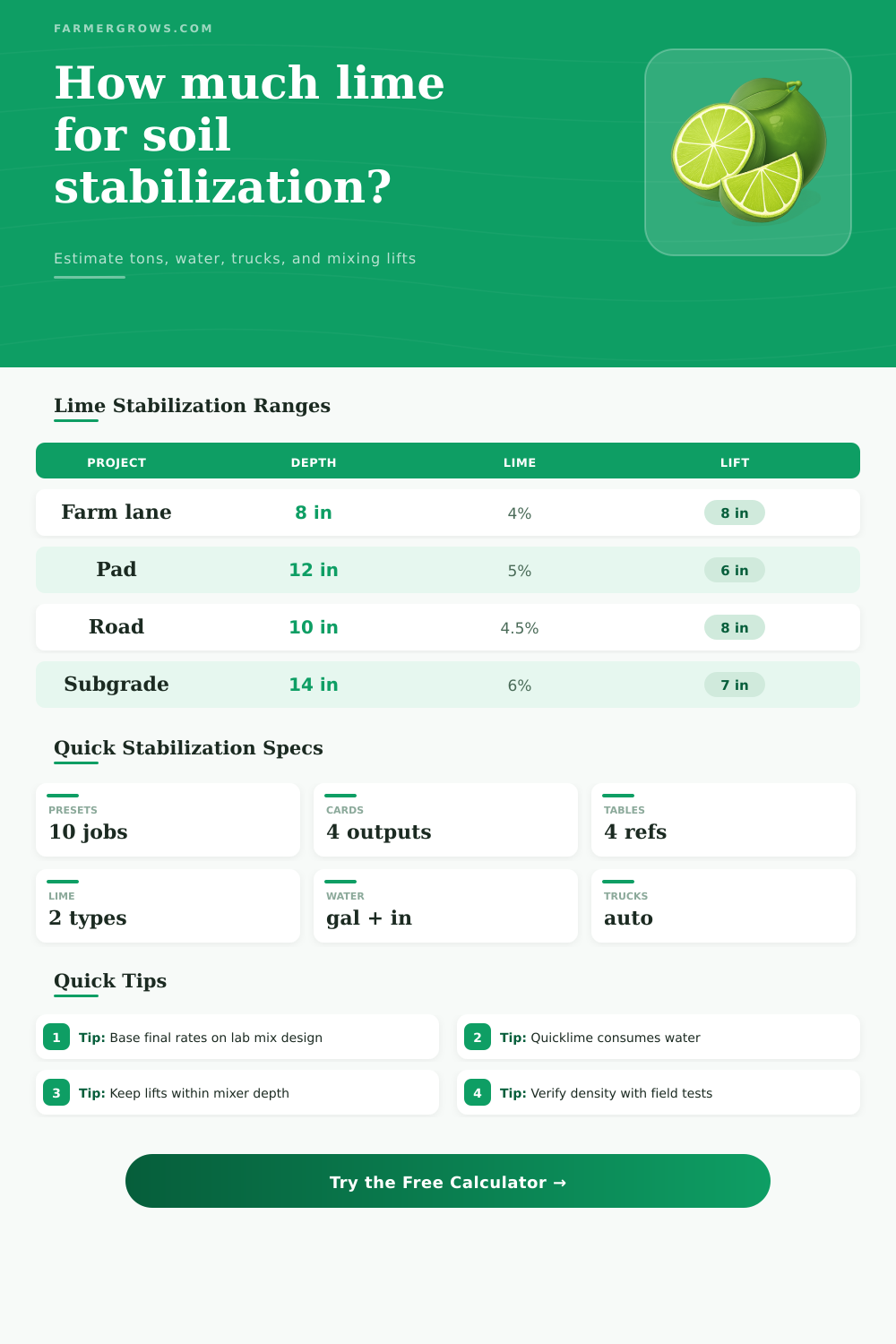
Lime Stabilization Calculator
Estimate dry soil mass, quicklime or hydrated lime quantity, water conditioning, treated volume, truckloads, and mixing lift staging for farm roads, pads, lanes, and subgrade work.
This calculator is for planning quantities and crew logistics. Final lime percentage, mellowing time, compaction target, and safety controls should come from lab mix design, field trials, and project specifications.
Stabilization Estimate
Calculated from project area, treatment depth, dry density, lime percentage, moisture targets, swell factor, and lift limit.
| Project type | Typical depth | Typical lime | Density range | Planning note |
|---|---|---|---|---|
| Farm lane clay repair | 6 to 10 in | 3% to 5% | 100 to 115 lb/cu ft | Focus on drying, plasticity reduction, and rut resistance. |
| Equipment yard or pad | 8 to 14 in | 4% to 6% | 105 to 120 lb/cu ft | Stage lifts if the mixer cannot uniformly reach full depth. |
| Feedlot or manure pad | 10 to 14 in | 5% to 7% | 105 to 120 lb/cu ft | Control moisture carefully before aggregate or surface layers. |
| Temporary haul road | 8 to 12 in | 3.5% to 5.5% | 100 to 118 lb/cu ft | Balance fast drying with the required service life. |
| Heavy road subgrade | 10 to 16 in | 4% to 8% | 110 to 125 lb/cu ft | Use lab mix design and field proof rolling. |
| Lime product | Typical solids | Water effect | Best use | Handling caution |
|---|---|---|---|---|
| High calcium quicklime | 88% to 96% | Strong drying | Wet clay, deep stabilization, fast moisture reduction | Heat, dust, caustic exposure, and slaking control |
| Dolomitic quicklime | 85% to 94% | Strong drying | Clay subgrades where magnesium lime is specified | Needs controlled spreading and mixing water awareness |
| Hydrated lime | 90% to 98% | Low drying | Controlled pads, small work areas, slurry blending | Fine dust and caustic contact protection |
| Hydrated lime slurry | 30% to 45% | Adds water | Uniform distribution on smaller or windy sites | Count carrier water in final moisture conditioning |
| Custom product | Use analysis | Varies | Supplier-specific stabilizers and blends | Verify solids, available lime, and specification basis |
| Moisture condition | Field sign | Calculator effect | Action before compaction |
|---|---|---|---|
| Too wet by more than 4 points | Pumping, sheen, sticky clods | Shows drying need after quicklime credit | Allow mellowing, aerate, or adjust lime type. |
| Wet by 1 to 4 points | Plastic clods but workable | Quicklime may absorb part of the excess | Mix, mellow, and recheck moisture before rolling. |
| Near target | Friable soil and good pulverization | Minimal water correction | Proceed with final mix and compaction testing. |
| Dry by 1 to 4 points | Dusty mix, weak clod breakdown | Estimates gallons to add | Add water uniformly before final compaction. |
| Very dry | Dust and poor reaction | Large conditioning water estimate | Water in stages to avoid slick spots and runoff. |
| Mixing lift limit | Full depth to treat | Suggested staging | Field check |
|---|---|---|---|
| 6 in mixer pass | 6 in or less | One lift | Confirm full-depth color change and pulverization. |
| 6 in mixer pass | 8 to 12 in | Two equal lifts | Keep lower lift scarified before second lift blending. |
| 8 in mixer pass | 8 in or less | One lift | Watch edge overlap and moisture uniformity. |
| 8 in mixer pass | 10 to 16 in | Two lifts | Compact each staged layer to the project spec. |
| Over 16 in treatment | Deep stabilization | Multiple engineered lifts | Use a geotechnical plan and proof roll each stage. |
Caustic material caution: Quicklime and hydrated lime can burn skin and eyes, create dust hazards, and generate heat when water is added. Use the product safety sheet and site controls.
Design caution: Lime percentage by dry soil mass is not a substitute for lab mix design, plasticity index testing, compaction curves, strength checks, and field density verification.
Lime stabilization is an soil treatment process that changes the properties of soft, plastic clay. Soft, plastic clay is a soil type that becomes unstable and rutted when it is wet. However, by adding lime to the clay soil, it will become firm enough for people to drive on or build on it.
The process of lime stabilization works because the lime changes the way that the clay particles behave within the soil. Specifically, the lime reduce the amount of water that the clay soil can hold. As a result, the soil becomes firm enough to allow for driving or building on the soil.
Making Clay Soil Firm with Lime
A person planning to build on clay must determine the amount of lime that is required to stabilize the soil and in what way should the lime stabilization process be staged. One of the first factors to consider in lime stabilization is the moisture content of the clay soil. Clay that is wet will often need to be dried before it can be compacted enough for driving or building on it.
Quicklime will react to the moisture within the soil. The amount of water that the quicklime will remove depends on the type of lime that is used and the amount of moisture within the soil. Hydrated lime will remove less moisture from the soil than quicklime.
In cases where the soil is already too wet for building, extra mellowing time or aerations will be needed in addition to adding hydrated lime. A calculator can be used to calculate the moisture-related variables in lime stabilization because calculators can perform the necessary mathematics to determine the amount of moisture that the lime will remove and prevent a person from having to guess at the amount of moisture to remove. Another factor that will influence lime stabilization is the depth to which the lime is to be mixed into the soil.
The soil will be mixed in lifts. Rotary mixers have a limited depth to which they can mix the lime into the soil. If the depth of the clay soil to be treated is too great for the machines to mix it in a single pass, the soil will be under-mixed at the bottom of the soil lift.
The depth of soil that a single pass of a rotary liming mixer can mix is typically between six and eight inches. For soils deeper than that depth, multiple lifts of soil will have to be mixed with lime in stages. Each lift will need to have a specific percentage of lime relative to the dry mass of the soil.
When lime is mixed into soil, the soil expands to accommodate the lime. This expansion of soil volume is called swell. The number of lifts that will be treated with lime and the total volume of the soil (in cubic yards) will have to be calculated to determine the amount of movement of the soil and the amount of time for the soil treatment.
The amount of lime that will be needed to treat the soil will determine the type and number of trucks that will be used to transport the lime to the project site. If the amount of tons of lime that are required are known, then the payload capacity of the trucks can determine the number of truckloads that will be needed to deliver the required amount of lime. However, lime should not be left on site for too long after it has been spread.
Quicklime will react to the moisture in the soil as soon as it comes into contact with the soil. Therefore, the time between when the lime is delivered and when the soil is compacted will be short. During the mellowing period, the lime will sit in the soil long enough to react to the soil moisture.
This reaction period must be accounted for before soil can be mixed a second time and compacted. The density of the soil will have an influence on the amount of lime that will be required. If the soil is dense, then each cubic foot of soil will have more dry mass.
The more dry mass that the soil has, the more lime that will be required to reach the percentage of lime that is required. Tables can be referenced to determine the typical dry mass of soils for various types of projects. However, these tables are not rules because not all clay soils has the same weight.
The weight of the soil can be tested at the project site. If the dry density of the soil is found to be more or less than the density that is referenced in these tables, that density can be entered into a calculator to determine the amount of lime that will be required. This adjustment of the dry mass of soil in a calculator will automatically update the amount of lime that is required so that the person does not have to calculate the amount of lime needed by hand.
Another variable to consider is the depth of soil treatment. A lift is a layer of soil that will be treated with lime. Rotary mixers have a limit to the depth of soil that can be mixed in a single pass.
If the depth of soil to be treated is beyond the limit of the soil mixers, it will have to be treated in multiple stages with different soil lifts. Each stage will require a specific amount of lime relative to the dry mass of the soil in that stage. The addition of lime will swell the soil.
This swell will change the volume of soil that will be treated. In order to ensure that the amount of lime and number of lifts of soil is accounted for, the number of lifts of soil and the amount of cubic yards of soil will have to be calculated prior to the soil treatment process. The amount of lime that will be used to treat the soil will determine the number of trucks that will be needed.
Once the amount of tons of lime that are required is known, the payload of the trucks will enable the person to calculate the number of truckloads of lime that will be required to deliver the amount of lime needed. However, lime should not be left at the treatment site once it has been delivered. If lime is quicklime, it will begin to react with the moisture in the soil as soon as the lime and soil come in contact.
Therefore, there has to be an allowance for the time between when the lime is delivered to the site and when it will be compacted with a mixer. During this time, which is known as the mellowing period, the lime will sit in the soil to react with the soil moisture. This period of reaction will have to be accounted for in the lime treatment process prior to the second mixing of the soil.
The density of the soil will impact the amount of lime required to stabelize the soil. Soils that are dense have more dry mass per cubic foot. Soils that have more dry mass per cubic foot require more lime to counteract the properties of the soil to allow for driving or building on the soil.
Reference tables can be used to determine the dry mass of soil for various projects. However, these tables are not rules to follow because the weight of clay soils is not the same. Field tests will determine whether the dry mass of soil is more or less than the dry masses referenced in these tables.
The dry mass of soil can be entered into a lime calculator. The lime requirement for the soil will be automatically updated once the dry mass of soil is entered into the calculator so that persons do not have to calculate the amount of lime required for the project. The depth of soil treatment will determine if there will be the need to use multiple engineered soil lifts.
The depth of soil that can be mixed by rotary soil mixers in a single pass is limited. The depth that is mixed in one pass is referred to as the mixing lift limit. If the depth of soil to be treated is deeper than the mixing lift limit, then there will have to be multiple soil lifts to treat the soil with lime.
The amount of lime that will be used for each of these soil lifts will have to be calculated prior to treatment of the soil in stages. Each lift will require a specific percentage of lime to the dry mass of the soil. When lime is mixed into soil, the soil swell.
The swell of soil will change the volume of the soil that will be treated. The number of soil lifts and the total volume of soil (in cubic yards) that will be treated will have to be calculated with a lime calculator prior to treatment of soil at the project site. Beyond the variables mentioned in the previous paragraphs, there are additional considerations that must be made prior to the lime stabilization process.
The amount of lime that is required to stabelize the soil will influence the number of trucks that will be needed to deliver lime to the project site. The amount of tons of lime that will be required will be divided by the payload capacity of the trucks to determine how many truckloads will arrive at the project. Because lime will react with the soil as soon as it comes in contact with soil moisture, the lime will have to be delivered to the project site, but the lime will not remain at the project site for long periods.
The time that is required for the lime to interact with the soil is referred to as the mellowing period. Therefore, the number of days or how long the lime will remain at the project site must be accounted for prior to the start of the project. A lime calculator will provide a general estimate of the amount of lime that will be required for the soil treatment project.
However, that estimate will be approximate because the numbers are based upon predetermined variables. However, the amount of lime that is required can be calculated with actual measurements of the soil dry density and moisture so that the amount of lime that is calculated will be closer to the amount of lime that will actually be used in the project. The main goal for lime stabilization is to create a layer of soil that will remain firm and shed water rather than holding water within the soil.
The variables for lime treatment can be set to the characteristics of the soil that will be treated and the number of lifts of soil that will be mixed with lime can be accounted for by the equipment that will be used in the soil treatment process. The quantities of each of the variables will be aligned with the amount of lime that will actually be spread and mixed into the soil to create a firm surface from what was once a wet and unstable clay soil.