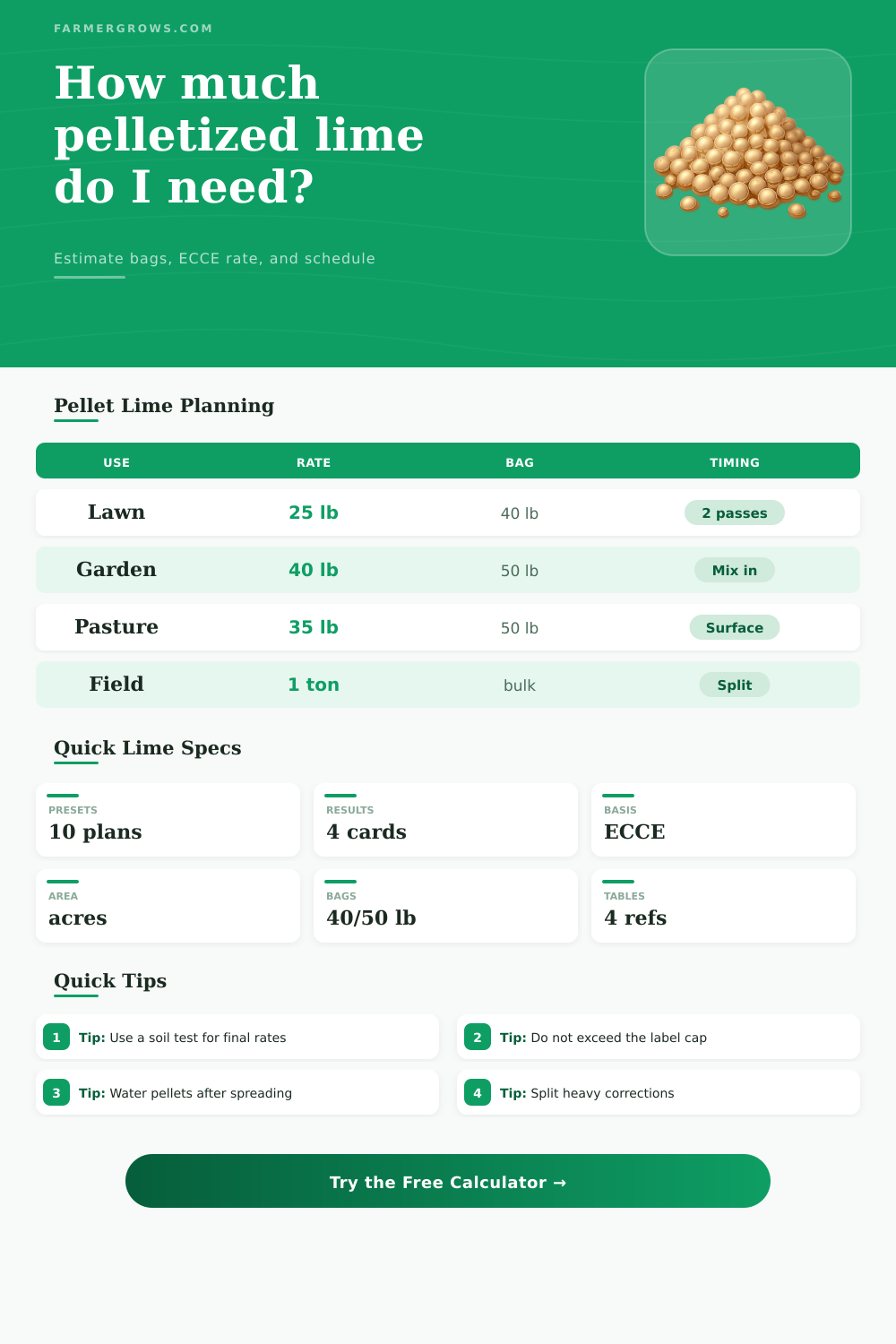
Pelletized Lime Calculator
Estimate pelletized lime bags, label-rate limits, ECCE-adjusted lime requirement, ag lime equivalent, and application schedule from acres, pH change, texture, and correction goal.
This planner estimates lime logistics from common agronomic relationships. Use a current soil test and your product label for final recommendations, especially on turf, established pasture, or sensitive crops.
Pelletized Lime Plan
Your pellet lime estimate will appear here.
| Label rate | Per acre equivalent | 40 lb bags per acre | 50 lb bags per acre | Use case |
|---|---|---|---|---|
| 15 lb per 1,000 sq ft | 653 lb/ac | 17 bags | 14 bags | Light maintenance |
| 25 lb per 1,000 sq ft | 1,089 lb/ac | 28 bags | 22 bags | Turf and gardens |
| 40 lb per 1,000 sq ft | 1,742 lb/ac | 44 bags | 35 bags | Common max pass |
| 50 lb per 1,000 sq ft | 2,178 lb/ac | 55 bags | 44 bags | High label cap |
| Product ECCE | Multiplier vs 100% | 1 ton ag lime equivalent | 2 tons ag lime equivalent | Planning note |
|---|---|---|---|---|
| 60% | 1.67x | 3,333 lb product | 6,667 lb product | Low effective value |
| 75% | 1.33x | 2,667 lb product | 5,333 lb product | Check economics |
| 90% | 1.11x | 2,222 lb product | 4,444 lb product | Common pellet basis |
| 100% | 1.00x | 2,000 lb product | 4,000 lb product | Direct equivalent |
| Scenario | Area | pH move | Texture | Typical plan |
|---|---|---|---|---|
| Home lawn correction | 10,000 sq ft | 5.8 to 6.5 | Loam | Split into 2 passes |
| Vegetable garden | 2,000 sq ft | 5.9 to 6.6 | Sandy loam | Apply before tillage |
| Food plot | 0.5 acre | 5.5 to 6.3 | Silt loam | Compare to bulk lime |
| Pasture touch-up | 2 acres | 6.1 to 6.4 | Clay loam | Maintenance surface pass |
| Pass count | Spacing | Best timing | Moisture note | Retest window |
|---|---|---|---|---|
| 1 pass | Single trip | Fall or early spring | Water in after spreading | 6 to 12 months |
| 2 passes | 8 to 12 weeks apart | Fall plus spring | Avoid runoff storms | 9 to 12 months |
| 3 passes | 3 to 4 months apart | Multi-season correction | Keep within label rate | 12 months |
| Maintenance | Annual or biennial | After soil test | Light, even coverage | Every 2 to 3 years |
Use the label cap. Pelletized lime is convenient, but a single heavy pass can still sit on the surface or move off-site during intense rain. Split applications when the calculator flags more than one pass.
Compare by ECCE. A pallet of pelletized lime can be useful for small areas, but acres often pencil out better with bulk ag lime once the equivalent tons and delivery options are known.
Pelletized lime is often used to raise the pH levels of soil in yards and fields. Pelletized lime is often used over bulk agricultural lime because pelletized lime are easier to spread with farm machinery. Pelletized lime can be purchased in bag at garden centers and can be spread with the same equipment that is used to spread fertilizer.
Pelletized lime often produces faster results than agricultural lime. However, people often make mistakes when adding pelletized lime to soil, such as guessing at how much pelletized lime to add. If there is too little pelletized lime, the soil will remain acidic.
How to Add Pelletized Lime to Fix Soil pH
If there is too much pelletized lime, the pelletized lime will remain on the surface of the soil or run off the field during periods of heavy rainfall. A planning tool allow people to calculate the correct amount of pelletized lime to add to soil to ensure that these errors do not occur. One of the variable that impacts how much pelletized lime is required is soil texture.
Soil texture change the calculation for the amount of pelletized lime that is required because different soil textures react differently to pelletized lime. Sandy soils allow water to pass through the soil much more fast than clay soil. Because of this fast movement of water, pelletized lime has to be added to sandy soil in larger amount to change the pH level of the soil.
Clay soil hold onto acidity for longer periods of time than sandy soil. Thus, the user has to add pelletized lime to clay soil in higher amounts than sandy soil to even achieve the same pH level for the soil. The soil texture can be accounted for in the planning tool.
When users select different soil textures, the planning tool will automatically adjust the suggested amount of pelletized lime based off the texture of the soil. Another variable that impacts the amount of pelletized lime that is required to fix soil with an acidic pH is the depth at which pelletized lime is to be incorporated into the soil. The depth of incorporation will determine how much of the soil will be impacted by the pelletized lime.
If the pelletized lime is incorporated into the soil to a depth of only four inches, then the soil that is impacted will be limited to only those four inch of the soil. If pelletized lime is to be incorporated six inches into the soil, more of the soil will be impacted by pelletized lime. This depth can also be accounted for in the planning tool.
If the depth of the soil is altered, the planning tool will change the amount of pelletized lime that is suggested for incorporation into the soil. Another value that is used in the planning tool is the ECCE value. The ECCE is a measurement of how much of the pelletized lime behaves like pure calcium carbonate.
Many individual who are correcting the pH levels of soil with pelletized lime often overlook this measurement. If pelletized lime contains 90 percent ECCE, then it will require less weight than pelletized lime that has a 70 percent ECCE. This value is also accounted for in the planning tool.
After the user enters the ECCE value, the planning tool will automatically calculate the amount of pelletized lime that should be added to soil to even bring the pH level of that soil to the target pH level. The ECCE value must be used when calculating the amount of pelletized lime that should be added to soil. If the ECCE value is not used, the pH of soil will either not be corrected proper or money will be wasted if pelletized lime of the calculated amount is purchased.
Another factor to consider when applying pelletized lime to soil is that pelletized lime can sit on the surface of soil if it is applied at high rate. The rates that is suggested by the planning tool can be compared to the maximum single-pass rate for pelletized lime as published on the label of pelletized lime products. The planning tool will tell how many separate applications of pelletized lime will be required to raise the pH of soil to the target pH level.
This number of applications can be followed to ensure that pelletized lime is not applied in amounts that is too high for the soil. By breaking up the amount of pelletized lime into separate passes, it allows for the first pass of pelletized lime to be able to work into the soil before the next pass of pelletized lime is applied to soil. In addition to the initial correction of the pH of soil, maintenance is another process that must be performed with pelletized lime.
The maintenance of soil with pelletized lime require a different calculation than the correction of the initial pH levels of soil. Once the pH levels of soil are near the target pH level, a lighter application of pelletized lime can be applied to those field every year or every two years. The planning tool can be changed to calculate the amount of pelletized lime required for maintenance of soil rather than correcting the initial pH levels of soil.
Fields and pastures that use the lighter maintenance amount of pelletized lime will remain in good condition. The calculations created for the planning tool are meant to account for ideal conditions in soil. Real fields and lawns contain various variables that can impact the required amount of pelletized lime.
Variables include the amount of moisture in the soil, the amount of organic matter in the soil, and the history of the soil and pelletized lime applications to those fields. The numbers that are calculated with the planning tool remove these variables from the equation to make it easy for individual to determine how much pelletized lime to add to soil. The amount of pelletized lime that is added to soil should be adjusted according to the response of the grass or crops in that soil.
Based on the results of another soil test, the amount of pelletized lime that should be added to soil each year can be adjusted accordingly. Using the plan that is created with the planning tool and adjusting the application of pelletized lime according to observations of grass or crop growth will allow pelletized lime to become a reliable tool in correcting soil pH levels.