Lime Calculator
Estimate field, pasture, lawn, or garden lime from area, soil pH, target pH, soil texture, lime material, CCE, ECCE, neutralizing value basis, incorporation depth, and spread limits.
Use this as a planning calculator for lime logistics and rate comparison. Final rates should be checked against a current soil test, local buffer pH method, crop tolerance, and product label.
Lime Application Estimate
Results adjust the base lime need for soil buffering, pH change, incorporation depth, neutralizing value basis, and selected ECCE.
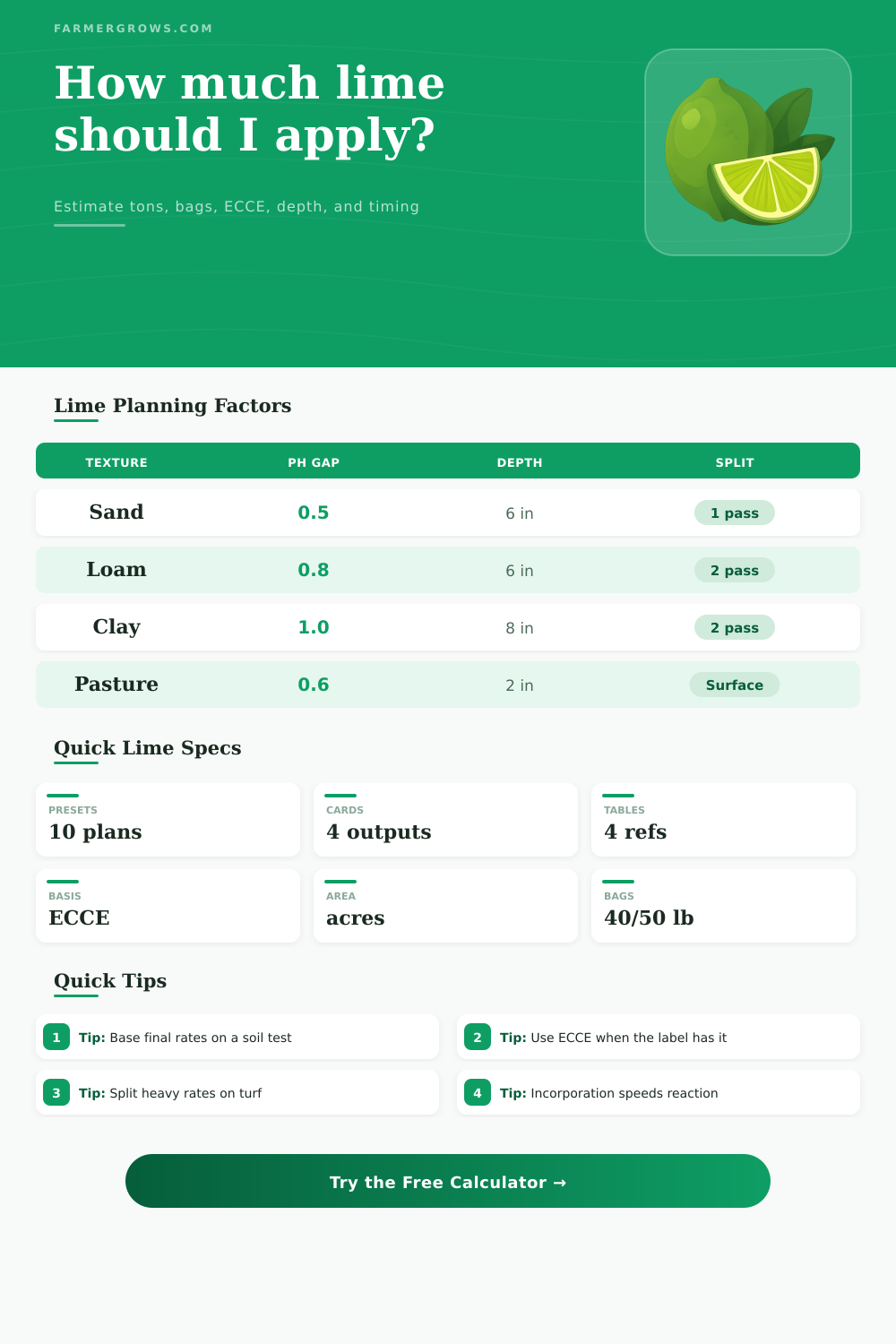
| Soil texture | Buffering strength | Base tons/ac per 1.0 pH | Typical reaction | Planning note |
|---|---|---|---|---|
| Sand or loamy sand | Low | 1.2 to 1.6 | Faster pH movement | Avoid heavy single surface rates |
| Sandy loam | Low to medium | 1.6 to 2.0 | Moderate reaction | Often responds well to maintenance lime |
| Loam | Medium | 2.0 to 2.5 | Balanced response | Use soil test buffer pH when available |
| Silt loam | Medium high | 2.3 to 2.8 | Moderate to slow | Common field calibration range |
| Clay or high organic | High | 2.8 to 3.6 | Slower pH movement | Often needs more lime for the same pH change |
| Lime material | Common CCE | Common ECCE | Best fit | Handling note |
|---|---|---|---|---|
| Calcitic agricultural lime | 85% to 100% | 50% to 75% | General field lime | Compare quarry analysis and fineness |
| Dolomitic agricultural lime | 85% to 105% | 50% to 75% | Low magnesium soils | Good when Mg is needed with pH correction |
| Pelletized lime | 90% to 105% | 75% to 95% | Lawns, gardens, small areas | Easy to spread but still product-rate limited |
| Marl or soft lime | 45% to 80% | 30% to 60% | Local bulk source | Moisture and purity change tons needed |
| Hydrated lime | 115% to 135% | High reactivity | Special uses only | Caustic; use careful handling and guidance |
| Incorporation depth | Depth factor | Where used | Expected speed | Calculator effect |
|---|---|---|---|---|
| 1 to 2 inches | 0.35 to 0.55 | Pasture, turf, no-till surface | Slow below surface | Lower treated soil volume |
| 3 to 4 inches | 0.65 to 0.80 | Garden bed, shallow till | Moderate | Moderate rate adjustment |
| 6 inches | 1.00 | Standard plow layer | Normal benchmark | Base rate depth |
| 8 inches | 1.33 | Deep incorporation | More soil volume | Raises tons per acre |
| 10 to 12 inches | 1.67 to 2.00 | Deep renovation | Slow but deep | Usually needs split planning |
| Recommended rate | Single-pass guidance | Split timing | Surface caution | Follow-up check |
|---|---|---|---|---|
| Under 1 ton/ac | Usually one pass | Apply any workable season | Low burn risk with ag lime | Retest in 12 to 24 months |
| 1 to 2 tons/ac | Usually one incorporated pass | Surface turf may split | Water pelletized lime after spreading | Retest after reaction period |
| 2 to 4 tons/ac | Consider two passes | Split 6 to 12 months apart | Avoid burying crowns in pasture | Track pH by field zone |
| Over 4 tons/ac | Split strongly preferred | Multiple passes or staged renovation | Do not shock sensitive crops | Use soil lab recommendation |
| Hydrated lime | Use lower single rates | Separate from seeding if advised | Caustic on foliage and skin | Confirm local guidance first |
Before spreading: Match the calculator to your soil test units. Some labs already adjust to a local lime quality basis, while others report pure calcium carbonate equivalent.
Before splitting: Heavy rates are easier to manage when half is incorporated before planting and the rest is applied after the first pH response is measured.
Lime is used to change the pH of the soil. You must use the correct amount of lime for the soil. Using too little lime will not fix the pH level of the soil.
Using too much lime introduce unnecessary cost for the farmers. The amount of lime needed to adjust the pH of the soil depend on several factors. These factors include the texture of the soil, the depth to which the farmer will apply the lime to the soil, and the quality of the lime that is to be applied.
How to Use a Lime Calculator
One tool that a farmer can use to determine the amount of lime that should be ordered is a lime calculator. To use the lime calculator, the farmer must input the current pH level of the soil in the field, the target pH level of the soil, the texture of the soil in the field, and the neutralizing value of the lime that will be used. The pH and target pH fields is used to determine how the soil resists changes to it’s pH level.
The incorporation depth field is used to calculate the total volume of soil that will be treated by the lime. The neutralizing value determine how effective the lime will be in changing the pH level of the soil. While the pH level of the soil can tell the farmer its current state, it will not provide information regarding how much lime to buy.
Soils of different texture hold acidity differently. Therefore, different amount of lime are required to achieve the same pH level in each soil texture. For instance, clay soils tend to hold more acidity than sandy soil, and, therefore, require more lime to raise the pH level of clay soils to the same pH level as sandy soils.
The lime calculator accounts for soil texture. Additionally, the lime calculator also accounts for the depth to which the farmer will apply the lime to the soil. If lime is only applied to the surface of the soil, then less lime will be required than if the lime is to be applied to a deep layer of soil.
The quality of lime will play a role in the cost of lime that the farmers must purchase to achieve the desired pH of the soil. Two different brands of agricultural lime may be available in the market. However, each brand of lime may have different effective neutralizing values.
For instance, lime ground into a fine powder will contain more calcium carbonate in the product than lime that is coarsely ground. Therefore, the fine lime will be more effective in changing the pH of the soil than the coarsely ground lime. Since the fine lime is more effective, less tons of lime will be required to achieve the target pH level of the soil.
Therefore, the lime calculator will ask for both the Calcium Carbonate Equivalent (CCE) of the soil and the Effective Calcium Carbonate Equivalent (ECCE). Using only the CCE without the ECCE could result in purchasing too much lime for the soil. In some cases, split applications of lime may be required.
If the amount of lime required for the soil is very large, applying that amount all at once to the soil could cause injury to the sod and the roots of young plant. To avoid this type of injury to the plants, the farmer may break the total amount of lime into two or three separate applications. Each of these applications should be made months apart from each other.
The first application of lime will have time to react with the soil before the second application is made to the soil. While the lime calculator may suggest split applications, the specific crop and the calendar for that year will help to determine the split applications of lime. It is important to make sure that the units entered into the lime calculator match the units from the soil test.
Some soil tests may provide recommendations that have already been adjusted for lime quality. Other soil tests may only provide the pure Calcium Carbonate Equivalent (CCE) value. If the CCE value from the soil test is entered into the lime calculator, the lime calculator must apply the Effective Calcium Carbonate Equivalent (ECCE) to that value.
This step will ensure that the soil test and the lime calculator provide the same value regarding the lime that should be applied to the soil. Another factor that should be considered when applying lime to the soil is the time for which the lime is applied. Lime moves slow through the soil.
Therefore, lime should be applied at a time when there is enough time for the lime to react with the soil prior to planting a new crop. The rate at which lime reacts with the soil can be increased by using tillage to incorporate the lime into the soil. However, the depth of the tillage must be the same as the depth that was entered into the lime calculator.
If the tillage is shallower than that which was entered into the lime calculator, the lime will not reach the portions of the soil that need to have their pH levels adjusted. The lime calculator will provide a recommendation regarding the amount of lime to apply based on the average conditions for the field. However, fields can be of variable condition.
For instance, one part of the field may be sandy soil while another part of the same field may be loam soil. Additionally, one part of the field may contain more organic matter than other parts of that same field. These variables in the field can best be discovered using handheld pH meter and soil samples.
Based on these samples of the soil in the field, the farmer may be able to decide whether to use the recommendation from the lime calculator or to apply different amounts of lime to the different sections of the field. The lime calculator will assist the farmer in ordering the lime that is required to achieve the target pH level of the soil.