Soil pH Lime Calculator
Estimate lime rate from current pH, target pH, buffer pH, soil texture, CEC, organic matter, incorporation depth, product ECCE, and field area.
Use a recent soil test when possible. This tool estimates a planning rate for raising soil pH; local lab recommendations, crop sensitivity, tillage depth, and lime fineness should guide final application.
Soil pH Lime Output
Estimated rate, total product, and split application plan.
Lower values usually mean more reserve acidity and more lime for the same active pH change.
Higher exchange capacity resists rapid pH change and often needs a larger neutralizing dose.
Most field recommendations assume a six inch furrow slice unless the lab states otherwise.
ECCE or ENV accounts for purity and fineness, so it is the best product-rate adjustment.
| Crop or use | Useful pH band | Common target | Notes |
|---|---|---|---|
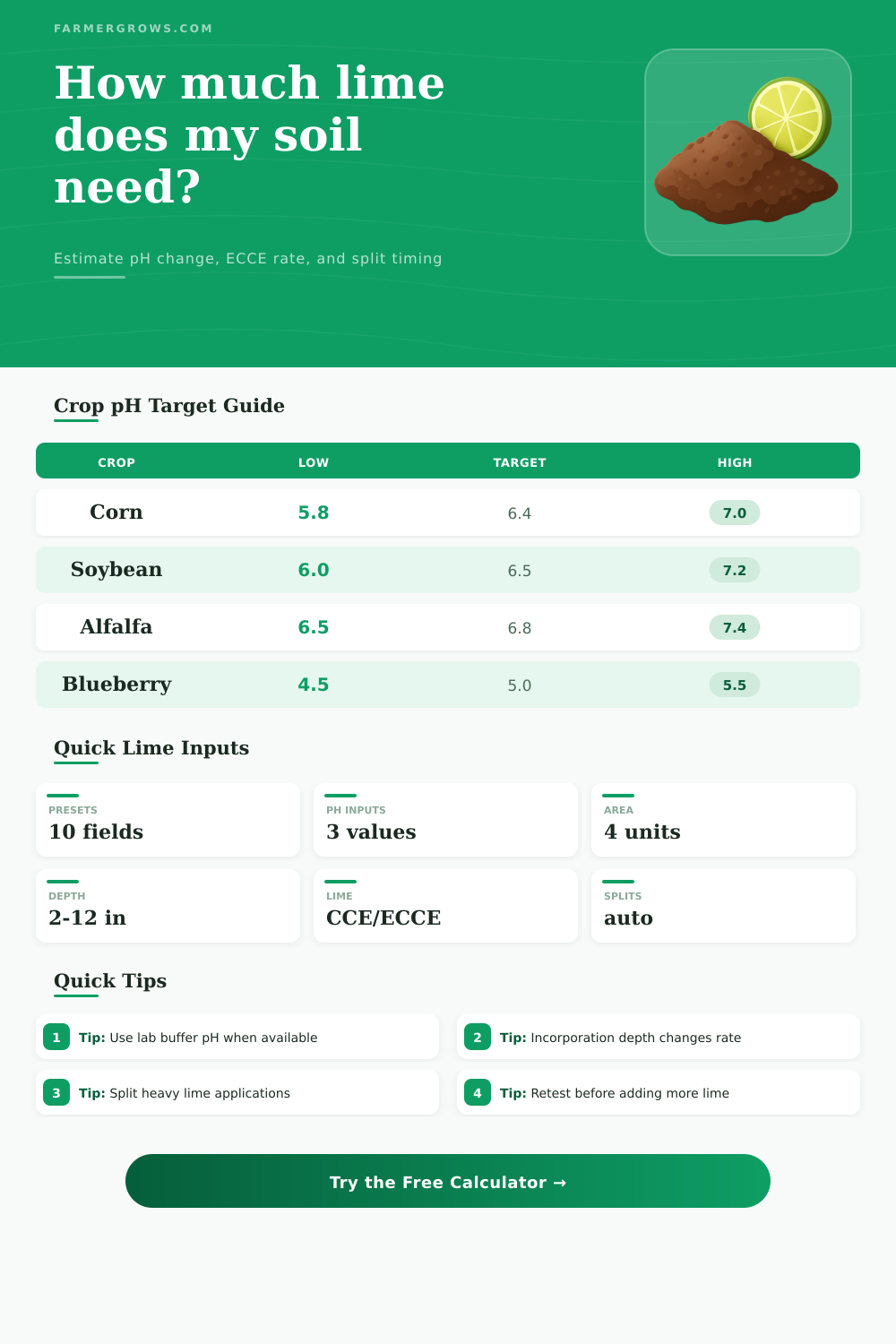
| Corn and sorghum | 5.8 to 7.0 | 6.3 to 6.5 | Yield response is strongest when acidic subsoil and low base saturation limit roots. |
| Soybean and beans | 6.0 to 7.2 | 6.4 to 6.8 | Nodulation and nutrient availability usually improve after moderate acidity is corrected. |
| Alfalfa and clover | 6.5 to 7.4 | 6.8 to 7.0 | Legumes are sensitive to acidity and often justify a higher target than grass. |
| Vegetable beds | 6.2 to 7.0 | 6.5 to 6.8 | Most mixed vegetables prefer near-neutral soil, with crop-specific exceptions. |
| Blueberry | 4.5 to 5.5 | 4.8 to 5.2 | Do not lime acid-loving crops unless a soil test target calls for it. |
| Texture class | Reserve acidity tendency | Base tons/ac per 1.0 pH | Calculator role |
|---|---|---|---|
| Sand or loamy sand | Low | 1.1 to 1.4 | Small lime changes can move pH quickly, so avoid over-application. |
| Sandy loam or loam | Moderate | 1.8 to 2.3 | Often a good match for standard field and garden recommendations. |
| Silt loam or clay loam | Moderate to high | 2.6 to 3.2 | Higher buffering means the same pH target takes more neutralizing material. |
| Clay or organic soil | High | 3.8 to 4.2 | Use lab guidance carefully because pH movement can be slow and persistent. |
| Lime source | Typical CCE | Typical ECCE | Best use |
|---|---|---|---|
| Ag lime - calcitic | 80% to 100% | 50% to 80% | Field scale pH correction where magnesium is already sufficient. |
| Ag lime - dolomitic | 85% to 105% | 45% to 75% | pH correction when magnesium is also low or crop demand is high. |
| Pelletized calcitic lime | 85% to 100% | 70% to 95% | Small acreage, turf, gardens, and surface applications needing even spread. |
| Pelletized dolomitic lime | 85% to 105% | 65% to 90% | Small areas needing both pH correction and magnesium support. |
| Situation | Depth factor | Split trigger | Timing note |
|---|---|---|---|
| Surface lawn or pasture | 2 to 3 in | Over 1.5 tons/ac | Surface lime works gradually; retest before repeating heavy rates. |
| Shallow garden mixing | 4 in | Over 2 tons/ac | Mix evenly and allow reaction time before planting sensitive crops. |
| Standard field tillage | 6 in | Over 2.5 tons/ac | Apply several months ahead of legumes or high pH demand crops. |
| Deep incorporation | 8 to 12 in | Over 3 tons/ac | Higher depth raises the calculated rate because more soil is treated. |
Retest before stacking lime: Lime reaction is not instant, especially on untilled sod, dry soil, coarse ag lime, or cold ground. Give the product time before chasing the same target twice.
Keep crop exceptions visible: Blueberry, potato scab-sensitive fields, and some ornamentals may need acidic soil. A higher pH is not automatically better for every planting.
Soil acidity can present problem in the garden or field, but soil acidity is often hidden until the gardener or farmer notice that the crops are not growing as well as they could. For instance, a corn field may have thin plant in certain spots, or the fruit produced by the plants in a vegetable garden may be small. These problems is often caused by the pH of the soil being lower then the pH that the crop requires for healthy growth.
Adding lime to the soil will raise the pH, but determining the amount of lime required isnt a simple process. The calculator will perform the calculation for you, but you have to provide the calculator with the information that will allow it to calculate the amount of lime required for your soil. You will need to provide information about the current pH of your soil, the target pH that the crop require, and the buffer pH of your soil.
How Much Lime Does Your Soil Need
The buffer pH is an important measurement because it tells you how much acidity is contain within the soil particles and organic matter in your soil. The soil texture and the cation exchange capacity of your soil will also affect the amount of lime required. Soils with different texture will have different cation exchange capacities, and these exchange capacities will determine the amount of lime required to raise the soil pH to the target level.
For instance, sandy loam soil will have a lower cation exchange capacity than clay loam soils; they will change soil pH more quick. Soils with more organic matter will require more lime to raise the soil pH than soils with little organic matter. You will also have to consider the depth of the soil where you will apply the lime.
Lime only react to the soil in the areas where the lime is placed. If you are applying lime to a pasture or garden bed, you may only be able to mix the lime into the soil to a depth of six inches. However, if you are adding lime to soil to a depth of more than six inches, you will have to increase the amount of lime required to raise the soil pH.
Considering the depth of the soil is important so that you do not under-lime the soil or spend your money liming the soil beyond what is necessary. The quality of the lime that you will add to the soil is another factor that will affect how much lime is required to raise the soil pH. Pure calcium carbonate is the base that will be used in the calculations, but real lime products will contain other material.
The effective calcium carbonate equivalent to the lime product will allow you to calculate how much product will be required to neutralize the soil pH to the target level. If you enter the type of lime product that will be used in your garden or farm, the calculator will account for the effective calcium carbonate equivalent of the product. Additionally, the calculator will automatically suggest splitting the lime application into part if the total amount of lime required is more than what your lime applicator equipment can handle in a single pass over the fields where you will apply the lime.
Unfortunately, mistake will likely be made when applying lime to the soil. One of the most common mistake is applying the same amount of lime each few year without testing the soil again. As a result, the soil pH may drift from the target level of the crop that is grown in those fields.
Another mistake is the desire to make the soil in the fields neutral in pH. Most plants do not require the soil in which they are grown to have a neutral pH. Some plants, such as blueberries and certain varieties of potatoes, require the soil in which they are grown to have a slightly acidic pH.
Corn and wheat varieties, for instance, have an upper limit to the soil pH that will ensure that the crop will still have adequate levels of soil micronutrients. These limit is represented on the grid included in the lime calculator. Lastly, there are additional factor that will impact the effectiveness of lime in the soil, but these factors will not be accounted for in the lime calculator.
Liming soil requires exposure of the lime to the soil and time for the chemical reaction between the lime and the soil. Therefore, liming fields in the late fall when the ground may be frozen or dry will make the lime inactive until the next growing season. In this instance, it may be better to split the lime application over two season to allow the first application time to react with the soil.
Additionally, if you split the amount of lime that you apply, you can give the soil time to react to the first application before you apply the second application of lime. Splitting the lime application will ensure that the pH of the soil is corrected and will also allow for better control over the cost of liming the soil. The goal in liming the soil is to ensure that each acre of soil that will be used to grow crop has a soil pH that is suitable to that crop.
The amount of lime that will be applied should be the least amount of lime required to ensure that the soil pH return to the target level that the crop requires. With the information provided and using the product description that you provide, the calculator will provide a rate at which lime can be applied to the fields. After liming the soil, allow time for the reaction between the lime and the soil particle.
After the waiting period, retest the soil and adjust the amount of lime to be applied in the following season based on the test of the soil.