Soil Triangle Calculator
Enter sand, silt, and clay percentages to normalize your sample total, identify the USDA soil texture class, and estimate infiltration, water holding, compaction risk, amendments, and crop fit.
Use lab or jar-test percentages by weight. If the three values do not add to exactly 100, the calculator rescales them proportionally before classifying the texture.
Sand
Very coarse texture with low nutrient holding. It warms quickly but needs frequent irrigation and steady organic matter additions.
Loamy sand
Still drought-prone, but a little silt and clay improve moisture retention compared with pure sand.
Sandy loam
Good early-season soil for vegetables and roots, with moderate water holding and easy cultivation.
Loam
A practical middle ground for many crops, balancing drainage, aeration, nutrient holding, and tilth.
Silt loam
High available water and fertility, but bare surfaces can crust and compact after heavy rain.
Clay loam
Strong water and nutrient holding with slower drainage. Timing field traffic matters more.
Silty clay
High clay and silt can hold water well, yet structure must be protected to avoid sealing.
Clay
Excellent cation exchange potential but slow infiltration, high shrink-swell, and narrow working moisture range.
Soil Texture Results
Results use normalized particle percentages, then adjust field behavior for organic matter, density, structure, and drainage.
| USDA texture class | Common particle pattern | Drainage behavior | Field management note |
|---|---|---|---|
| Sand | Very high sand, very low clay | Very rapid | Irrigate lightly and often; protect nutrients from leaching. |
| Loamy sand | High sand with slight fines | Rapid | Add compost and keep cover to build moisture storage. |
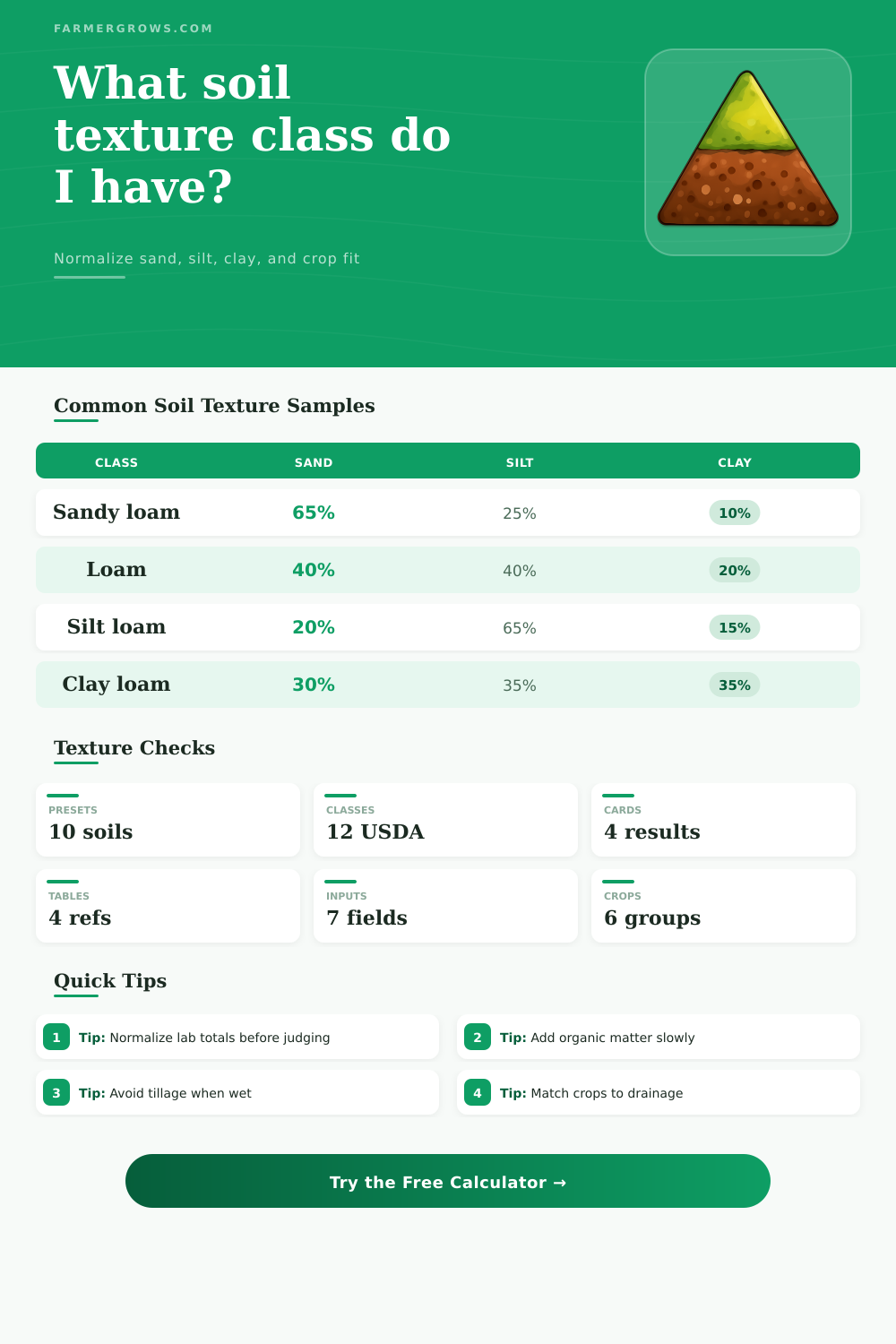
| Sandy loam | Sand dominant with useful fines | Moderately rapid | Good for early planting and root crops with steady water. |
| Loam | Balanced sand, silt, and clay | Moderate | Flexible soil for many crops when organic matter is maintained. |
| Silt loam | Silt dominant with low to moderate clay | Moderate to slow | Keep residue cover to reduce crusting and erosion. |
| Clay loam | Moderate clay with balanced sand and silt | Slow to moderate | Avoid traffic when wet; improve aggregation with roots and cover crops. |
| Silty clay | High clay and high silt | Slow | Surface sealing and ponding risk increase when structure is weak. |
| Clay | High clay with lower sand and silt | Very slow | Use permanent beds, deep roots, and careful timing instead of aggressive tillage. |
| Texture group | Typical infiltration | Available water | Compaction tendency | Best suited crop style |
|---|---|---|---|---|
| Sandy soils | 1.00 to 2.00 in/hr | 0.6 to 1.2 in/ft | Low to medium | Roots, melons, peanuts, irrigated vegetables |
| Sandy loam | 0.60 to 1.20 in/hr | 1.1 to 1.6 in/ft | Medium | Vegetables, small fruit, early corn |
| Loam | 0.30 to 0.80 in/hr | 1.5 to 2.1 in/ft | Medium | Broad crop mix, pasture, gardens |
| Silt loam | 0.20 to 0.60 in/hr | 1.8 to 2.4 in/ft | Medium to high | Corn, soybeans, hay, vegetables with cover |
| Clay loam | 0.10 to 0.40 in/hr | 1.7 to 2.3 in/ft | High | Pasture, grain, trees on drained sites |
| Clay soils | 0.03 to 0.25 in/hr | 1.3 to 2.0 in/ft | High to very high | Pasture, rice, wet-tolerant crops, raised beds |
| Amendment goal | Sandy texture approach | Loamy texture approach | Clayey texture approach |
|---|---|---|---|
| Improve water storage | Add compost, mulch, and cover crop roots | Maintain residue and organic matter | Improve aggregation before adding more water |
| Improve infiltration | Keep surface covered; avoid hydrophobic dry mulch | Prevent crusting and shallow compaction | Use gypsum only when sodium issue is confirmed |
| Reduce compaction | Use controlled traffic and avoid over-tilling | Keep beds covered and avoid wet passes | Use permanent beds, deep roots, and dry traffic windows |
| Support nutrients | Split fertilizer applications | Use soil test rates and compost maintenance | Watch pH, potassium fixation, and drainage limits |
| Crop group | Preferred texture | Texture caution | Practical adjustment |
|---|---|---|---|
| Vegetables and mixed garden | Loam, sandy loam, silt loam | Heavy clay delays planting and root growth | Use raised beds and compost where drainage is slow. |
| Corn and grain sorghum | Loam, silt loam, clay loam | Sand can drought-stress without irrigation | Match population and nitrogen timing to water holding. |
| Pasture and hay | Loam, clay loam, silt loam | Wet clay compacts under hooves | Rotate traffic and keep dense living cover. |
| Orchard and berries | Sandy loam, loam, well-drained silt loam | Poor clay drainage damages roots | Use berms, tile, or choose tolerant rootstock. |
| Root crops | Sand, loamy sand, sandy loam | Clay causes forking and harvest trouble | Build loose beds and avoid fresh chunky manure. |
| Rice or wet-tolerant crops | Clay loam, silty clay, clay | Sandy soils lose flood water quickly | Use water control and puddling only where appropriate. |
Sampling tip: Mix several cores from the same management zone before testing. A single scoop from a wet spot can misrepresent the whole bed or field.
Management tip: Texture does not change quickly. Focus on structure, organic matter, cover, drainage, and traffic timing to change how the soil behaves.
Soil texture refer to the balance of sand, silt, and clay particle in the soil. Soil texture is a primary factor that determine how water and nutrients interact with the soil. Soil texture determine how much water the soil can hold.
Soil texture also determine how easy the roots of plant can grow through the soil. The soil triangle calculator allow you to input the percentage of sand, silt, and clay particle in the soil. Using these percentage, the soil triangle calculator can give you a USDA texture class of the soil in question.
How to Use the Soil Triangle Calculator
The percentage of sand, silt, and clay particle must be entered correctly into the soil triangle calculator. Sand particle are large and water drains away from sandy soil very quick. Silt particle are of medium size and hold more water than sand particle.
However, silt particle can form a crust on the soils surface when the silt dry out. Clay particle are small in size and hold onto the nutrient very tight. However, clay soil swell when wet and become compacted when stepped on or driven over.
The soil triangle calculator tool will rescale the percentage of sand, silt, and clay to total to 100%. This rescaling process ensure that the soil texture is correctly calculated even if the percentage of sand, silt, and clay are slightly incorrect when enter into the soil triangle calculator. After determining the texture class of the soil, the soil triangle calculator can determine other information about the soil.
One such data point are the amount of organic matter in the soil. The amount of organic matter will change the soil’s water holding capacity and compaction. Another data point is bulk density.
Bulk density will tell you if the soil are compacted or not. Another data point is soil structure and drainage. Soil structure will determine how fast the water enter the soil.
Crumbly soil will allow water to enter the soil more faster than soil that tends to puddle or plow. The last data point is the type of crop that will be plant in the soil. Different crop require different soil condition.
For instance, corn require different soil condition than carrots. The reference table provided by the soil triangle calculator tool will show you how different soil texture will behave in different environment. For instance, sandy loam are good for root crop that are planted at the beginning of the season.
Clay loam, on the other hand, are good for pasture since the clay-based soil will remain wet for longer period of time and warm up slowly in the spring. You should always remember that the estimate of the availability of water and infiltration of water into the soil provide by the soil triangle calculator are only estimate. The actual behavior of the soil within your field depend on a variety of factor, such as how deep the roots of the plant in that soil grow, and how much organic residue you add to that soil.
Although soil texture cannot be quickly change, there are a variety of management practice that can alter the behavior of soil. For example, if your soil is a silt loam that tends to crust when wet, you can add mulch to the soil or use the roots of living plant to cover the soil to prevent it from crusting. If the soil is sandy loam and dry out too quick, adding compost to the sandy loam soil will increase the amount of water that the sandy loam soil can hold.
Although the soil triangle calculator will provide you with a map of your soil, your management of the soil each day will determine how the soil perform in your field. You should not treat the texture of your soil as a permanent classification. For instance, if your soil is of loam texture, it does not necessarily mean that the soil drain at a moderate rate; adding organic matter will change the rate of drainage of that soil.
Similarly, if the soil clay loam texture indicate a high risk of compaction into your field, you can use that information to avoid placing farm equipment onto those field while the soil is wet. Another useful tool is to use the soil triangle calculator to determine the soil texture of different area of your own property. Since different field may contain different soil texture in different area of that field, you must use the soil triangle calculator in each of these area of the field.
With this information, you can manage your crop to each of these area according to there requirements. Perhaps the most important use of the soil triangle calculator is to time your farming operation. For example, if your soil drain slowly and has a high risk of compaction, it is important to wait until the soil is dry before placing farm equipment onto the area.
Similarly, if your soil drain rapidly, you will have to water your field more frequently or add mulch to the soil to reduce evaporation. Through making these small adjustment to the management of your field, you can ensure that your soil remain healthy and your crop yield are high throughout the growing season.