Fertilizer Blend Calculator
Build a dry fertilizer blend from field N-P2O5-K2O targets, acres, urea, DAP or MAP, potash, AMS sulfur, and lime filler while checking blend weight, application rate, and nutrient gaps.
Use fertilizer label analyses and a current soil recommendation. The calculator balances phosphorus, potassium, sulfur, and nitrogen carriers, then shows whether the selected blend rate leaves enough room for filler or causes nutrient shortfalls.
Edit the analysis if your fertilizer tag differs. Values are percentage nutrient analysis by product weight, using P2O5 and K2O label basis.
| Role | Product | N % | P2O5 % | K2O % | S % |
|---|---|---|---|---|---|
| N source | |||||
| P source | |||||
| K source | |||||
| S source | |||||
| Filler |
Blend Results
The blend calculation will appear here.
| Product | Typical analysis | Main use | Blend note |
|---|---|---|---|
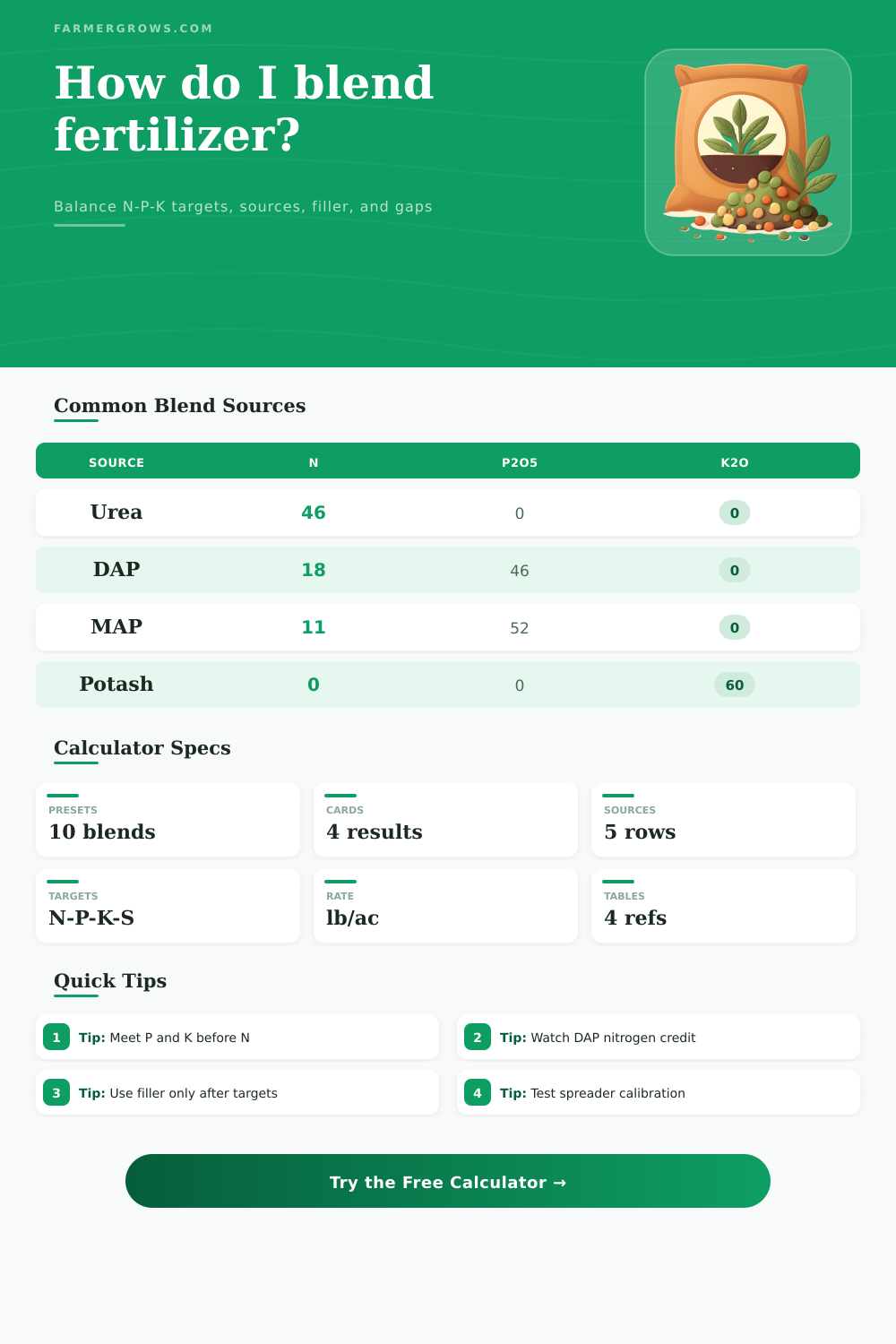
| Urea | 46-0-0 | N source | Very concentrated, so small weight changes move N quickly. |
| DAP | 18-46-0 | P2O5 plus N | Credits 0.39 lb N for each lb P2O5 supplied. |
| MAP | 11-52-0 | P2O5 plus lower N | Useful when a starter needs less extra N. |
| Muriate of potash | 0-0-60 | K2O source | Highest common K analysis, but chloride-sensitive crops may need review. |
| Ammonium sulfate | 21-0-0-24S | S and N | Supplies sulfur while replacing some urea N. |
| Lime filler | 0-0-0 | Weight carrier | Use as filler only after nutrient pounds fit the rate. |
| Crop or use | N target | P2O5 target | K2O target |
|---|---|---|---|
| Corn preplant base | 60 to 120 lb/ac | 30 to 70 lb/ac | 40 to 90 lb/ac |
| Soybean maintenance | 0 to 20 lb/ac | 20 to 60 lb/ac | 50 to 120 lb/ac |
| Wheat fall blend | 20 to 60 lb/ac | 25 to 70 lb/ac | 20 to 80 lb/ac |
| Hay or pasture | 40 to 100 lb/ac | 20 to 60 lb/ac | 80 to 180 lb/ac |
| Vegetable field | 50 to 120 lb/ac | 40 to 100 lb/ac | 60 to 160 lb/ac |
| Check | Formula | What it means | Action |
|---|---|---|---|
| Product rate | Target lb/ac / analysis decimal | Carrier pounds needed to supply a nutrient | Use label analysis, not product name alone. |
| Blend grade | Nutrient lb/ac / blend lb/ac | Final N-P-K percentage in the mix | Higher filler lowers the printed grade. |
| Filler room | Desired rate - carrier rate | Extra non-nutrient material possible | If negative, rate is too low for the targets. |
| Total batch | lb/ac x acres x buffer | Loader or tender quantity to mix | Round to scale and equipment limits. |
| Item | Basis | Credit example | Blend caution |
|---|---|---|---|
| N | Elemental N | 100 lb urea gives 46 lb N | Credit N from DAP, MAP, and AMS before adding urea. |
| P2O5 | Fertilizer phosphate | 100 lb DAP gives 46 lb P2O5 | Soil tests may report P, but fertilizer labels use P2O5. |
| K2O | Fertilizer potash | 100 lb potash gives 60 lb K2O | High K goals often drive most of the blend weight. |
| S | Elemental sulfur | 50 lb AMS gives 12 lb S | S targets can add meaningful N through AMS. |
Tip: Balance P2O5, K2O, and sulfur sources first, then var urea fill the remaining nitrogen after all nutrient credits are counted.
Caution: A blend rate below the required carrier pounds will create nutrient gaps; lower targets, raise the rate, or change source analyses before spreading.
To create a fertilizer blends, you need to understand which component contain which nutrients. You need to determine how much nitrogen, phosphate, potassium, and sulfur your field will need. Furthermore, you must determine which fertilizer product will help provide these nutrients to the soil.
If you dont account for the nutrients that is contained within each of these products, you may either create a fertilizer blend that has too many filler, or that does not contain enough of each nutrient to meet the nutrient requirement of your field. Not all of the nutrients are created equal, and each of the different nutrients presents different tradeoff. For instance, urea will provide nitrogen to your field, but it wont contain any other nutrient.
How to Make a Fertilizer Blend
DAP and MAP will provide nitrogen and phosphate to your fields, which will reduce the amount of urea that you need to apply to your fields. Potash will provide potassium to your fields, but it will also contain chloride. Finally, AMS will provide both sulfur and nitrogen to your fields, which will alter the amount of nitrogen that you will need from other fertilizer product.
Each of these products must be considered in relation to each of the others in your proposed fertilizer blend. The order in which you consider the nutrients in your fields is important. For instance, you should satisfy the phosphate, potassium, and sulfur target first in the calculation process.
This is because many of the source of these nutrients will contain nitrogen. Once you have accounted for the nitrogen from these other sources, you may then determine how much nitrogen you will need from urea or other nitrogen sources. If you do not consider this order, you may end up with too much nitrogen in your fields, or you may have to apply too heavly of a rate of fertilizer in order to meet your target yield.
Beyond the soil test result for your fields, there are other factor that may play a role in the actual nitrogen, phosphate, potassium, and sulfur levels that your fields will require. For instance, if your soil test indicate that your fields have enough potassium to support the crops that you will grow, you may still have to add additional fertilizer to provide enough potassium for high yield crops. Similarly, the amount of sulfur that is available in your fields may change with the rainfall that your fields receive, so a recommendation for sulfur level in mid-April may have to be changed in response to a wet spring.
Furthermore, there are always gap between the targets for each nutrient and the sources of each nutrient. You may have to adjust your fertilizer blend to either increase the total rate of nutrients to provide for each nutrient, or change which source you utilize to provide each nutrient. The rate at which you will apply the nutrients to each field is another consideration in the planning of your fertilizer blend.
The analysis of each of these products will indicate how much nitrogen, phosphate, potassium, and sulfur are contained in each product. Because of this information, it is possible to determine the total number of pounds of each product that will be required to provide enough nutrient to achieve your targets for each nutrient. Furthermore, the calculation tool will indicate whether or not the application rate is too high, or whether the application rate will force you to scale back the amount of fertilizer that you spread to your fields.
Each of these factor will help you to determine whether your original targets were realistic. Another consideration in the creation of a fertilizer blend is how the fertilizer will be calibrate and handled. In many cases, fertilizer manufacturers do not provide for a buffer for fertilizer shrink and calibration error.
Thus, many people often introduce a two-percent buffer to ensure that the fields dont be short of the amount of fertilizer that is calculated. The total batch weight from the calculation tool will reflect this buffer in the total weight of the fertilizer blend that should be loaded onto each fertilizer spreader. The reference table are provided to help you to understand the analysis of different fertilizers.
However, the product tag that is provided by each of the fertilizer manufacturer is not a replacement for the reference tables. The reference tables will help to determine if the custom analysis of a fertilizer is any different than the standard analysis of that fertilizer. Given the extent of many farms in providing fertilizer to hundreds of acre, the small difference in the analysis of fertilizers can have a greater effect on the amount of fertilizer that is required to meet the nutrient needs of each acre.
The fertilizer blend calculator is a tool that will help you to determine the variable of your proposed fertilizer blend. However, the fertilizer blend calculator is not the final answer. You will need to use your judgment to decide whether or not the amount of each nutrient that is calculated is acceptable, and whether or not the amount of filler in each blend will be acceptable.
Your judgment will improve with time in using this calculation tool, but the calculation tool couldnt replace your own judgment.