Yard Fertilizer Calculator
Estimate fertilizer pounds, bags, nitrogen delivery, split applications, spreader passes, and phosphorus or potassium load for lawns, turf, and planted landscape areas.
Use this calculator for planning a yard fertilizer application from a measured area and a fertilizer label. Follow local nutrient rules and soil test recommendations when phosphorus or potassium are restricted.
Fertilizer Plan
Results are based on measured yard area, selected N rate, fertilizer grade, slow-release share, soil test notes, split count, and spreader width.
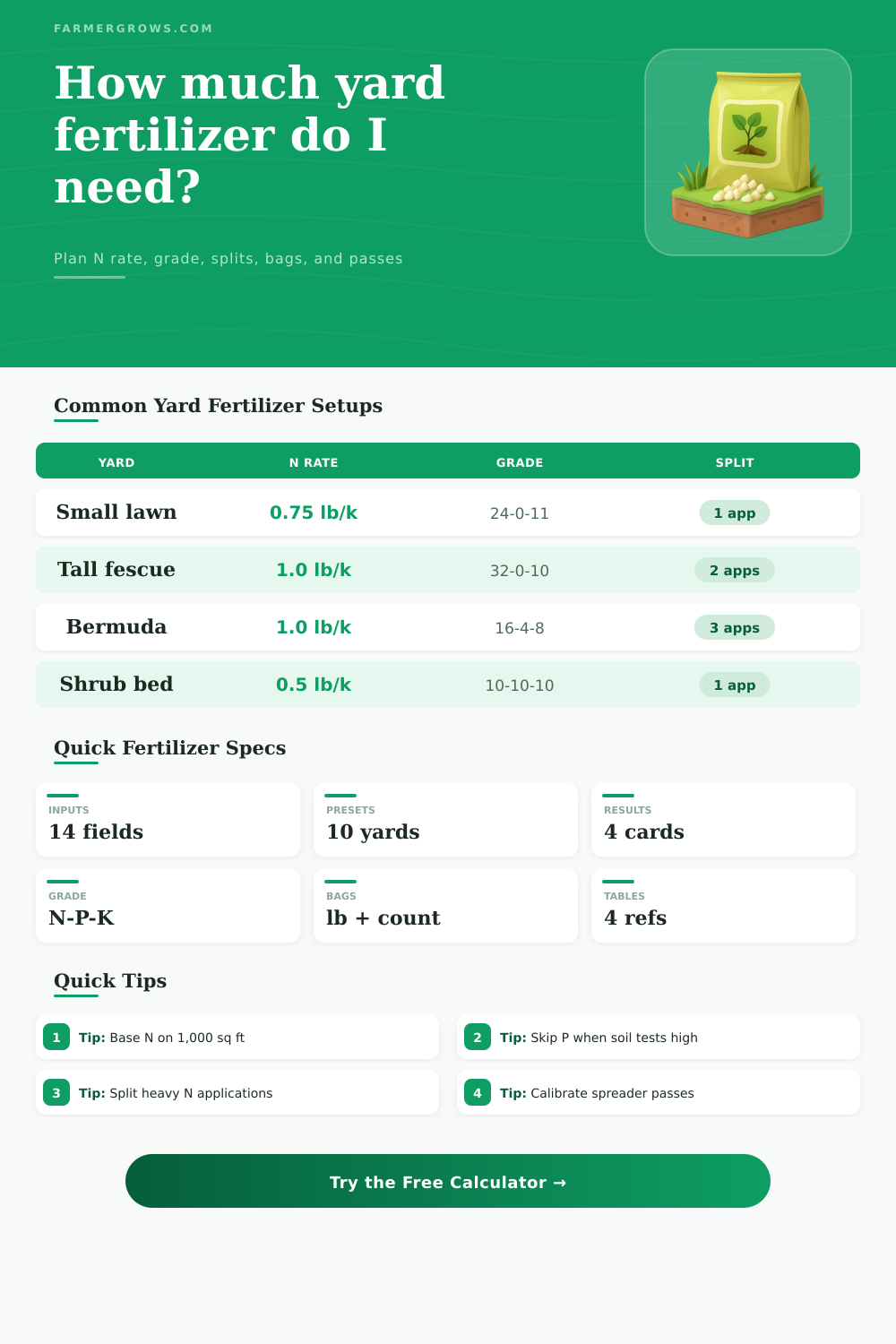
| Yard type | Typical single N rate | Season timing | Split guidance | Planning note |
|---|---|---|---|---|
| Cool-season lawn | 0.5 to 1.0 lb N per 1,000 sq ft | Spring or fall | 1 to 3 splits | Avoid pushing growth during heat or drought stress. |
| Warm-season lawn | 0.5 to 1.0 lb N per 1,000 sq ft | Active summer growth | 2 to 4 splits | Feed after green-up and before the late-season cutoff. |
| High-use turf | 0.75 to 1.0 lb N per 1,000 sq ft | Recovery periods | 2 to 4 splits | Split applications reduce burn risk and improve uniformity. |
| New seed or sod | 0.5 to 1.0 lb N per 1,000 sq ft | At establishment | 1 to 2 splits | Use starter phosphorus only when soil test and rules allow. |
| Shrub or perennial bed | 0.25 to 0.5 lb N per 1,000 sq ft | Early active growth | 1 split | Keep granules off foliage, crowns, and trunks. |
| Fertilizer grade | Product for 1 lb N/k | P₂O₅ delivered | K₂O delivered | Best fit |
|---|---|---|---|---|
| 32-0-10 | 3.13 lb per 1,000 sq ft | 0.00 lb/k | 0.31 lb/k | Low-volume lawn feeding with no phosphorus. |
| 24-0-11 | 4.17 lb per 1,000 sq ft | 0.00 lb/k | 0.46 lb/k | Common maintenance fertilizer for established turf. |
| 16-4-8 | 6.25 lb per 1,000 sq ft | 0.25 lb/k | 0.50 lb/k | Balanced program where P and K are needed. |
| 10-10-10 | 10.00 lb per 1,000 sq ft | 1.00 lb/k | 1.00 lb/k | General landscape beds with soil-test need. |
| 18-24-12 | 5.56 lb per 1,000 sq ft | 1.33 lb/k | 0.67 lb/k | Starter use when phosphorus is recommended. |
| Soil test level | Phosphorus approach | Potassium approach | Calculator flag | Field note |
|---|---|---|---|---|
| Low | P fertilizer may be recommended | K fertilizer may be recommended | Need likely | Use the lab recommendation for exact lb per 1,000 sq ft. |
| Medium | Use moderate P if crop needs it | Maintain K where turf demand is high | Check rate | Maintenance rates often work better than heavy one-time feeding. |
| High | Avoid added P unless directed | Little K may be needed | Limit nutrient | Many areas restrict phosphorus on established lawns. |
| Unknown | Prefer no-P lawn grade | Use conservative K | Test soil | A soil test is the cleanest way to choose grade. |
| Bag size | Product at 0.5 lb N/k, 24% N | Product at 1.0 lb N/k, 24% N | Approx coverage at 1.0 lb N/k | Spreader note |
|---|---|---|---|---|
| 14 lb bag | 2.08 lb per 1,000 sq ft | 4.17 lb per 1,000 sq ft | 3,360 sq ft | Small yards, narrow passes. |
| 32 lb bag | 2.08 lb per 1,000 sq ft | 4.17 lb per 1,000 sq ft | 7,680 sq ft | Common home lawn size. |
| 40 lb bag | 2.08 lb per 1,000 sq ft | 4.17 lb per 1,000 sq ft | 9,600 sq ft | Large lawn or multi-zone application. |
| 50 lb bag | 2.08 lb per 1,000 sq ft | 4.17 lb per 1,000 sq ft | 12,000 sq ft | Calibrate before crossing driveways or beds. |
Before spreading: Measure the actual treated area, close spreader gates on pavement, and make two light perpendicular passes when uniformity matters more than speed.
Before choosing grade: Use a soil test to decide whether phosphorus or potassium belongs in the application, especially for established turf near waterways.
A healthy lawn isnt created by the application of large amount of fertilizer to the lawn until the grass blades become dark green. Furthermore, simply dumping fertilizer products onto the ground dont create a healthy lawn. A healthy lawn is created by determining the amount of nitrogen that the turf area require.
Furthermore, the person will determine how much nitrogen is contained within the specific fertilizer product that is to be applied. Many people do not understand that it is also necessary to check the amount of phosphorus and potassium that is contained within the soil. Many people skip these step in the process of applying fertilizer to their lawns.
How to Use a Fertilizer Calculator to Fertilize Your Lawn
Thus, many people apply fertilizer to lawns that does not require it. If an individual purchases bags of fertilizer based off only upon the square footage of their lawn, they may end up burning their grass in strips or their grass may remain pale despite their financial commitment to purchasing fertilizer for their turf. The timing and the number of applications of fertilizer will determine whether the fertilization process include maintenance fertilization or rescue fertilization.
Cool-season grasses will require lighter doses of nitrogen applied during the spring and fall months. Cool-season grasses require these lighter doses of nitrogen so that the grass does not produce soft grass blades during the summer months. Warm-season grasses will require the addition of nitrogen while they are actively growing.
Warm-season grasses typically will require two or three application of fertilizer between late spring and early fall. Starter fertilizer for new grass seeds or sod contains different logic than nitrogen fertilizer. Starter fertilizer is applied to young grass roots only in response to a test of the soil that reveals a shortage of phosphorus.
Landscape beds containing shrubs and trees will require lower rate of nitrogen and will require the fertilizer to be applied further apart from the plants then fertilization of grass areas. This spreading of the fertilizer apart from the roots of shrubs and trees is required so that the fertilizer does not touch the trunk or crowns of those plants. The calculator will provide mathematical results once you enter the area size, the amount of nitrogen that is to be fed to the lawn, and the percentage of nitrogen that is contained within the fertilizer product.
The calculator will provide the total pound of the fertilizer that is to be applied to the lawn, the total number of bags of fertilizer that are to be purchased, and the total distance that the spreader will have to travel across the lawn. These answers are important in determining the amount of fertilizer that is to be purchased, the number of bags of fertilizer that are to be bought, and the distance that the fertilizer spreader will have to travel. Furthermore, the calculator will determine how much phosphate and how much potash will reach the soil.
These two measurements are important to determine because local rules may limit the amount of phosphate fertilizer that can be applied to soil near waterways. The results of soil tests can be difficult to read, and turf professional often misread the results of soil tests. A high reading of the amount of phosphorus that is present in the soil does not indicate that the lawn is thriving; it only indicates that fertilizing with phosphate will not assist in the growth of the grass.
Furthermore, adding phosphate to the lawn if the soil contains high amount of phosphorus may lead to the phosphate compounds running off of the land into the environment after rainfall. The same is true of potassium levels in the soil. The fertilizer calculator will indicate high levels of these nutrients so that the individual can make the decision of whether a no-phosphorus fertilizer will be purchased instead of one that contains the nutrient.
Additionally, the fertilizer calculator will prevent the individual from making such mistake in applying fertilizer to the turf. Spreader calibration is a step that is often overlooked in fertilizing the lawn. Calibration of the spreader is required for even application of fertilizer.
For instance, using a push spreader with a pass width of eight feet may seem simple. However, it may not be effective if the lawn is comprised of narrow strips of grass between driveways and other garden area. The fertilizer calculator will determine the total walking distance that is required for even application of the fertilizer.
Furthermore, by determining the distance that the spreader will have to walk, the individual can determine if two passes perpendicular to each other will be effective within the available time for fertilizing. If an individual over-applies fertilizer in one direction of the lawn, but under-applies the fertilizer in another direction, the grass will grow in stripes in that lawn area. These stripes will take several week to even out.
Many lawns are not perfect rectangles. Many lawns contain odd shape and slopes. The odd shapes and slopes for fertilizing the lawn will change the amount of fertilizer that lands upon the grass area.
Furthermore, odd shapes will change the amount of fertilizer that is needed in different areas of the lawn. Thus, an individual will have to measure the actual area of the lawn that is to be fertilized. The fertilizer calculator will take the area that is to be treated, and it will process that area according to the percentages of nutrients in the fertilizer and the split count of how often that fertilizer are to be applied.
The goal of fertilizing turf is not to achieve the maximum amount of green color in the lawn. The goal of fertilizing turf is to provide the correct amount of nitrogen at the correct time. The amount of nitrogen must be provided correctly when the soil contains its nutrients.
Furthermore, providing the correct amount of nitrogen at the correct time will ensure that the lawn remains densely populated with green grass blades, will allow it to recover quickly from traffic, and will require fewer applications of fertilizer to rescue the lawn. Finally, the individual must stay off of the fertilized lawn until the granules of the fertilizer are water into the soil.