Harvest Calculator
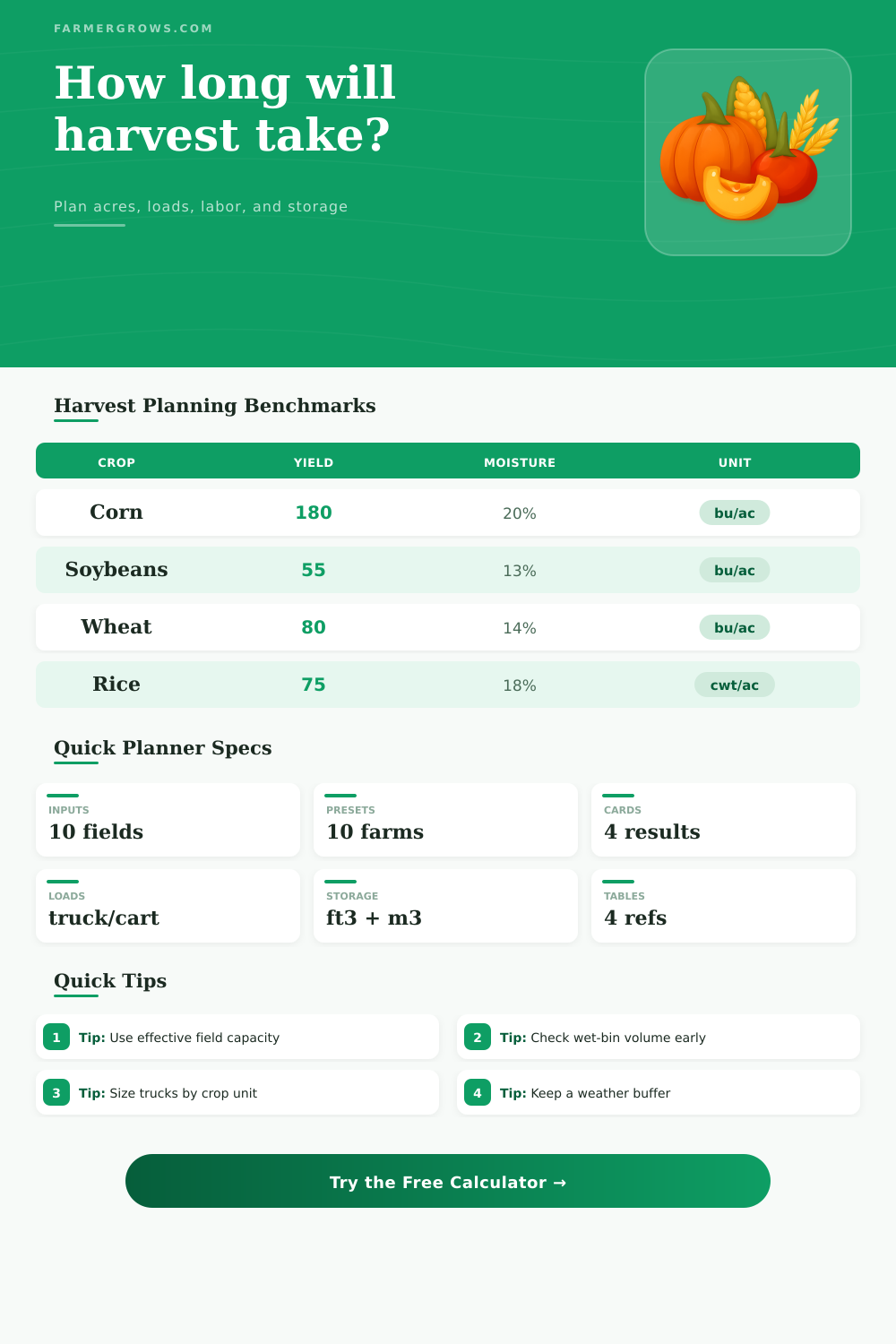
Estimate harvest days, combine or picker hours, truck and cart loads, moisture shrink, labor demand, and storage volume for grain, oilseed, forage, and cotton harvest planning.
Use field-ready machine capacity and realistic labor hours. The calculator keeps crop units visible so bushels, tons, hundredweight, or bales do not get mixed during load and storage planning.
Harvest Planning Results
Harvest timing, loads, labor, and storage are calculated from effective machine capacity and crop volume.
| Crop | Planning unit | Common harvest moisture | Storage target | Storage volume used |
|---|---|---|---|---|
| Corn grain | Bushels per acre | 18% to 25% | 15% | 1.244 ft³ per bushel |
| Soybeans | Bushels per acre | 11% to 15% | 13% | 1.25 ft³ per bushel |
| Wheat | Bushels per acre | 12% to 16% | 13.5% | 1.25 ft³ per bushel |
| Rice | Hundredweight per acre | 17% to 22% | 14% | 2.22 ft³ per cwt |
| Corn silage | Tons per acre | 60% to 70% | 65% | 43 ft³ per ton at packing density |
| Machine setup | Typical capacity | Good field efficiency | Best use | Planning caution |
|---|---|---|---|---|
| 6 row corn head | 4 to 8 ac/hr | 70% to 82% | Smaller corn acres | Unloading time can dominate |
| 12 row corn head | 10 to 18 ac/hr | 72% to 85% | Large corn blocks | Truck queue limits output |
| 30 ft platform | 7 to 13 ac/hr | 68% to 82% | Soybeans and wheat | Green stems slow feed rate |
| 40 ft draper | 12 to 22 ac/hr | 70% to 84% | Small grains and soybeans | Cart timing matters |
| Forage harvester | 3 to 8 ac/hr | 60% to 78% | High-ton silage | Packing pace must match |
| Field efficiency | What it represents | Typical range | When to lower it |
|---|---|---|---|
| 85% to 90% | Long runs with cart support | Excellent | Only for very organized fields and crews |
| 75% to 84% | Normal turns and unloading | Strong | Use for efficient grain harvest days |
| 65% to 74% | Small fields or modest delays | Average | Use when roads, gates, or terraces interrupt |
| 55% to 64% | Frequent stops or wet spots | Tight | Use for lodged crop, mud, or slow hauling |
| Below 55% | Interrupted operation | Low | Use for salvage, breakdown risk, or short days |
| Hauling setup | Common capacity | Equivalent use | Planning note |
|---|---|---|---|
| Single grain cart | 800 to 1,100 bu | One combine support | Best when trucks stay near field edge |
| Semi grain trailer | 900 to 1,100 bu | Road haul grain | Use legal weight and crop test weight |
| Gravity wagon | 300 to 650 bu | Short farm haul | Good for smaller blocks or close bins |
| Silage truck | 12 to 24 tons | Forage harvest | Scale by packed bunker capacity |
| Cotton module | 4 to 6 bales | Picker staging | Keep module area dry and accessible |
Set capacity from field history: Rated machine capacity is usually cleaner than real harvest. Use the acres actually covered between the first pass and the last unload.
Separate wet crop from stored crop: Loads are based on harvest units, while bin or bunker volume should be checked after shrink to the selected storage moisture.
Harvest planning require the use of specific data to prepare for the harvest period. There are numerous variable that affect the harvest period, such as the weather and the performance of the equipment. A planning calculator can take all these different variables and create a plan for the harvest period.
The planning calculator will show any bottlenecks in the harvest operation before they becomes a problem. To use the planning calculator, you will need to enter the field size, the speed of the machine, and the expected yield from the field. The capacity of the machine that you enter into the calculator are an important value.
How to Use a Harvest Planning Calculator
The capacity that is listed in the machine’s brochure is not the same than the capacity that the machine will have during the harvest. The actual machine capacity will factor in the amount of time it takes to make headland turns with the tractor and the amount of time the machine will have to wait for a cart to come to it. An efficiency percentage must be entered into the planning calculator.
This efficiency will account for the difference between the capacity of the machine as rate by the manufacturer and the actual capacity that will be available during the harvest period. The percentage of efficiency should not be too highly for the planning calculator. If you enter it at such a high value, then the plan that is shown on the calculator will take place at a pace that is more too rapid to be realistic for the actual harvest period.
The moisture shrink of the harvest must also be accounted for when using the planning calculator. Moisture shrink is the amount of weight that is lost when drying the crop from a wet state to a dry state suitable for long-term storage. The planning calculator account for this moisture shrink for the crops that will be harvested.
The moisture shrink is important to consider because it will help to determine how much storage space will be needed for the harvested crops. The number of labor hour for the harvest and the length of the harvest window for the crops are two variables that people often dont correct estimated. The harvest window is the amount of time that will be available for completing the harvest period.
The labor and machines that are currently used during the harvest will use what percentage of the harvest window. If the percentage of the harvest window is at 70 or 80 percent, then there is no margin for error. The percentage of the harvest window must be monitored so that any delay in the harvest due to rain or other weather problems or a machine breakdown will have a better idea of the amount of time that will be needed to complete the harvest.
The storage volume for the crops will need to be calculated with the planning calculator to determine whether the storage space for the crops will be sufficient for the barn or storage facility. The storage volume will be calculated in units of volume such as cubic feet or meters. The information will be calculated from dry bushel or tons of the harvest.
There will be a need to enter different value into the planning calculator for different type of crops. Forage crops will have a different value for density then crops that contain grains. Silage will have a different density than grain crops, so there will be a separate coefficient for silage in the calculation.
The farmer need to check the calculated storage volume to ensure that the volume of the crops will not exceed the capacity of the storage bins or bunkers. Another variable that must be included in the planning calculator is the capacity of the trucks that will be used to transport the harvested crops to the storage facility. The capacity of the truck will be entered in the same units as the crop.
The planning calculator will use this information to find out how many load of crops the trucks can produce each day. If the number that is calculated is higher than what the available driver can transport the harvested crops in the trucks each day, then there will be a bottleneck in the transport of these crops. Adding more trucks or changing the unloading strategy for the trucks can resolve any bottlenecks.
The planning calculator cannot determine the weather or if there will be a failure in a machine part during the harvest. Thus, the percentage of the harvest window is a number that must be monitor. If the percentage of the harvest window is high, then it will be easier for any delays caused by weather or another machine failure to force a decision about whether to extend the harvesting crew or add more harvesting capacity.
Another decision that will need to be made is whether some of the field will remain unharvested for a period that is longer than planned. The data that was entered into the planning calculator should be revisited after the first day of the harvest of the fields. The input to the calculator can be changed based off the data that was gathered from the first day of the harvest to determine any change to the harvest plan.
Revisiting the harvest planning calculator will allow the farmers to see any trade-offs in their harvest operation. Using the math that is included in the planning calculator to determine these trade-offs will allow the farmers to better complete the harvesting of the crops in the field.