Seed Calculator
Estimate seed counts, ounces, pounds, packets, bags, pure live seed adjustment, and row or bed layout for vegetable beds, cover crops, grain plots, lawns, and small fields.
Use seed tag values whenever possible. Germination, purity, seed size, and planter losses vary by lot, so this calculator turns your actual seed data into a practical order quantity.
Seed Estimate
Results include the target stand, pure live seed correction, planting mode factor, order buffer, packet count, bag count, and row or bed layout.
| Seed type | Seeds per ounce | Seeds per pound | Typical package unit | Planning note |
|---|---|---|---|---|
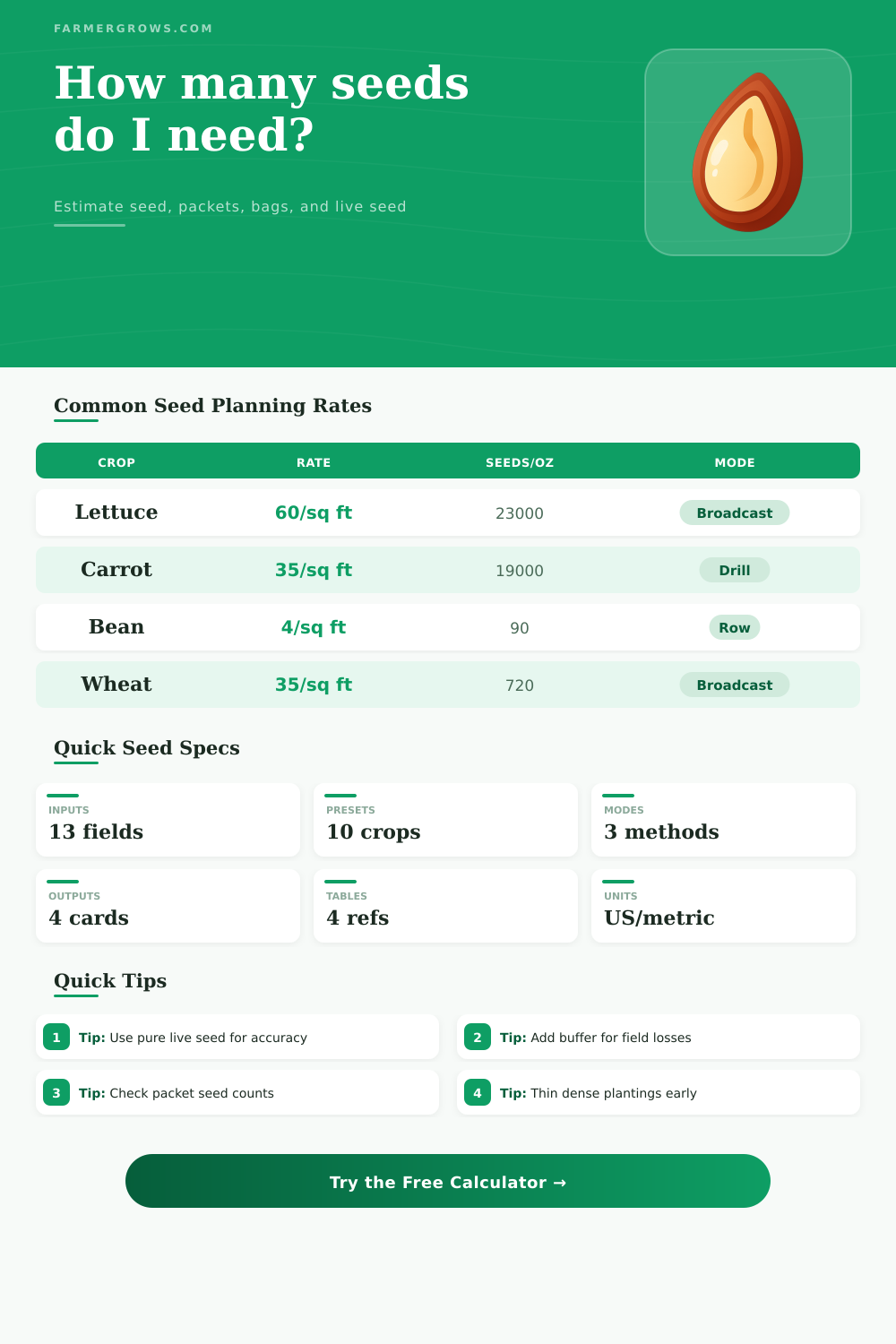
| Lettuce | 18,000 to 25,000 | 288,000 to 400,000 | 250 to 1,000 seeds | Very small seed; baby leaf rates can be much higher than head lettuce. |
| Carrot | 18,000 to 23,000 | 288,000 to 368,000 | 1,000 to 10,000 seeds | Fine seed and slow emergence often justify a larger field buffer. |
| Bush bean | 80 to 120 | 1,280 to 1,920 | 50 seeds to 1 lb | Large seeds make packet count and row length easy to compare. |
| Sweet corn | 120 to 180 | 1,920 to 2,880 | 100 seeds to 5 lb | Block planting improves pollination; spacing usually sets seed count. |
| Tomato | 8,000 to 12,000 | 128,000 to 192,000 | 20 to 100 seeds | Transplant starts need extra seed for culls, trays, and backup plants. |
| Spinach | 2,500 to 3,500 | 40,000 to 56,000 | 250 seeds to 1 lb | Seed size varies by variety; check the packet or lot tag. |
| Radish | 2,000 to 3,000 | 32,000 to 48,000 | 250 to 2,000 seeds | Fast emergence means a modest buffer often works for good beds. |
| Wheat or rye | 600 to 900 | 9,600 to 14,400 | 1 lb to 50 lb bag | Field lots should be adjusted by germination and purity. |
| Crop or use | Common rate guide | Seeds per sq ft equivalent | Mode | Spacing guide |
|---|---|---|---|---|
| Lettuce baby leaf | 40 to 80 seeds/sq ft | 60 | Broadcast or drill | Rows 2 to 6 in, thin as needed |
| Carrot fresh market | 25 to 45 seeds/sq ft | 35 | Precision drill | Rows 12 to 18 in, 1 to 2 in final spacing |
| Bush bean | 3 to 5 seeds/sq ft | 4 | Direct seed rows | Rows 18 to 30 in, 3 to 6 in in-row |
| Sweet corn | 0.4 to 0.8 seeds/sq ft | 0.7 | Direct seed rows | Rows 30 to 36 in, 8 to 12 in in-row |
| Tomato starts | Spacing based | 0.13 | Transplant | Rows 36 to 60 in, 18 to 30 in in-row |
| Wheat food plot | 90 to 150 lb/acre | 25 to 45 | Broadcast or drill | Drill 6 to 8 in rows where equipment allows |
| Cereal rye cover | 60 to 120 lb/acre | 15 to 35 | Broadcast or drill | Higher rates for late planting or rough seedbeds |
| Alfalfa | 12 to 20 lb/acre | 55 to 90 | Broadcast or drill | Firm seedbed and shallow placement matter most |
| Germination and purity | Pure live seed | Multiplier to order | Example impact | Best use |
|---|---|---|---|---|
| 95% germ, 99% purity | 94.1% | 1.06x | 1,000 live seeds need about 1,063 gross seeds | Fresh vegetable seed |
| 85% germ, 98% purity | 83.3% | 1.20x | 1,000 live seeds need about 1,200 gross seeds | Older seed or common field lots |
| 75% germ, 95% purity | 71.3% | 1.40x | 1,000 live seeds need about 1,404 gross seeds | Low-vigor lots needing caution |
| 60% germ, 90% purity | 54.0% | 1.85x | 1,000 live seeds need about 1,852 gross seeds | Only when no better lot is available |
| Packet or bag size | Useful for | Approximate coverage examples | Counting method | Planning caution |
|---|---|---|---|---|
| 100 seed packet | Tomato, pepper, corn trial | 100 starts at 100% before culls | Packets = seed need / 100 | Add extra for trays, misses, and backup plants. |
| 500 seed packet | Greens, radish, small beds | 8 sq ft at 60 seeds/sq ft | Packets = seed need / 500 | Fine seed is easy to over-sow by hand. |
| 1 ounce packet | Carrot, lettuce, spinach | Crop dependent by seeds per ounce | Ounces = seed need / seeds per ounce | Use the lot-specific count if printed. |
| 1 pound bag | Beans, cover crops, food plots | 16 ounces or listed seed count | Pounds = seed need / seeds per pound | Round up for planter cleanout and edge rows. |
| 25 to 50 pound bag | Wheat, rye, pasture, alfalfa | Usually rated per acre | Bags = required pounds / bag size | PLS tags are especially important for field seed. |
Use the seed tag: Enter the printed germination, purity, seeds per ounce, or seeds per pound from the actual lot. Catalog averages are helpful, but lot tags make the order more accurate.
Keep the buffer practical: Add more buffer for hand broadcasting, old seed, rough beds, bird pressure, or planter cleanout. Use less buffer for precision trays and high-germination fresh seed.
When you plant a garden or a field, you must determine how many seed to purchase to fulfill the planting requirement for that specific area. The process of determining how many seeds to purchase are complex. You must take into account the area of the soil in which you will be planting the seeds.
Additionally, you must also account for the biological reality of the seed and the germination rate of that specific seed. The germination rate of the seed determine how many seeds will grow in the soil. Additionally, the purity percentage of the seed determine how many actual seeds are contained within the seed package that you purchase.
How to Calculate How Many Seeds You Need
Both of these factor will change the number of seeds that you must place into the ground in order to fulfill your planting goals. Furthermore, that final number will allow you to determine how many packet of seeds or bags of seeds you must purchase. The number of seeds that you will need will depend upon the type of crop that you are planting.
For example, crops like lettuce may require thousands of seeds to be planted into the ground in order to provide baby leaf for sale. Additionally, crops like bush beans only require a handful of seeds to be planted into the ground to provide a larger number of beans for sale. Additionally, the size of the seeds can vary from variety to variety, as well as year to year.
To account for this variable, many farmer use a seed calculator that allow them to enter the number of seeds that they need to be planted into the ground and the number of seeds per ounce of that specific type of seed. The information that can be found on the tag that is attached to the bags of seeds contains two critical variable. The first variable is the germination percentage of the seeds and the second is the purity percentage of the seeds.
These two percentages of the seeds will provide the pure live seed percentage, which is the number of those seeds that will germinate and grow into a plant. If the percentage of live seeds that are contained within the package of seeds that is for sale is low, more seeds will be needed to provide the same number of plants as the percentage of live seeds suggest. The seed calculator will provide this calculation for the farmer of how many additional seed are needed due to the germination percentage of the seeds.
The method for planting the seeds can change the number of seeds that is needed. For instance, if the seeds are to be broadcast into the field, an additional number of seeds will be required, because the distribution of the seeds when broadcast isnt even. Drill seeding also lose some of its seeds when planted into the ground due to skips by the drill planter.
Additionally, if seeds are transplanted into the ground, some of those plants will die in the starting tray for some reason, so more seeds will be needed for starting plants. These different method of planting the seed calculator accounts for for the farmer. The area of the soil that will be planted with the seeds needs to be determined.
The area of the soil can be of any shape. However, the seed calculator can calculate the area of the soil regardless of shape. Additionally, the dimensions of the soil can be changed from units of feet to acres, and the seed calculator can also perform this calculation.
Reference tables contain information about the number of seeds of various types of crops per ounce of that type of seed. These tables also contain information about the different rates at which seeds can be planted into the ground. Additionally, these reference tables can show how many seeds is in each packet or bag of the seeds.
These tables allow individuals to verify the calculations made from the seed calculator as well as to estimate the number of seeds needed for various planting situations. Environmental conditions may make it difficult for the number of seeds that are planted into the ground to germinate. For example, soil that is too hot or too moist, or that is exposed to birds may result in fewer seeds germinating into plants.
These environmental variable may be accounted for in the seed calculator so that the estimated number of seeds to be planted into the ground can reflect the actual growing conditions in which the seeds will germinate. For the most accurate estimation of the number of seeds that will be needed to produce the desired number of plants, you should use the values on the tag attached to the bag of seeds instead of the values from a catalog. These values will remove the guesswork from the planting of seeds in the ground.
Additionally, the farmer is able to utilize the values to determine how many additional seeds should be planted in case any additional insurance is required.