Horse Breeding Color Calculator
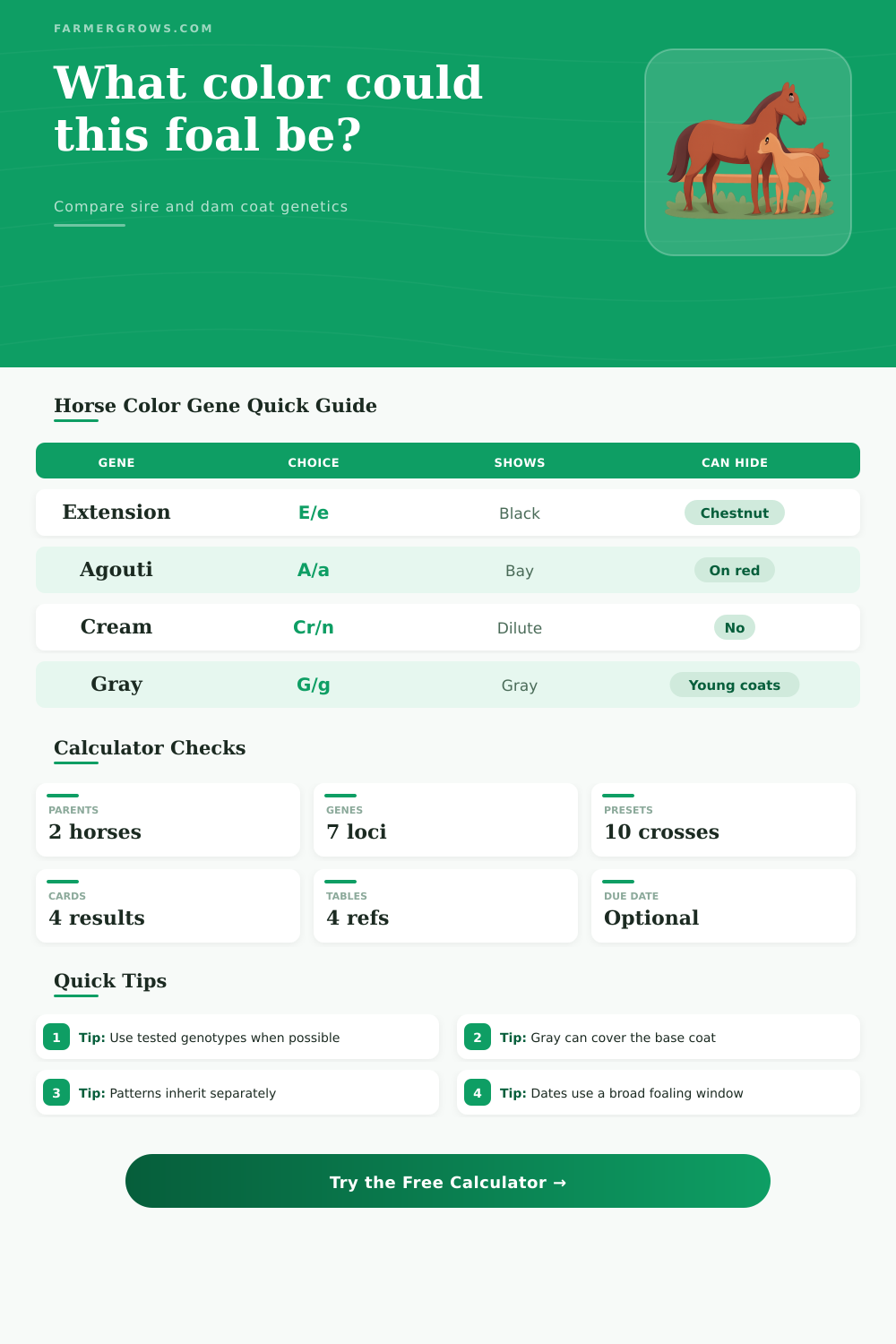
Estimate foal coat color likelihood from sire and dam base color, Extension, Agouti, Cream, Gray, Tobiano, Sabino, and Roan selections.
Choose the closest known genotype for each parent. The calculator treats each selected gene as a simple independent inheritance pair, then combines the results into practical foal color probabilities.
Controls whether black pigment can appear. Horses with ee are red based, so Agouti does not show visually.
Base switchMoves black pigment to the points when an E allele is present, making bay instead of black.
Bay modifierOne cream copy creates palomino, buckskin, or smoky black. Two copies create double dilutes.
DilutionGray is dominant and can gradually cover the birth color, so the foal's base color may be hidden later.
OvercoatWhite spotting patterns are layered on top of the base coat and dilute colors in this simplified model.
Pattern layerClassic roan adds intermingled white hairs while leaving head, mane, tail, and lower legs darker.
Roan layerSire
Dam
Foal Color Probability Results
These are simplified Mendelian odds from the selected sire and dam genotypes. Real foal color can depend on additional genes and lab-tested parent results.
| Base color | Extension result | Agouti result | Visual meaning | Breeding note |
|---|---|---|---|---|
| Chestnut or sorrel | ee | Any A status | Red based coat without black pigment in the body points | Can carry Agouti, but it is hidden on red based horses |
| Bay | E present | A present | Black pigment is limited to points, mane, tail, and lower legs | May carry red if Ee and may carry black if Aa |
| Black | E present | aa | Black pigment remains across the body because Agouti is absent | Can produce bay if bred to a horse contributing A |
| Brown or seal bay | E present | Usually A related | Often managed as bay in simple calculators | Some shades involve additional modifiers not modeled here |
| Base coat | No cream | One cream copy | Two cream copies | Common note |
|---|---|---|---|---|
| Chestnut | Chestnut | Palomino | Cremello | Single cream is usually obvious on red based horses |
| Bay | Bay | Buckskin | Perlino | Buckskin keeps black points unless other modifiers act |
| Black | Black | Smoky black | Smoky cream | Single cream on black can be subtle and may need testing |
| Gray over dilute | Birth color varies | Dilute hidden later | Double dilute hidden later | Gray can cover cream clues as the horse ages |
| Gray genotype | Gray foal chance | Typical clue | What changes | Calculator handling |
|---|---|---|---|---|
| g/g x g/g | 0% | No dominant gray allele | Foal stays its non-gray color pattern | No gray overlay added |
| G/g x g/g | 50% | One gray parent, heterozygous | Half of foals may gray over time | Gray and non-gray outcomes are split |
| G/G x g/g | 100% | Homozygous gray parent | All foals inherit a gray allele | Every listed color is gray over its base |
| G/g x G/g | 75% | Both parents gray carriers | Most foals gray, some remain non-gray | Gray probability is layered on top |
| White or roan pattern | Heterozygous choice | Homozygous choice | Visual range | Caution |
|---|---|---|---|---|
| Tobiano | TO/to | TO/TO | Bold white patches crossing the topline are common | Other pinto genes can mimic or modify the pattern |
| Sabino 1 | n/SB1 | SB1/SB1 | White markings, roaning edges, or high white expression | Many sabino-like patterns are not SB1 |
| Classic roan | Rn/rn | Rn/Rn | White hairs mixed through body color | Roan expression varies by base color and age |
| Combined patterns | Any carrier mix | Any homozygous mix | Patterns can stack on the same foal | This calculator adds them simply, not as show predictions |
Genetic caveat: Treat these as planning odds, not a lab result. Champagne, dun, silver, pearl, flaxen, appaloosa patterns, shade modifiers, and many white spotting genes are not included.
Breeding tip: When color matters, test both parents and record the actual gene panel. Visible coat color alone can hide recessive red, Agouti, cream, or pattern status.
Planning a foal requires that a breeder consider many different factors that may impact the color of the foal that will be born. Beyond considering the pedigree of the horses to be breed, coat color is one of the factors that a breeder must consider. Breeders must consider the factor that impact coat color, such as the genes that determine the color of a horse’s coat.
The color that a foal will exhibit are not always in evidence in the coats of the breeders breeding horses. A calculator that models these different color gene can provide information about the color of the foal that will be born that is not visible from the coats of the breeding horses. The genes that matter most in the color calculator are the Extension and Agouti genes.
How to Predict a Foal’s Coat Color
These two gene are important in determining whether the foal will produce black pigment in its coat, and where the black pigment will be located on the body. The Extension gene determines if the foal will be able to produce black pigment. If the foal contains a dominant allele of the Agouti gene, the Extension gene will restrict the black pigment to the “points” of the foal (the legs, mane, tail, ears).
Each of the genotypes of each breeding parent can be selected in the calculator, and the calculator will provide an estimate of how often each of these genotype will appear in the offspring. Cream dilution genes can impact the color of the foal in addition to genes like the Extension and Agouti genes. If a foal contains only a single copy of the cream dilution gene, its red pigment will be lighten if its base color is chestnut.
If a foal contains only a single copy of the cream dilution gene, it will have palomino or buckskin coat color if its base color is bay or chestnut. If a foal contains two copy of the cream dilution gene, it will have a double-dilute coat color. The cream dilution gene is incompletely dominant so it tracks the number of copies of the cream dilution gene that each parent contribute to the offspring.
The gray gene is different than cream dilution genes because it is a dominant gene. If a foal has the gray gene, its birth color will be replaced with white hair as the foal matures. Unlike cream dilution genes, the gray gene is tracked separately from the base color of the foal.
Other genes contribute to the color of a foals coat in the form of different white spotting patterns. These patterns do not impact the pigment of the coat, but they do impact the appearance of the foals coat. Examples of these genes include tobiano, sabino, and roan genes.
The calculator treats these genes as independent of the color of the foals coat, allowing for the equations to remain manageable. Because these genes can interact with other genes in the coat, the calculator may list several version of the same color with different markings with each version of the color. In addition to genetic factors, there are other factors to consider when breeding foals.
For example, the calculator can calculate the time at which the foal will be born. Gestation periods for foals can vary so instead of providing the date on which the foal will be born, the calculator will provide a window within which the foal will be born. The value of this window of dates for birth is that it provides a breeder with an estimate of the birth dates of the foal; the exactness of the dates are not important.
There are several factors outside of those that are accounted for in the calculator. For example, the calculator does not include genes like champagne, dun, silver dapple, or appaloosa genes. Furthermore, the calculator does not account for genes that introduce subtle difference in the shade of the foals coat color.
Testing the genes of the breeding foals can reveal information that can help remove some of the uncertainty in the breeding process. Many breeders find that a horse that appears to have solid coat color actualy has the gene alleles for a different coat color pattern. For instance, a breeder often finds that a seemingly black horse can be heterozygous for the Extension gene that determines if the foal can produce black pigment.
In general, the color calculations that the color gene calculator performs work best when they are only one of many calculations that a breeder performs to determine the factors that will impact the birth and care of the foal. The color calculations help the breeder to understand the color of the foal that will be born. Furthermore, color calculations help the breeder make decision about the breeding horses for the foal.
However, these calculations are not a replacement for the observation of the foal after it is born, or for the genetic records of the breeders horses that have been tested for genes that impact the color of their coats. Overall, then, the probabilities of the color of the foals coat provided by the calculator are not an absolute to the color of the foals coat.