Goat Breeding Calculator
Plan doe breeding dates, return heats, buck exposure, expected kidding, pregnancy checks, dry-off timing, CDT vaccine reminders, kidding kit prep, and breeding readiness.
Use this calculator for planning herd records, not as a veterinary diagnosis. Real kidding dates can shift with breed line, nutrition, single versus multiple kids, heat detection, buck fertility, and doe health.
Goat breeding calendar
Enter breeding details to estimate expected kidding and management checkpoints.
| Breed or type | Typical gestation | Season pattern | Planning note |
|---|---|---|---|
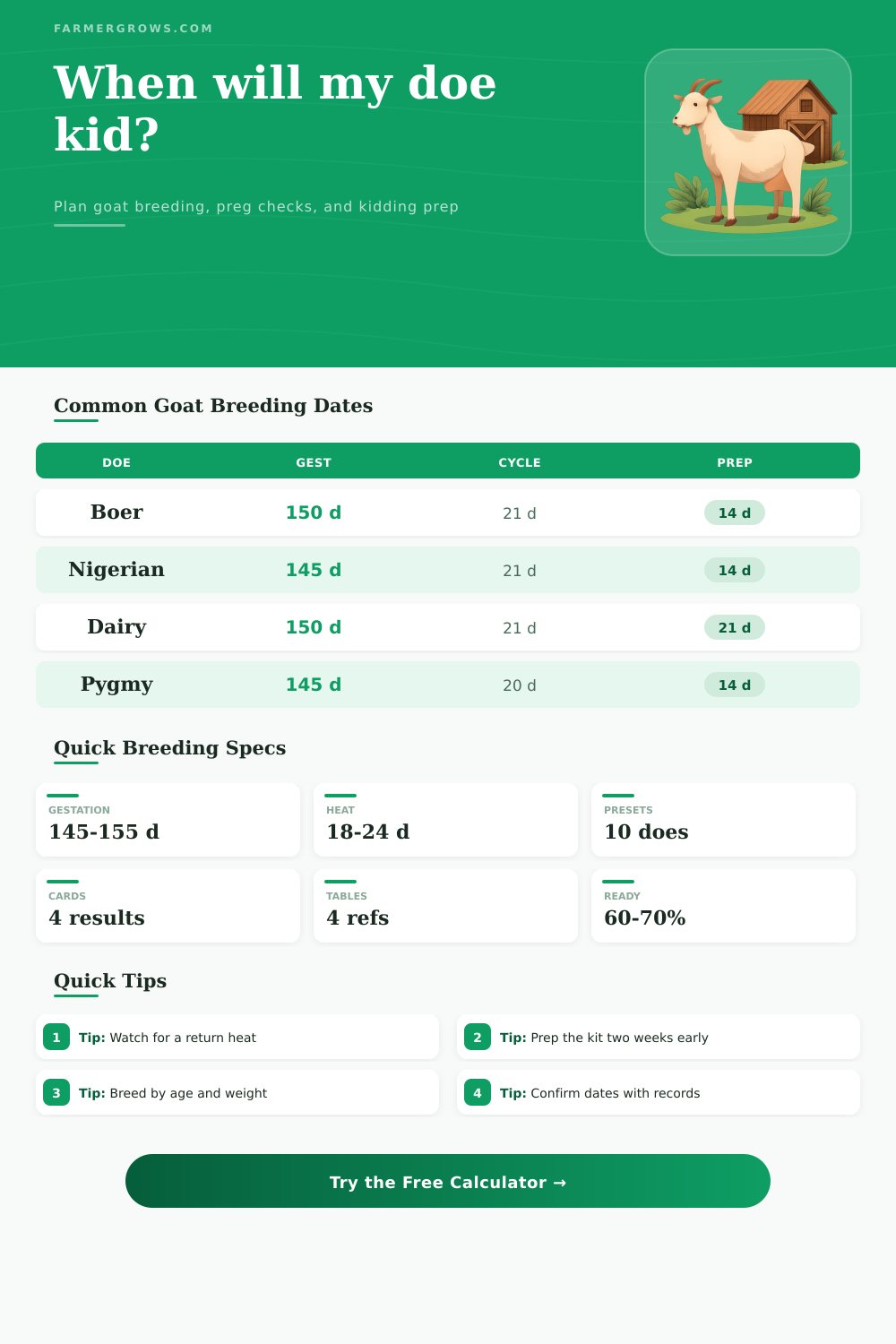
| Boer | About 150 days | Extended seasonal | Often planned for meat kid crop timing. |
| Nigerian Dwarf | About 145 days | Often flexible | Small breeds can cycle outside the main fall window. |
| Pygmy | About 145 days | Often flexible | Use mature size and pelvic readiness carefully. |
| Alpine, Saanen, Nubian | About 150 days | Fall and winter strongest | Milk plans often drive dry-off and kidding dates. |
| Kiko and Spanish | About 150 days | Extended seasonal | Pasture exposure windows are common in range systems. |
| Angora | About 150 days | Seasonal | Coordinate breeding with shearing and weather risk. |
| Calendar item | Common timing | Calculator input | Why it matters |
|---|---|---|---|
| Return heat watch | 18 to 24 days after service | Heat cycle length | A doe showing heat again may not be settled. |
| Pregnancy check | 30 to 45 days after breeding | Preg check days | Ultrasound or blood tests need the right timing. |
| Dry-off | 45 to 60 days before kidding | Dry-off days | Dairy does need udder rest before the next lactation. |
| CDT booster | 3 to 4 weeks before kidding | CDT days | Helps time pre-kidding vaccination plans. |
| Kidding kit | 1 to 3 weeks before due date | Kit days | Supplies should be ready before ligaments soften. |
| Seasonality choice | Strong months | Shoulder months | Calculator cue |
|---|---|---|---|
| Seasonal fall breeder | September to December | August and January | Best for strongly seasonal dairy or fiber lines. |
| Extended dairy or meat season | August to January | February and July | Useful for Boer, Nubian, and many dairy herds. |
| Year-round capable line | Any month | None | Small breeds and selected lines may breed broadly. |
| Out-of-season attempt | Herd dependent | Spring to summer | Expect more uncertainty without light or hormone planning. |
| Readiness check | Common target | Calculator threshold | Herd note |
|---|---|---|---|
| Doe age | At least 7 to 10 months for many doelings | Breed size adjusted | Slow-growing or fiber does may need more time. |
| Weight percent | About 60% to 70% mature weight | 65% target | Use the doe's frame, not age alone. |
| Body condition | About 2.5 to 3.5 on a 5-point scale | Warns under or over | Thin and overly fat does both deserve caution. |
| Health status | Sound feet, parasite control, vaccines current | Record outside calculator | Use veterinary and herd records before breeding. |
Tip: If the doe returns to heat near the next cycle date, keep both the original and possible rebreed due dates in the herd record until pregnancy is confirmed.
Tip: For young does, avoid putting the calendar ahead of body size, condition, parasite status, and advice from a veterinarian familiar with your herd.
Planning a kidding date is an importance task for the person who keep goats. Planning a kidding date allows a goat keeper to organize there task for the rest of the year. A person must pick a breeding window for the does and they must also mark the calendar for that period, as it will allow them to order the hay they will need for the kid, purchase the kid coats that will be needed, and even to purchase the necesary equipment for the kids to have when they are in their milk period.
It is important to note, however, that planning a kidding date can be difficult due to the fact that goat breeds do not always follow the round numbers that a person may otherwise expect for the number of days that it take for a doe to give birth. Not only do different breeds of goats have different gestation length, but they also have different heat cycles. With the assistance of a calculator, a goat keeper can create a series of reminders for different period throughout the kidding period.
Plan kidding dates for goats
The calculator will ask for information regarding the service date, the breeding method for the does, and the type of breed of the does. Based off this information, the calculator will display the kidding window for the does, the time to watch for a return heat from the does, and the time to perform a pregnancy check on the does. Additionally, the calculator will also determine when to begin the dry-off task for the does and when to begin the vaccination tasks for the does.
The breeding method will impact the kidding period; pasture breeding of bucks will lead to more longer kidding periods than observed hand breeding. Does with shorter heat cycles will require more closely schedule heat cycles than does with longer heat cycles. Furthermore, the type of breed of the does will impact the length of their gestation period.
For instance, Nigerian Dwarf and Pygmy goats will have a gestation period of 145 days, while breeds like Boer, Alpine, and Nubian goats will have a gestation period of 150 days. This five-day difference can have an impact upon the kidding period; five days may mean the kidding kit will be moved into the barn in January as opposed to in February. The calculator also allows for tracking of the body condition and weight of the does; younger does may still be growing even if they appear to have reached the age to breed.
If a doeling is bred too soon, it may not have the strength to produce the same amount of kid as an adult doe and it may struggle to recover from the birthing process. Finally, you must also consider the seasonal cycle of the does when calculating the kidding period; some lines of goats will be bred in the fall while others will not be. Fall breeders will cycle reliably from September through December, though other families of goats can be managed to breed year-round.
The calculator will show you if the birthday you have chosen is within the breeding window or in one of the shoulder months for goats. Should the birthday fall within the shoulder months, it is important to watch for silent heat from the does. Breeding during the fall is possible, but it is necessary to confirm that the doe has settled during the breeding season.
Once you have set the dates, you must decide how to use this information to care for the does in your herd. It is important to perform a return heat watch on the does at roughly three weeks, but only if you are looking for heat from the does. Additionally, you should perform pregnancy checks at thirty to forty days to ensure that your does have time to adjust their feeding and housing prior to becoming heavily pregnant with kids.
Dry-off timing is also important to protect the udder of the doe for the next lactation period. Finally, preparing kidding kit is important to ensure that you are ready for the doe’s kids to be born. While each task is a separate step in the process, each task is dependent upon the others to be properly perform.
It is common for people to think of doe birthday dates as the appointment date for the does to deliver their kids. However, this date is only the middle date of a time window during which the does can range anywhere from five to seven days from the chosen birthday. Therefore, the birthday should not be treated as a fixed appointment for the does to deliver their kids.
Instead, the range of dates from the calculator will allow you to plan for the close watch period for each doe in your herd. Good herd management require that you pay close attention to any of the “small” signals that could develop into a larger problem. For example, you should watch the body condition of each doe, pay attention to when they exhibit heats, and monitor their weights.
The calculator will remove the need for performing the arithmetic in your herd; instead, you can focus on the animals. Additionally, planning for the kidding date of each doe will provide “breathing room” for your other management tasks.