Cow Feed Calculator
Estimate mature cow dry matter intake, hay as-fed pounds, pasture contribution, energy, crude protein, mineral, salt, and weekly feed totals for beef and dairy cattle.
This planner estimates a starting ration for ordinary farm decisions. Use current forage tests, local mineral advice, veterinary guidance, and actual cow condition to fine tune any feeding program.
Feed Estimate
Results are shown per head first, with herd totals in the breakdown.
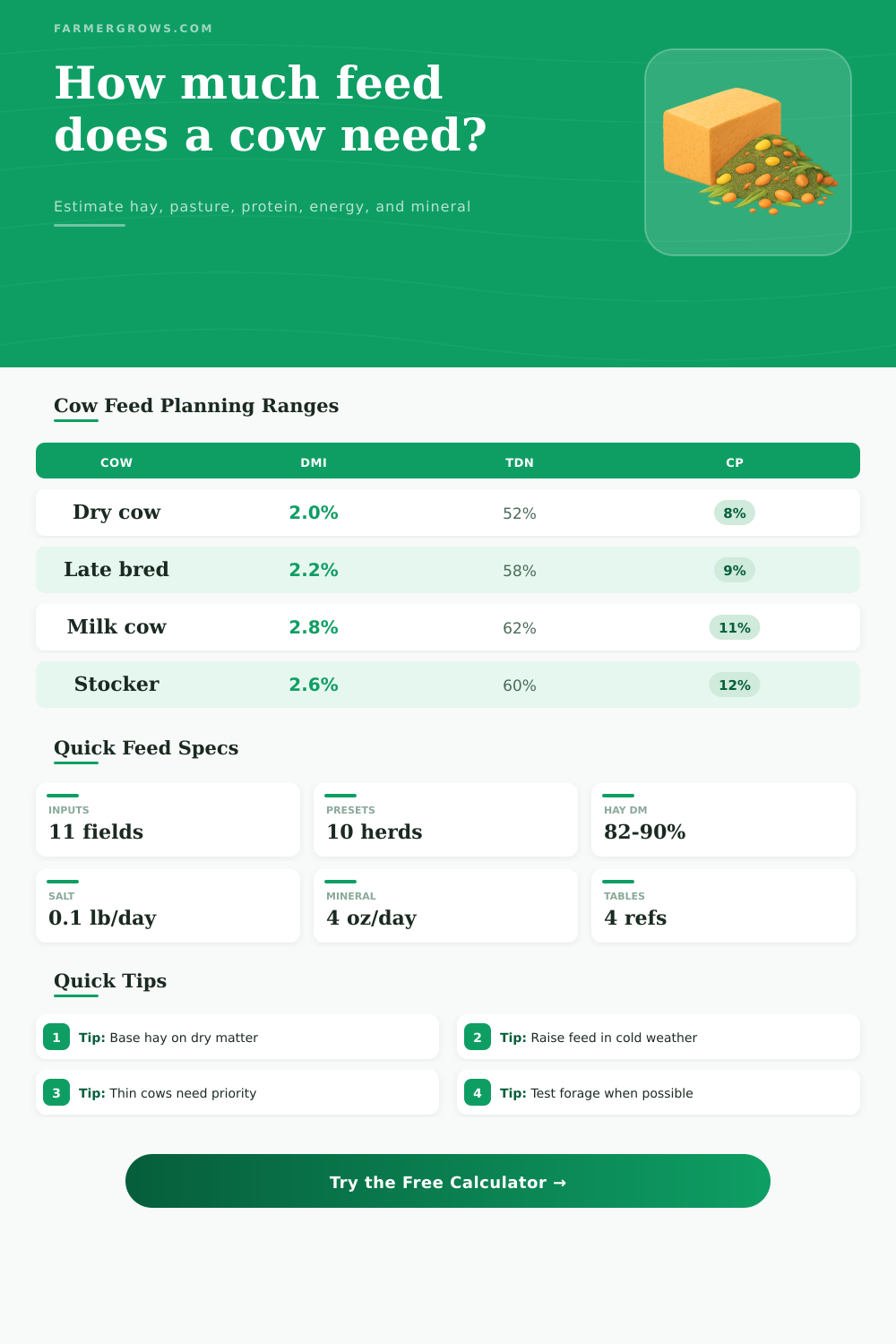
| Cow class | Expected DMI | Typical TDN need | Typical CP need | Feed note |
|---|---|---|---|---|
| Dry mature beef cow | 1.8% to 2.2% of body weight | 50% to 55% | 7% to 9% | Body condition and weather decide whether average hay is enough. |
| Late gestation cow | 2.0% to 2.3% of body weight | 55% to 60% | 8% to 10% | Nutrient density matters because intake can be crowded by pregnancy. |
| Early lactation beef cow | 2.3% to 2.8% of body weight | 58% to 64% | 10% to 12% | Peak milk demand usually needs better forage or supplement. |
| Mid-lactation dairy cow | 3.0% to 4.0% of body weight | 65% to 72% | 14% to 17% | This simple estimator is a starting point, not a full dairy ration balancer. |
| Stocker or growing heifer | 2.4% to 3.0% of body weight | 58% to 68% | 11% to 14% | Target gain and frame size change the supplement need quickly. |
| Forage category | Dry matter | TDN used here | Crude protein | Practical interpretation |
|---|---|---|---|---|
| Prime grass-legume hay | 86% to 90% | 62% | 13% | Often supports cows with moderate lactation or thin cows better than mature hay. |
| Good grass hay | 84% to 90% | 58% | 10% | Reliable winter hay for cows in good body condition. |
| Average mixed hay | 82% to 88% | 56% | 8.5% | May work for dry cows, but protein can be tight for late gestation. |
| Mature stemmy hay | 82% to 88% | 50% | 6.5% | Lower digestibility can reduce intake and energy at the same time. |
| Crop residue or straw base | 85% to 90% | 45% | 4.5% | Usually needs protein support before cattle can use the fiber well. |
| Silage base | 30% to 40% | 65% | 8% | As-fed pounds are high because much of the feed weight is moisture. |
| Weather condition | Temperature cue | Energy adjustment | Management note |
|---|---|---|---|
| Mild and dry | Above 32°F | 0% to 3% | Ordinary winter ration works if cows are dry and protected. |
| Cold but sheltered | 20°F to 32°F | 3% to 8% | Extra hay may be enough when forage quality is good. |
| Cold and windy | 0°F to 20°F | 8% to 18% | Windbreaks and bedding can reduce the feed penalty. |
| Wet coat or mud | Any cold rain or thaw | 10% to 25% | Wet hair loses insulation, so energy demand rises sharply. |
| Severe cold snap | Below 0°F | 15% to 30% | Feed before the worst weather and check timid cows. |
| Daily feed item | Common range | Why it matters | Calculator treatment |
|---|---|---|---|
| Stored hay or forage | 20 to 35 lb as-fed per cow | Main fiber source for rumen function and winter heat. | Dry matter target minus pasture, corrected for hay DM and waste. |
| Protein supplement | 0 to 5 lb per cow | Needed when hay protein cannot meet cow class demand. | Deficit divided by supplement crude protein percent. |
| Energy supplement | 0 to 8 lb per cow | Supports cold stress, lactation, and weight gain. | TDN deficit divided by supplement TDN percent. |
| Loose mineral | 3 to 4 oz per cow | Provides macro and trace minerals missing from forage. | Raises intake target for lactation, growth, or poor forage. |
| Plain salt | 1.0 to 1.6 oz per cow | Encourages normal intake and sodium balance. | Estimated from cow size, heat, and production pressure. |
Dry matter first: Compare feeds after moisture is removed. Twenty pounds of wet silage and twenty pounds of dry hay do not deliver the same nutrients.
Watch the thin cows: Sort timid, young, old, or low body condition cows when possible. A herd average can hide animals that need feed earlier.
To keep a cow in good condition during the winter months without wasting money on hay purchases, you must first understand the specific amount of hay that a cow need to eat to stay healthy. The amount of hay that a cow needs to eat change based upon the situation of the cow, such as whether it is dry or nursing, and also how cold it is outside. For example, a dry cow that eats good hay will require less hay than a nursing cow that eats hay in the cold winter months; the nursing cow will require hundreds of pound of hay to supplement its diet over the few months it nurses its calf.
Because hay requirements change so frequent for cows, a planning tool can help to calculate the amount of hay that each cow will require each day. The most important factor in feeding hay to cows is the dry matter intake of each cow; all other factors for hay intake are based off this factor. A dry cow that weighs 1,250 pounds will require about 2% of its weight in dry matter intake, or about 25 pounds of hay.
How to Plan Winter Hay for Cows
However, the cow’s dry matter intake will increase if the cow is producing milk or if the outside temperature decrease. A calculator can help to determine the amount of dry matter that a cow will require by entering the weight of the cow, the body condition score of the cow, the quality of hay that will be provided, and the weather that will exist outside. Each of these factor will change the total amount of hay that the cow requires; the calculator adjust for these variables in determining the total amount of hay that the cow will require for the winter.
Another factor that will have a large impact upon the amount of hay that is required of the cow is the quality of the hay. High-quality grass-legume hay will provide more energy and protein to the cows than hay that is mature and stemmy. If the calculator provide a shortfall in hay requirements, it is likely that the hay that will be provided does not contain enough nutrients to fulfill the cows requirements.
The calculator will provide a supplement to the hay diet that will fix the shortfall created by low nutrient content in hay; this prevents hay suppliers from purchasing hay and supplements that contain more protein or energy than the cows require. Another factor that will reduce the amount of hay that is stored in the barn for the winter is the pasture credit. Each pound of dry matter that a cow consume from the pasture will reduce the amount of stored hay that is required to be provided to the cow.
If the pasture provide 18 pounds of dry matter per head of cow, for example, the amount of stored hay that the cow will be required to eat will decrease. Additionally, the amount of tonnage of hay (by the weight of hay per ton) that will be required each week will also decrease. The calculator will place a cap on the amount of hay that can be provided from the pasture; the amount of stored hay will not become unrealistic, but will still be reduced.
Another factor that will change the requirement of hay for the cows is the weather in which the cows are exposed. For example, if a cow is sheltered from the weather and the outside temperatures are mild, the cow will require less energy than a cow standing in the mud outside and covered in mud. Cows exposed to the weather will require 15-25% more energy than cows that is sheltered from the weather.
The calculator will adjust for the low outside temperatures and the exposure of the cows to the weather. These variables help to ensure that hay farmer do not mistakenly feed average rations to cows during periods of very cold weather. In addition to hay, cows require mineral and salt; these are not as important as hay for cows diets.
However, a calculator will determine the amount of ounces of minerals that are required each day based upon the class of cow and the type of hay that is provided to the herd. These ounces of minerals will be scaled to the amount of cows in the herd. Minerals and salt aid in maintaining the health of the cows digestive systems, especially if the quality of hay that is provided to the cows is low.
While the cost of minerals is low for farmers, it is still important to provide the minerals for the cows health throughout the winter months. Body condition score is another factor that must be entered into the calculator to determine how much hay to feed to each cow. For thin cows, the farmer will require more hay so that the thin cows can gain the body condition that they will require before calving.
Conversely, cows that are too fat will require less hay than the base table indicate. The calculator will adjust the dry matter intake for the herd according to the body condition score of the cows; this ensures that hay farmers do not overfeed fat cows or underfeed thin cows. The calculator will work best for farmers that adjust only one variable at a time.
For example, increasing the low temperature that will be outside, decreasing the quality of hay that will be provided to the cows, or even increasing the amount of milk that the nursing cows produce can all be accounted for by the calculator. By adjusting each of these variable, farmers can understand how each will change the total amount of hay that must be provided to the herd. Thus, the calculator enable hay farmers to turn each of these separate variables into one total ration that will meet the needs of each farmers herd of cows.