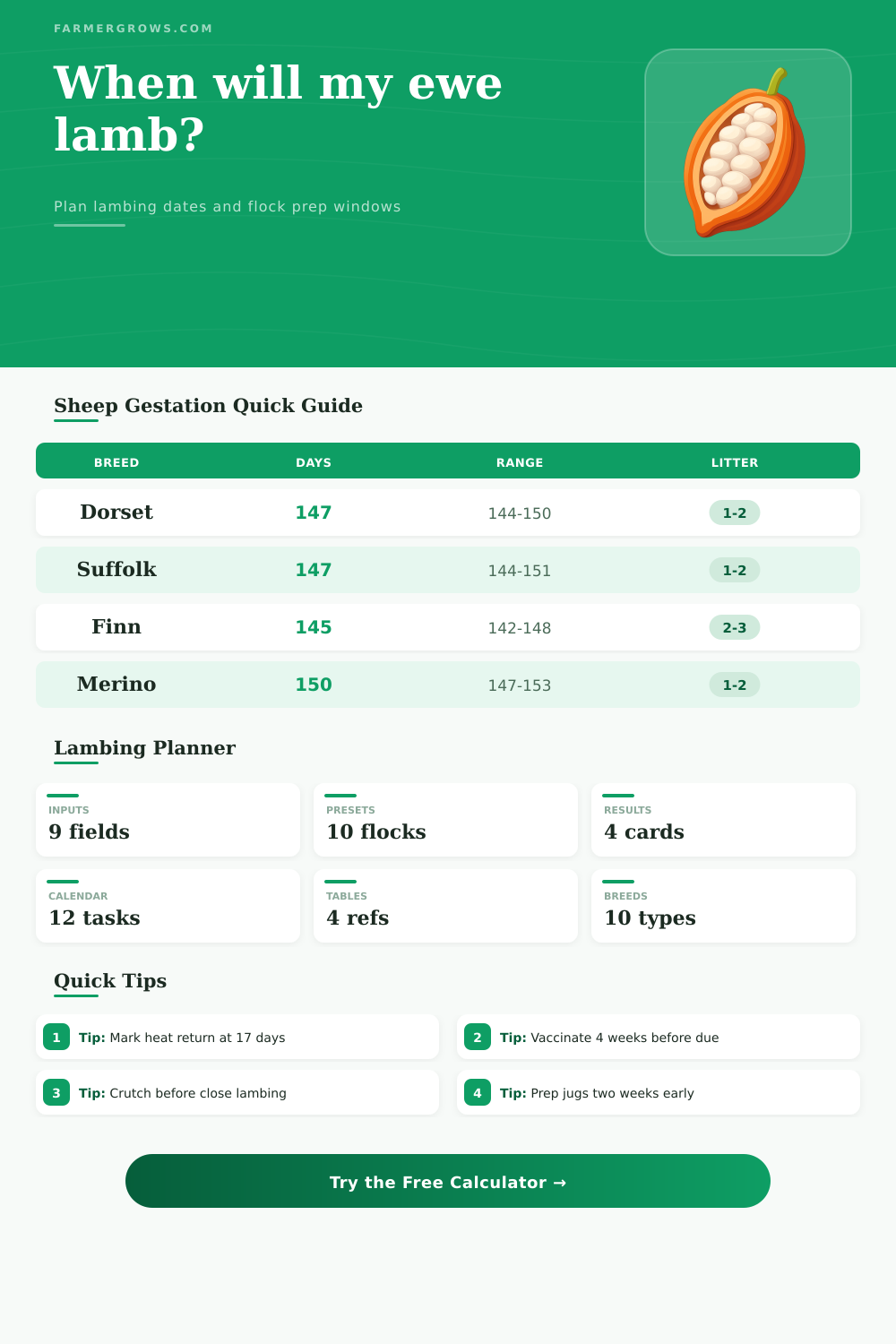
Gestation Calculator for Sheep
Plan lambing date windows, heat-return checks, flushing, vaccination, shearing or crutching, and lambing jug preparation from one breeding date.
Use the breeding date from observed standing heat, hand breeding, or ram turn-in. Individual ewes can lamb outside the estimate, so confirm pregnancy and health protocols with your flock veterinarian.
Sheep Lambing Calendar
Dates use the selected breed gestation baseline, litter-size adjustment, and a practical window around the expected lambing date.
| Breed type | Planning days | Usual range | Litter tendency | Calendar note |
|---|---|---|---|---|
| Dorset | 147 | 144 to 150 | Singles to twins | Good fit for fall and out-of-season breeding plans |
| Suffolk | 147 | 144 to 151 | Singles to twins | Watch ewe condition when terminal lamb birth weights run high |
| Katahdin | 146 | 143 to 150 | Twins common | Pasture systems still need a firm close-watch window |
| Dorper | 146 | 143 to 149 | Singles to twins | Plan shade, bedding, and close checks by season |
| Finnsheep | 145 | 142 to 148 | Twins to triplets | Move nutrition and jug prep earlier for high-prolific groups |
| Merino | 150 | 147 to 153 | Singles to twins | Wool management and weather exposure matter before lambing |
| Rambouillet | 149 | 146 to 152 | Singles to twins | Schedule shearing or crutching with weather in mind |
| Polypay | 146 | 143 to 149 | Twins common | Useful for prolific and accelerated lambing groups |
| Texel | 147 | 144 to 151 | Singles to twins | Monitor lambing ease in terminal-cross ewes |
| Hampshire | 147 | 144 to 151 | Singles to twins | Good candidate for individual lambing records |
| Calendar task | Timing from breeding or due date | Why it matters | Field note |
|---|---|---|---|
| Flushing ration starts | 14 to 28 days before breeding | Supports ovulation rate before joining | Best for thin or moderate ewes, not overfat ewes |
| Heat return check | 17 days after breeding | Flags ewes that may not have settled | Watch again around day 34 for a second cycle |
| Pregnancy scan | 45 to 90 days after breeding | Sorts open, single, twin, and triplet ewes | Use scan results to refine the litter-size input |
| Late gestation feed | 42 days before due date | Most fetal growth happens near the end | Triplet ewes usually need earlier and tighter attention |
| CDT booster window | 3 to 5 weeks before due date | Boosts colostrum antibodies for lambs | Follow the product label and veterinary guidance |
| Jug and lambing kit prep | 10 to 14 days before due date | Keeps bedding, iodine, tags, and records ready | Prepare more jugs when lambing is tightly grouped |
| Litter size | Gestation adjustment | Watch window | Nutrition note | Jug planning |
|---|---|---|---|---|
| Single | Add about 1 day | Standard breed range | Avoid over-conditioning mature ewes | Fewer jugs, but watch large lambs |
| Twins | No adjustment | Normal flock baseline | Separate thin twin ewes if feed is tight | Plan most jugs around expected date |
| Triplets or higher | Subtract about 2 days | Start close watch earlier | Higher energy and protein demand late | More pens, colostrum backup, and checks |
| Unknown | Use twin baseline | Keep the full range open | Scan or body-condition sort if possible | Hold extra bedding and supplies |
| Ewe age class | Calendar effect | Risk focus | Handling note |
|---|---|---|---|
| Ewe lamb or yearling | Add one day to estimate | Growth plus pregnancy demand | Keep a separate group when feed competition is high |
| Prime mature ewe | Use breed baseline | Match feed to scan result | Most predictable age group for calendar planning |
| Aged ewe | No date shift, wider watch | Teeth, udder, and body condition | Bring into close observation earlier |
| Thin ewe | No date shift, more prep | Pregnancy toxemia and weak lambs | Use body condition scoring before late gestation |
Record by ewe: Keep breeding date, ram ID, scan result, vaccine date, and actual lambing date together. Those records make the next lambing season much sharper.
Prep the close group: Multiples, thin ewes, ewe lambs, and aged ewes deserve earlier checks, better feed access, and cleaner lambing space before the main due date.
A sheep breeder know the date on which each ewe stands for a ram, but the date on which the lambs arrives is to be estimated. The time between when a ewe is bred and when the lamb is born is a period of gestation of the ewe, and the length of gestation isnt a constant figure. The length of gestation may change due to the breed of sheep, the age of the ewe, or the number of lambs that the ewe will have born.
Consequently, a way of mapping out the week of pregnancy for an ewe is necessary. For instance, if the ewe is older or if it has more lambs to care for while pregnant, the change in the number of lambs will change the period in which grain, jugs, or vaccines are provide to the ewe. Consequently, if any of these variables are changed, the breeder must know the effect that it will have upon the pregnancy of each of the ewes; otherwise, the breeder may waste labor or may not be able to care for the lambs in time for there arrival.
When Will the Lambs Be Born
The calculator can mathematically calculate the pregnancy of each of the ewes after the breeder enters the breeding date into the calculator. However, the breeder must enter the behavior of each of the flock of sheep into the calculator to ensure accuracy in the calculations. For instance, if the ewes are of an older age and have given birth to twins prior, their gestation period will differ from a yearling ewe that has not given birth to any lambs before.
The ewes that are pregnant with triplets will have a different gestation period than those that are pregnant with one lamb. Consequently, each of these variable will allow for the care of each group of ewes according to the needs of each group. The breed of the ewe will also impact the length of gestation for each of the ewes.
For instance, fine wool breeds will have different gestation periods than those of the meat breeds of sheep; additionally, sheep breeds that are sheared while on the pasture will have different gestation lengths than those that are raised in a barn and sheared in the barn. The reference tables will indicate the type of breed that each ewe is, and how long each of these type of breeds will have a gestation period of. Consequently, these dates will allow for the care of the lambs after their births; for instance, knowing when to provide the ewes with the CDT vaccine will ensure that the lambs recieve the necessary amount of antibody to ensure there health.
In addition to the due date for the lambs, the range of dates for which the lambs may be born must also be considered. Problems with the ewes often occur within these dates. For instance, the ewes that are thin or that have given birth to multiple lambs may have their lambs born more earlier than the calculated date.
Thus, if the ewes are thin or have multiple lambs, adjusting the due date for those ewes to be born earlier will ensure that there is enough colostrum to provide to the lambs at their births. Additionally, it will ensure that the ewes are not left without jugs in which to provide the colostrum to their lambs. After determining the due date for the lambs, the calendar can be used to determine when to perform other tasks related to the care of the ewes.
For instance, the due date for the lambs may allow for the shearing of the ewes around the udder, or for the movement of the ewes into the barn. Additionally, if knowing how many jugs to provide for the ewes that may give birth to their lambs more earlier than the calculated date. Additionally, the flushing period that the ewes experience prior to breeding will allow for the knowing of the care of the ewes during the final weeks of gestation; the ewes that were flushed for additional energy during the flushing period will require additional energy during the final weeks of pregnancy.
Consequently, these two periods should of been entered into the calendar at the same time in the breeders mind. Additionally, the breeder should maintain the records for each of these ewes. By noting the date on which the ewes actualy delivered their lambs, the breeder will be able to adjust for each of these ewes in the following breeding season.
Over time, the records will allow the breeder to determine whether the ewes of a certain breed or lineage tend to deliver their lambs earlier or later in the years, and if certain rams tend to produce lambs that are born on a certain schedule. Consequently, while the calculator will provide a map for the breeding process, the records will allow for the necessary correction to that map. The biology of the sheep cannot be changed, but the care that is provided to the flock may be controlled.