Sow Gestation Calculator
Turn a service date into a sow-specific farrowing plan with parity adjustment, house entry timing, feed bump windows, vaccine reminders, return-to-estrus checks, and batch group flow.
Use this as a sow barn scheduling tool. It does not replace herd records, ultrasound confirmation, observation, veterinarian-directed vaccine protocols, or farm-specific nutrition targets.
Sow Gestation Results
Dates are calculated from the service date, parity adjustment, batch interval, farrowing room entry, feed timing, vaccine timing, and return-to-estrus checks.
| Parity class | Planning adjustment | Watch window | Management focus |
|---|---|---|---|
| Gilt, P0 | Use 114 days, watch 2 days earlier | Day 112 to 116 | Calm movement, extra observation, careful first-litter notes |
| Parity 1 | Use 114 days, add recovery review | Day 112 to 116 | Wean condition, feed intake, service quality, repeat checks |
| Parity 2 to 5 | Use 114 days as batch center | Day 113 to 116 | Stable batch flow, room setup, late gestation feed tracking |
| Parity 6+ | Use 114 days, wider watch | Day 112 to 117 | Soundness, comfort, farrowing assistance readiness, culling notes |
| Calendar item | Typical timing | Calculator field | Why it matters |
|---|---|---|---|
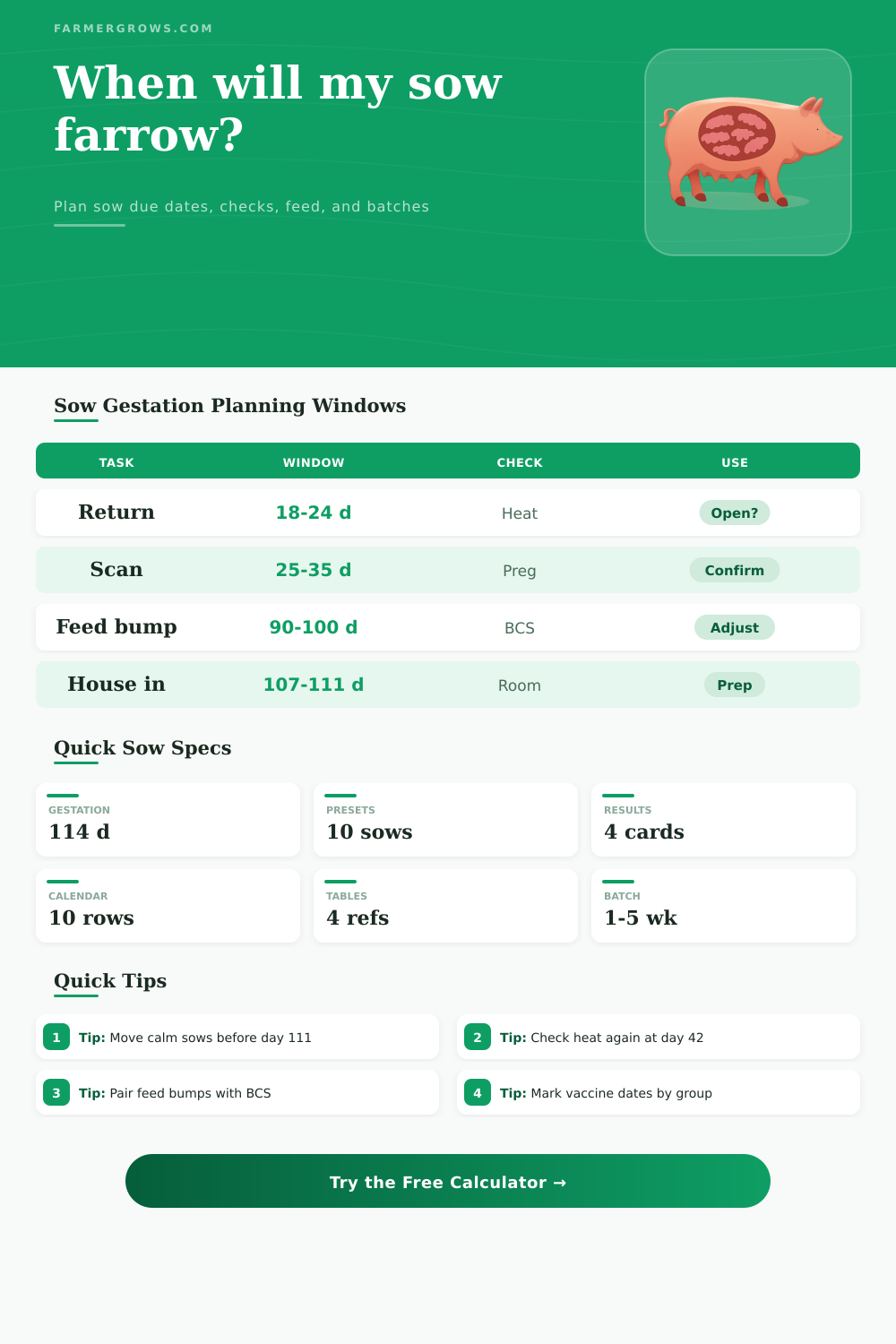
| First heat return check | 18 to 24 days after service | Automatic | Find open females before they drift into the next production slot |
| Second return check | 38 to 45 days after service | Automatic | Catches repeats that were missed or delayed after the first cycle |
| Pregnancy confirmation | 25 to 35 days after service | Automatic | Confirms bred group size before room and feed plans are locked |
| Farrowing house entry | 3 to 7 days before due | House entry days | Gives time for washing, settling, equipment checks, and heat setup |
| Feed window | Gestation stage | Calculator use | Practical check |
|---|---|---|---|
| Service to day 30 | Early gestation | Protect conception window | Avoid major feed swings; track returns and heat signs |
| Day 30 to 75 | Mid gestation | Condition correction period | Use body condition scoring to sort thin and heavy sows |
| Day 90 to 100 | Late gestation review | Feed bump planning | Confirm farm target with nutritionist and parity group |
| House entry to farrow | Transition period | Room-ready ration schedule | Watch appetite, manure consistency, comfort, and water access |
| Batch interval | Farrowing rhythm | Good fit | Scheduling note |
|---|---|---|---|
| 1 week | 52 groups per year | Large continuous systems | Steady labor and room turnover pressure every week |
| 2 weeks | 26 groups per year | Moderate batch flow | Cleaner grouping than weekly with less farrowing room idle time |
| 3 weeks | 17 groups per year | All-in, all-out nursery flow | Common rhythm that matches one sow cycle after weaning |
| 4 to 5 weeks | 10 to 13 groups per year | Small herds | Larger single groups and longer gaps between farrowing weeks |
Record by service group: Keep breeding date, parity, service type, return checks, scan result, vaccine protocol, and room entry date in the same line of the sow card or herd software.
Use dates as prompts: The calculator marks practical windows, but individual sow condition, farm vaccine labels, veterinary guidance, and room availability should set the final action plan.
When formulating a farrowing schedule for a batch of sows, the process begin with the service date for the sows. The service date is the date that the sow is bred. Based off this service date, it is possible to calculate the other dates for that batch of sows, such as the dates for the return checks, the pregnancy checks, the feed adjustments, and the dates upon which the sows should be moved into the farrowing rooms.
Each of these dates must be known in order to effectively manage the farrowing rooms and the labor that are required to service those sows. This calculator tool can calculate these dates, which utilize the service date for the sows, the parity of the sows, and the management targets for the batch. This calculator tool can help to eliminate guesswork in determining these dates.
How to Plan a Farrowing Schedule
While 114 days is the gestation period that is often used for farrowing schedules for sows, the actual period can differ depending upon the parity of the sow. Gilts, which are sows that have not yet farrowed at least once, may have a wider period of observation both before and after their expected date of farrowing. Conversely, sows that are of an older parity may also require a period of observation that is more longer than that of prime sows in the middle parities.
Gilts and sows of an older parity tend to be more difficult to manage than the prime sows in the middle parities, and thus, a longer period of observation is required in either of these scenario. The calculator tool accounts for each of these parity classes, and ensures that the resulting schedule reflect the different levels of risk associated with each of these parity classes. Return checks are used to help identify which sows are not pregnant.
There is a return check between 18 and 24 days after the service date for the sows, and a second return check between day 38 and day 45 after the service date. During the first return check, sows can be identified as not pregnant. A second return check is used to identify sows that were missed during the first return check.
Between these two return check dates is the pregnancy check. This pregnancy check will allow the farm manager to determine the number of sows that will be pregnant, and thus, allow for the apropriate allocation of farrowing rooms and late gestation feed to the sows. In addition to determining when the sows should be fed and what type of feed is to be used, there are also requirement regarding the vaccination of the sows.
The feed bump for the sows should begin between three and four weeks before the sows are to be farrow. The feed bump is used to even out the body condition of the sows. Additionally, there are specific protocols regarding the vaccination schedules for the sows.
These dates can be entered into the calculator tool, as well. While the calculator tool will generate dates for each of these management tasks, actual decision will need to be made regarding these dates based upon the condition of each of the sows, and the availability of farrowing rooms. Another consideration in formulating a farrowing schedule for a batch of sows is the batch size and the number of spaces in which sows can farrow.
If a farm services a large group of sows, but only expects an 88% conception rate for those sows, the calculator tool will calculate the number of sows that will farrow. Based upon the number of sows that are to farrow, the manager can determine if there are enough farrowing spaces to handle the number of sows that will be delivering their piglets. If there are not enough spaces, additional decision must be made regarding the management of the sow group.
The length of lactation for the sow will impact the length of time until the next service date for the sow. Shorter lactation lengths will shorten the time until the next service date for the sow, and can also impact the size of the sows subsequent litters. Longer lengths of lactation will provide more time for the sow to recover after farrowing, and will allow those sows to be used in the farrowing process less frequently each year.
The calculator tool can calculate each of these dates, and thus can be accounted for when determining management schedule. The tables located on the page provide information regarding the length of time for various event for sow management. These return check dates, pregnancy check dates, house entry dates, and feed stage dates are provided in these tables.
These tables allow for the manager to become familiar with the sow management schedule without memorizing each of the dates. Additionally, the tables indicate the changes in batch rhythms with different farm sizes. Small farms may use one batch every four or five weeks, but larger farms may service their sows once a week.
These tables can help to confirm that the calculator tool is correctly calculating each of the dates. The tool can test each of the dates calculated for accuracy with the information provided in the tables. While the calculator tool can effectively calculate the dates for each of the management tasks for the sows, the calculator tool is not an indicator of which tasks must be performed; it is only a suggested tool for the manager.
For instance, a thin sow at 90 days may require a feed bump earlier than calculated for that batch of sows. A room that was hot during the last cycle may require some time to cool before the arrival of a new batch of sows. Additionally, a gilt that experienced a poor farrowing process during its first parity may require a longer observation period than those that are manage at the farm.
The value of this calculator tool becomes apparent when testing the different parity class of sows, and the different batch intervals in which the sows may be managed. By changing each of these variable, the manager can observe how the calendar changes. These changes allow for the establishment of consistent patterns in the management schedule, which help to avoid potential scheduling issues.