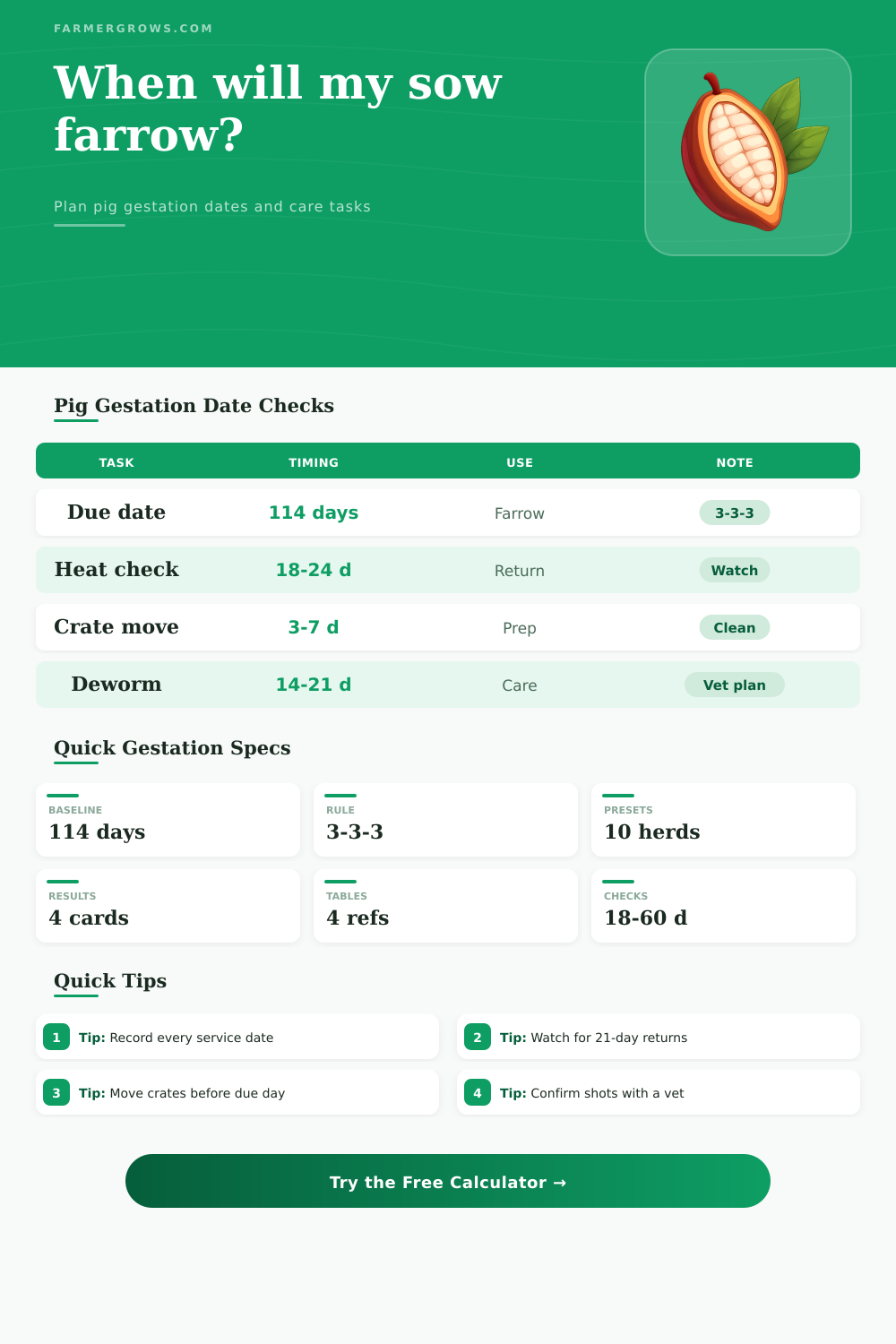
Gestation Calculator for Pigs
Plan sow and gilt farrowing dates from breeding day, parity, breed type, service method, the 3-3-3 rule, heat-return checks, crate moves, and pre-farrow care windows.
Use this calculator for herd calendar planning. Vaccine, deworming, induction, assisted farrowing, and treatment decisions should follow your veterinarian's protocol and local animal health rules.
Pig Gestation Calendar Results
Dates use the selected breed gestation length, service confidence, parity watch width, and your care-task lead times.
| Breed type | Default days | Planning window | Calendar note |
|---|---|---|---|
| Commercial crossbred | 114 | 112 to 116 | Good default for most farm sow calendars |
| Yorkshire or Large White | 114 | 112 to 116 | Use herd records to tighten repeated sow dates |
| Landrace | 114 | 112 to 116 | Often managed on the standard 3-3-3 rule |
| Duroc | 115 | 113 to 117 | Slightly later default for planning, not a guarantee |
| Hampshire | 113 | 111 to 115 | Use the calculated window and watch udder fill |
| Berkshire | 114 | 112 to 116 | Works well with the standard swine baseline |
| Kunekune | 116 | 113 to 118 | Smallholder records can vary by individual sow |
| Mini or potbellied pig | 114 | 112 to 116 | Confirm body size and care plan with a veterinarian |
| Service method | Date confidence | Farrow window adjustment | Best record to keep |
|---|---|---|---|
| Single timed AI | High | Add 0 days | AI time, semen batch, sow ID, standing heat |
| Double AI in same heat | High | Add 1 day | First and second AI times in the same heat |
| Observed hand mating | Medium high | Add 1 day | First mount date and repeat service date |
| Pen or pasture boar exposure | Medium | Add 2 days | Boar-in and boar-out dates, standing heat notes |
| Service date uncertain | Low | Add 3 days | Best estimate plus ultrasound or return checks |
| Calendar task | Typical timing | Calculator output | Why it matters |
|---|---|---|---|
| First heat-return watch | 18 to 24 days after service | Heat-return card and breakdown | Open sows commonly cycle near 21 days |
| Ultrasound or pregnancy check | 25 to 35 days after service | Breakdown calendar row | Confirms pregnancy before feed and group changes |
| Mid-pregnancy recheck | About 60 days after service | Breakdown calendar row | Useful for body condition and record cleanup |
| Pre-farrow vaccine window | 2 to 6 weeks before farrowing | Custom start and finish inputs | Aligns boosters with the herd veterinarian plan |
| Deworming window | 14 to 21 days before farrowing | Custom start and finish inputs | Keeps the farrowing room schedule visible |
| Move to farrowing crate | 3 to 7 days before due date | Crate-move result card | Gives the sow time to settle before labor |
| Observation | Date range | Likely meaning | Record action |
|---|---|---|---|
| Standing heat at 18 to 24 days | First cycle | Possible missed conception | Record return, rebreed or check plan |
| Standing heat at 39 to 45 days | Second cycle | Possible early loss or missed first return | Flag sow and verify pregnancy status |
| No heat by 24 days | No-return check | Pregnancy is possible | Schedule confirmation check if used |
| Vulva swelling near due date | Pre-farrow | Labor may be approaching | Increase checks and prep supplies |
| Milk letdown and nesting | Hours to days before | Farrowing watch should be active | Check crate, heat source, and records |
When a sow receives two services in one standing heat, calculate from the first service and keep the second time in your herd records.
Vaccine and deworm dates vary by herd health status, product label, and veterinarian protocol, so use the calendar as a scheduling checklist.
Pig breeders must knows the due date for each of their sows. The due date will determine when to check for returns from the sows, when to move the sows into the farrowing crates, and when to provide vaccines and deworm the sows. If any of these dates is missed, the sow will be missed out on labor or may not have the proper care provide before the sow gives birth.
All pigs has the same length of pregnancy. From this known length of pregnancy, the baseline number can be used to calculate when the sow will give birth. However, the due date may change after calculating based on the breed of sow, the parity of the sow, and the service method use on the sow.
Know Your Sow’s Due Date
Gilts will typicaly have a longer watch window then a prime sow because the gilt is still young and the sow has already farrowed several times. Additionally, if a boar is running with the sows in the pasture, then the service date may be more uncertain than if only one boar inseminates the sows. Although these times may be similar, they are different enough to account for when performing this task on the farm.
After entering the service date and information regarding the sow and breeding method, the calculator will provide the dates for each of the tasks to occur while the sow is pregnant. The calculator can find the first return to heat window for the sow, the date to move the sow into the crate, and when to provide vaccines and deworm the sows. Each of these dates provide a timeline for the sow while pregnant, and they are necessary to provide proper care for the sows and they future piglets.
Although this calculator will provide the dates for each task to occur while the sow is pregnant, there will be daily observations of the sow that may reveal whether or not the sow is actualy pregnant and how far along the pregnancy is for that specific sow. If a sow is not eating or displaying udder development, it may indicate that the sow is becoming pregnant earlier than calculated. If a sow is displaying those same physical characteristic at the due date, it may indicate that the sow is not pregnant as calculated.
Therefore, these observations are used in addition to the calculated dates to monitor the sows pregnancies. While the calculator may provide structure for the sows pregnancy, the sow itself is the final confirmation of that pregnancy. The 3-3-3 rule states that three months, three weeks, and three days from the service date will allow the sow to give birth.
While not precise enough for planning the sows pregnancies, this rule allows for an estimation of the due date for the piglets. This calendar expands on the 3-3-3 rule and allows for each task to be calculated and account for during the pregnancy of the sow. Additionally, if each of the sows information are entered into the calculator simultaneously, it is possible to find patterns in how each of the sows may give birth.
Each line of pigs may give birth two days earlier or later then the baseline and the other lines of sows. These patterns are only visible to those who use the calculator to determine when each of the sows will give birth. Finally, the last decision to make is the width of the watch window for the sows.
If it is too narrow, then the sow may be missed during the birth of the piglets. If it is too wide, then the sows may be required to perform labor over several day. The calculator allows the breeder to adjust the sows watch window, but the breeder must make the decision of the proper length of the watch window by observing the sows pregnancies.
With experience observing the sows, the calendar will become the sows production calendar.