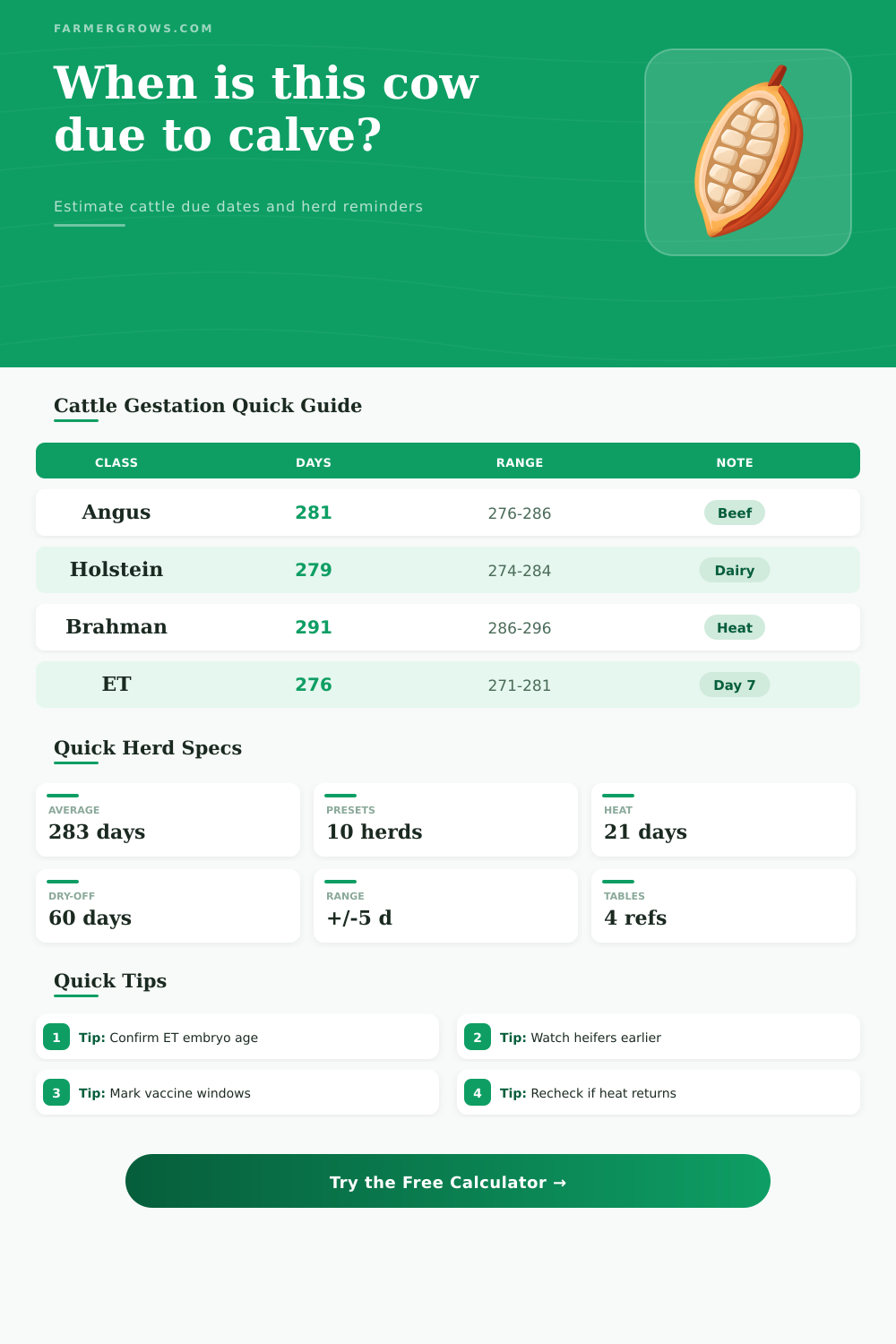
Gestation Calculator for Cattle
Estimate expected calving date, early and late calving range, heat return timing, and common herd calendar reminders from a breeding, AI, or embryo transfer date.
This planning tool uses a 283-day cattle baseline, then adjusts for breed class, calf sex expectation, parity, and embryo age when the date entered is an embryo transfer date. Use herd records and your veterinarian's protocol for final health decisions.
Cattle Calving Calendar
Results will appear after calculation.
| Breed class | Calculator days | Typical range | Planning note |
|---|---|---|---|
| Angus or British beef | 281 days | 276 to 286 days | Often slightly shorter than the old 283-day calendar average. |
| Hereford or Red Angus | 282 days | 277 to 287 days | Close to average for many British-influenced beef herds. |
| Commercial beef cross | 283 days | 278 to 288 days | Good neutral choice when sire and dam influence are mixed. |
| Continental beef | 285 days | 280 to 290 days | Charolais, Simmental, Limousin, and similar lines may run longer. |
| Brahman-influenced beef | 291 days | 286 to 296 days | Heat-tolerant Bos indicus influence can extend the due window. |
| Dairy breeds | 278 to 279 days | 273 to 284 days | Holstein and Jersey schedules often use a shorter calendar. |
| Breeding method | Date entered | Math used | Field note |
|---|---|---|---|
| Natural service | Observed service date | Breed days from service | If bull exposure was a range, run the first and last observed service dates. |
| Fresh AI or timed AI | Insemination date | Breed days from AI | Best when the AI time and cow identity were recorded accurately. |
| Embryo transfer | Transfer date | Breed days minus embryo age | A day 7 embryo transferred today is already seven gestation days along. |
| Custom correction | Known conception basis | Manual day value | Use for herd-specific EPD data, IVF programs, or veterinarian guidance. |
| Calendar task | Common lead | Calculator output | Management use |
|---|---|---|---|
| Heat return watch | 18 to 24 days after breeding | Cycle date and watch span | Flag cows that may not have settled and need recheck. |
| Pregnancy diagnosis | 30 to 45 days after breeding | Early palpation or ultrasound window | Schedule herd-side preg checks according to local practice. |
| Dry-off or transition move | 45 to 70 days before due | Dry-off lead date | Important for dairy cows and useful for beef body-condition planning. |
| Pre-calving vaccine | 30 to 60 days before due | Vaccine start and booster dates | Follow the product label and veterinarian protocol for timing. |
| Close-up check | 14 to 30 days before due | Close-up and watch dates | Move animals, check tags, prep clean pasture, and watch udders. |
| Adjustment factor | Days used | Why it shifts | When to override |
|---|---|---|---|
| Bull calf expected | +1 day | Male calves often average slightly longer gestation. | Use unknown if calf sex is not known or records are mixed. |
| Heifer calf expected | -1 day | Female calves can average slightly shorter gestation. | Use herd history if sexed semen results have a known pattern. |
| Bred heifer | -1 day | First-calf females may calve a little earlier in some herds. | Override if your replacement group consistently runs late. |
| Older cow | +1 day | Mature and older cows may carry slightly longer. | Health, body condition, and sire genetics can matter more. |
| Twin flag | -3 days | Twin pregnancies often need earlier observation. | Use veterinary confirmation for any twin-risk management. |
For embryo transfer records, store both transfer date and embryo age. A day 7 embryo due date is not the same as adding a full gestation to transfer day.
Use the vaccine and dry-off dates as calendar prompts, then match actual products, labels, withdrawal rules, and herd health plans with your veterinarian.
Planning a calving seasons involves selecting specific dates to manage the cattle operation in the facility. Planning a calving season will help you better control the feed cost for the herd and protect the body condition of heifers. Additionally, planning a calving season allow you to provide the herd with a realistic time window in which to move the animals into the close-up lot.
When most people thinks of the gestation period of cattle, they use a single number to represent it. However, the average gestation period for cattle are approximately 283 days. This number does not account for a few different variable that will impact the length of gestation for each cow in the herd.
How to Plan a Calving Season
These variables include the breed of the cow, its parity, and the breeding method use to breed the cows. To find accurate calving dates, the calculator will need to account for these variables. A calving calculator will begin with the breeding date or the transfer date of the herd member.
Then, the calculator will account for the breed class of the cows. Different breed class have gestation periods that differ from the average gestation period of 283 days. For example, British beef breed have shorter gestation periods than the average, while continental and Brahman-influenced breed have longer gestation periods than the average.
It is vital to select the appropriate breed class because a five-day shift in gestation can impact the observation of the calves’ births and the pregnancy of the cows in the herd. Additionally, the breeding method that is use will impact the calculation of the calving window. If the breeding method is natural service, the calving calculator will use the breeding date as the starting point for the calving window.
If the cows is bred through timed artificial insemination (AI), the AI calendar date will be used. Additionally, if the breeding method for the herd is embryo transfer, the calving calculator will account for the age of the embryo because embryos contain days of development before being transfer into another cow’s uterus. Additionally, the class of the cow and the sex of the calf will impact the calving window.
First-calving heifers will typically deliver their calves approximately an day earlier than mature cows. Bull calves will typically arrive a day later than heifer calves. Additionally, if the cow is pregnant with twins, the gestation period will be shorter by several days than a single pregnancy.
Within the calving calculator, the calculator accounts for these variables in the final range of dates indicated for each cow’s calving window. The early date and the late date within this range have been adjusted to account for the information above to ensure that the calving dates are not guess. After the projected due date is establish for each cow in the herd, the calving calculator will provide several dates to help monitor each cow’s health and calving.
These dates will include the date on which to check for the return of heat from the cows, which will occur approximately three weeks after the breeding dates. Additionally, using these dates, cows can be diagnosed for pregnancy roughly one month after the breeding dates. For dairy cows, these dates allow the keeper to manage the dry-off of the cows six week before the projected date of calving.
Additionally, pre-calving vaccine can be administered and the cows can be moved into close-up facilities using these dates. These reminder dates will use the same variable as the calving dates for each cow in the herd. The calving calculator will provide a range of dates rather than just the projected date for the calves’ births.
Several variables impact the calving dates. These variables include the body condition of the cows at breeding, the level of heat stress they endure while pregnant, and the sire of the cows. By watching the early edge of the calving date range, herd manager can prepare for the births of calves that will be born ahead of schedule.
However, by monitoring the late edge of the calving date range, the manager can prepare for the birth of calves that will be born later than the projected date. Before using the calving calculator to enter the data for each herd member, a herd manager can use the reference tables to view the typical calving date range according to the breed class and breeding method of the cows. These ranges will allow the herd manager to select the closest date that match the characteristics of the cows in the herd.
Using the data for each herd member, the calving calculator will produce specific calendar dates for the calves’ births. The herd managers crew can print or share these calendar dates. Planning a calving season involves entering the breeding date and the breed class of the herds cows.
With these two variables accounted for, the other calving date variables will follow.