Soil Calculator
Plan soil for raised beds, garden plots, lawn topdressing, containers, and bulk deliveries with shape, depth, density, settling, blend, bag, and truck-load estimates.
Use measured inside dimensions for beds and the finished planting depth you want after settling. Soil weights vary with moisture, so delivery weight is shown as a practical range.
Your Soil Estimate
Includes raw bed volume, settling, overage, bags, bulk yards, amendment split, weight range, and delivery loads.
| Depth | 1 cubic yard covers | 2 cu ft bag covers | Metric depth |
|---|---|---|---|
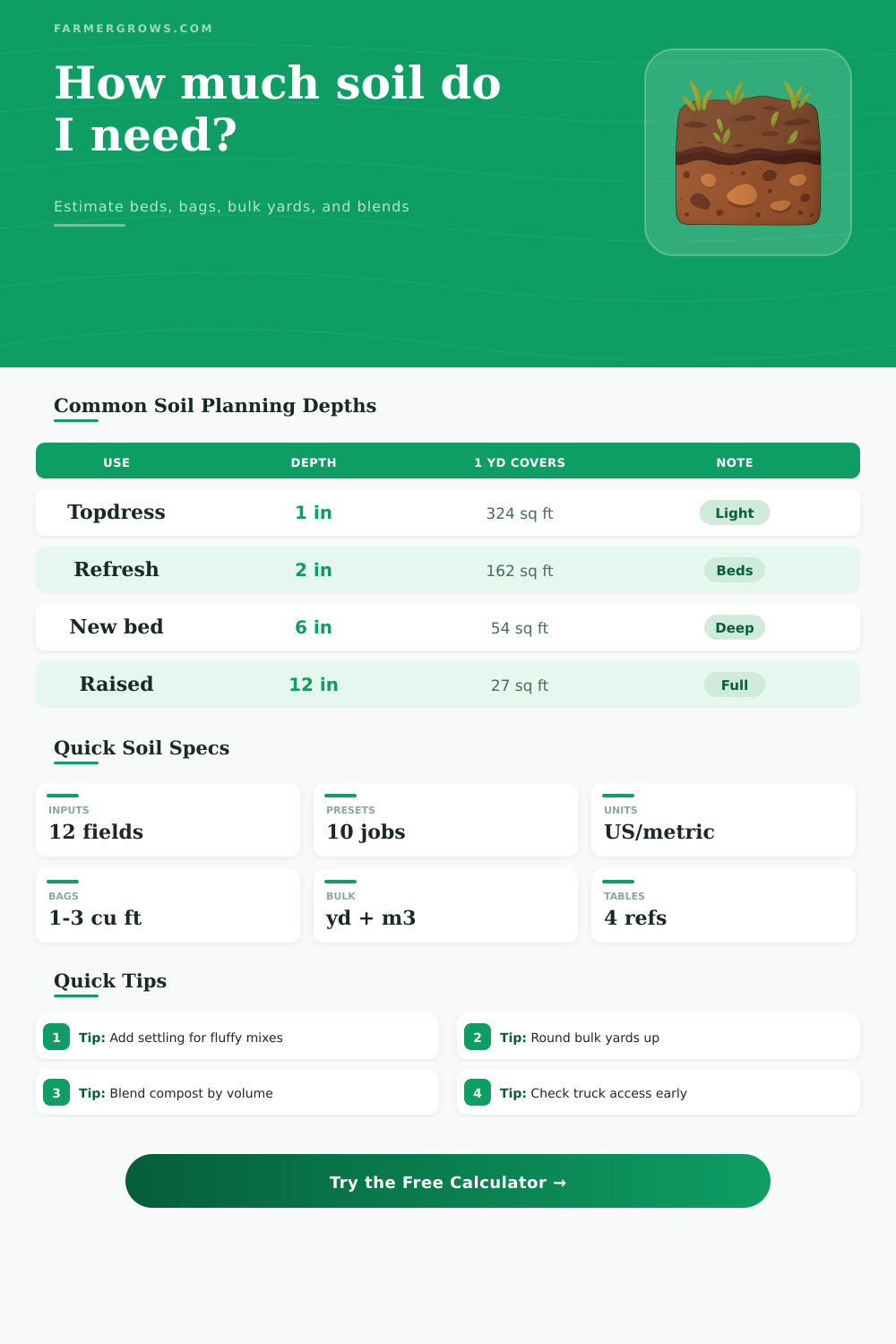
| 1 inch topdress | 324 sq ft | 24 sq ft | 2.5 cm |
| 2 inches refresh | 162 sq ft | 12 sq ft | 5 cm |
| 3 inches bed boost | 108 sq ft | 8 sq ft | 7.6 cm |
| 4 inches planting layer | 81 sq ft | 6 sq ft | 10 cm |
| 6 inches new bed | 54 sq ft | 4 sq ft | 15 cm |
| 12 inches raised bed | 27 sq ft | 2 sq ft | 30 cm |
| Package | Volume | Bags per cubic yard | Good use |
|---|---|---|---|
| Small bag | 1 cu ft | 27 bags | Containers and spot repairs |
| Medium bag | 1.5 cu ft | 18 bags | Porch beds and small patches |
| Large bag | 2 cu ft | 13.5 bags | Raised bed top-offs |
| Jumbo bag | 3 cu ft | 9 bags | Small bed projects |
| Bulk yard | 27 cu ft | 1 cubic yard | Large beds and lawn topdressing |
| Delivery type | Typical soil volume | Weight caution | Access note |
|---|---|---|---|
| Pickup truck | 0.5-1.0 cu yd | Check payload rating | Best for dry, light mixes |
| Small dump trailer | 2-5 cu yd | Can exceed 5 tons wet | Needs firm driveway |
| Single axle dump | 5-8 cu yd | Heavy soil limits volume | Room to tip bed |
| Tandem dump | 10-14 cu yd | Very heavy when damp | Plan drop zone early |
| Landscape truck | 15-20 cu yd | Often volume-limited | Best for bulk topdress |
| Project | Area | Soil at 3 inches | 2 cu ft bags |
|---|---|---|---|
| 4 x 8 raised bed top-off | 32 sq ft | 0.30 cu yd | 5 bags |
| 10 x 20 garden refresh | 200 sq ft | 1.85 cu yd | 25 bags |
| 6 ft tree ring | 28 sq ft | 0.26 cu yd | 4 bags |
| 15 x 15 play area fill | 225 sq ft | 2.08 cu yd | 29 bags |
| 1,000 sq ft lawn topdress | 1,000 sq ft | 9.26 cu yd | 125 bags |
Settling tip: Loose compost and raised bed mixes can drop after watering. Use the settling allowance for new fills, then save a small amount for topping off low corners.
Delivery tip: Ask the supplier for a current wet weight estimate before sending a pickup or trailer. A yard of damp soil can weigh more than a small vehicle should carry.
Calculating the correct amount of soils necessary for your garden project is a critical step in the gardening process. The amount of soil that is necessary for your garden beds can determine whether your garden bed will be healthy or unevenly. Many people attempt to calculate the amount of soil necessary for there garden by considering the size of the garden beds or by relying on their memory of the soil quantities that was required for other gardening projects.
Unfortunatly, these methods of calculating the amount of soil that is necessary tend to create error in the estimation of that amount. The errors in calculating the amount of soil that is necessary can lead to soil that is too many or that is too little for the garden beds. Too little soil may result in sunken and short garden bed after rainfall.
How much soil do you need for your garden
Too much soil can lead to swampy garden beds. Thus, gardeners must measure the amount of soil that is necessary for their garden beds to ensure that their garden beds remains even. The volume of soil that is necessary can not be calculated by simple multiplication of the length, width, and depth of the proposed garden bed by the density of the soil that are to be utilized.
For instance, screened topsoil often has a different density than a raised bed blend that may contain bark or compost ingredients. The different soil types will settle at different rates. Therefore, the density of the soil must be accounted for in the calculation of the volume of soil that is necessary.
In addition to density, the weight of the soil must be accounted for. The weight of the soil is important because some soil types are more heavy than others. For example, damp clay loam soil will be much heavier than sandy soil.
Therefore, the gardener should account for the weight of the soil in the calculation of the volume of soil that will be ordered for the garden project so that the weight of that soil doesnt become too much for the vehicle that will deliver the soil to the delivery site. Another variable that is important to account for is the depth of the soil. The depth of the soil will change after it is deliver to the garden, watered, and when it settles into the garden bed.
Thus, an allowance for settling must be provided. An allowance of ten to fifteen percent can be added to the depth measurement to compensate for the settling of the soil into the prepared bed. In addition to providing for settling, an overage of ten percent can be allowed for the soil delivery.
This overage can account for the situation in which one corner of the bed may require more soil than the other area of the bed. Thus, allowing for both settling and overage will ensure that the depth of the soil in each corner of the bed will remain even when the soil settles. Bags of soil can be purchased as compared to bulk soil order.
The choice between bags of soil versus bulk soil is dependent upon the volume of soil that will be required for the garden project. Small gardening projects may be adequately fulfilled with bags of soil. However, bulk soil may be more cost-effective for larger projects.
The number of bags of soil can be calculated by using a calculator for the soil project. A calculator will make it easier to convert the number of bags to the volume of soil that is required. However, care must be taken when using this calculation method because its easy to underestimate the number of bags of soil that will be required for a project.
The weight of the soil should be considered prior to ordering soil for a garden project. Different type of soil can have different weights. Moisture content in the soil will contribute to additional weight to the soil.
Therefore, the volume and the weight of the soil should be checked prior to placing an order for soil. The weight of the soil will help determine if a delivery truck will be able to access the location of the soil order. For instance, if the soil is very heavy, it may not be able to traverse the soft edge of a lawn.
Thus, checking the weight of the soil will prevent any potential problem associated with the delivery of that soil. In addition to the variables described above, the way that soil amendments are mixed into the soil will require some measurement. For instance, if the garden bed that is to be prepared includes compost, the amount of compost will have to be measured separately from the soil that will be delivered.
Furthermore, compost will settle at a different rate than the soil; thus, different calculations will have to be made for the soil and the compost to account for the settling rates of the two component of the garden bed. Gardeners who use a soil calculator that allows for splitting the soil and the compost will be able to order both the soil and the compost in the appropriate amounts. Some common sizes of gardening projects can help to demonstrate the importance of calculating the volume of soil that is required to complete a project.
For instance, a four-by-eight foot raised bed that is six inches deep will require less than half a yard of soil. However, a thousand square feet of lawn that is to be top-dressed with one inch of soil will require more than nine yard of soil. Thus, one individual may be able to complete their small herb garden with a few bags of soil.
However, another individual may need to order a dump-truck load of soil to cover their large lawn. A soil calculator is a tool that can be used to calculate the amount of soil that is necessary for a project. These soil calculators include variables related to the project for the user to consider.
These variables can include the area of the garden beds, the depth of the garden beds, the type of soil to be used, any allowance for settling of the soil into the beds, the overage for any filling needs for the project, the size of bags of soil that will be delivered, and the load size. Each of these variable is difficult to calculate individually. However, by using the calculator, an individual can view each of the variables simultaneously and ensure that their calculations are even.