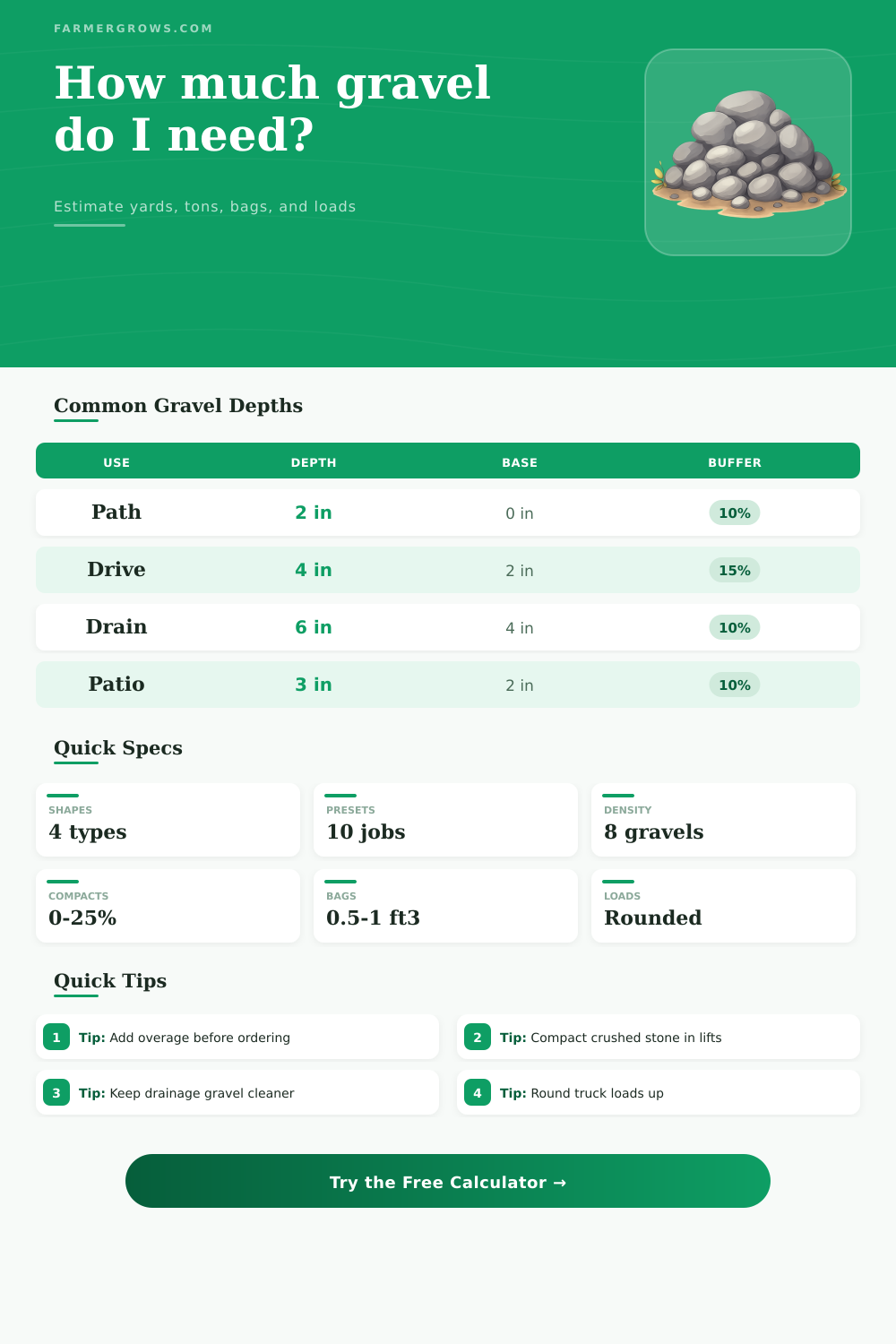
Gravel Calculator
Estimate gravel by shape, area, depth, density, compaction, drainage base, overage, bags, tons, cubic yards, and rounded truck loads.
Use compacted depth for the finished layer. The calculator adds compaction and overage after raw volume, then estimates weight from the selected gravel density.
Gravel Estimate
Results update after calculation.
| Depth | Sq ft per cubic yard | Sq m per m³ | Typical use |
|---|---|---|---|
| 1 in | 324 sq ft | 12.00 m² | Thin decorative refresh where the old base is sound |
| 2 in | 162 sq ft | 6.00 m² | Garden paths, bed cover, and low-traffic walkways |
| 3 in | 108 sq ft | 4.00 m² | General paths, seating areas, and shed approaches |
| 4 in | 81 sq ft | 3.00 m² | Driveway surface or compacted parking pad top layer |
| 6 in | 54 sq ft | 2.00 m² | Deep base, drain field cover, or rough farm access layer |
| Container | Volume | Per cubic yard | Coverage at 3 in |
|---|---|---|---|
| Small gravel bag | 0.5 cu ft | 54 bags | 2 sq ft |
| Medium gravel bag | 0.75 cu ft | 36 bags | 3 sq ft |
| Large gravel bag | 1.0 cu ft | 27 bags | 4 sq ft |
| Bulk tote | 2.0 cu ft | 14 bags | 8 sq ft |
| Loose bulk yard | 27 cu ft | 1 yd³ | 108 sq ft |
| Truck size | Useful for | Approx yards of #57 stone | Rounding rule |
|---|---|---|---|
| 3 tons | Small paths and rings | 2.2 yd³ | Round up to whole loads |
| 5 tons | Home landscape jobs | 3.7 yd³ | Round up after overage |
| 10 tons | Driveways and pads | 7.4 yd³ | Confirm access and dump area |
| 15 tons | Long lanes or farm work | 11.1 yd³ | Split loads for grading |
| 20 tons | Large base projects | 14.8 yd³ | Check road and gate limits |
| Project | Area | 3 in compacted volume | 1 cu ft bags |
|---|---|---|---|
| Narrow garden path | 120 sq ft | 1.22 yd³ with 10% compaction | 33 bags before overage |
| Tree ring, 8 ft diameter | 50 sq ft | 0.51 yd³ with 10% compaction | 14 bags before overage |
| Shed pad, 12 ft x 16 ft | 192 sq ft | 1.96 yd³ with 10% compaction | 53 bags before overage |
| Parking pad, 18 ft x 20 ft | 360 sq ft | 3.67 yd³ with 10% compaction | 99 bags before overage |
| Single driveway | 400 sq ft | 4.07 yd³ with 10% compaction | 110 bags before overage |
Compaction: Angular base gravels settle tighter than rounded decorative stone. Add the compaction factor when the final depth is measured after tamping or rolling.
Drainage: Keep clean drain rock separate from fines-heavy road base. Fines compact well, but they can slow water movement in trenches and wet areas.
Calculating an amount of gravel that you need for your project require that you take into account a variety of variables. Some of the variables that must be taken into account include the fact that gravel will change its volume when compact, the need to order an overage of gravel to account for gravel that may be lost to curve in the ground, the type of gravel that will be used in the project, the need to calculate the weight of the gravel in ton so that costs can be calculated, the number of layer of gravel that will be laid in the project, the shape of the area in which the gravel will be laid, the way in which the gravel will be spread, the fact that gravel suppliers will round gravel amounts to the nearest truck size, and the fact that suppliers will not deliver a partial load of gravel. Each of these variables will have an impact upon the amount of gravel that is required to be order for the project.
For each of these variables, explanations will be made in the descriptions that follow. The type of gravel that will be utilized in the project will have different weights associate with each of the various types of gravel. The gravel calculator will use the density of each type of gravel to calculate the total weight that the gravel will have.
How to Work Out How Much Gravel You Need
Additionally, if the type of gravel is change within the calculator from one type to another, the calculator will automaticly updated the total weight of the gravel according to the new type of gravel that is to be used within the project. For instance, if the type of gravel changes from decorative stone to crusher run gravel, the calculator will automatically update the total weight of the gravel that will be ordered for the project. Furthermore, because gravel suppliers typically order gravel by the ton, it is important for the individual planning the project to understand the total weight of the gravel that will be need; this will allow for the individual to understand the number of truck trip that will be required to deliver the gravel to the project site.
Many projects will require gravel to be laid in layers. For instance, it is common for projects to require a base layer of gravel to be place before laying a surface layer of gravel on top of the base. The gravel calculator will allow for the depth of each of these layers to be enter into the calculator.
By separating the variables for each of the layers, the gravel calculator will allow for the individual to understand the total volume of gravel that will be required for the project, as well as to understand whether the cost of creating a base layer of gravel is necessary for that specific project site. The shape of the area in which the gravel will be laid can also impact the calculation of the volume of gravel that will be needed. For instance, if the project is to lay gravel on a path, the area that will be covered in gravel may be in the shape of a long rectangle.
Alternatively, the area that will be covered in gravel may be in the shape of a circle or a triangle if the gravel is to be laid in a garden area. The gravel calculator will allow the individual to enter the number of sides of the area that will be covered in gravel, and the volume of gravel that the calculator determines will be required will match the shape of the area that will be covered in gravel. Furthermore, it is also important to consider the way in which the gravel is to be spread.
For instance, a wide parking pad will require different gravel spreading equipment than a narrow path. Finally, another variable to consider is that many supplier will round the amount of gravel that is needed for a project to the nearest truck size. For example, a supplier will not typically will deliver a partial load of gravel to a project site.
Thus, the total amount of gravel for the project will be rounded up to the nearest amount that can be supply by a delivery truck. This will allow for the individual to understand whether the gravel will be delivered in one large load of gravel or in two separate load of gravel. Each of these variables can be adjusted in the gravel calculator.
By adjusting the depth of the gravel, the compaction of the gravel, the inclusion of an overage buffer for gravel lost to curves in the site, the type of gravel, and the other variables described above, the individual will be able to create a plan for the placement of the gravel such that the plan avoids the need to order additional gravel for the project site after its initial order.