Mulch Bed Calculator
Plan landscape bed mulch by shape, edge style, plant openings, zone depth, refresh depth, edging length, material density, bags, bulk yards, and overage.
Choose a landscape bed pattern, then adjust the shape, zone split, plant openings, edge detail, and mulch material for the real site.
Best when one long back edge meets a wall and the front edge curves around shrubs.
Use oval or custom area, then count edging around the entire exposed boundary.
Subtract trunk or root flare circles so mulch stays away from bark and stems.
Run shallower crown zones near plants and deeper outer zones for weed control.
Mulch Bed Estimate
Results update after calculating.
| Bed zone | Refresh depth | New install depth | Plant note |
|---|---|---|---|
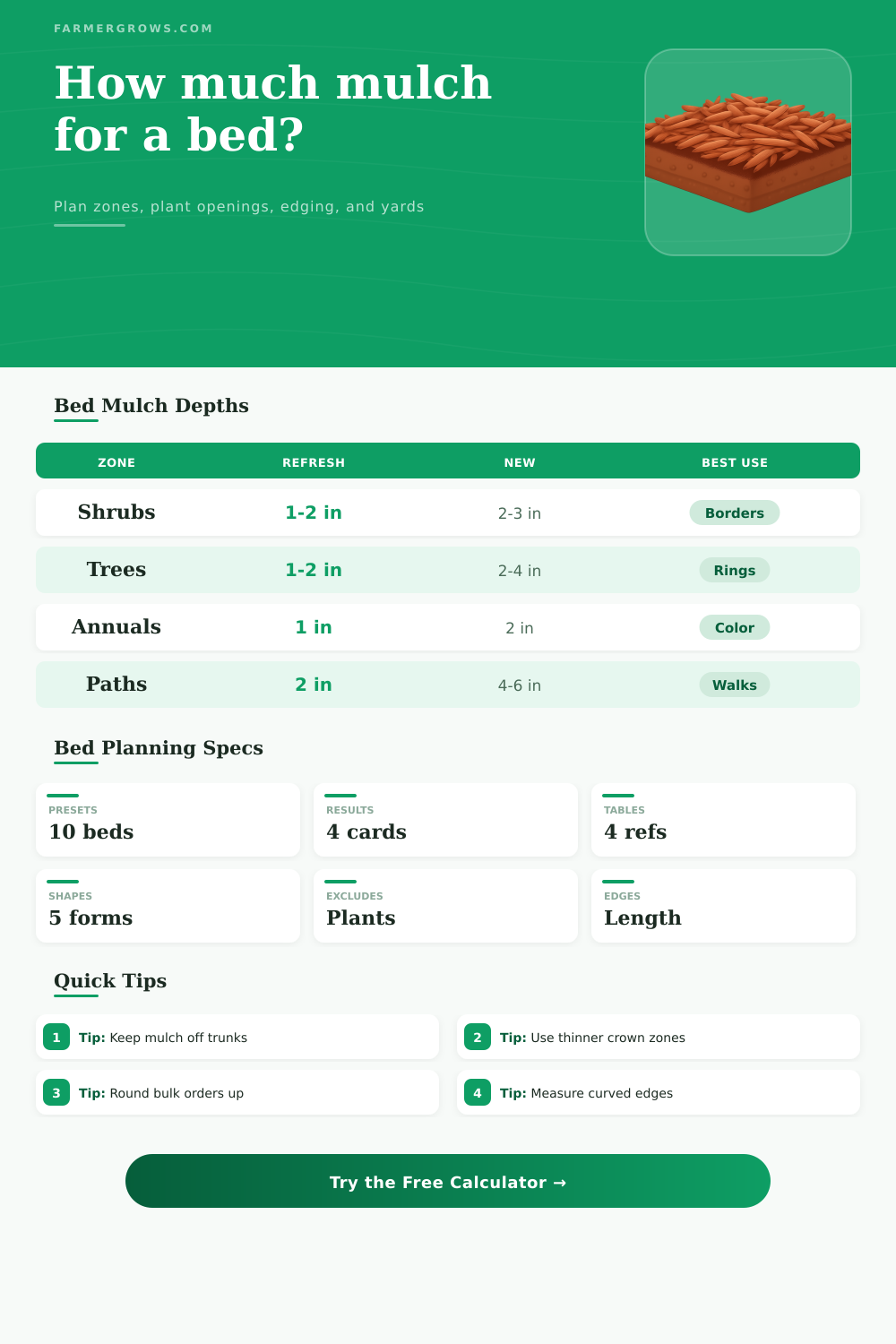
| Shrub border outer edge | 1 to 2 in | 2 to 3 in | Keep a thinner ring around stems and crowns |
| Open bed interior | 1.5 to 2 in | 3 to 4 in | Useful for weed suppression between plants |
| Tree ring | 1 to 2 in | 2 to 4 in | Leave the root flare open and visible |
| Annual color pocket | 1 in | 1.5 to 2 in | Thinner cover protects small crowns |
| Wood chip path edge | 2 in | 4 to 6 in | Deeper layers handle foot traffic better |
| Installed depth | Coverage per yd³ | 2 cu ft bag | 3 cu ft bag |
|---|---|---|---|
| 1 in | 324 sq ft / 30.1 sq m | 24 sq ft | 36 sq ft |
| 2 in | 162 sq ft / 15.1 sq m | 12 sq ft | 18 sq ft |
| 3 in | 108 sq ft / 10.0 sq m | 8 sq ft | 12 sq ft |
| 4 in | 81 sq ft / 7.5 sq m | 6 sq ft | 9 sq ft |
| 6 in | 54 sq ft / 5.0 sq m | 4 sq ft | 6 sq ft |
| Bed shape | Area formula | Edge formula used | Best field measurement |
|---|---|---|---|
| Rectangle border | Length x width | Full perimeter or front edge | Measure average width if front edge curves |
| Circle or ring | Outer circle minus inner circle | Outer circumference | Measure diameter across the widest point |
| Oval island | Pi x half axes | Ramanujan oval perimeter | Measure long and short axes through center |
| Triangle corner | Base x height / 2 | Three sides estimated from base and height | Use right-angle height, not slope length |
| Custom plan | Known area | Measured edge entry | Trace curve with a tape or measuring wheel |
| Bulk amount | 2 cu ft bags | 3 cu ft bags | 3 in bed coverage |
|---|---|---|---|
| 1 yd³ | 14 bags | 9 bags | About 108 sq ft |
| 2 yd³ | 27 bags | 18 bags | About 216 sq ft |
| 5 yd³ | 68 bags | 45 bags | About 540 sq ft |
| 10 yd³ | 135 bags | 90 bags | About 1,080 sq ft |
A bed with shrubs often needs less mulch near crowns than at open edges. Use the zone split to avoid burying stems while still covering bare soil.
Curved beds add both edging material and small installation waste. Measure the exposed curve separately when a wall, fence, or walk forms one side.
To plan a mulch bed, you must determine the total amount of mulch material that you need. To determine the amount of mulch material that you need, you must account for the shape of the bed, the plants that is already in the bed, and the depth to which you will apply the mulch material to each part of the bed. The amount of mulch material that you need is rarely a single number that you determine; there are many different factor that can impact the total amount of mulch material that is required for your planned mulch bed.
These factors include whether you will be placing mulch material into an existing mulch bed or onto bare soils. Other factors include whether the mulch bed will be in contact with walls or fences, and how much mulch material you should order to account for settling and spreading of the mulch material after it has been placed into the bed. Many people who calculate the amount of mulch material that they will need for their mulch bed make the mistake of measuring the outer perimeter of that bed.
How to Calculate the Amount of Mulch You Need
In most cases, this is sufficient for rectangular beds or mulch beds that is against house or fences. However, for curved mulch beds or mulch beds that are placed against trees, you must account for the area that is lost due to the crowns of the existing plants in the bed in the calculation of the total amount of mulch material needed for the bed. Additionally, small pockets of mulch material may be gained in areas of the bed where the mulch bed bumps out against those plant.
Therefore, if you do not take into account both the plant exclusion circles and the extra pockets of mulch material, you may either not have enough mulch material to cover the entire bed, or you may order too much mulch material. Therefore, you should use the inputs that account for these two factor in order to recieve the correct calculation of the total amount of mulch material that is needed. Another factor that you must take into account in determining the amount of mulch material that will be placed into the mulch bed is the depth of that mulch material.
The depth of the mulch material will affect the way in which it interacts with the plants that are existing in the bed. For instance, a depth of three inches of mulch material may be appropriate for most plants, but three inches of mulch material may be too deep for plants whose roots is visible just above the soil; the depth of the mulch material may bury those roots. Therefore, it is common for mulch beds to have different depths of mulch material in different parts of the bed.
For instance, one portion of the bed may be deeper than other portions in order to help control weeds that emerge in that portion of the bed. Other portions may have a middling depth, and other portions may be thinner to prevent the mulch from covering the stems of the plants. In addition to depth, you must calculate the length of the edging that will go around the mulch bed.
The length of the edging that is required for a mulch bed will depend upon the shape of the bed. For instance, if the mulch bed is rectangular and against a wall, only three sides must be measured. However, an oval mulch bed that does not directly against a fence will require the measurement of the entire perimeter of the bed.
Additionally, if any mulch beds are curving into a walkway, you will require additional mulch material to cover those edges, and that amount of mulch material must be accounted for in the planning of the mulch bed project. Therefore, the length and the overlap percentage of the edging should be entered into the calculator to ensure that the amount of edging material that is purchased is the amount that is actualy required for the mulch bed. Another factor in the calculation of the amount of mulch material that is required is the type of mulch material itself.
Different types of mulch material have different weights, and some types of mulch material will settle in the bed after they are placed into that bed. For instance, shredded hardwood mulch will be more compact than pine bark nugget mulch. Additionally, composted leaf mulch will contain more moisture than mulch material made from other types of leaves; therefore, it will weigh more per yard of mulch material.
Additionally, rubber mulch will not settle after it rains, but other types of mulch will. These difference in the density of the different types of mulch material must be taken into account in the calculation; the density will impact the total weight of the order. Referencing the density information that is published in the reference material for the calculator will help to ensure that you order mulch material that accounts for the weight capacity of any truck that will be used to deliver the mulch material to the site of the mulch bed.
The amount of existing mulch that is found in the bed must also be accounted for. The amount of mulch that will be placed onto existing mulch will behave differently than mulch that is to be placed onto bare soil. The depth of existing mulch material must be accounted for in the calculation; if it is not accounted for, the amount of mulch material that is ordered will be too great for the needs of the mulch bed and its plants.
The calculator will provide three different figures as outputs after you have entered the dimension of your mulch bed. The bulk order of mulch material will be rounded to the nearest yard, the number of bags of mulch material will be provided for small project, and the total length of edging material for the mulch bed will be provided (including waste). These three figures will allow you to order the correct amount of mulch material from a supplier, load the correct amount of mulch material onto the delivery truck, and purchase the necessary length of edging to contain the mulch material within the planned boundaries of the mulch bed.
Finally, you should walk the mulch bed while you have the calculator open and use a tape measure to make any final adjustment to the dimensions of the bed. After you have an estimate of the amount of mulch material that is required for the bed, you should walk the bed with a tape measure to adjust for any changes in the width of the bed or the evenness of the spacing between the plants in the bed. These adjustments should be entered into the calculator, as the calculator will automatically provide new estimates for the amount of mulch material that is needed to accommodate those changes.
Therefore, the process of walking the bed and adjusting the dimensions with a tape measure and the calculator is the way in which you will complete your planning for a mulch bed.