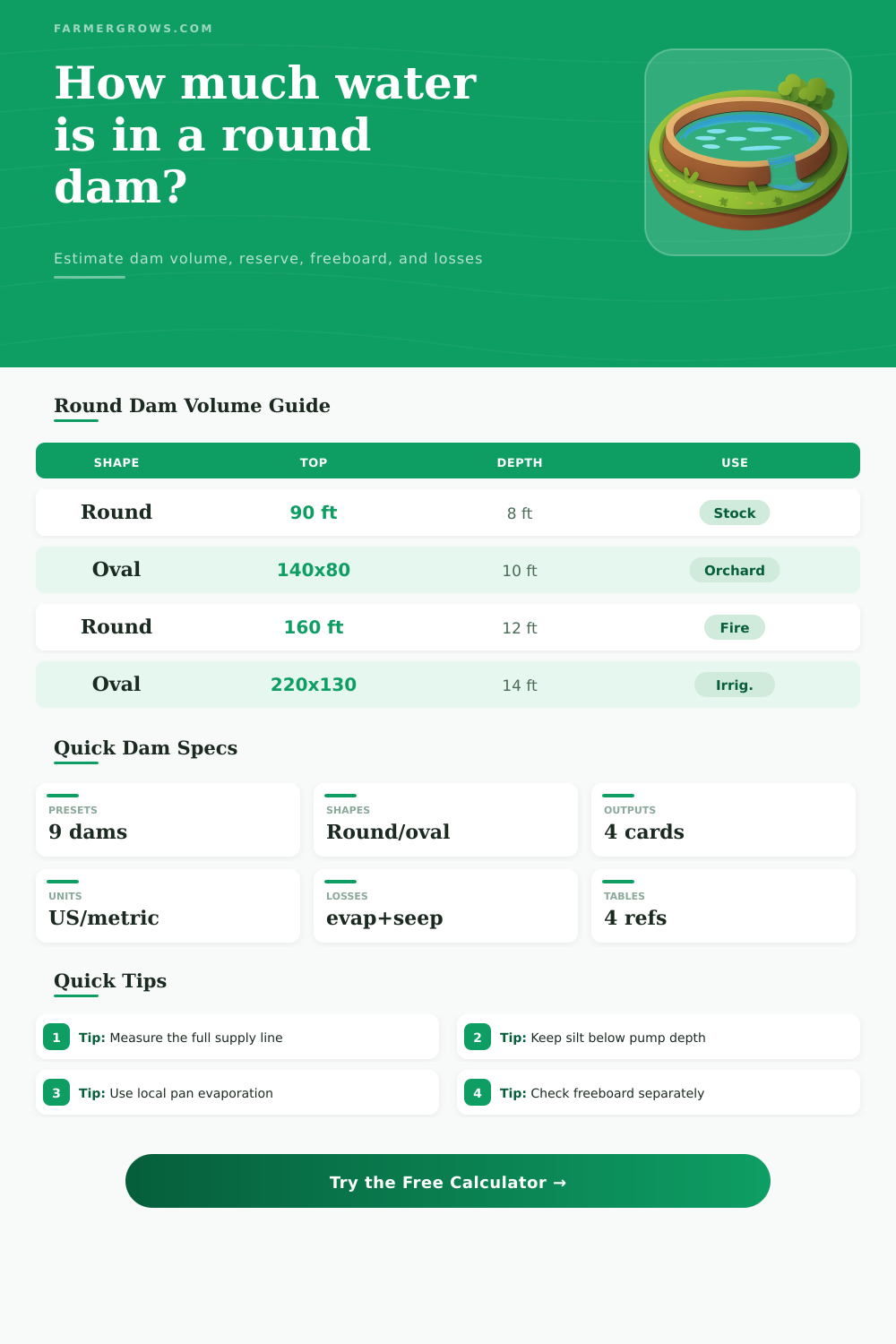
Round Dam Volume Calculator
Estimate circular or oval farm dam storage from top diameter, bottom diameter, water depth, side slope, freeboard, silt reserve, partial fill, evaporation, and seepage.
Load a common circular or oval dam, then adjust the measured waterline, floor, side slope, freeboard, silt allowance, fill level, and water-loss assumptions for your site.
Use one top diameter and one bottom diameter when the dam is close to round at both waterline and floor.
Use long and short diameters for elongated farm dams, hillside pockets, or storage built along a contour.
Subtracts the lowest layer from usable storage so sediment and pump intake clearance stay out of working volume.
Interpolates diameter by water depth so current storage, surface area, and losses reflect the fill percentage entered.
Round Dam Volume Results
Storage results update from the entered dam geometry and loss assumptions.
| Dam shape | Top waterline | Bottom floor | Depth | Approx gross storage |
|---|---|---|---|---|
| Small round stock dam | 80 ft diameter | 38 ft diameter | 7 ft | 0.63 acre-ft / 0.78 ML |
| Medium round dam | 120 ft diameter | 66 ft diameter | 9 ft | 1.84 acre-ft / 2.27 ML |
| Orchard oval dam | 150 ft x 90 ft | 78 ft x 36 ft | 10 ft | 2.08 acre-ft / 2.57 ML |
| Large irrigation oval | 220 ft x 130 ft | 122 ft x 62 ft | 14 ft | 6.56 acre-ft / 8.09 ML |
| Side slope | Where it is common | Volume effect | Planning note |
|---|---|---|---|
| 2:1 | Compacted clay, limited space | More floor area and more storage | Can be steep for livestock access and bank safety. |
| 3:1 | General farm dam default | Balanced storage and bank width | Often a good first planning slope. |
| 4:1 | Stock access, softer banks | Smaller bottom at same top diameter | Needs a wider dam for the same depth. |
| 5:1 | Very flat, equipment-friendly banks | Least deep storage for a fixed waterline | Useful for safety but storage drops quickly. |
| Allowance | Typical range | Calculator role | Field note |
|---|---|---|---|
| Freeboard | 1.5 to 3 ft | Air space above full supply | Not counted as normal usable water storage. |
| Silt reserve | 0.5 to 2 ft | Dead storage subtracted from usable volume | Increase where runoff carries sediment. |
| Partial fill | 25% to 100% | Current water level estimate | Surface area shrinks as the water level drops. |
| Pump intake margin | 1 to 3 ft | Related to silt reserve | Keep intake above mud and poor-quality bottom water. |
| Loss setting | Typical range | Volume effect | Best use |
|---|---|---|---|
| Cool humid month | 1 to 3 in/month | Lower drawdown | Use for winter or cloudy wet seasons. |
| Warm growing season | 4 to 7 in/month | Moderate storage loss | Common irrigation planning range. |
| Hot dry month | 8 to 12 in/month | High drawdown | Use for exposed, windy, dry-season dams. |
| Seepage add-on | 0.25 to 2 in/month | Depends on soil and liner | Raise it for sandy, cracked, or unsealed basins. |
For round dams, a small diameter error changes surface area across the whole calculation. Use the full-supply waterline for storage and keep bank crest measurements for freeboard checks.
Evaporation and seepage can dominate shallow storage during hot months. Recalculate with dry-season loss rates before counting partial-fill water for irrigation or stock.
This calculator is for planning and comparison. Dam safety, spillway sizing, embankment stability, water rights, and environmental approvals should be checked with local professionals and agencies.
A round dam volume calculator allow a person to calculate the amount of water that is store within a farm dam. Farm dam may appear simple to inspect, but the volume of water that is contain within that dam can be more difficult to calculate due to the fact that the volume of that dam can change based off the depth of the water within the dam, the slope of the sides of the dam, and the amount of sediment that is contained within the bottom of that dam. Each of these variable can be entered into the round dam volume calculator to determine the amount of water that is being held within that dam.
To use the round dam volume calculator, there are several different measurement that must be entered into the calculator. The diameter of the dam at the top of the dam and the diameter at the bottom of the dam must be entered into the calculator. Most farm dams has the bottom diameter smaller than the top diameter of the dam, and the round dam volume calculator must account for this difference in the diameters.
How to Use the Round Dam Volume Calculator
The side slope of the dam must be entered, as well as the depth of the silt reserve within the dam, and the depth of the freeboard within the dam. The side slope determine the amount of water that is held within the dam. The depth of the silt reserve is important due to the potential of the silt to cover the intake of a pump within the dam.
Finally, the depth of the freeboard within the dam is used to protect the embankment of the dam during periods of heavy rain and storms. Additionally, the depth of the water within the dam (which may not often be full of water) can be measured to account for the actual surface area of the water within the dam. The calculator will provide different types of outputs.
For instance, the round dam volume calculator will provide a measurement of the gross storage and usable storage within the dam. The gross storage within the dam is the total amount of water that the dam can contain, but the usable storage within the dam is the amount of water that can be used. Additionally, the calculator will also provide estimates as to the amount of water that may be lost within the dam each month.
These losses are due to both evaporation and seepage of the water within the dam, and the amount of water that may be lost each month is based upon the surface area of the water within the dam. Thus, the calculation of the depth of the water within the dam may be used to provide accurate estimates of potential water loss each month. Different types of dams may have different requirements for measurements.
For example, stock dams often have silt layers at the bottom of the dam that have no effect upon the amount of water that is supplied to the stocked animals within that dam. Irrigation dams, however, may require more precise measurements of the dimensions of that dam due to the fact that the water level within that dam will drop more frequent. If the level of water within an irrigation dam decreases, the surface area of that water will also decrease.
Thus, the potential loss of water due to evaporation will also decrease. Additionally, the round dam volume calculator can also account for oval dams. The long and short axes of that oval dam dont have to be converted into a circle to be accounted for by the round dam volume calculator.
Errors may occur in calculating the volume if the dam is treated as if it is a cylinder. If the dam is treated as a cylinder, the calculation will be incorrect due to the fact that the sides of the dam are sloped. Additionally, the measurements of the dam may only be taken at the crest of the dam rather than at the normal full-supply line within the dam.
Any small error in the measurement of the diameter of the dam will have a large effect upon the calculated area of the dam, and any error in the area will also have a large effect upon the volume of the area. Another potential error is to ignore the side slope of the dam; however, the round dam volume calculator will include a check to ensure that the dimensions at the bottom of the dam are equal to the side slope and depth of the dam. The round dam volume calculator will also provide different types of reference tables for the dam.
These tables may include tables that depict different side slopes for the dam and how those side slopes may affect the storage volume of the dam, and how usable the banks of the dam will be. Additionally, there may be tables that show how the potential loss of water from the dam due to evaporation and seepage may change with different climates within the dam, as well as the type of soil within the area. Additionally, there may also be tables that show the importance of providing both space for freeboard within the dam, as well as providing space within the dam for the silt to accumulate at the bottom.
It is also recommended that the round dam volume calculator is run more than once. One calculation may be made that uses the full-supply conditions within the dam to determine the total volume of the dam. A second calculation can be made that uses the current depth of the water within the dam, as well as the loss rate of the water within that dam.
The difference between these two calculations will provide information regarding the risk of the dam becoming depleted of water. Thus, by calculating the volume of the dam, and then determining the difference between these two calculations, a person can understand both the pattern in which the water is being used within the dam, as well as the amount of water that is being lost to evaporation.