Micronutrient Calculator
Estimate field-scale zinc, boron, manganese, iron, copper, or molybdenum applications from crop sensitivity, soil and leaf tests, pH, organic matter, product analysis, method, and safety caps.
Use lab reports and local extension guidance when available. This tool estimates elemental nutrient and product rates for planning; it is not a substitute for a crop adviser where soil type, cultivar, irrigation water, and product label restrictions matter.
Micronutrient Rate Results
Rates are expressed as elemental nutrient first, then converted to product using your product analysis.
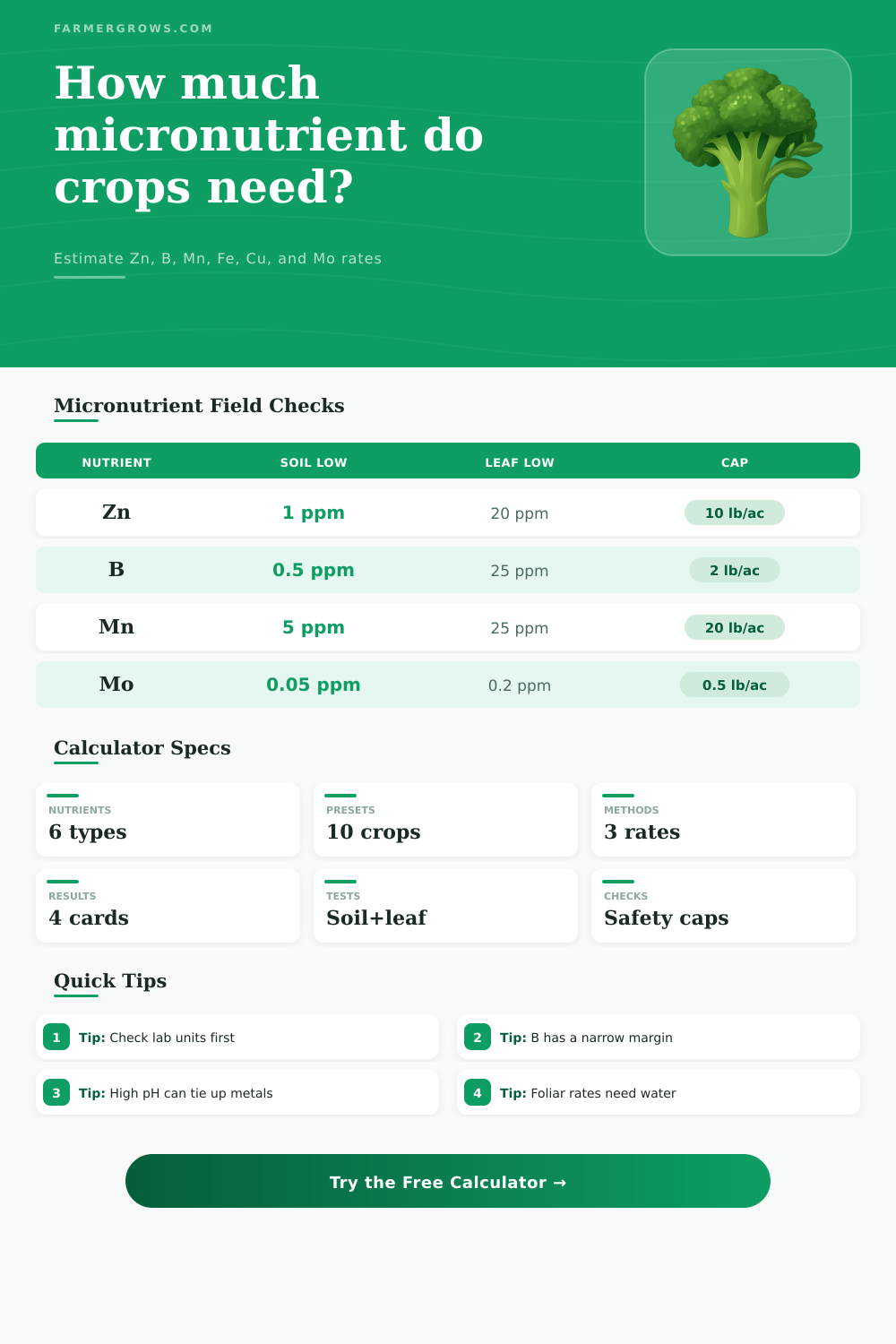
| Nutrient | Common low soil test | Common low leaf level | Default product analysis | Planning caution |
|---|---|---|---|---|
| Zinc (Zn) | Below 1.0 ppm DTPA | Below 20 ppm | 35% Zn sulfate | High pH, high P, cool soil can reduce availability |
| Boron (B) | Below 0.5 ppm hot-water | Below 25 ppm | 11% B borate | Small over-application can injure sensitive crops |
| Manganese (Mn) | Below 5 ppm DTPA | Below 25 ppm | 31% Mn sulfate | High pH and dry soil often trigger deficiency |
| Iron (Fe) | Below 4.5 ppm DTPA | Below 50 ppm | 6% Fe chelate | Soil Fe may be present but unavailable at high pH |
| Copper (Cu) | Below 0.3 ppm DTPA | Below 5 ppm | 25% Cu sulfate | Can accumulate, especially after repeated use |
| Molybdenum (Mo) | Below 0.05 ppm | Below 0.2 ppm | 39% sodium molybdate | Rates are very small and need careful weighing |
| Application method | Best fit | Rate behavior | Placement note |
|---|---|---|---|
| Broadcast soil | Build or correct a field-wide deficiency | Highest elemental rate per acre | Incorporate where label and crop system allow |
| Band or starter | Seedling access and low-rate placement | Lower total rate, higher root-zone concentration | Keep seed safety, salt, and product label distance in view |
| Foliar spray | In-season rescue or temporary correction | Lowest elemental rate per acre | Use enough water, avoid heat stress, and prevent leaf burn |
| Seed treatment | Mo on legumes or small starter packages | Very low nutrient amount | Match inoculant compatibility and seed label rules |
| Soil condition | Most affected nutrients | Rate effect in this tool | Interpretation note |
|---|---|---|---|
| pH above 7.3 | Zn, Mn, Fe, Cu, B | Raises estimated need up to a capped range | Availability declines for many metallic micronutrients |
| pH below 6.0 | Mo | Raises Mo need | Liming often improves Mo availability for legumes |
| Organic matter below 2% | B, Zn | Raises B and small Zn need | Sandy low-OM soils have less nutrient buffering |
| Organic matter above 5% | Cu, Zn | Raises Cu and Zn slightly | Organic complexes can reduce immediate availability |
| Crop profile | Often watched nutrient | Typical trigger | Practical check |
|---|---|---|---|
| Corn | Zinc | Low Zn, high pH, cool spring soil | Starter band or broadcast correction |
| Soybean | Manganese | High pH spots or dry compacted areas | Foliar correction after tissue confirmation |
| Alfalfa | Boron and molybdenum | Low B soils or poor legume nodulation | Small split rates and careful cap checks |
| Wheat | Copper and manganese | Sandy, organic, or high-pH soils | Use tissue tests before broad correction |
| Vegetables and orchards | B, Fe, Zn, Mn | High demand or high-pH chlorosis | Often needs crop-specific leaf standards |
Narrow safety margin: Boron, copper, and molybdenum can move from correction to injury quickly. Use label limits and local lab recommendations before increasing capped rates.
Test interpretation: Soil and leaf tests use different extraction methods and crop stages. Confirm ppm units, sample timing, and crop-specific sufficiency ranges before ordering product.
Micronutrients is nutrients in small amounts that are necessary for the nutrition of crops. Due to this, grower often dont notice micronutrients until the deficiency of those nutrients results in poor yield from those crops. For instance, a corn field may display the appropriate conditions for corn plants, but it may not contain the necessary amount of zinc to those crops.
Likewise, a soybean field may appear dark greenly (indicating adequate chlorophyll) yet it may lack manganese availability for the soybean plants. These type of deficiencies often go unnoticed until they lead to a reduction in yields from the fields before the growing season is halfway finished. The status of the micronutrients in the soil can be determined with soil tests and leaf tests.
How to Test and Apply Micronutrients to Your Crops
Soil tests will reveal which micronutrients is present in the soil, while the leaf tests will reveal which micronutrients the crops absorbs from the soil. The results of these two tests will often be the same; in the case that they are not, the difference between the two tests can be determined whether it is due to the testing method, the time of year in which the tests were performed, or issues related to the soil chemistry. Tools that combine these two tests along with tests for the pH and organic matter of the soil and the type of crops that are grown in those fields can assist in creating a plan for treating the fields for micronutrient deficiency.
The method in which the micronutrients are applied to the fields will determine the amount of that micronutrient that need to be applied. For instance, if the grower applies the micronutrients to the entire field (broadcast application), then more of the material will be required to reach the roots of the crops. If, however, the nutrients are to be placed near the seed (banding), then the amount of material that is placed into the field will be the same as if it were to be broadcast.
Finally, if the micronutrients are to be applied to the leaves of the plants (foliar sprays), then the material will bypass the soil entirely, yet more precise consideration must be made for the amount of water that will be used, the growth stage of the crops, and the size of the plants leaf. A micronutrient calculator allow for the amount of each nutrient to be calculated after each of these parameters are entered into the calculator. Using such a calculator ensures that there is no guesswork involved in the application of these micronutrients to the fields.
Boron and molybdenum are two micronutrients that has specific requirements for those nutrients. For instance, boron is a nutrient that is helpful for crops like alfalfa and cotton if it is added to soils that contain low amounts of that nutrient; however, if a grower adds too much boron to the soil, those crops will experience leaf burns. Molybdenum, meanwhile, is a nutrient that legumes require in small amounts; legumes require even more of this nutrient if the pH of the soil is low.
These factors are included in the micronutrient calculator, ensuring that the estimate of how much of each nutrient is required is adjusted according to the type of crops to be grown (corn, alfalfa, pasture, etc.). The pH of the soil and its levels of organic matter can impact the ability of the plants to access the micronutrients. Soils with high pH levels often contain large amount of iron or manganese; however, the plants are unable to access those nutrients.
Therefore, foliar sprays may be used to provide those nutrients to the plants, as changing the pH of the soil is unlikely to occur within a single season. Levels of organic matter in the soil also impact the availability of those nutrients to the crops; soils that are sandy often contain less than 2% organic matter, and contain less available boron and zinc level. Therefore, micronutrients will need to be added to sandy soils with low organic matter levels.
Prior to ordering any micronutrient for the fields, the grower should of calculate the needs of those fields. By calculating the needs of each field, the grower is able to consider each of the parameters related to the fields (severity of nutrient deficiency, test weighting, safety caps for micronutrients), as the relationship between these factor will impact the amount of micronutrients needed for those fields. Thus, using the calculator is the most effective means of determining the amount of each nutrient needed by each field.
Finally, the best way to manage these micronutrients is to treat the programs as an ongoing process. Fields that required zinc levels in the spring, for instance, may require less zinc in the following year in relation to the amount of effectiveness of the starter band of zinc that was added to those fields in the spring. By using a calculator with updated tests for each field, any program established for those fields will automatically adjust to avoid either deficiency or excess amounts of those required micronutrients.