Gypsum Application Rate Calculator
Estimate gypsum product rate from field area, sodium or SAR correction, clay sealing need, target calcium and sulfur supply, product analysis, application cap, and runoff buffer.
This planning calculator estimates agricultural gypsum rates. Sodium reclamation should be checked against a current soil test, drainage, irrigation water quality, and local extension guidance before applying large rates.
Gypsum Rate Result
Enter a soil and product profile to calculate the application plan.
| Material | Typical purity | Calcium | Sulfur | Planning note |
|---|---|---|---|---|
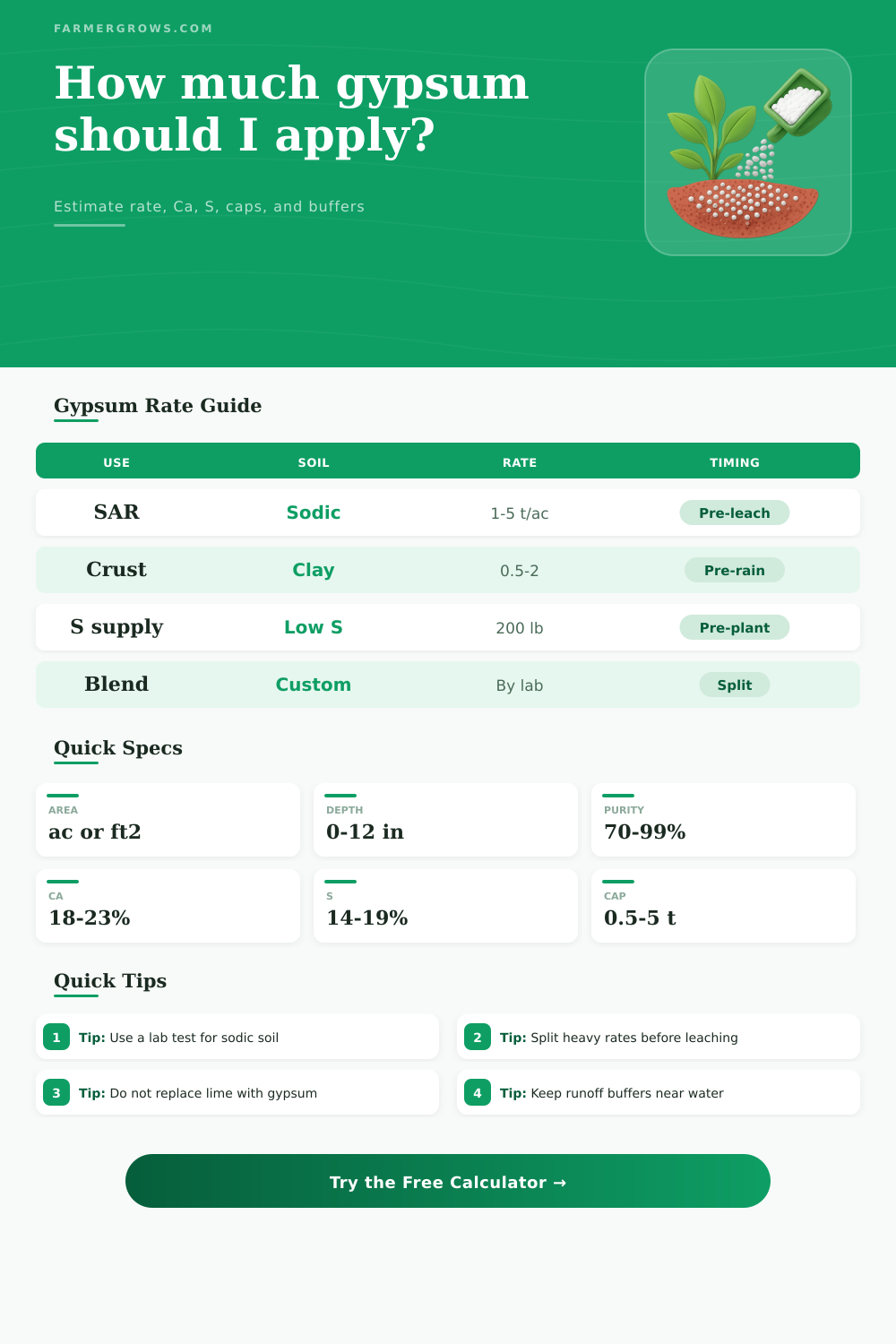
| Mined agricultural gypsum | 80-95% | 20-23% Ca | 16-19% S | Most common bulk field source; confirm fineness and moisture. |
| Pelletized gypsum | 85-95% | 20-22% Ca | 16-18% S | Spreads evenly at low rates and works well for small-acre jobs. |
| Solution grade gypsum | 90-99% | 22-23% Ca | 18-19% S | Fine grind or soluble product used where quick dissolution matters. |
| FGD gypsum | 85-96% | 20-23% Ca | 16-18% S | Can be consistent, but quality documentation should travel with the load. |
| Recovered wallboard gypsum | 70-90% | 17-21% Ca | 13-17% S | Use only clean agricultural material with low paper and contaminant levels. |
| Use case | Main input | Typical goal | Water need | Watch-out |
|---|---|---|---|---|
| Sodic soil reclamation | ESP, CEC, depth | Replace exchangeable sodium with calcium | Leaching is needed | Drainage must be adequate before large applications. |
| SAR irrigation problem | Water or soil SAR | Lower sodium hazard estimate | Match irrigation sets | Gypsum does not remove salts without water movement. |
| Surface clay crusting | Texture and severity | Improve aggregate stability and infiltration | Rainfall helps dissolve | Do not expect deep sodium correction from a light surface rate. |
| Sulfur nutrition | Target S lb/ac | Supply sulfate sulfur | Normal rainfall | Balance with crop sulfur need and other fertilizers. |
| Calcium without pH shift | Target Ca lb/ac | Add soluble calcium while keeping pH mostly stable | Moist soil improves response | Gypsum is not a liming replacement for acidic soil. |
| Situation | Common band | Depth basis | Split guidance | Field check |
|---|---|---|---|---|
| Light garden crusting | 0.25-0.75 ton/ac | Surface 0-1 in | Usually one pass | Watch infiltration after first rain. |
| Moderate clay sealing | 0.75-1.5 ton/ac | Surface 0-2 in | One or two passes | Pair with residue and reduced disturbance. |
| Low sulfur maintenance | 0.10-0.40 ton/ac | Nutrient target | One pass | Use plant tissue or soil sulfate tests. |
| Mild sodic correction | 1-3 ton/ac | Usually 6 in | Split above cap | Retest ESP after leaching cycles. |
| Severe reclamation | 3-8 ton/ac | 6-12 in | Multiple passes | Engineer drainage and water quality first. |
| Timing window | Best fit | Moisture condition | Buffer practice | Reason |
|---|---|---|---|---|
| Fall after harvest | Sodic fields and no-till acres | Trafficable soil, rain ahead | Keep setbacks near ditches | Allows winter precipitation to dissolve and move calcium. |
| Pre-plant spring | Sulfur and surface crusting | Avoid saturated soil | Delay before heavy storms | Places sulfate before rapid crop uptake. |
| Before planned leaching | Reclamation projects | Field can drain freely | Split high rates | Gypsum must dissolve and sodium must move below roots. |
| Standing forage or pasture | Surface structure and S supply | Apply before gentle rain | Protect streams and ponds | Low disturbance application works with rainfall incorporation. |
| Greenhouse or beds | Small-area nutrient adjustment | Blend evenly and water in | Use low rates first | Small volumes can be over-applied quickly. |
Tip: For sodic soil, gypsum is only one part of reclamation. You also need enough clean water to leach sodium and enough drainage to carry it below the root zone.
Tip: For clay sealing, pair gypsum with residue cover, organic matter, traffic control, and gentle irrigation. A surface rate helps aggregation but does not rebuild structure alone.
When you face sodic ground or clay surface that seal after every rain, you must decide how much gypsum to apply to your soil. Determining how much calcium are needed to move the sodium from the exchange sites of your soil is the first task. You then has to decide how deep the exchange of these ion should occur in your soil.
Finally, you have to determine how much water will move through your soil after gypsum are applied. A gypsum application rate calculator will help you with this task. However, there is work to be done before you can approach the gypsum application rate calculator.
How to Figure Out How Much Gypsum to Apply to Your Soil
Gypsum provides both calcium and sulfate to the soil but dont play a role in increasing the soil pH like lime does. Your field may already feature a high pH. However, the soil may still require the addition of calcium in order to loosen its clay soil structure.
The sulfate component of gypsum can benefit soils that contains low level of sulfur or are managed using no-till farming methods. The rate of gypsum you apply contains both the benefits of calcium and sulfate. Inputs for the gypsum application rate calculator will depend off the issue you are trying to fix in your soil.
If you are applying gypsum to fix high levels of sodium in your soil, you will have to provide the calculator with information about the current and target level of sodium in your soil, as well as the soils cation exchange capacity and mixing depth. If you are applying gypsum to fix clay soil sealing, you will have to provide information about the type of clay in your soil and the severity of the soil sealing. Finally, if the goal for adding gypsum to your soil is to increase the amount of sulfur in your soil, you will provide information about the amount of sulfur you want in your soil.
Depending on the problem you are trying to fix, the base rate gypsum application will change. After the gypsum application rate calculator set a base rate, it will add layers to calculate the gypsum rate according to product analysis, application cap, and runoff buffer. The product purity and nutrient percentage will determine the amount of gypsum that you will apply to the soil.
The application cap will ensure that the amount of gypsum calculated will not be more than what your equipment can apply to the field in a single pass. The runoff buffer will account for gypsum that may be lost to the wind, that may land on residue on the soil, and that may not be able to be applied to the soil at all. These additions will allow the calculator to arrive at a practical rate of gypsum application.
The reference tables that are provided will provide information on the different materials that can be used in your fields in regard to there purity and nutrient content. Additionally, these tables will show typical application rate bands for different situations in the fields. You dont need to memorize these tables.
However, it is important to see how the rate of gypsum that will fix surface crusting will be more different than the rate required to reclaim sodium in the soil. This is due to the depth at which gypsum must be applied. This logic will be built into the application rate calculator when you enter the information about your soil.
The gypsum application rate calculator cannot calculate information about your soil drainage or water quality. The practice of adding gypsum to sodic soils will not work if there is no place for the sodium to go or if there isnt enough low-sodium water in your fields to carry the sodium away. Therefore, the gypsum application rate calculator will include a parameter that allows you to enter your leaching depth for the calculation.
Many people will run the numbers through the gypsum application rate calculator twice. The first time, the rate calculator will show you the ideal rate of gypsum application for your soil. However, the second time, you can test the effect of lowering the application cap or increasing the runoff buffer.
These calculations will show you if you will need additional applications of gypsum. Finally, you must look at the tonnage of gypsum that you will apply to your fields, how many application will be made, and the nutrient supply that the gypsum will provide. Based off all of this information, you can determine whether the gypsum application plan will fit within your field calendar and budget.
Although the gypsum application rate calculator has removed the arithmetic involved in calculating the rate at which to apply gypsum, you are still required to make the decision about drainage, water management, and application timing. You should of checked your soil first. It can be a lot of work to recieve the correct results if you dont plan actualy.