Tractor Ballast Weight Calculator
Estimate tractor target weight, front and rear axle split, liquid fill, suitcase weights, wheel weights, and slip goal for draft, 3-point, PTO, and loader work.
Use scale weights whenever possible. This calculator estimates a practical ballast plan from horsepower, tractor weight, implement load, tire type, drive type, current ballast, and the front/rear split you want in the field.
Ballast recommendation
Recommended ballast appears here after calculation.
| Tractor setup | Heavy draft target | PTO or lighter work | Typical slip goal |
|---|---|---|---|
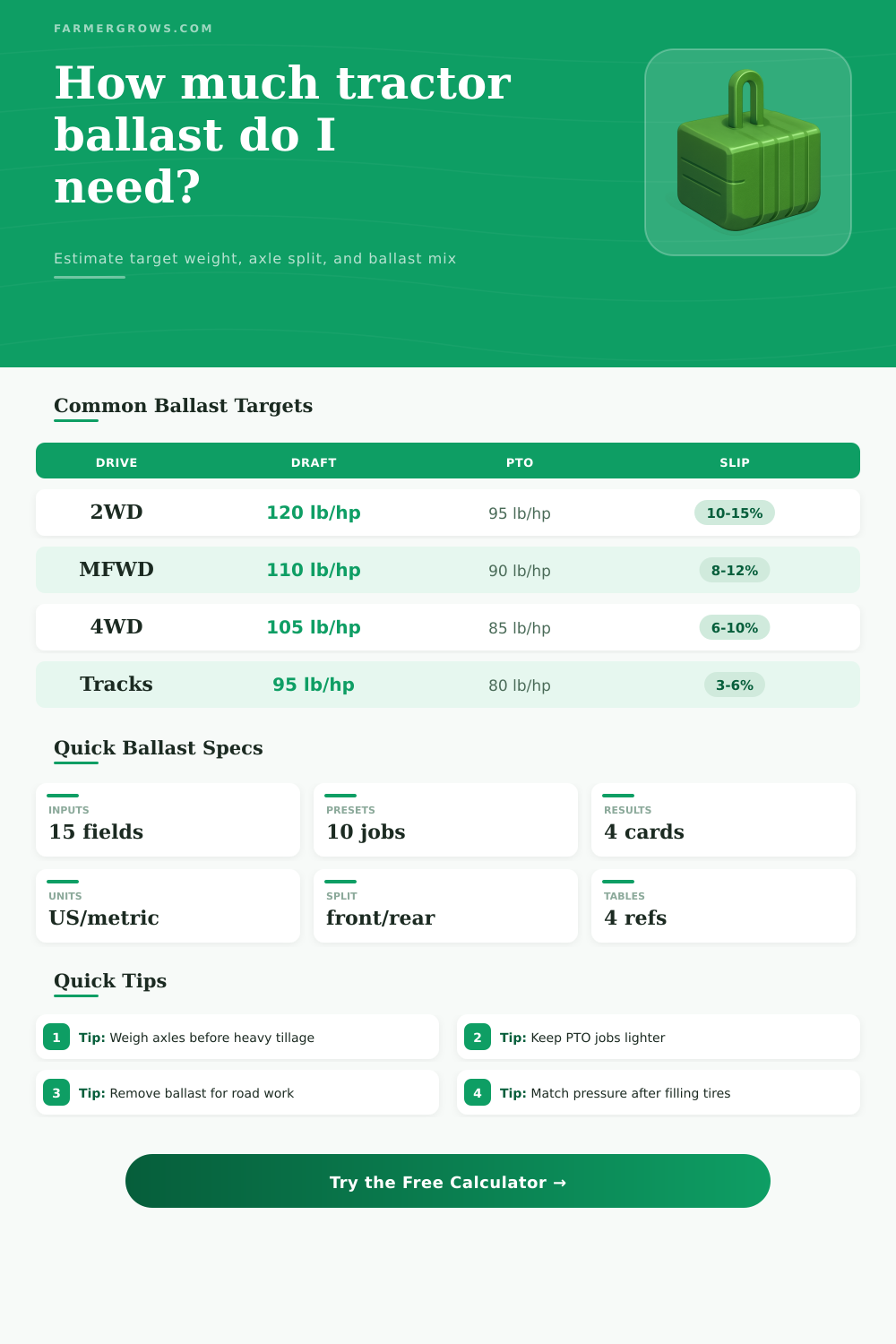
| 2WD row-crop | 115 to 130 lb/hp | 85 to 100 lb/hp | 10% to 15% |
| MFWD or front assist | 105 to 120 lb/hp | 80 to 95 lb/hp | 8% to 12% |
| Articulated 4WD | 95 to 115 lb/hp | 75 to 90 lb/hp | 6% to 10% |
| Rubber tracks | 85 to 105 lb/hp | 70 to 85 lb/hp | 3% to 6% |
| Use case | Front axle share | Rear axle share | Why it matters |
|---|---|---|---|
| 2WD drawbar draft | 25% to 35% | 65% to 75% | More rear weight improves traction |
| MFWD heavy draft | 35% to 40% | 60% to 65% | Front assist needs usable front load |
| 3-point carried tool | 35% to 45% | 55% to 65% | Rear leverage can unload steering |
| Loader or front tool | 30% to 40% | 60% to 70% | Rear ballast keeps braking and stability |
| Tire type | Ballast response | Pressure note | Watch point |
|---|---|---|---|
| Bias ply | Needs weight for bite | Check load tables closely | Can ride hard when over-ballasted |
| Radial | Efficient with correct pressure | Set pressure by axle load | Too much pressure wastes footprint |
| IF/VF radial | Can carry more at lower pressure | Use maker load chart | Ballast may be lower than old habits |
| Rubber tracks | Less slip at lower weight | Balance frame and idlers | Excess weight can hurt ride and soil |
| Method | Best location | Adjustment speed | Planning note |
|---|---|---|---|
| Liquid tire ballast | Rear or drive tires | Slow | Good low center weight, but hard to seasonally remove |
| Front suitcase weights | Front bracket | Fast | Useful for 3-point tools and steering recovery |
| Rear wheel weights | Drive wheels | Moderate | Durable draft ballast with no tire fluid service |
| Frame or belly weight | Chassis | Moderate | Helps total mass without concentrating all load in tires |
Before field work: Weigh the tractor by axle with the implement attached and raised or lowered the way it runs. Ballast targets are much more useful when the axle numbers are real.
After changing ballast: Reset tire pressure from the tire manufacturer's load table. Added ballast without pressure adjustment can waste fuel, increase compaction, or shorten tire life.
Ballast for tractor is the process of adding weight to a tractor to improve the performance of the tractor. Tractor ballast are used to provide traction to the tractor and to provide stability to the tractor. If a tractor dont have enough ballast, the tractors front wheel may lift off the ground, especially on slopes.
Additionally, the rear tires of the tractor may spin if the tractor does not have enough ballast to pulling heavy loads. Beyond providing ballast to tractors, the purpose of tractor ballast is to provide ballast in specific areas of the tractor so that the tractor is provided with both traction and stability during specific task. The amount of ballast that is required for a tractor can depend upon a variety of factor.
Adding Weight to a Tractor for Traction and Stability
Factors such as the horsepower of the tractor, the drive type of the tractor, the type of tires of the tractor, the type of implement that are to be used with the tractor, and the amount of ballast that is required for the tractor based off those factors will all play a role in determining the necessary amount of tractor ballast. Additionally, different type of tractor ballast exist, each with there own advantage and disadvantages. For instance, you can add ballast in the form of liquid to the tractor to provide ballast for the tractor, but the disadvantage of utilizing liquid ballast is that the liquid is difficult to remove from the tractor as tasks change.
In contrast, suitcase weights can be added or removed from the tractor to adjust the ballast provided by the tractor, but ballast in the form of weights that is placed upon the wheels of the tractor can be helpful for providing ballast to the rear of the tractor, but make it more difficult to change the tractors tires. The different ballast options can be combined to form a ballast mixture that best fits the needs of the tractor based upon its specific tasks. The tire pressure of the tractor is a variable that is direct connected to ballast for the tractor.
For instance, if you add ballast to the tractor but the tire pressure is not adjusted with that added ballast, the tires may compact the soil, which may reduce the efficiency of the tractor. Additionally, different types of tire construction may respond differently to the addition of ballast to the tractor. In addition to the variables that is established before the tractor begins to perform its tasks, there are other variable in the job site that can affect tractor ballast.
For instance, the moisture of the soil, the slope of the ground, and the way in which the implement is carried may all have an effect upon ballast. For example, one means of determining if the ballast for a tractor is correctly set is to use the slip goal for the tractor. If the tire slip decreases from the tractor is below the recommended range, the tractor has too much ballast.
If the tire slip increases beyond the recommended range for the tractor, the tractor have too little ballast, and more ballast must be added to the tractor. The best way to determine ballast for a tractor is to weigh the tractors axles before the farming or similar task begins for the season. The weight of the tractor can not be accurately guessed from the weights that is published for tractors in general.
After determining the weights of the axles, the tractor can be tested with a calculator to determine how ballast can be adjusted to provide for the tasks that the tractor will perform. By using the tractor ballast calculator to test the ballast that should of been added to the tractor, a tractor can have both stability and good steering response, but will not have to overexpend on fuel to provide those characteristic, nor will the tractor damage the soil in the process.