Barbed Wire Fence Calculator
Estimate pasture perimeter, strand wire footage, rolls, corner and end posts, line posts, brace assemblies, gates, stays, staples, clips, and tensioners for farm barbed wire fencing.
Use this as a planning takeoff before ordering materials. Walk the proposed fence line afterward to confirm gates, corners, draws, creek crossings, steep pulls, and local bracing practice.
Fence Material Estimate
Results include gate deductions, strand count, pressure adjustment, terrain waste, brace style, stays, and attachment hardware.
| Livestock or use | Typical strands | Post spacing | Stay use | Planning note |
|---|---|---|---|---|
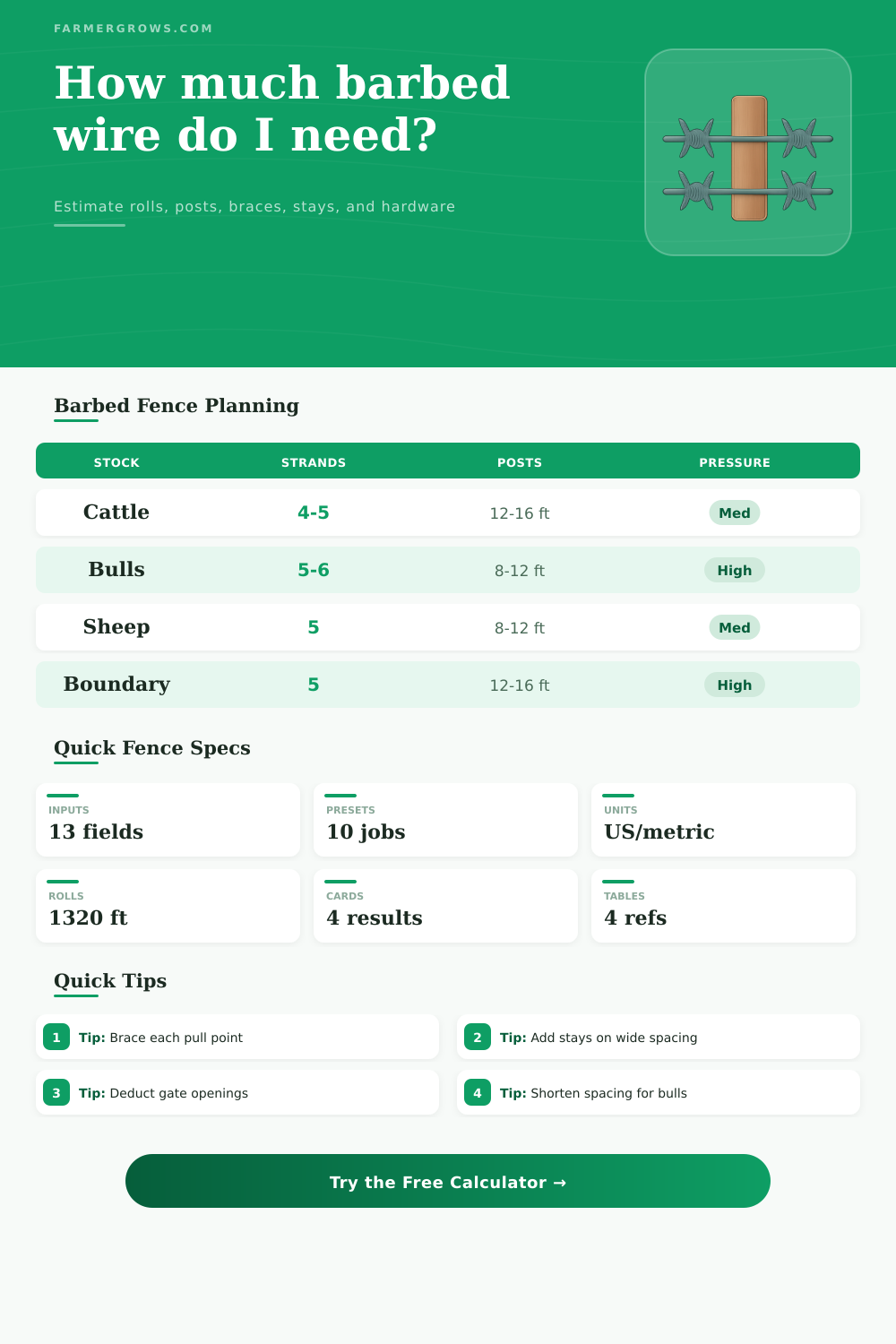
| Beef cattle pasture | 4 to 5 | 12 to 16 ft | Optional | Common permanent pasture layout when animals are fence trained. |
| Bulls or weaning lots | 5 to 6 | 8 to 12 ft | Useful | Use stronger braces and closer spacing for repeated pressure. |
| Large range boundary | 4 to 5 | 16 to 20 ft | Often used | Stays help hold strand separation on long open spans. |
| Sheep secondary line | 5 | 8 to 12 ft | Recommended | Barbed wire is usually secondary to woven or electric control. |
| Horse-adjacent boundary | 3 to 4 | 10 to 12 ft | Visibility helps | Use caution, setbacks, and local safety guidance near horses. |
| Brace assembly | Posts counted | Rails counted | Brace wire loops | Best fit |
|---|---|---|---|---|
| Single H brace | 2 | 1 | 1 | Normal corners, gate pulls, and short to medium runs. |
| Double H brace | 3 | 2 | 2 | Long pulls, hills, heavy strain, and boundary corners. |
| N brace or angle brace | 2 | 1 | 1 | Useful when space or post supply is limited. |
| Light temporary end | 1 | 0 | 0 | Short cross fences and low pressure temporary lines. |
| Roll length | Rods | One strand covers | Four strands covers | Common use |
|---|---|---|---|---|
| 1320 ft | 80 rods | 1320 ft | 330 ft | Common farm roll for repairs and paddocks. |
| 1650 ft | 100 rods | 1650 ft | 412 ft | Useful where suppliers stock 100 rod rolls. |
| 2640 ft | 160 rods | 2640 ft | 660 ft | Large boundary and rangeland runs. |
| 5280 ft | 320 rods | 5280 ft | 1320 ft | Long straight lines with fewer roll changes. |
| Item | Calculator method | Pressure effect | Field check |
|---|---|---|---|
| Line posts | Fence run divided by effective spacing | High pressure shortens spacing | Mark slope breaks and low spots before setting. |
| Gate posts | Two heavy posts per gate opening | Wide gates need stronger hinge posts | Match hinge post depth to gate weight and soil. |
| Staples or clips | Posts times strands plus allowance | More pressure adds extra fasteners | Do not drive staples so tight that wire cannot move. |
| Tensioners | Based on strands and pull points | High strain uses more control points | Place where future retensioning is reachable. |
| Droppers or stays | Fenced run divided by stay spacing | Useful on wide posts and wildlife pressure | Keep wire separation consistent between posts. |
Before ordering: Count every gate, end, sharp corner, and major grade change as a pull location. Brace quantities rise fast when a fence line is not a simple square.
Before stretching: Match tension to post strength and soil. Over-tight wire can lean weak posts, while loose wire invites rubbing, crawl-under spots, and broken clips.
Building a barbed wire fence require considering many different variable. The variable to consider include the pasture that you would like to fence in, the corner of the pasture, any gate, the slope of the land that will be fenced in, and the way that the livestock will interact with the fence constructed of barbed wire. If these variable are not consider and measured correctly prior to the installation of the first fence post, the barbed wire fence may sag under the pressure of the livestock.
Thus, it is important to consider and account for all of the variables that may affect the construction and function of the barbed wire fence that is to be built. The calculator that are provided on this page will simplify the process of measuring a barbed wire fence by taking into account each of these variables. You will enter the length of the area that is to be fenced in into the calculator, as will the number of strand that are to be built, and the distance between the fence post.
How to Measure and Plan a Barbed Wire Fence
The calculator will account for any gate that will be constructed along the barbed wire fence, the type of brace that is to be built at each of the pull point along the fence, and the amount of wire that will be necessary to allow for waste in the terrain and due to the pressure of the livestock on the barbed wire fence. The distance between each of the fence post is an important variable to consider in relation to the type of livestock that is to move within the barbed wire fence. If the distance between the fence post is too great, the bottom wire of the barbed wire fence may sag, causing the livestock to learn how to crawl underneath the fence.
The calculator will automatically adjust for the distance between the posts if livestock with high amount of pressure on the fence (such as bull or calves) are to move within the barbed wire fence. Barbed wire fence require the incorporation of brace assemblies at each of the corner in the pasture, any gate, or any point where the fence line may change direction. The calculator will account for the number of post that will be built and the number of rail that will be constructed for any brace assembly (if an H brace, double H brace, or angle brace is to be constructed).
An H brace may work well at the corner in a pasture, but if the fence is to include a long line of post along a hill or ridge, a double H brace may be better for those corner. If a double H brace is omitted, the fence may have to be reretensioned at those point later. The hardware that will be utilized in the construction of the barbed wire fence should also be considered.
The hardware for a barbed wire fence may include post, wire, staple, clip, tensioner, and other small component. These hardware component will be accounted for in the calculator to provide an estimation of the total amount of hardware that will be necessary for construction of the barbed wire fence. For instance, the calculator will provide the total amount of wire that will be necessary for construction of the barbed wire fence if the stay are to be placed every eight feet along the fence.
This information will help to determine if any extra wire will be purchased, or if dropper will be purchased to hold the gap between the barb to the same distance apart in any fence that includes large distance between the post. The variable that affect the actual construction of a barbed wire fence may be different than the variable that are considered during the planning phase of fence construction. Variable such as the location of any tree in the pasture, low area in the pasture that may flood, or the fence line that livestock must move around will alter the length of the barbed wire fence that is constructed.
Thus, the terrain waste allowance will be incorporated into the calculation in the calculator to account for this possible variable. Additionally, you can walk the route of the fence with a measuring wheel to confirm the actual distance that will be required for the construction of the barbed wire fence. Many people may be surprised to learn that the wire is only one part of the total cost of constructing a barbed wire fence.
Other cost may involve the time required to reset the fence post if the distance between each fence post is too great, or to retension the barbed wire fence if there are not enough pull point to allow the fence to properly retain the livestock that are to move within the fence. Thus, it is important to run the number associated with constructing the barbed wire fence with the variable that are to impact the fence, and to confirm those number in person to actualy construct the fence. You should of considered the terrain waste alot before startin.