Fence Stain Calculator
Estimate stainable fence surface area, board overlap, picket edges, rails, posts, coats, waste, gallons, quarts, and the dry-time window for a wood fence staining job.
Use the presets as real-world starting points, then adjust the fence style and stain label coverage. The calculator treats the fence plane, picket edge exposure, overlap shadow, rails, and posts as separate surface areas.
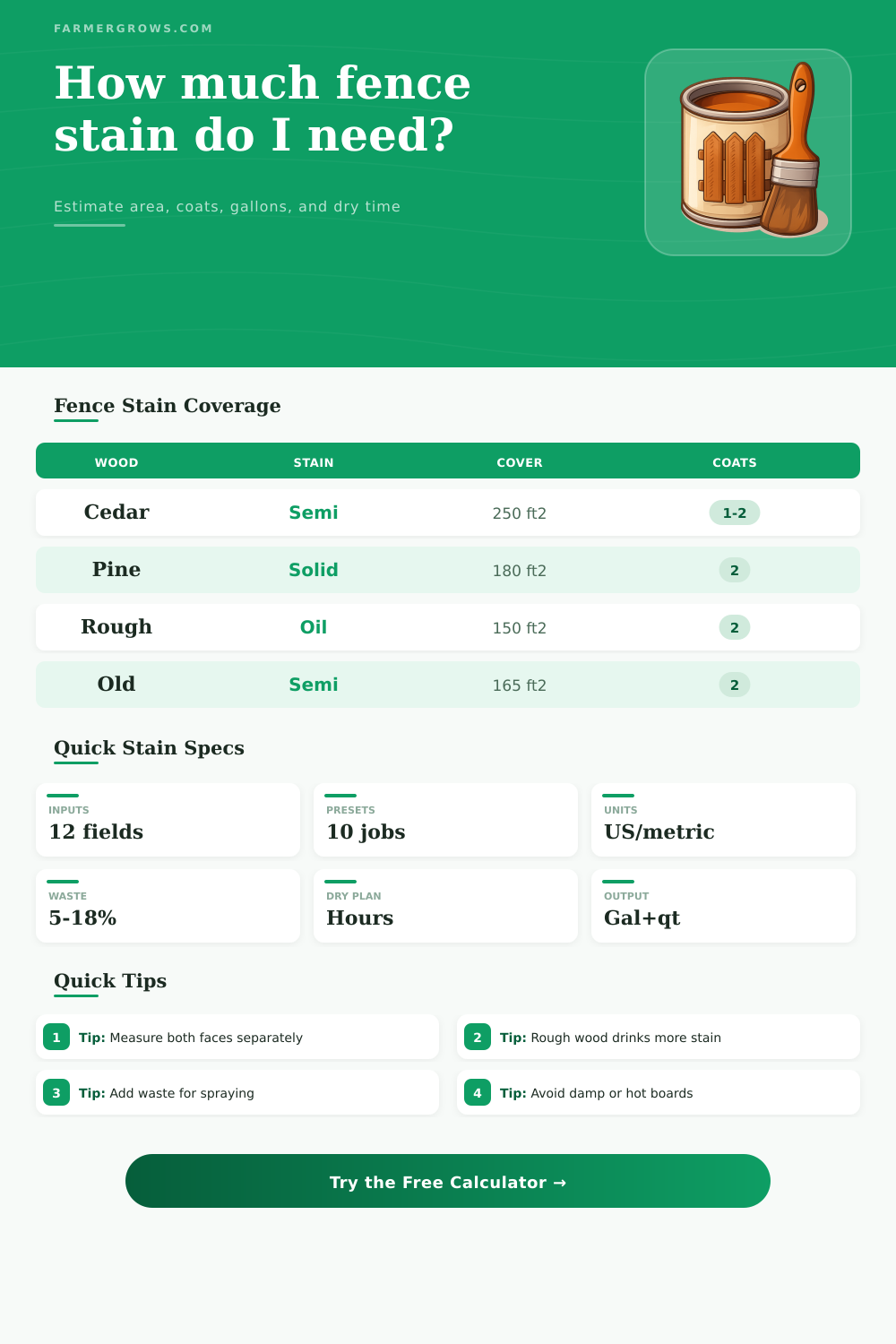
| Wood or surface condition | Porosity factor | Typical first-coat coverage | Use when |
|---|---|---|---|
| Smooth cedar or redwood | 1.00x | 225 to 325 sq ft per gal | Boards are planed, clean, and not sun-baked |
| New pressure-treated pine | 1.08x | 200 to 275 sq ft per gal | Wood has dried enough to accept stain evenly |
| Aged pine or spruce | 1.18x | 175 to 250 sq ft per gal | Common privacy fence after a season outdoors |
| Weathered cedar | 1.28x | 160 to 225 sq ft per gal | Grain is open and gray fibers remain after cleaning |
| Rough-sawn boards | 1.45x | 120 to 190 sq ft per gal | Sawn texture holds more stain in the surface |
| Old dry thirsty fence | 1.55x | 110 to 175 sq ft per gal | Boards are checked, porous, or very weathered |
| Coat plan | Area multiplier | Best fit | Planning note |
|---|---|---|---|
| One coat | 1.00x | Maintenance coat, transparent oil, good boards | Works when the color is already even and absorption is low |
| Heavy coat plus touch-up | 1.50x | Rails, pickets, or spotty aged wood | Allows a second pass on dry ends and shadow strips |
| Two coats | 2.00x | Semi-transparent, semi-solid, or solid stain | Most reliable plan for uniform fence color |
| Three thin coats | 3.00x | Low-build finishes or very porous wood | Use only when the product label allows extra coats |
| Application method | Waste allowance | Production rate | Where it helps |
|---|---|---|---|
| Brush only | 5% | 90 to 140 sq ft per hour | Small picket sections, posts, and careful edge work |
| Roller with brush back-brush | 8% | 170 to 260 sq ft per hour | Privacy fence faces with rails and posts nearby |
| Stain pad | 7% | 150 to 230 sq ft per hour | Smooth boards where overspray is a concern |
| Sprayer with back-brush | 12% | 260 to 420 sq ft per hour | Long fences, textured wood, and better penetration |
| Sprayer only | 18% | 350 to 550 sq ft per hour | Open rural runs where drift control is manageable |
| Weather window | Temperature | Humidity | Dry-time effect |
|---|---|---|---|
| Ideal staining day | 60 to 80°F | 40% to 60% | Use normal label dry and recoat times |
| Cool morning or evening | 50 to 59°F | Under 70% | Add about 25% to recoat time |
| Hot boards | 86 to 95°F | Under 60% | Work smaller sections because stain flashes faster |
| Humid conditions | 60 to 85°F | 70% to 85% | Add about 35% to dry and cure timing |
| Delay work | Below 50°F or above 95°F | Above 85% | Wait for safer drying and better absorption |
Area check: Shadowbox and board-on-board fences can need much more stain than a flat privacy face because laps, returns, and picket edges all drink finish.
Dry-time check: Keep the plan flexible when humidity rises or boards are cool. A second coat that traps moisture can leave shiny patches or weak color.
Calculating the amount of wood stain need for a fence require that you account for many different variable. Many individuals believe that fences are flat surface that can be stained with wood stain. However, fences are made up of many different surface.
The individual surfaces that are made up of fences include the edge, rails, and the posts themselfs. Because wood stain will adhere to these additional surfaces, the amount of wood stain must be provide for these additional surfaces, as well. Otherwise, an individual may find themself out of wood stain prior to completing the staining of the fence.
How Much Wood Stain Do You Need for a Fence
The style of the fence will impact the amount of wood stain that is need for staining the fence. For example, fences that include picket, such as privacy fences, will require you to apply wood stain to the edges of each picket. Shadowbox and board-on-board fences will typically have even more surfaces stained with wood stain than fences that contain picket.
Open rail fences will require the application of wood stain to the fence rail and posts. Each of these different fence style will have different amount of surfaces that require staining with wood stain, and that amount must be calculated prior to staining the fence. The type of wood from which the fence is constructed will impact the amount of wood stain that the fence will absorb.
Wood that is fresh cedar and sanded will have smooth grain that allow the wood stain to adhere to the surface of the fence. Wood that is aged pine or boards that were sawed will have open grain that allow the wood stain to penetrate deep into the fence boards. Finally, old wood that was exposed to sun and rain will absorb the wood stain as if it were a sponge.
Old fence boards will absorb more wood stain than new fence boards. Thus, the type of wood from which the fence is constructed will impact the amount of wood stain that the fence will consume. The method with which the fence is stained will impact the amount of wood stain that is purchased.
For example, brushing the fence with wood stain take more time than other methods of staining the fence. However, you will waste less wood stain if you brush the fence with wood stain. Spraying the fence with wood stain allow for the fastest staining of the fence.
However, spraying the fence with wood stain wastes more wood stain. Finally, the weather will also impact the amount of wood stain. For example, if the weather is dry and hot, the wood stain will dry quick.
Thus, fewer coat of wood stain may be applied in a single day. However, if the wood stain takes longer to dry, such as in damp weather, more coat of wood stain will be required to stain the fence in a single day. It is better to purchase additional amount of wood stain than to purchase the amount that is suggested on the label.
The amount that is suggested on the label is for a flat surface with no fence. You must also purchase enough wood stain to allow for two coat of wood stain, as well as wood stain for the corner and end posts of the fence. If you dont purchase wood stain for these extra stains, the wood stain will be depleted before the fence is stained in its entirety.
The calculator account for the different variable of wood stain needed for a fence. The calculator can account for the dimension of the fence. The calculator can account for the style of the fence.
Finally, the calculator can account for the type of wood stain. The calculator accounts for the hidden surface of the fence, as well as accounts for wood stain waste. Thus, the calculator will provide a plan for the number of gallon of wood stain that will be needed for your fence project.
However, the weather must still be accounted for in the staining of the fence. However, the calculator will provide the number of gallon of wood stain that is need for the project.