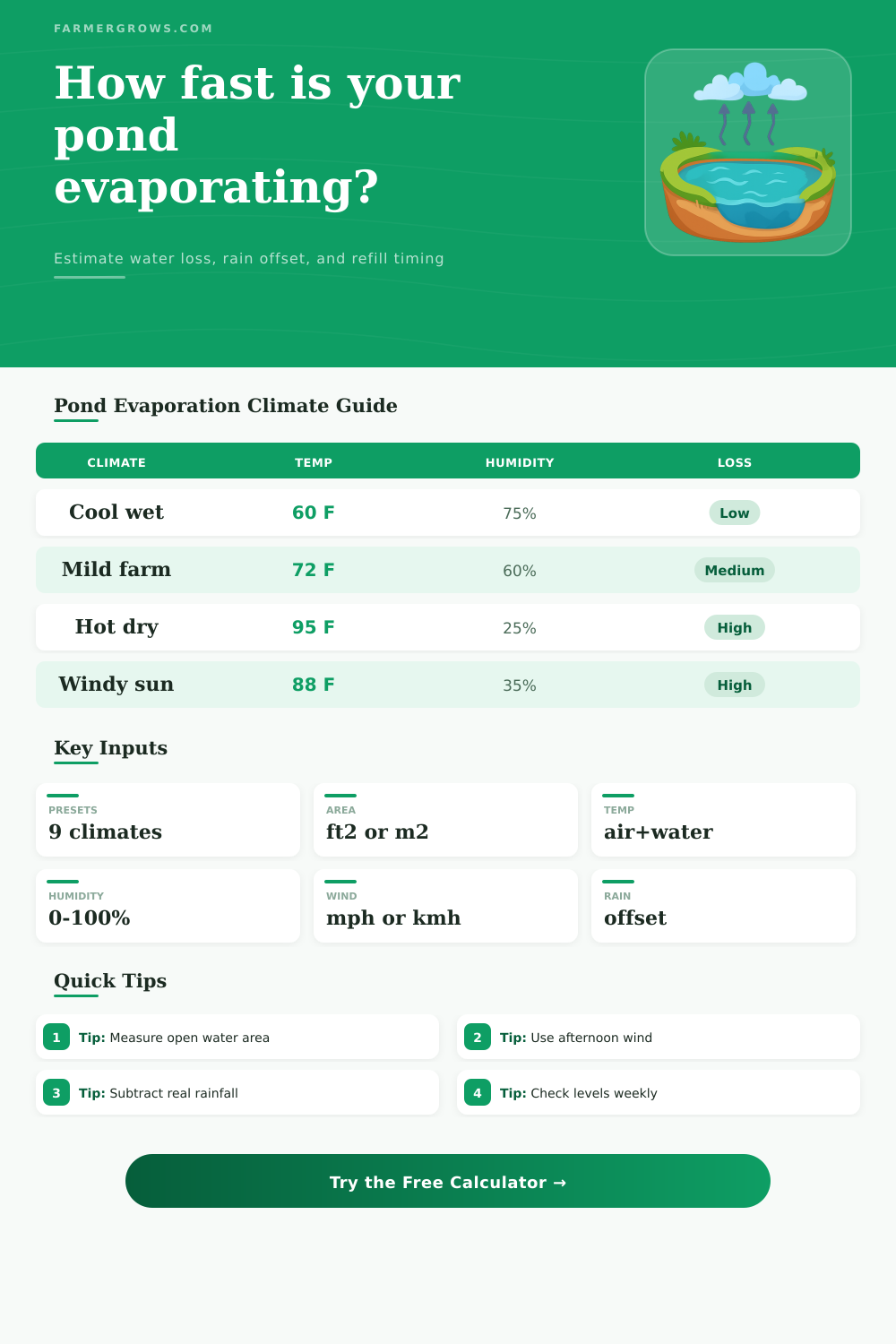
Pond Evaporation Rate Calculator
Estimate daily pond evaporation from open water area, air and water temperature, humidity, wind, sunlight, rainfall offset, and refill interval.
Pick a climate and season starting point, then adjust area, temperatures, humidity, wind, sun exposure, rain, and refill interval to match your pond.
Evaporation Estimate
Enter pond and weather details to estimate open-water drawdown.
High humidity, lower water temperature, and cloud cover keep daily loss modest.
0.04 to 0.10 in/dayOpen ponds with moderate wind often lose noticeable water between weekly checks.
0.10 to 0.20 in/dayDry air, warm water, and full sun can turn small depths into large daily gallons.
0.22 to 0.40 in/dayWindy dry weather may outpace irrigation returns even when air temperature is not extreme.
0.30+ in/day| Condition | Typical input | Evaporation effect | Field note |
|---|---|---|---|
| Cool water, humid air | 55-65°F water, 70-90% RH | Low vapor pressure gap | Drawdown may be hard to see unless wind is strong. |
| Mild water, mixed air | 65-78°F water, 45-70% RH | Moderate daily loss | Useful default for spring and fall farm ponds. |
| Warm water, dry air | 78-90°F water, 20-45% RH | High daily loss | Expect larger refill volumes from broad ponds. |
| Hot water, very dry air | 90°F+ water, under 25% RH | Very high daily loss | Check shallow ponds and lined basins more often. |
| Exposure | Input range | Multiplier idea | Use when |
|---|---|---|---|
| Sheltered shade | 0-3 mph, under 3 hr sun | Lower than baseline | Pond is protected by trees, buildings, or banks. |
| Partial exposure | 3-7 mph, 3-5 hr sun | Slightly lower | Half-day shade or windbreak covers one side. |
| Open farm pond | 6-12 mph, 6-8 hr sun | Baseline | Typical open pasture or garden pond conditions. |
| Windy full sun | 12+ mph, 9+ hr sun | Higher than baseline | Exposed ridge, reflective soil, or hot dry spell. |
| Planning item | Formula | Best input | Why it matters |
|---|---|---|---|
| Gross loss | Evap depth x pond area | Weather-driven estimate | Shows total water leaving the pond surface. |
| Rain offset | Rain depth x pond area | Gauge or forecast average | Credits direct rainfall before refill planning. |
| Net loss | Gross loss - rain offset | Zero floor applied | Prevents negative refill needs on wet days. |
| Refill volume | Net daily loss x interval | Days between top-offs | Sizes hose time, pump runtime, or make-up water. |
| Reference | Value | Evaporation use | Quick check |
|---|---|---|---|
| One inch over 1 sq ft | 0.623 gallons | Depth loss to gallons | Area x inches x 0.623 = gallons. |
| One acre-inch | 27,154 gallons | Farm pond drawdown | Useful for large reservoirs and irrigation ponds. |
| One square meter | 10.764 sq ft | Metric area conversion | Metric inputs are converted internally. |
| One millimeter over 1 sq m | 1 liter | Metric depth to liters | Simple field check for small lined ponds. |
Evaporation is driven by exposed pond area. A pond that narrows as it drops will lose fewer gallons per inch at lower water levels.
Wind, humidity, and water temperature change faster than pond size. Recheck during heat waves, after storms, and when pumps or livestock demand rise.
This calculator gives planning estimates for open water evaporation. Confirm seepage, overflow, irrigation withdrawals, and local water restrictions separately.
Pond waters dissapears at a rate that is more faster than many people expect. The loss of pond water isnt very obvious until the pond water level have dropped. Evaporation from ponds occur due to the difference between the vapor pressure at the pond waters surface and the vapor pressure in an air above the water’s surface.
The greater the difference between those two value, the faster the pond water will lose depth. After you enter the size of your pond and the weather condition in your area, the calculator will perform such calculations. The calculator will allow you to avoid having to guess at the various factor that will affect your pond.
How to Calculate Pond Water Loss
Air temperature does have an effect upon evaporation from ponds. However, water temperature has a more important effect on the rate at which pond water disappear. The vapor pressure at the surface of the pond water increase as the temperature of the pond water increases.
Ponds that is in full sun reach water temperatures that are several degree warmer than the air temperatures in those same area. Therefore, the calculator will ask for both the air temperature and the water temperature of your pond. Higher humidity level will result in less pond evaporation because the vapor pressure in the air is higher.
Therefore, high humidity level will result in less pond water loss. Wind has an opposing effect on pond evaporation. Wind strip the layer of saturated water vapor away from the water’s surface.
The calculator will ask for the wind speed near the water’s surface because that value will more accurate impact the evaporation rate of your pond than the wind speed measured near the pond. Rainfall is the only input that will reduce the net loss of water from your pond. A daily average of a few hundredth of an inch of rainfall may sound like a small amount.
However, such rainfall amount will result in a noticeable offset in the net loss of pond water. The calculator will subtract the amount of rainfall from the total pond water loss to provide you with a realistic measurement of the number of gallons of pond water that will need to be replaced. This number will help you to determine how often you will need to refill your pond.
If you choose to refill your pond once a week, the calculator will show you the amount of water that will need to be added to the pond on a weekly basis. The reference table on this website will show you the effect that different climate will have upon your pond water evaporation. Cooler and more humid climate will result in less water loss from the pond than in area with warm and dry climates.
The tables will also allow you to easily see the effect that the location of your pond can have upon evaporation. For instance, if your pond is located near a windbreak or if it is shaded for a portion of the day, your pond will experience less evaporation than if it was located in an area that is exposed to the full force of the sun and the wind. One of the most common mistake made by pond owners is in measuring the area of the pond.
Many people measure the entire excavation of the pond to determine the area of the pond. However, this result in an incorrect calculation of the evaporation of pond water. The depth of the banks of the pond and the amount of area covered by pond vegetation will all reduce the area of the water’s surface that will evaporate from the pond.
Measuring the entire excavation of the pond will result in overestimation of the amount of water that evaporates from the pond. Another common mistake is to use a measurement of wind speed that is not that of the area nearest the pond’s surface. The wind speed at the pond’s surface will be higher than the wind speed in the air near the house or near the pond vegetation.
The calculator will ask for the wind speed near the pond’s surface. Finally, measuring the water level of the pond every day is a more difficult task than every other week. The small difference in water levels each day will likely be misread as seepage of pond water.
The calculator does not take into account the loss of pond water due to leaks in pond liner. The calculator does not take into account the amount of water that may spill over the edge of the pond during period of heavy rainfall. The calculator does not take into account the amount of water that may be use for irrigation or by the pond’s inhabitants.
Each of these losses of pond water is outside the calculation of the calculator. The calculator will help to turn the weather condition of your area into a schedule for refilling your pond with water. Should the daily loss of pond water be more than you expected, you will be able to determine whether you need to increase the number of time that you refill the pond or if you need to adjust the refill schedule of your pond.
The same physical principle that determine the evaporation of small garden pond will also apply to large reservoir. Thus, this calculator will make the calculations equally applicable to large ponds. The goal of pond owners is not to eliminate evaporation of pond water.
However, the goal is to ensure that people are not surprised by the loss of that water to evaporation. By being able to determine the daily loss of pond water, pond owners can make sure that the topping off of the pond becomes a routine task rather than an emergency task.