Pond Volume Calculator With Slope
Estimate sloped pond gallons from top dimensions, bottom dimensions, depth, side slope ratio, benches, average depth, freeboard, excavation volume, and soil swell.
Load a common pond profile, then adjust the waterline, pond floor, side slope, bench shelf, freeboard, and swell values to match your planned dig.
Sloped Pond Volume Results
Enter top dimensions, bottom dimensions, slope, benches, depth, and freeboard to calculate water and excavation volume.
| Item | Formula | Calculator use | Notes |
|---|---|---|---|
| Top area | Top length x top width x shape factor | Water surface and average depth | Use waterline dimensions, not outer bank. |
| Bottom area | Bottom length x bottom width x shape factor | Lower floor of the pond | Must stay smaller than top area. |
| Frustum volume | Depth / 3 x (A1 + A2 + sqrt(A1 x A2)) | Smooth sloped pond volume | Works well for tapered rectangular basins. |
| Bench volume | Upper shelf frustum + lower basin frustum | Two-stage bench model | Bench width creates an intermediate shelf area. |
| Gallons | Cubic feet x 7.48052 | Final water volume | Also shown as acre-feet and cubic meters. |
| Side slope | Horizontal widening | Best fit | Field caution |
|---|---|---|---|
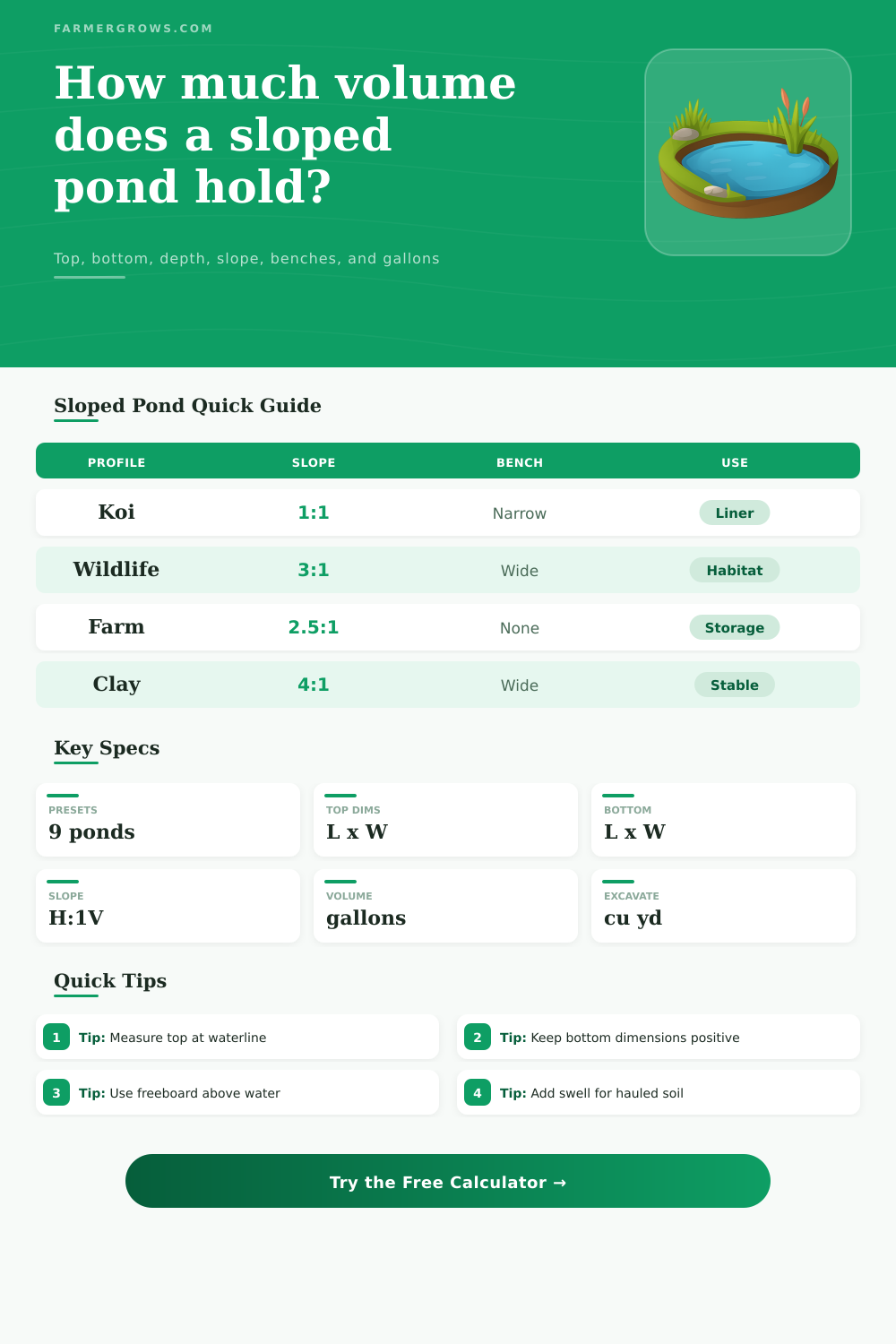
| 1:1 | 1 ft per 1 ft depth | Small lined ponds with protected edges | Confirm soil stability and safe exit routes. |
| 2:1 | 2 ft per 1 ft depth | Compact farm reservoirs and clay ponds | May still be steep for mowing or livestock. |
| 3:1 | 3 ft per 1 ft depth | Wildlife edges, shelves, and general farm use | Requires more top area for the same floor size. |
| 4:1 | 4 ft per 1 ft depth | Mowable banks and gentle access | Excavation footprint grows quickly. |
| 5:1 | 5 ft per 1 ft depth | Very gentle shoreline transitions | Useful for shallow habitat, less useful for storage. |
| Feature | Typical range | Volume effect | Planning note |
|---|---|---|---|
| Plant shelf bench | 1 to 3 ft deep | Adds shallow volume and reduces lower basin area | Keep shelves wide enough for baskets or rock. |
| Safety bench | 2 to 6 ft wide | Creates a broad upper stage | Common on ponds visited by people or livestock. |
| No bench | 0 ft width | Uses one smooth frustum | Simple for storage ponds and clean excavation. |
| Freeboard | 1 to 3 ft | Not counted as water volume | Included in excavation and rim footprint checks. |
| High-water reserve | Site specific | May exceed calculator waterline | Confirm overflow and spillway elevations. |
| Reference | Value | Used for | Why it matters |
|---|---|---|---|
| Cubic yard | 27 cubic feet | Excavation volume | Common unit for hauling and earthwork. |
| Cubic foot water | 7.48052 gallons | Pond gallons | Main water-volume conversion. |
| Acre-foot | 325,851 gallons | Farm storage | Useful for irrigation and larger reservoirs. |
| Cubic meter | 35.3147 cubic feet | Metric volume | Shown for metric records and pump sizing. |
| Soil swell | 10% to 40% | Loose spoil estimate | Excavated soil often occupies more volume. |
Top pond dimensions should describe the filled water surface. Freeboard adds extra height and width above that line for excavation, overflow, and bank planning.
If the entered bottom size differs sharply from the side-slope prediction, resurvey the top line, adjust the floor size, or treat the pond as an irregular engineered shape.
Calculating the volumes of a sloped pond involves many different measurement. It is important to calculate the volume of a sloped pond because the volume of that pond will determine how much water it will hold and how much dirt people will move in the excavation process. Many people make mistake when planning ponds because they do not account for the slope of the sides of the pond or the shape of the bottom of the pond.
If people do not account for the taper of the sides of the pond when calculating the total volume of the pond, then that pond may hold less water than desire and cost more to dig than people might have anticipated. The side slope that is chosen for a pond will change the volume of that pond and the footprint of the excavation that will be required for that pond. Using a one to one slope will create a steep pond that saves space in the overall footprint of the excavation site.
How to Calculate the Volume of a Sloped Pond
However, using a one to one slope may be unsafely for young children or livestock, and it will require a liner for the pond. Using a three to one or a four to one slope will create a gentler bank for the pond and will increase the footprint of the excavation site. You can use a calculator to manage the mathematics of the side slope of the pond by entering the dimensions of the pond and the desired slope ratios to determine if the desired floor area for the pond is possible at the desired slope.
Benches will be created in the pond as shallow shelves that are placed into the sides of the pond at a point partway down the slope of the pond. These benches will provide additional planting space or allow for safety step. Adding benches will change the volume of water that will be in the pond.
Additionally, benches will also change how the slopes of the pond will meet the floor of the pond. You should account for the width and depth of benches separately when calculating the total volume of gallons of water that will be in the pond to ensure that you do not overestimate the number of gallon or underestimate the amount of soil in the pond. The freeboard for the pond will be the extra height of the pond rim that will sit above the waterline of the pond.
Using freeboard will allow for the banks of the pond to withstand the force of heavy rains without the banks of the pond eroding. Additionally, using freeboard will provide a place to place an overflow for the pond to avoid the need to continually add water to that pond. The volume of excavation of the site for the pond will show both the volume of gallons of water that will be stored in the pond and the total size of the hole that must be dug.
Knowing the size of the hole that must be dug will help to order a liner for the pond and also to determine how many day it will take to dig that hole using a truck to remove the spoil of excavation of the pond. The soil swell for the pond is one of the factors that will affect how much space the excavated soil will occupy. Once removed from the ground, the volume of soil will change.
Clay soils will swell thirty percent once excavated, while sandy soils will swell only ten percent. Using a soil swell calculator will allow a person to select the percentage that the soil will swell once removed. This will help ensure that the excavation volume calculations is accurate regarding the volume of soil that will be hauled to another location.
The average depth of the pond is a specific measurement of the pond that is rarely the same than the depth of the deepest part of the pond. The depth of the pond may be less than the depth of the deepest part because of the sloped side of the pond. Knowing the average depth will allow a person to size the pump that will be used to fill the pond.
Additionally, knowing the average depth will help to calculate how many days the pond will be able to sustain evaporation before the water level become too low for the fish or plants that live in the pond. Ponds are rarely perfectly formed in their dimensions as they are built. The corners of the pond may not be perfectly rounded to the others, the banks may settle in the pond over time, and the waterline in the pond may not be the same as the height of the design of the pond.
You can compare the slope of the bottom of the pond to the slope that is created using an online calculator to ensure that the measurements of the pond are accurate. If the fit score is low between the two values, it may be necessary to take another measurement of the pond or to accept that the pond will have irregular dimension. To plan a pond, it is first important to measure the desired waterline of the pond.
Based off the size of the area that is planned to contain the pond, it will be possible to determine the slope of the pond that will be created. Using a tool to convert the measurements of the pond into gallons or cubic yard will help to determine how much water the pond will contain and how much soil will be excavated from the site. Each variable for the pond can be adjusted one at a time to see how that changes the total volume of the pond.
Using these numbers will help to create an idea as to the total resources that will be needed for the creation of this pond. However, these numbers are merely a start to the creation of the pond and dont replace a visit of the site and an engineer to create plans for the pond.