Cinder Block Garden Bed Calculator
Estimate cinder blocks, courses, corner units, cap blocks, cell fill, soil depth, drainage gravel, and repeated bed quantities from one practical garden bed layout.
Load a realistic dry-stacked bed, then adjust the block size, number of courses, corner handling, cap style, cell fill, soil depth, drainage gravel, and bed count.
Cinder Block Garden Bed Results
Your block, cap, soil, gravel, and cell-fill estimate will appear here.
| Outside Bed | One Course | Two Courses | Three Courses | Use Note |
|---|---|---|---|---|
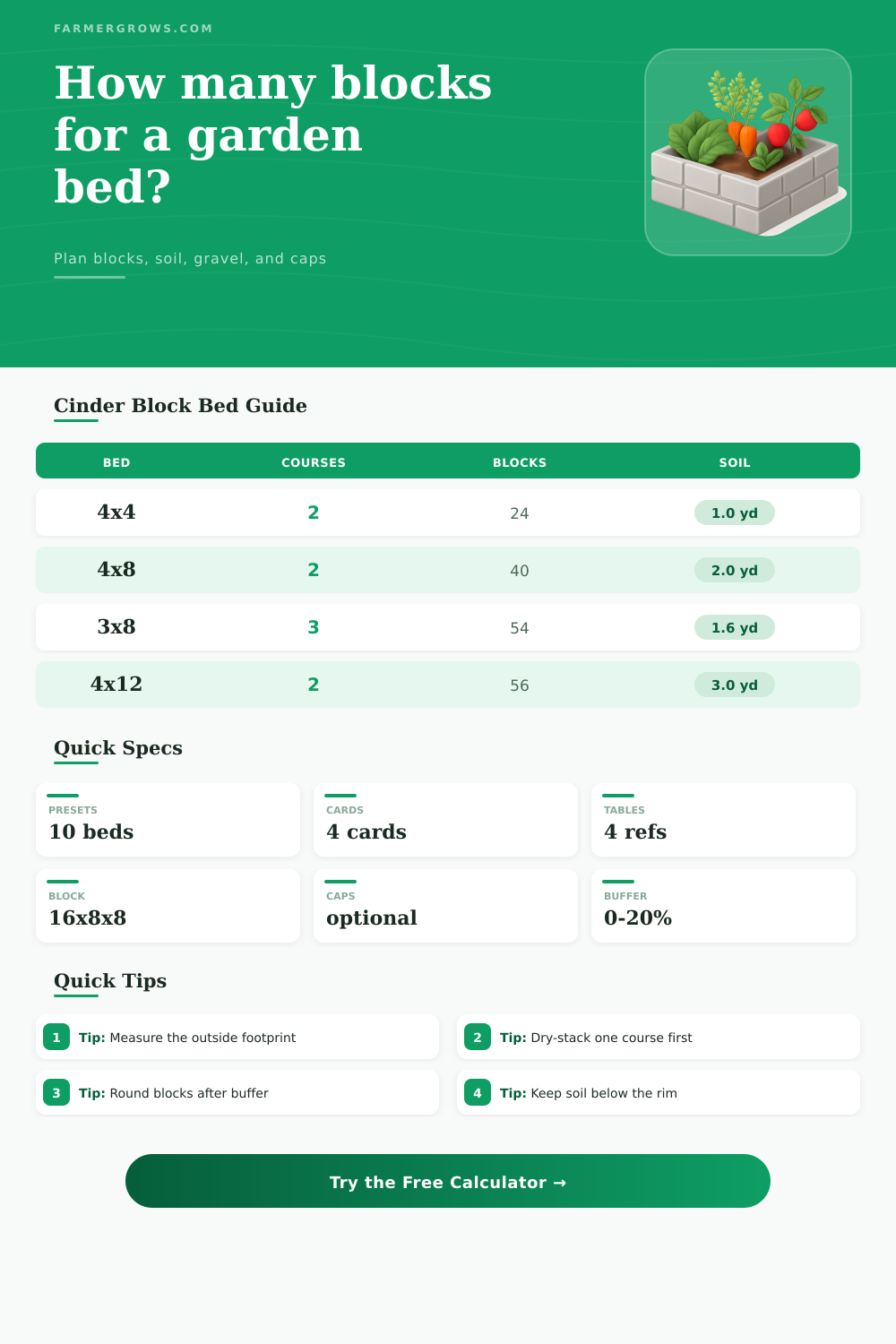
| 4 x 4 ft | 12 blocks | 24 blocks | 36 blocks | Compact herb or flower bed |
| 3 x 6 ft | 14 blocks | 28 blocks | 42 blocks | Narrow path-side bed |
| 4 x 8 ft | 20 blocks | 40 blocks | 60 blocks | Classic vegetable bed |
| 3 x 10 ft | 22 blocks | 44 blocks | 66 blocks | Long salad row |
| 4 x 12 ft | 28 blocks | 56 blocks | 84 blocks | Large kitchen garden bed |
| 6 x 12 ft | 34 blocks | 68 blocks | 102 blocks | Shared or school garden bed |
| Block Type | Nominal Size | Wall Height Per Course | Planning Note |
|---|---|---|---|
| Standard CMU | 16 x 8 x 8 in | 8 in | Most common dry-stack bed block |
| Half-height CMU | 16 x 8 x 4 in | 4 in | Useful for low herb beds or caps |
| Metric concrete block | 400 x 200 x 200 mm | 200 mm | Close to standard 16 x 8 x 8 |
| Skinny garden block | 12 x 6 x 6 in | 6 in | Smaller footprint, more pieces |
| Corner unit | Varies | Matches course | Count four per course when used |
| Cap block | Often 16 x 8 x 2 in | Finish only | Calculator counts caps by top perimeter |
| Crop Use | Soil Depth | 4 x 8 Bed Soil | Drainage Layer | Notes |
|---|---|---|---|---|
| Herbs and lettuce | 6 to 8 in | 0.45 to 0.60 yd³ | 0 to 1 in | Good for one low course |
| Leafy greens | 8 to 10 in | 0.60 to 0.75 yd³ | 1 to 2 in | Leave a watering lip |
| Peppers and beans | 10 to 12 in | 0.75 to 0.90 yd³ | 1 to 2 in | Two courses are comfortable |
| Tomatoes | 12 to 18 in | 0.90 to 1.35 yd³ | 1 to 3 in | Use deeper media or open bottom |
| Carrots and beets | 12 to 16 in | 0.90 to 1.20 yd³ | 0 to 1 in | Keep the fill fine and stone-free |
| Potatoes | 16 to 24 in | 1.20 to 1.80 yd³ | 0 to 2 in | Plan extra hilling space |
| Material | Volume Unit | Approx Bags Per Yard | Best Use | Calculator Field |
|---|---|---|---|---|
| Raised bed soil | 2 cu ft bag | 13.5 bags | Main bed fill | Soil depth |
| Compost blend | 1.5 cu ft bag | 18 bags | Top-up or mix share | Soil settling |
| Pea gravel | 0.5 cu ft bag | 54 bags | Drainage or cells | Drainage gravel |
| Bulk soil | 1 yd³ | 27 cu ft | Multiple beds | Soil volume result |
| Bulk gravel | 1 yd³ | 27 cu ft | Several bed bases | Gravel result |
| Block cell fill | cu in per block | 46,656 cu in | Open cores or anchors | Cell fill choice |
Lay out one course before buying every block. A path edge, slope, or slightly different block length can change the rounded side count.
Two 8-inch courses make a 16-inch wall, but soil often sits lower after gravel, settling, mulch, and watering clearance are included.
Cinder block garden bed are permanent structure due to the fact that cinder block garden beds dont easily move when the rain or frost fall on them. Many individual choose to purchase cinder block garden beds due to the sturdiness of these type of garden beds in comparison to wooden garden beds. Before beginning to build the cinder block garden beds, the individual must determine both the number of cinder block that are required for the garden beds as well as the amount of soil and drainage material that will be needed to fill the cinder block garden beds.
The dimensions of the cinder block garden beds will determine the number of cinder blocks that is required for the project. For instance, cinder blocks with a width of eight inches will be required to build a project with a four by eight footprint. However, the number of cinder blocks that are required may change based off the width of the cinder blocks that are to be used for the project or upon the method in which the individual will build the cinder blocks; for instance, if the individual is to place the cinder blocks on there sides to create a lower profile for the garden beds.
Planning and Building Cinder Block Garden Beds
Additionally, the type of treatment that are applied to the corners of the cinder block garden beds will impact the number of cinder blocks that the project requires; for instance, long cinder blocks can be placed through the corners of the project instead of utilizing corner specific cinder blocks or half cinder blocks. The height of the cinder block garden beds will determine the amount of soil and drainage material that will be required to fill the cinder block garden beds. For instance, if two course of cinder blocks are to be used, the height of the garden beds will be approximately sixteen inches; sixteen inches is generally sufficient for vegetables that do not have deep root system.
However, if three course of cinder blocks are to be used in the garden bed, the depth of the soil can accommodate plants with deep roots system; however, three course of cinder blocks will add to the weight of the project to be built; as such, the base course of cinder blocks will have to rest upon solid and level ground. The use of a calculator will help to determine the math behind the construction of the cinder block garden beds, and the calculator can help to determine if the depth of cinder block garden beds will provide the benefits to the vegetables that are to be grown in those beds. The choice of what to fill the cinder block garden beds with will impact their function.
For instance, leaving the core of the cinder block garden beds empty will save on the amount of material that is to be purchased; however, soil may enter into those empty core over time. Additionally, if the individual is to fill the core of the cinder blocks with gravel, drainage will be improved at the edge of the cinder block garden beds. Additionally, filling the cores of the cinder blocks with a soil mix will provide more growing space for the crops; however, this will require purchasing more soil to fill the cinder blocks.
Additionally, the individual should place drainage gravel at the bottom of the cinder block garden beds to prevent the bottom of the cinder block garden beds from becoming waterlogged after the rain. It is possible for individuals to underestimate the amount of soil that will be required to fill the cinder block garden beds. For instance, soil will settle within the cinder block garden beds.
Additionally, other factor, such as mulch and the area required to water the crops, may also impact the amount of soil that is required. Most plant require between eight and twelve inches of soil to grow good; however, crops like tomatoes and root crops require more than eight and twelve inches of soil. Therefore, a percentage of soil can be accounted for in the building of the cinder block garden beds to ensure that there is enough soil to grow the vegetable without running out of soil following the first rain that falls after the soil is planted.
Many individual make mistake in measuring their cinder block garden beds. For instance, they may use the incorrect measurement for the garden bed, or they may not account for the thickness of the cinder blocks in their calculation. For instance, the individual should measure the length of the garden bed from the cinder blocks themself; individuals and supplier purchase cinder blocks by the piece.
Additionally, the use of reference table for different sized garden beds can help to ensure that the proper number of cinder blocks will be purchased for the project. The dimensions of the cinder block garden beds must be constructed to fit the type of crops that will be grown within the garden beds and to fit the amount of space that is available for those garden beds. For instance, narrow cinder block garden beds may be best utilized along the fence line in the yard; however, the narrow width may prevent the crops from being rotated.
Additionally, larger cinder block garden beds will provide more area for the planting of crop; however, larger garden beds may make it more difficult to reach the center of the garden bed without stepping on the soil that contain the plant. A calculator will help to determine the cost of the material for each option for cinder block garden beds; however, no calculator can determine the best dimension for the cinder block garden beds. When each element of the cinder block garden bed matches the need for each element, the cinder block garden beds will be able to perform their function and fulfill their purpose.