Microgreen Seeding Density Calculator
Estimate seed grams per tray, live seed density, recommended sowing weight, germination loss, overage, soak hours, blackout days, and harvest timing for common microgreen crops.
Use weighed seed and measured tray dimensions for the best repeatability. Density values are planning targets; seed lot age, airflow, media moisture, and crop variety can shift the ideal rate.
Seeding Density Results
These values convert seed weight to seed counts, then adjust for germination and waste so the final stand can be compared with the target crop density.
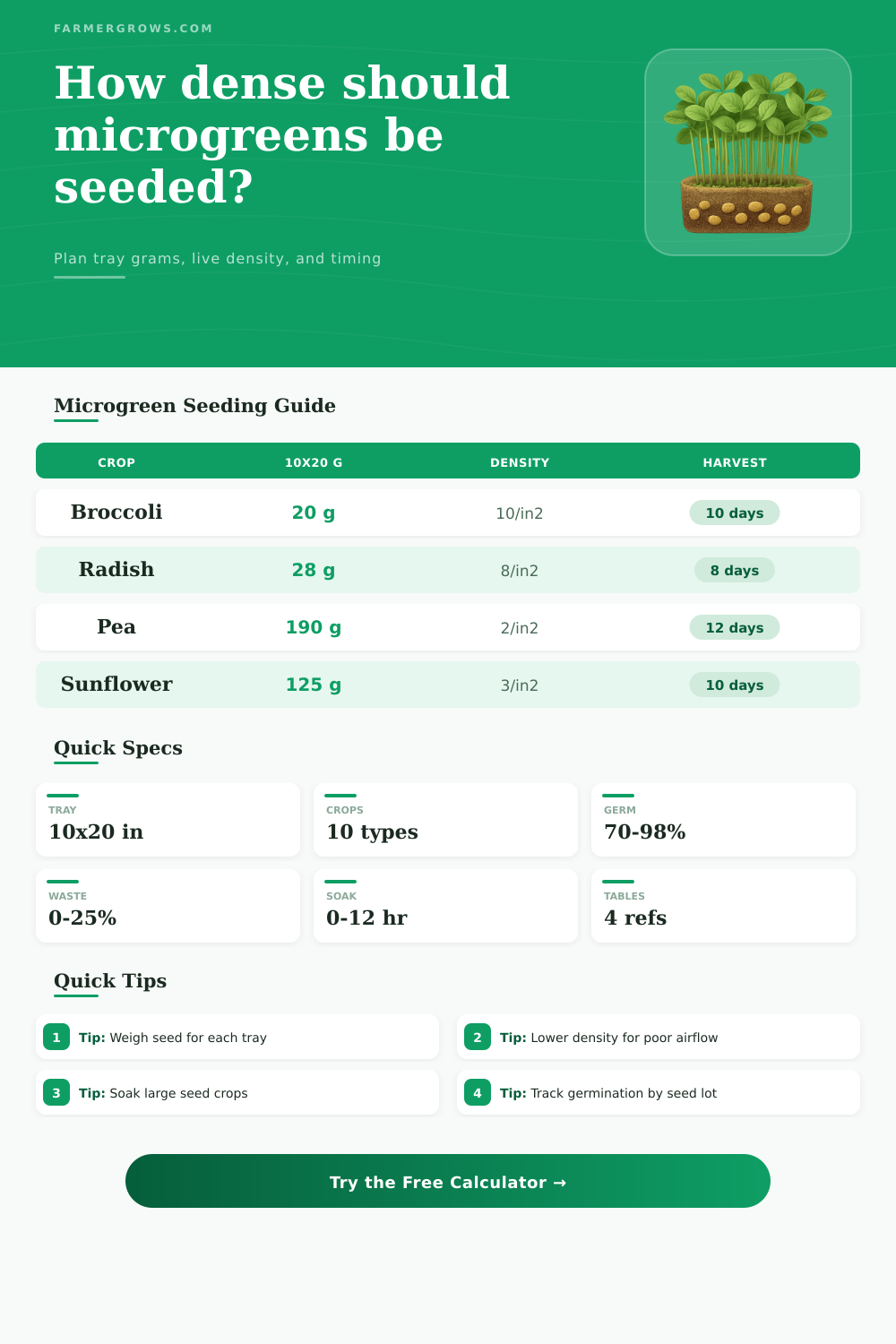
| Crop | Typical 10 x 20 grams | Seeds per gram | Target live density | Notes |
|---|---|---|---|---|
| Broccoli | 18 to 24 g | 85 to 110 | 9 to 12 per sq in | Even spread, moderate airflow demand. |
| Radish | 24 to 32 g | 55 to 70 | 7 to 9 per sq in | Fast canopy; avoid overly wet media. |
| Pea shoots | 170 to 220 g | 2.5 to 4 | 1.7 to 2.4 per sq in | Large seed with soak and drain step. |
| Sunflower | 110 to 145 g | 5 to 7 | 2.5 to 3.5 per sq in | Hull removal improves harvest quality. |
| Basil | 10 to 18 g | 650 to 800 | 8 to 11 per sq in | Mucilaginous seed; avoid soaking. |
| Cilantro | 55 to 75 g | 11 to 15 | 3 to 5 per sq in | Split seed germinates more evenly. |
| Tray format | Inside size | Area sq in | Area sq ft | Seed scaling from 10 x 20 |
|---|---|---|---|---|
| Full 1020 tray | 10 x 20 in | 200 | 1.39 | 100% |
| Half 1010 tray | 10 x 10 in | 100 | 0.69 | 50% |
| Quarter 5 x 10 tray | 5 x 10 in | 50 | 0.35 | 25% |
| Small 5 x 5 tray | 5 x 5 in | 25 | 0.17 | 12.5% |
| Euro tray | 30 x 40 cm | 186 | 1.29 | 93% |
| Seed lot condition | Germination range | Waste allowance | Calculator effect | Production note |
|---|---|---|---|---|
| Fresh tested seed | 92 to 98% | 3 to 8% | Small adjustment | Good for stable weekly production. |
| Average storage seed | 85 to 92% | 8 to 12% | Moderate extra seed | Retest when crop stand looks patchy. |
| Older seed lot | 70 to 85% | 12 to 20% | Large extra seed | Trial before using for orders. |
| Hard-to-spread crop | 80 to 94% | 10 to 18% | Compensates for clumps | Use shaker jars or split the seed pass. |
| Crop group | Soak time | Blackout days | Harvest window | Density caution |
|---|---|---|---|---|
| Brassicas | 0 hr | 2 to 4 | 8 to 12 days | Thin if stems stretch in humidity. |
| Radish and mustard | 0 to 2 hr | 2 to 3 | 6 to 9 days | Too dense can trap hulls and moisture. |
| Pea shoots | 8 to 12 hr | 3 to 5 | 10 to 14 days | Drain soaked seed very well. |
| Sunflower | 8 to 12 hr | 3 to 5 | 8 to 11 days | Avoid seed piles thicker than one layer. |
| Herbs | 0 hr | 3 to 6 | 14 to 24 days | Use lighter density for airflow. |
If stems are long, pale, or collapsing, reduce target density before increasing light. Crowding often shows first as weak airflow and uneven drying.
Record seed lot, grams, germination, blackout days, harvest day, and yield. The best density is the one that repeats cleanly in your own room.
Seed densities is used as a critical factor in the production of crops for several reasons. The density of the seeds that you place in the tray will determine how many plant will grow within that specific area of the tray. If you use too little seed, the plants that grow from that tray will stretch out toward the light.
Alternatively, you will find that if you place too much seed into the tray, the plants will become overcrowded, and they will develop disease from the lack of airflow between each plant. To prevent these problems, you must weigh the amount of seed that you will use for the size of the tray. The dimensions of the tray are another critical element in calculating the correct seed density for your crop.
How to Choose Seed Density for Trays
The internal dimensions of the tray are different than the external dimension of the tray. For instance, a 10 by 20 tray may have a different measurement of square inch within the tray than it does on the outside of the tray. By entering the inside dimensions into the calculator, you can ensure that you dont use the incorrect measurements for the size of the tray.
By entering the area of the tray, the calculator will tell you how many seeds the area can hold. The number of seeds that exist within a gram of that specific crop is another critical measurement. Some crops, like broccoli, contain ninety-five seeds within a gram.
Other crops, like peas, contain three seeds within a gram. Because these two crops are of a different weight, twenty grams of broccoli seed will grow more plants than twenty grams of pea seeds. Each grower should keep a log of the number of seeds per gram for each batch of seeds that they recieve.
This number can change, and it is essential to know that the target seed density will also change. Germination rate and the allowance for waste when planting the seeds is used to determine the number of seeds that will eventually grow as plants. The germination rates will tell you the percentage of the seeds that will grow.
In addition to this, you must also allow for the number of seeds that will be wasted when planting the seeds into the tray. Some of the seeds may fall towards the edges of the tray, others may be buried too deep into the soil, and some of the seeds will not germinate into plants due to different factors. By allowing for waste when calculating the number of seeds to be planted, the calculator will provide the grower with the information needed to determine how many grams of seed should be used for that specific tray.
The soak time and number of blackout days for the seeds will also impact the use of seed density calculations. For seeds that are large and contain more nutritional content, such as sunflower and pea seeds, soaking the seeds allows them to germinate more quickly. If the seeds germinate quickly due to soaking, the grower could utilize a lower density with the seeds.
Blackout days are the number of days that the seeds will not be exposed to light. The longer that the tray is without light, the more dense the seeds can be as the stems will not grow too weak and thinly with the lack of exposure to light from the grow room. The harvest time for the crops will also play a crucial role in the calculation of the density of the seeds.
The younger the radish that is harvested, the less leaf mass that will be grown compared to a radish harvested later in the growing cycle. If you harvest the plants too soon, you will have to increase the amount of seed that is used within the tray. If you allow the plants to grow longer, the density of the seeds can be decreased so that the lower leaves of the plants dont become yellowed before they are harvested.
There are also tables included on this page that provide additional information regarding the topic of seed density. The first table provides the gram range for common crops within a 10 by 20 tray. Additionally, the seeds per gram range for those crops is listed as well.
There is also another table that provides information regarding the format of the trays that are used and how these sizes can scale to other brands of growing trays. The third table explains how the condition of the seeds will impact the number of extra grams of seeds that should be added to the trays. Although these tables provide information that is essential for the grower to know, they are not a replacement for the grower measuring the number of grams of seeds and the number of plants that are grown in their room.
In addition to the information within the article, there are also a few environmental variables that will impact the results of the calculations that are made. The humidity of the growing room, where the fans are placed, and how often the trays are watered will impact the density calculations that are made within the grow room. Each calculation of the amount of grams of each type of seed to be planted in the trays is a hypothesis that should be observed as the plants are growing from the trays.
After the plants are harvested, the number of plants that were grown will provide information regarding whether or not the calculations were correct. This information will allow the grower to adjust the waste rate or the density of the seeds for the next cycle of planting of these crops. These principles can also be applied to the scaling of the grow room production.
By testing the density of the seeds within a small portion of the tray, the grower can determine the density that should be used within the entire tray. By utilizing the tray area calculator, growers can easily change the size of the trays that are used without having to calculate the area of the trays by the grower themselves. If a grower establishes a process for each cycle of planting the seeds, these trays can be easily turned into a production schedule.
Each cycle will eventually become a routine task for the grower, as the task of weighing the amount of seeds to be planted and germination rates of each type of seed will become routine tasks for that grower. While the information provided in this article is helpful for those who are just beginning to establish grow rooms and learn how to maximize their yields from those grow rooms, there are a few additional pieces of information that could of been provided. For instance, information regarding the type of soil that will be used within each tray would be helpful.
In addition to this, information regarding the type of lighting that will be provided to the trays would have been additionally helpful for the readers of this article. Other information that would have been additionally helpful is information regarding the types of crops that will be grown in the trays. This information would have allowed the readers to understand each grow room and how the information could potentially be applied to their grow room.