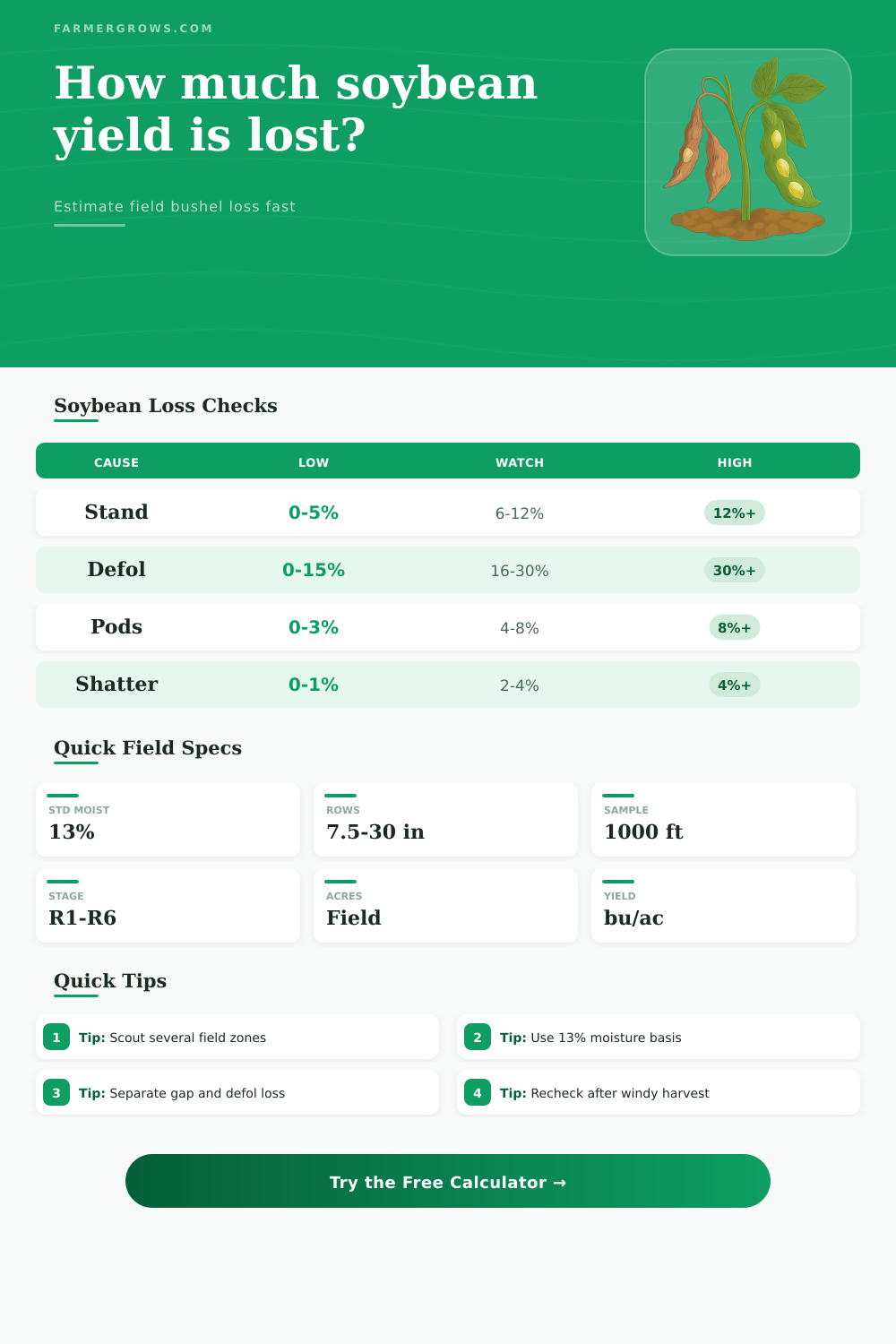
Soybean Yield Loss Calculator
Estimate soybean yield loss from missing plants, row gaps, defoliation, pod loss, shatter, harvest moisture, row spacing, expected yield, and affected acres.
Enter field scouting counts on a per 1,000 row-foot basis when possible. The calculator converts row spacing to row feet per acre, estimates stand and canopy loss, adds pod and shatter loss, then reports 13% moisture-equivalent bushels.
Soybean Yield Loss Results
Results update after calculation.
| Growth stage | Watch threshold | Model slope | Field note |
|---|---|---|---|
| Vegetative to V-stage | 35% leaf area removed | 0.10 yield point per extra point | Soybeans often regrow well before flowering. |
| R1-R2 bloom | 20% leaf area removed | 0.18 yield point per extra point | Use whole-canopy averages, not only worst leaves. |
| R3-R4 pod set | 15% leaf area removed | 0.28 yield point per extra point | Pod set is the calculator's most sensitive defoliation stage. |
| R5-R6 seed fill | 18% leaf area removed | 0.22 yield point per extra point | Late leaves still support seed size and fill. |
| Stand or gap condition | Suggested input | Model treatment | Scouting note |
|---|---|---|---|
| Scattered skips only | Gap pattern: scattered | 45% of open-row fraction | Neighbor plants can branch into small skips. |
| Mixed short gaps | Gap pattern: mixed | 65% of open-row fraction | Works for hail, crusting, and planter miss zones. |
| Long open gaps | Gap pattern: long gaps | 85% of open-row fraction | Use when bare row sections are easy to see from above. |
| Missing plant count | Plants per 1,000 row ft | 55% of missing stand percent | Converts to plants per acre using row spacing. |
| Harvest factor | Low concern | Watch level | Calculator use |
|---|---|---|---|
| Shatter and header loss | 0% to 1% | 2% to 4% plus | Subtracted after field damage loss. |
| Dry harvest moisture | 12% to 13% | Below 11% | Flags shatter-prone dry beans. |
| Wet harvest moisture | 13% to 15% | Above 16% | Converted to 13% moisture-equivalent bushels. |
| Total affected acres | Scouted zone | Whole field | Multiplies lost bu/ac into total bushels. |
| Row spacing | Row feet per acre | Missing plants/ac from 100 per 1,000 ft | Use case |
|---|---|---|---|
| 7.5 inches | 69,696 ft/ac | 6,970 plants/ac | Drilled or very narrow soybean rows. |
| 15 inches | 34,848 ft/ac | 3,485 plants/ac | Common narrow-row planter setup. |
| 20 inches | 26,136 ft/ac | 2,614 plants/ac | Split-row or intermediate spacing. |
| 30 inches | 17,424 ft/ac | 1,742 plants/ac | Wide rows with stronger branching potential. |
Split zones: Run the calculator separately for field edges, wet spots, hail streaks, and normal areas, then combine bushels by acre count.
Use averages: Estimate defoliation from the whole canopy and count pods on representative plants so a dramatic low spot does not skew the field result.
When you see gaps in your soybean field, you have to figure out how much yield you have lost. The number of soybean plant that are missing does not always translates to the amount of yield that your soybean plants will lose. Instead, to determine how much yield you lost, you must weigh the load of soybeans that you did harvest, and compare that amount of weight to the amount of yield that you expected to grow from your field.
Thus, calculating the loss of soybean plants can help you to determine the difference between the yield that you expected to grow from the field versus the actual soybean yield that you did harvest. Soybean plants are capable of compensating for some of the loss of soybean plants that are growing within the field, but the plants can only compensate for a limited amount of plant loss. When there are few soybean plants within a stand, many of the soybean plants may branch sideways toward the empty space created by the missing soybean plants.
How to Calculate Soybean Yield Loss
Thus, the soybean plants has the ability to compensate for the loss of individual soybean plants. However, if there are long gaps in the field of missing soybean plants, the soybean plants will leave the empty space within the field empty. A calculator can help to determine the amount of yield that you will lose based off the row spacing for your field, the target stand of soybean plants that you established for your field, and the length of the gaps that you measured within your field.
Using such a calculator is helpful in that it removes the guesswork as to how many soybean plants compensated for the missing plants. Defoliation of soybean plants will impact the yield of those soybean plants, but the extent of the impact of the defoliation will depend upon the growth stage of those soybean plants. For instance, if the soybean plants experience the loss of one-third of their leaves before the plants flower, the soybean plants are often able to grow the missing leaves and produce the normal number of soybean pods.
However, if the soybean plants lose their leaves while the soybean pods is filling, the soybean plants will experience a loss of those soybean pods, as they dont have time to grow the leaves before the size of the soybean pods is set. Thus, the timing of the leaf loss will impact the soybean yield. Pod loss and pod shatter are two different type of losses that can impact the soybean yield of a field.
Pod loss is experienced when a pod is clipped or removed from a soybean plant, such as at the R5 growth stage of development of the soybean pods. Pod shatter is experienced during the harvest of the soybean fields, where the soybean pods fall to the ground. Pod shatter differs from pod loss in that the soybean plants have already made the soybean pods prior to the shattering of those pods.
Thus, loss of pods and shattering of those pods will result in less soybeans being harvested from the soybean fields; however, pod loss and pod shatter should not be treated as the same type of loss due to the different causes for each type of loss. The moisture level of the soybean fields at the time of harvest will also impact the calculation of the soybean yield. The yield of soybeans is calculated based upon the moisture level of the soybeans at 13% moisture.
Therefore, any soybean loads that have a moisture level that is wetter or drier than 13% moisture will need to be adjusted. These adjustments will allow for the determination of whether or not the field performed better or worse than it initially appeared. Thus, running the data from the field through different moisture percentages will allow for the determination of whether the yield differences is due to water weight.
When you go into the field to scout the soybean fields for any types of damage to the soybean plants, you must make a decision as to which measurements of that field are the most accurate as to the yield of that field. It is not always the case that walking a single line through the field is representative of the yield of the entire field. For instance, the edge of the field that may be grazed by deer will contain different types of damage to the soybean plants than a low spot in the field that tends to become wet.
Thus, dividing the field into different zones will allow for the determination of the yield loss within each zone in the field, and the yields from each zone can be weighted according to the number of acre in each zone of the field. Row spacing will impact how many soybean plants can be grown per acre within the field. Fields with narrow row spacing will contain more soybean plants per acre than fields with wide row spacing.
Thus, if there are missing soybean plants in a field with narrow row spacing, there will be fewer percentage missing soybean plants than would be missing from a field with wide rows and fewer plants that are capable of compensating for the missing soybean plants. Soybean plants have a limit to how many plants they are capable of compensating for any damage to their stand of plants. Thus, the soybean plants will not be able to compensate for a 40% reduction in the stand of soybean plants within the field.
After a period of time, the soybean plants will reach out limit of how many soybean plants they are capable of compensating for the missing soybean plants. Thus, models that attempt to calculate the yield of soybean fields are more accurate than guessing at the yield of each field. Harvest losses can not be easily prevented within the harvest fields, but the losses within the harvest can be easily measured.
For instance, if the combine header is set too high, the combine header will remove some of the soybean yield from the field. For instance, if the speed of the reel within the combine is not correctly adjusted to the rest of the combine, the incorrect speed will remove soybeans from the field. Thus, counting the number of soybean pods that shatter behind the combine will allow for the determination of whether any of the soybean losses are from the field damage versus the soybean combine.
The figures calculated from the determination of yield loss from the soybean field is not the figure that represents the total yield of the field, but it is a figure that can be used to calculate the total yield of the field. For instance, the calculated yield can be used to compare the yield of each year of soybean growth. Thus, if the calculated yield figures for the soybean field matches the yield figures that were calculated from the scale tickets for the soybean fields, then there is a clear understanding of how much yield the soybean field produced.
However, if the two figures dont match, then there is a mismatch between the calculated yield and the actual yield of the field, suggesting that either that section of the field was missed when counting the yield, or that there were harvest losses beyond those that were calculated. The calculation of the yield loss of soybean fields should of been used as a starting point in determining the total yield loss for that field. For instance, if the yield loss calculation figure indicates an 8% yield loss for the field, the actual yield loss could be 12% if there were issues with harvesting that were missed by the calculation of yield loss.
Thus, while the calculation indicates the expected yield loss, the actual yield loss may be higher. However, it is also possible that the calculation of the yield loss overstates the actual loss that occurred to the soybean fields if the soybean plants within the field experienced branching of plants that was greater than that which is often indicated in the moddern models for yield loss determination. Thus, while the model is helpful in comparing different fields for soybean plants, the decision maker is still responsible for making the final judgment regarding the actual yield of those soybean fields.