Wood Drying Time Calculator
Estimate air-drying time for lumber, slabs, and firewood from wood species, thickness, moisture change, stack airflow, cover, humidity, temperature, and season start.
▶Drying presets
Choose a named starting point, then adjust the inputs for your pile, shed, or stickered lumber stack.
⚙Wood and drying conditions
Use board thickness, slab thickness, split face thickness, or round diameter.
▣Drying comparison grid
📊Species drying rates
| Species | Drying speed | Baseline MC drop per month | Typical note |
|---|---|---|---|
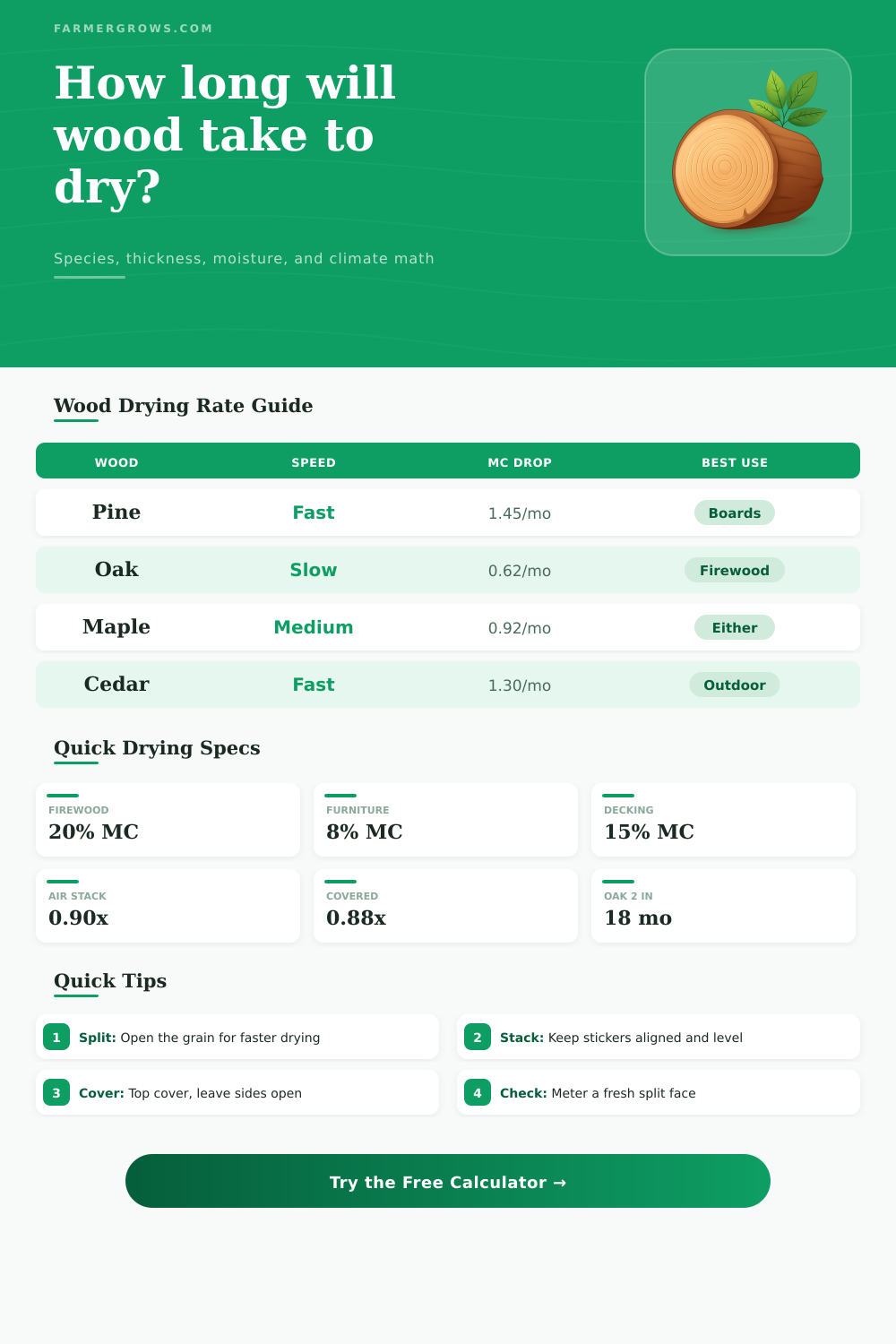
| White pine | Fast | 1.45 x reference | Open grain dries quickly when raised and stickered. |
| Cedar | Fast | 1.30 x reference | Lower density, good outdoor durability, quick surface drying. |
| Yellow poplar | Fast-medium | 1.15 x reference | Usually reaches shop targets faster than dense hardwoods. |
| Douglas fir | Medium | 1.05 x reference | Predictable for framing lumber with sticker space. |
| Soft maple | Medium | 1.00 x reference | Useful baseline for general air-drying estimates. |
| Hard maple | Medium-slow | 0.92 x reference | Watch for stain if airflow is weak early. |
| Cherry | Medium-slow | 0.88 x reference | Moderate density; benefits from shade and steady air. |
| Black walnut | Medium-slow | 0.82 x reference | Slabs need sticker spacing and patient equalizing. |
| Ash | Medium | 0.98 x reference | Often dries better than oak firewood in similar stacks. |
| Red oak | Slow | 0.62 x reference | Ring-porous hardwood with long firewood seasoning time. |
| White oak | Very slow | 0.55 x reference | Dense, tyloses-rich wood; expect long air-drying cycles. |
| Hickory | Very slow | 0.58 x reference | Dense firewood; split smaller and stack in full sun. |
↕Thickness multipliers
| Thickness or split size | Multiplier | Best fit | Planning note |
|---|---|---|---|
| 3/4 inch boards | 0.78 x | Thin boards | Short path to center, but avoid overdrying in hot sun. |
| 1 inch boards | 1.00 x | Reference stock | Common air-drying rule baseline for lumber. |
| 1.5 inch boards | 1.55 x | Heavy boards | Needs more time between early and final checks. |
| 2 inch slabs | 2.25 x | Slabs and thick planks | Keep stickers aligned to reduce twist and cup. |
| 3 inch slabs | 3.65 x | Thick slabs | Air drying can take several seasons before shop use. |
| 4 inch firewood splits | 1.75 x | Small splits | Good target for one-season softwood or ash drying. |
| 6 inch firewood splits | 2.65 x | Standard splits | Typical hardwood splits need long warm-season exposure. |
| 8 inch splits or rounds | 4.10 x | Large pieces | Split down for predictable stove moisture. |
| 12 inch rounds | 7.20 x | Unsplit rounds | Bark slows drying; center stays wet for a long time. |
🎯Moisture targets
| Use | Target MC | Check method | Why it matters |
|---|---|---|---|
| Indoor furniture lumber | 6-8% | Pin meter after acclimation | Matches heated indoor equilibrium moisture. |
| Interior trim | 8-10% | Meter several boards | Reduces gaps, swelling, and seasonal movement. |
| General shop lumber | 10-12% | Meter core or resaw face | Reasonable for unheated shops and farm repairs. |
| Outdoor boards | 12-16% | Meter shaded face | Closer to outdoor equilibrium in many climates. |
| Firewood for stoves | 15-20% | Fresh split face | Burns cleaner and gives more useful heat. |
| Campfire wood | 20-25% | Split sample | Usually lights acceptably but may smoke more. |
| Green turning blanks | 25%+ | Weight tracking | Stored for controlled rough turning, not final use. |
☀Climate modifiers
| Condition | Modifier | Drying effect | Practical reading |
|---|---|---|---|
| Excellent airflow | 0.84 x time | Faster | Single rows, raised base, wind crossing the stack. |
| Average airflow | 1.00 x time | Baseline | Common stickered lumber or stacked firewood. |
| Poor airflow | 1.30 x time | Slower | Tight pile, wall blocked, weeds, or closed sides. |
| Top covered only | 0.88 x time | Faster | Keeps rain off while letting side air pass through. |
| Fully tarped sides | 1.22 x time | Slower | Traps humidity and slows surface moisture loss. |
| Dry climate | 0.82 x time | Faster | Low relative humidity increases drying potential. |
| Humid climate | 1.22 x time | Slower | High RH narrows the vapor pressure difference. |
| Winter start | 1.35 x time | Slower | Cold months count, but drying is limited. |
ℹDrying tips
This calculator is a planning estimator for air drying. Kiln schedules, end sealing, defects, board orientation, local rainfall, and species variability can change real drying time.
Wood drying depend on specific condition to be successful, and several variable influence the time that it take for the wood to dry. If an individual decide to stack their lumber and wait for the lumber to dry out naturaly, the timeline for drying the wood can differ from piece of wood to the next. The timeline of drying wood depends upon the species of the wood, the thickness of the wood, the airflow that surrounds the wood, and the weather in the area where the wood is dried.
If these variable are managed correct, the wood will dry to the desired moisture level, saving the woodworker money and time that would otherwise be spent on stalling projects due to the need to dry the wood. Wood contain a large amount of water that exists within the cell wall of the wood and within the spaces between the wood cells. For the wood to dry, the water must leave the wood.
What Makes Wood Dry Fast or Slow
As the water leave the wood, the wood will shrink and stiffen. The speed at which the water leaves the wood can vary from one type of wood to another. For instance, wood species like pine and cedar tend to release moisture quick from the wood due to the open cellular structure of those species.
In contrast, oak and hickory naturally release moisture at a more slower rate due to the narrower pores within the wood cells of these species. Furthermore, white oak contains tyloses that naturally fill the pores of the wood, preventing the movement of moisture in and out of that species of wood. Because each species of wood dries at a different rate, the woodworker must identify the species of the wood prior to begin to dry the wood.
Another important factor in the drying rate of wood is the thickness of the pieces of wood that is drying. The thickness of the wood is an important factor because moisture must naturally travel from the center of the wood to the surface of the wood. The thicker the wood, the more difficult it is for moisture to leave the wood.
For instance, a one-inch plank of pine may dry out to the target moisture level in the span of one warm season. However, it may take twice as long to dry a two-inch plank of the same type of pine due to the moisture that remain within the center of the plank. Airflow around the wood is another important drying variable.
Air that move away from the wood carries the moisture away from the wood. Placing lumber in a single row on stickers that have open side will dry faster than placing alot of wood into a tight stack against a wall. Only the top of the wood should be covered with a tarp in order to keep the wood from being exposed to rainfall.
If the sides of the wood are covered, the moisture within the wood may re-enter the wood as the water evaporates from the top of the wood, slowing the drying process of the wood stack. The seasonal weather condition also impact the drying of the wood. Because warm air can hold more moisture than cold air, wood that dries in the summer will dry faster than wood that dries in the winter.
For instance, it take more time for wood to dry during the winter month than it does during the summer. The movement of moisture out of the wood each week decrease significantly when the temperature of the area drop below forty-five degrees. Finally, the way in which the wood will be utilized affects the target moisture level of the wood.
For instance, if the wood is to be used for furniture, it should be dried to a moisture level of around eight percent so that the resulting furniture will not move if placed in a heated house. If the wood will be used as firewood, however, twenty percent moisture is the target because it allows the firewood to burn more efficient and waste less energy in the form of steam. Thus, an individual must decide the desired moisture level of the wood.
Many people makes mistakes in the wood drying process because they treat all type of wood the same. For instance, if an individual place oak lumber in the same way that they would place pine lumber, it is likely that the oak will remain heavy after one year of drying because the species of oak dries at a slower rate than pine. Additionally, if the rounds of wood are not split, they will remain wet in the center of the round for two growing season.
To improve the drying of lumber, the individual can split the larger piece of wood, raise the bottom course of the lumber off the ground, and ensure that the stickers of the lumber are aligned. Each of these step will improve the drying condition for the wood.