Equilibrium Brine Calculator
Calculate salt, sugar, brine strength, and optional Cure #1 from the full food-and-water mass.
Equilibrium brine result
Equilibrium wet brine
Measures salt against the full food plus water mass.
Best when the food can sit long enough to equalize.
Gradient cover brine
Measures brine percentage against water only.
Best for short soaks where the surface seasons first.
Equilibrium dry salt
Measures salt directly against food weight.
Best for bacon, fish, and firm cuts in sealed bags.
Storage brine
Uses stronger brine to hold cheese, olives, or pickles.
Best after fermentation or curing has already set texture.
| Food or use | Common equilibrium target | Typical sugar | Notes |
|---|---|---|---|
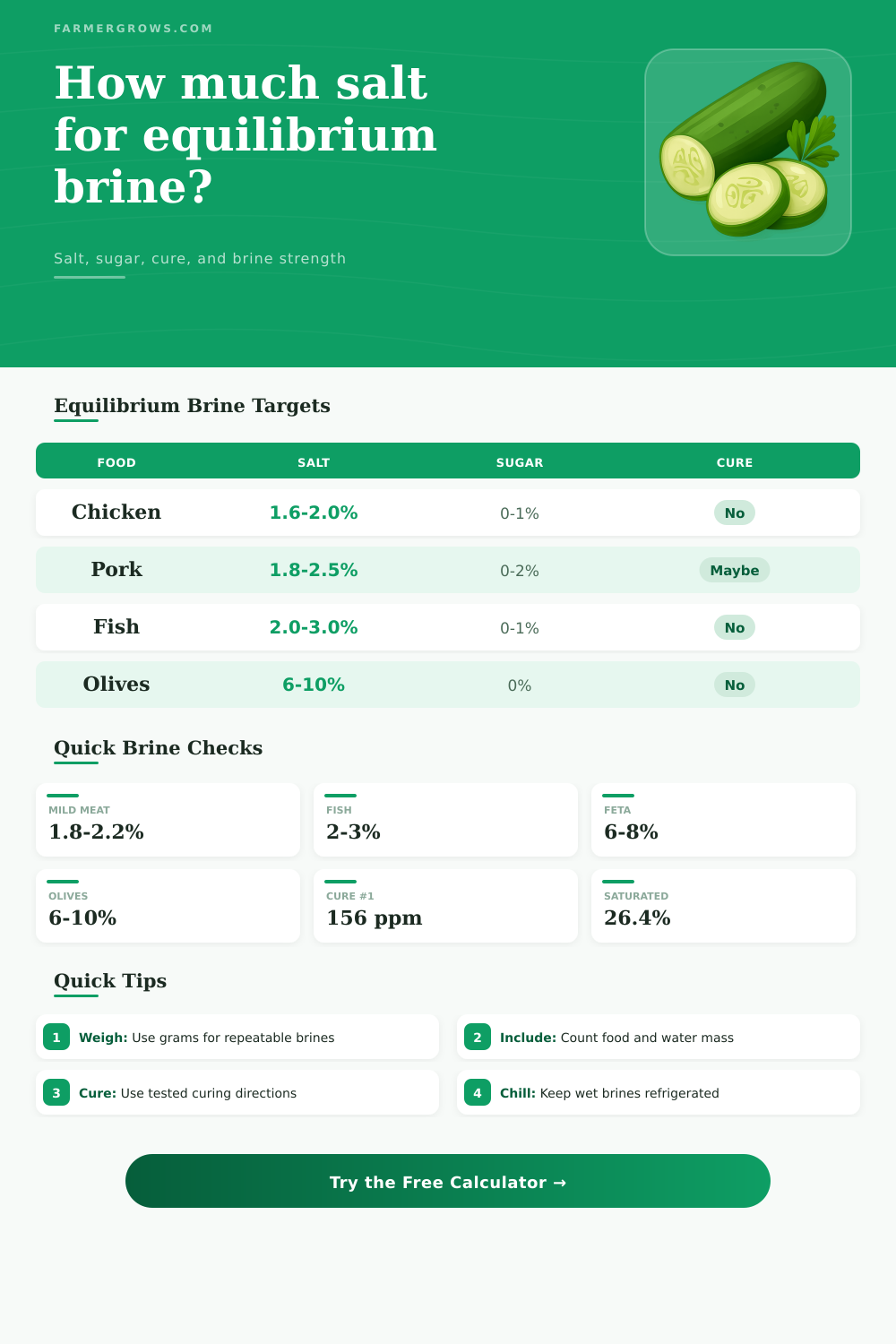
| Chicken or turkey pieces | 1.6% to 2.0% | 0% to 1% | Mild seasoning without ham-like texture. |
| Pork chops or roast | 1.8% to 2.5% | 0% to 2% | Use the higher end for thick cuts. |
| Fish fillet | 2.0% to 3.0% | 0% to 1% | Short brines usually need less water. |
| Bacon or ham with Cure #1 | 2.0% to 2.5% | 0.5% to 2% | Follow a tested curing schedule. |
| Feta storage brine | 6% to 8% | 0% | Acidified whey or water is commonly used. |
| Olive brine | 6% to 10% | 0% | Stronger brine supports long storage. |
| Cucumber ferment brine | 3% to 5% | 0% | Vegetables also contribute water. |
| Water-only brine | Salt per liter water | Approx. salometer | Common use |
|---|---|---|---|
| 2% | 20 g | 7.6° | Light vegetable brine. |
| 3.5% | 35 g | 13.3° | Cucumber fermentation range. |
| 6% | 60 g | 22.7° | Cheese and olive storage range. |
| 10% | 100 g | 37.9° | Strong pickling brine. |
| 26.4% | 359 g | 100° | Saturated brine near 60°F. |
| Cure #1 nitrite target | Cure #1 per kg batch | Salt contributed | Where it appears |
|---|---|---|---|
| 100 ppm | 1.60 g | 1.50 g | Lower cured-meat formulas. |
| 120 ppm | 1.92 g | 1.80 g | Moderate immersion cures. |
| 156 ppm | 2.50 g | 2.34 g | Common U.S. maximum for many pumped or comminuted products. |
| 200 ppm | 3.20 g | 3.00 g | Do not exceed applicable tested-process limits. |
| Batch example | Food | Water | Salt at 2% |
|---|---|---|---|
| Two chicken breasts | 700 g | 500 g | 24 g |
| Four pork chops | 1.4 kg | 1.0 kg | 48 g |
| Turkey breast roast | 3.0 kg | 2.0 kg | 100 g |
| Small ham piece | 3.5 kg | 2.5 kg | 120 g |
Equilibrium brining are a method of seasoning that involve using a specific mathematical calculation to determine the equilibrium concentration of salts. In traditional brining methods, the cook measures the salt according to the weight of the water that is being use. In equilibrium brining, however, the salt is measured according to the weight of the foods and the weight of the water.
In this method, the food, the water, and the salt is treated as one single system. As a result of this method, the salt concentration within the food will eventually become the same than the salt concentration within the brine. Therefore, the amount of salt that end up within the food will be the same percentage as the target percentage of salt that was choose for the equilibrium brining process.
How to Do Equilibrium Brining
In order to perform equilibrium brining, it is necessary to weigh the foods that is to be brined and the water that will be used in the brining processes. The weights of each of these components are to be combined to determine the total weight of the system that will be created through the brining process. The total weight are multiplied by the target percentage of salt to determine the total weight of salts that should be added to the system.
For instance, if the ingredient that is to be brined weigh two kilogram, and one liter of water is to be used, the salt should be calculate according to the total weight of the two-kilogram item and the one liter of water. It is common for the amount of salt that is calculated for equilibrium brining to be less then that which would be calculated through traditional brining methods, as the food itself will contain some of the salt necessary for the process. In addition to salt, sugar can also be used in equilibrium brining.
The amount of sugar that should be used can be calculate in the same way as the amount of salt. Should other ingredient, such as garlic or phosphates, be used in the brining process, those ingredients will also be considered part of the total weight of the system. Because the sugar is calculated as a percentage of the total weight of the system, the amount of sugar will remain in proportion with the other ingredient.
Thus, the brining process can be easily scaled from small amount of ingredients, such as fish, to large amount of ingredients, such such as turkey. In utilizing a cure, such as Prague Powder Number One, it is important to recognize that the cure contain both salt and nitrites. The equilibrium brining calculator will account for the salt that is contained within the cure; the calculator will calculate how much salt is require, and then automatically subtract the salt contained within the cure from that total salt amount.
The resulting amount will be the total amount of plain salt that should be added to the system. Additionally, the calculator will also indicate the amount of nitrite that should be added to the system, which is measured in part per million of the total weight of the system. Both of these calculations ensures that the salinity and safety of the curing process will remain accurate, whether the items being cured are poultry or bacon.
Temperature and type of salt to be used are two other factor that can impact the equilibrium brining process. For instance, salt solubility change according to the temperature of the brine. Brines that are much warmer or colder than the room temperature in which they is prepared can have different rates of salt solubility.
An equilibrium brining calculator will alert the individual if the salt percentage are within a range that might be impacted by such a temperature. Additionally, different type of salt have different density. For instance, while pickling and table salt may weigh the same amount per tablespoon, large flake of kosher salt will occupy more of the same volume.
While the equilibrium brining calculator can calculate the volume of salt that will be needed, based off the density of the type of salt that is to be used, it is always recommend to use a scale to measure the amount of salt to be used; humidity and air density may impact the accuracy of the calculation. The ratio of water to food that is to be brined will have an impact upon the resulting salt concentration within the food. If the ratio of water to food are low, the salt will season the food quick.
However, if the ratio of water to food is high, the salt will have more time to season the center of the food. Vegetables contain the liquid necessary to help them ferment. Additionally, as the vegetables ferment, their cell will break down, and the salt will change slightly.
However, for item that are to be stored for long period of time, such as cheese or olives, a higher percentage of salt will be used to prevent microbial growth. Many individuals tend to make mistake during the brining process. For instance, some individuals may be unaware of the importance of weighing the water and the food.
Some may only weight the water; others may forget to weight the food altogether. Other individual may add the cure to the food and salt separately, rather than considering the amount of salt contained within the cure itself. Each of these mistake may result in the food containing to be too salty or not salty enough.
However, by using an equilibrium calculator, these variable are accounted for; the mathematics of equilibrium brining will ensure that the salinity of the food will be that which was targeted by the briner. Furthermore, because the salt concentration can be adjusted, the flavor of the food can be altered accordinging.