Candle Wick Size Calculator
Choose a wax, vessel size, fragrance load, wick family, and burn-test target to get a practical starting wick plus nearby sizes to test.
Wick charts are starting points, not final safety approvals. This calculator uses inside candle diameter, wax heat demand, fragrance load, additives, room temperature, and selected wick family to choose a burn-test range. Always perform controlled burn tests before selling or gifting finished candles.
✦Named candle presets
⚙Candle and wax details
Recommended wick test plan
Use the starting size for your first pour, then burn-test the smaller and larger sizes shown below in the same wax, vessel, fragrance, cure time, and room conditions.
▣Wick family heat profile grid
≈Comparison grid for your test pour
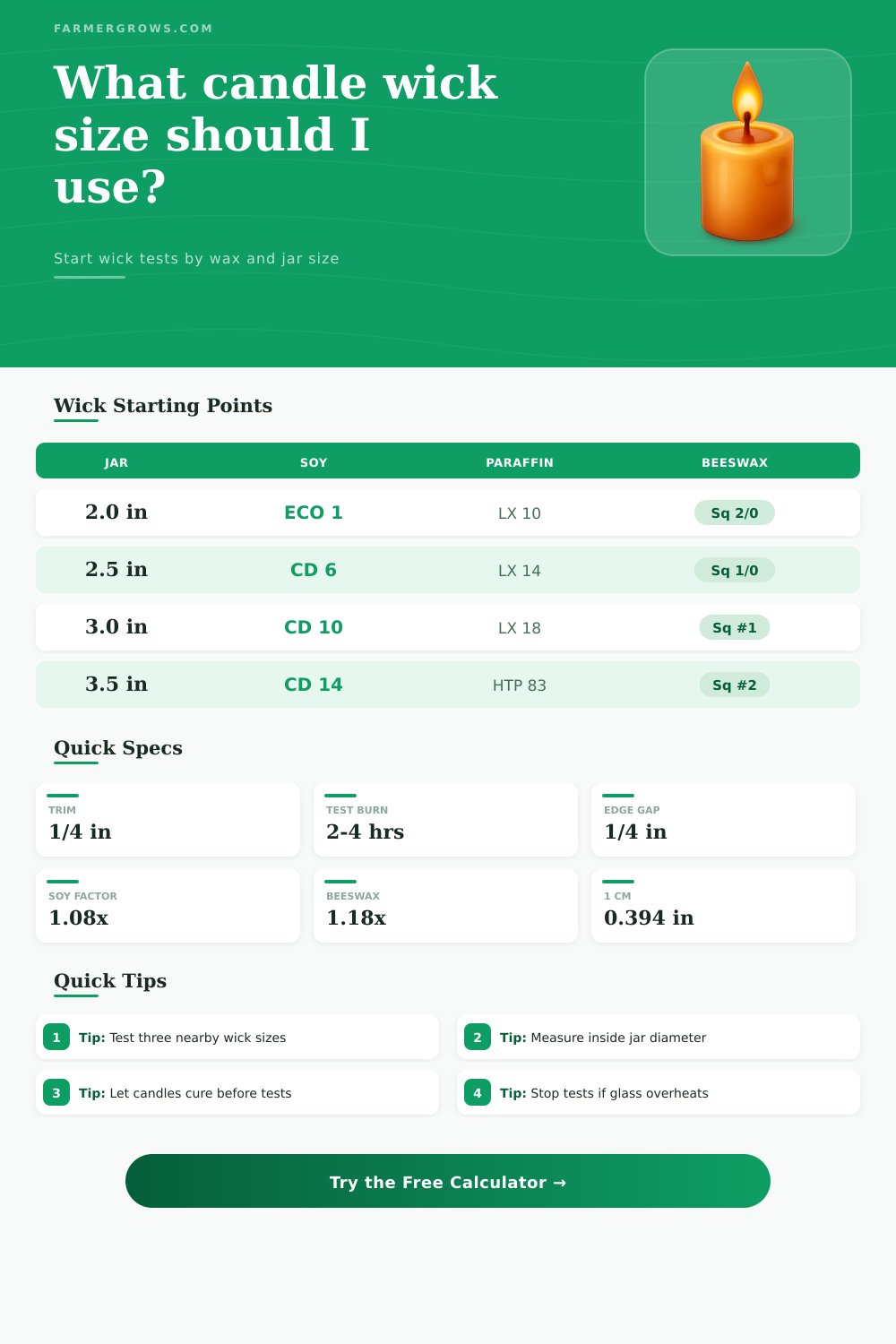
📊Reference table: starting wick by diameter
| Inside diameter | Soy start | Paraffin start | Beeswax or pillar start |
|---|---|---|---|
| 1.5-1.9 in (3.8-4.8 cm) | ECO .75 or CD 2 | LX 8 or HTP 31 | Square 3/0 or LX 8 |
| 2.0-2.4 in (5.1-6.1 cm) | ECO 1-2 or CD 4 | LX 10-12 or HTP 41 | Square 2/0 or LX 10 |
| 2.5-2.9 in (6.4-7.4 cm) | CD 6-8 or ECO 4-6 | LX 14-16 or HTP 52 | Square 1/0 or LX 14 |
| 3.0-3.4 in (7.6-8.6 cm) | CD 10-12 or ECO 8-10 | LX 18-20 or HTP 73 | Square #1 or LX 18 |
| 3.5-3.9 in (8.9-9.9 cm) | CD 14-16 or ECO 12 | LX 21-22 or HTP 83 | Square #2 or HTP 83 |
| 4.0-4.8 in (10.2-12.2 cm) | Two CD 6-10 wicks | Two LX 12-16 wicks | Two square 1/0-#1 wicks |
◎Reference table: multi-wick layout
| Vessel opening | Common wick count | Placement pattern | Clearance check |
|---|---|---|---|
| Under 3.7 in | 1 wick | Center point | Keep flame centered and trim to 1/4 in. |
| 3.8-5.2 in | 2 wicks | Even line across widest span | Keep each wick at least 1.0 in from glass. |
| 5.3-6.6 in | 3 wicks | Triangle or long oval line | Use smaller wicks to avoid a joined flame front. |
| 6.7-8.0 in | 4 wicks | Square, diamond, or long rectangle | Check hot spots at corners and thin walls. |
| Over 8.0 in | 5+ wicks | Evenly spaced grid or line | Prototype carefully; wide vessels need full testing. |
🌡Reference table: wax and additive factors
| Formula factor | Heat adjustment | Why it matters | Calculator treatment |
|---|---|---|---|
| Soy container wax | +8% | Soy commonly needs more heat to reach a full melt pool. | Raises service diameter before wick lookup. |
| Paraffin container wax | -8% | Paraffin usually melts and pools more readily. | Lowers service diameter before wick lookup. |
| Beeswax | +18% | Higher melt point and dense fuel often need stronger wicks. | Routes to square braid unless another family is chosen. |
| Fragrance above 6% | +2% per point | More oil changes fuel flow and can slow or dirty the burn. | Adds a controlled heat-demand correction. |
| Heavy dye or mica | +8% | Particles can clog capillary flow and shrink melt pools. | Adds a wick-power correction and warning. |
| Cool test room | +3% to +6% | Cool air steals heat from the melt pool. | Adjusts power when room temperature is below 68°F. |
✓Reference table: burn-test signs
| Observed result | Likely cause | Next wick test | Safety note |
|---|---|---|---|
| Tunnel remains after target interval | Wick too cool, too much dye, or short cure | Move one size hotter or reduce additives | Do not chase a full pool in the first hour. |
| Deep melt pool over 1/2 in | Wick too hot or too many wicks | Move one size cooler or reduce wick count | Stop if glass is uncomfortable to touch. |
| Sooting or mushrooming | Excess fuel, large flame, or poor fragrance fit | Trim, then test a smaller wick | Persistent soot means the formula needs revision. |
| Flame drowns late in burn | Wick too small for deep jar or heavy fragrance | Test hotter wick or lower fragrance load | Deep containers need bottom-half burn checks. |
| Wall blowout on pillar | Wick too hot for shell thickness | Use a smaller wick or harder wax blend | Pillars need shell retention, not edge-to-edge pools. |
Candle makers must find the correct size of melt pool to ensure that it reaches to the edge of the container; otherwise, there will be a ring of solid wax on the container. Additionally, the candle maker must not overheat the glass because the overheated glass can present a safety issue to the candle maker. The size of the wick will determine whether the candle creates a balanced melt pool or if the candle fail to burn correctly.
Using a wick that is too small will leave a ring of solid wax and cause the wax to tunnel in the middle of the candle. Using a wick that is too large will overheat the container of the candle. Finding the correct size of the wick will save the candle maker time and wax by avoiding having to continually test different sizes of wicks.
Finding the Right Wick Size for Your Candle
The diameter of the vessel is an important measurement to understand what size of wick to use. The candle maker must measure the diameter of the container at the inside measurement of the vessel at the level in which the wax will be poured into the vessel. The diameter of the vessel may be different at various points along the vessel.
The wick must be sized to the narrowest part of the vessel. The calculator use the inside diameter of the vessel measurement to determine the effective service diameter of the vessel. The effective service diameter isnt the same as the width of the vessel.
The flame does not heat the vessel in the same area. The width of the flame can change depending on the type of fragrance in the candle. Two candles that are the same size may have different sized wicks if the fragrance for the candle are different.
The type of wax that will be used in the candle will change the amount of heat that the candle will require to melt the wax. Soy container wax will require more heat than paraffin wax. This is due to the crystals in the soy container wax that require higher temperature to melt.
Bees wax will require even more heat than soy container wax. Due to the density of bees wax, a square braid wick will be required for burning candles that use bees wax. Coconut blends will require different amounts of heat based off the ratio of the amount of coconut wax to soy or apricot wax.
The heat factor within the calculator allow for the suggestion of wick size to account for the specific type of wax that is to be burned in the candle. If another type of wax is selected, the calculator will adjust the suggestion of wick size to reflect this change. The fragrance load of the candle will change how the wick function for that candle.
Using a fragrance load that is above six percent will slow the capillary action of the wax. If the capillary action of the wax is slowed, the melt pool will be smaller than that which would otherwise be created with a non-fragranced candle. A fragrance load between nine and ten percent will have more of an impact upon the size of the melt pool.
Using heavy dye and mica will also slow the capillary movement of the wax. The melt pool will be smaller than it would be with a non-dyed candle. The calculator makes adjustments to the suggested size of the wick to account for the effects of fragrance load and heavy dye.
Using such a wick will allow the candle to function as intended without the use of an oversized wick that may create soot in the candle. For multi-wick candles, the size of the wicks will change based upon the size of the vessel in which the candle will be poured. For instance, large vessels may use one large wick or several smaller wicks.
Using smaller wicks will reduce the amount of soot in the candle. Additionally, smaller wicks can be kept further from the glass containing the wax. The calculator will make an estimate of the number of wicks and the size of the flames that will work for the vessel area.
This auto-layout can be changed by the candle maker if they wish to use two or three wicks for the candle. If two flames are used, they should be spaced apart enough so that they do not merge into one flame when burning. If they do merge into one flame, the benefit of using multiple wicks will be lost.
The temperature of the room where the candle is to be tested will impact the result of the burn test. The temperature of the room will impact how much heat is extracted from the melt pool. In cool environments, the body heat of the candle maker will contribute to the melt pool.
In warm environments, heat will be extracted from the melt pool. A cool room will make the melt pool appear too small to be correct. A warm room will make the melt pool appear too large.
The temperature of the room should be recorded within the burn notes for the candle. By recording the temperature of the room where the candle is tested, the candle maker will be able to understand why the wick may behave differently in different environments. Testing the candles involves trimming the wick to a quarter inch, lighting the candle, and burning the candle for three or four hours.
After the length of time, the size of the melt pool should be measured. Additionally, the temperature of the glass should be measured. If the size of the melt pool has not reached the wall of the container but the container is warm to the touch, the wick is too large.
If the size of the melt pool has not reached the wall of the container and the container is cool to the touch, the wick is too small. Using three different sizes of wicks allows the candle maker to find the best size without pouring too much wax into too many candles. The reference tables for wicks are provided for quick orientation to the topic of wick size.
The reference tables display the size of the melt pool created by different types of wicks in different sizes of vessels. The reference tables also display the number of wicks used in vessels of various sizes. The tables also provide information about the signs of a wick that is too hot or too cool for the vessel containing the wax.
These tables are most useful for individuals who are familiar with the size of their vessels and the type of wax that will be used. These tables allow the candle maker to narrow the options for wick size before using the detailed calculator to determine the best wick size for their specific candle recipe. Finally, the cure time for the candle will impact the results of the burn test.
Most container wax requires a cure time of at least one week. During this time the fragrance will bind with the wax. Testing the candle before it has cured will cause the candle to appear to have a wick that is too small for the vessel.
Testing the same candle after a two-week cure time will create a melt pool that is wider along the container. The goal of testing is to find the best starting point for the candle recipe. Once found, small adjustments can be made to the recipe with confidence.
The calculator is used to find the math behind the candle recipe. Once the measurements for the ingredients are entered into the calculator, the candle maker can return to the candle bench to test the wick. By deciding on either moving the wick size up or down one size, the candle maker can create candles that burn properly and safely.