Dual Lye Soap Calculator
Build a NaOH and KOH recipe from oil weight, oil SAP values, lye split, KOH purity, superfat, water concentration, target hardness, and target solubility.
This calculator treats the KOH split as the share of alkali equivalents supplied by potassium hydroxide. KOH is converted from NaOH equivalents with a 1.403 molecular-weight factor, then adjusted for the KOH purity you enter.
| Oil row | Oil or fat | Blend % | NaOH SAP | Estimated profile role |
|---|---|---|---|---|
| Oil 1 | 0.000 | balanced | ||
| Oil 2 | 0.000 | balanced | ||
| Oil 3 | 0.000 | balanced | ||
| Oil 4 | 0.000 | balanced | ||
| Oil 5 | 0.000 | balanced | ||
| Oil 6 | 0.000 | balanced |
Dual Lye Recipe Results
Results use the current oil SAP values, superfat, NaOH/KOH split, KOH purity, and lye concentration.
| Oil or fat | NaOH SAP | KOH SAP estimate | Main profile signal |
|---|---|---|---|
| Coconut oil, 76 degree | 0.183 | 0.257 | High cleansing, high hardness, high solubility. |
| Olive oil | 0.134 | 0.188 | Conditioning, slower to harden, low cleansing. |
| Palm oil | 0.142 | 0.199 | Firm structure and steady bar hardness. |
| Beef tallow | 0.141 | 0.198 | Hard bar feel with creamy lather support. |
| Castor oil | 0.128 | 0.180 | Lather support, solubility, and humectant feel. |
| Shea butter | 0.128 | 0.180 | Firming butter with low cleansing. |
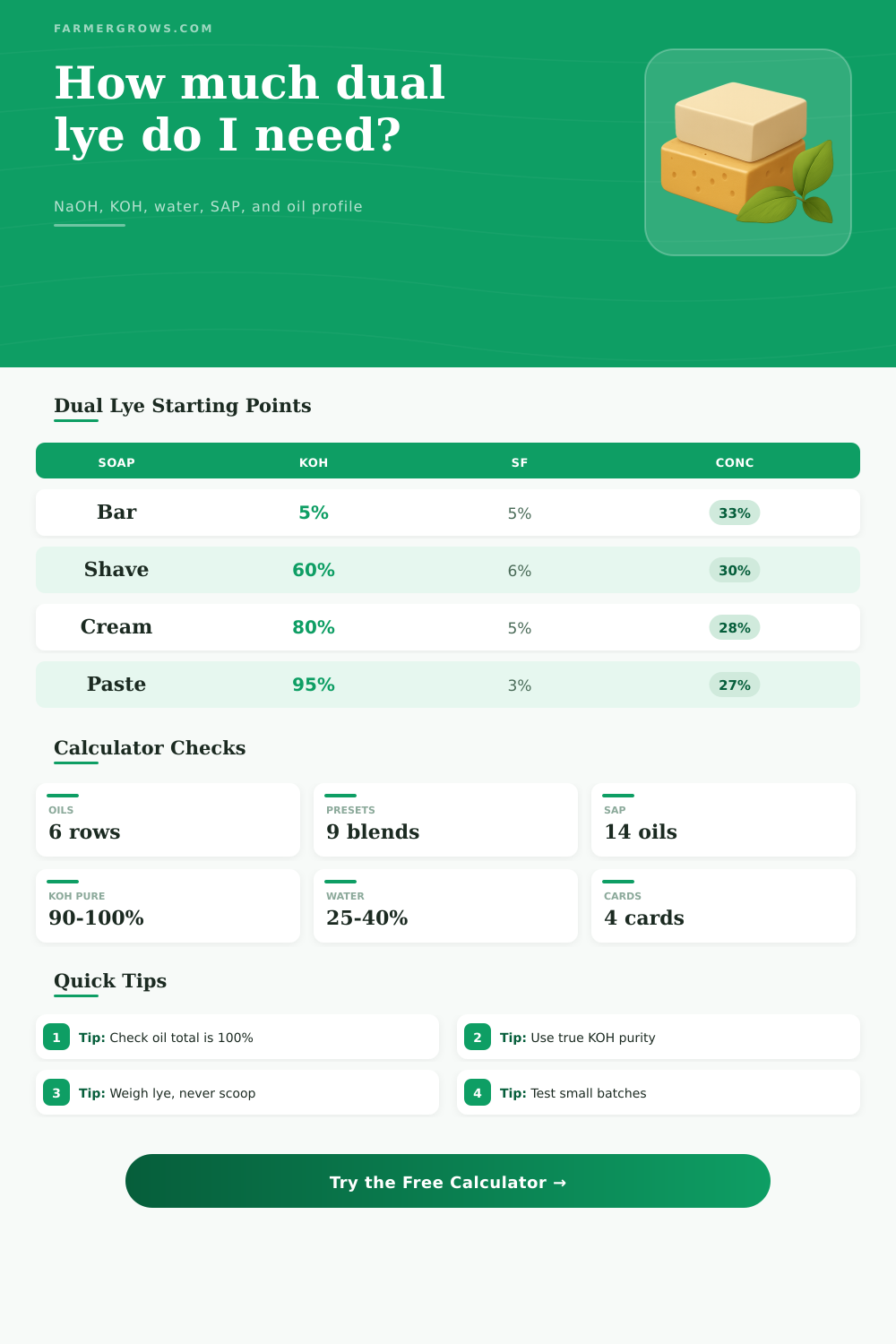
| KOH split | Typical format | Texture direction | Calculator note |
|---|---|---|---|
| 0-5% | Firm bar soap | Mostly sodium soap, slow solubility. | Use low KOH when bar longevity matters most. |
| 10-30% | Hybrid bar or puck | Slightly easier lather and faster wetting. | Good for dense hand soap or utility pucks. |
| 40-70% | Shave soap or croap | Softer structure and faster loading. | Watch water concentration and stearic-rich oils. |
| 80-100% | Cream soap or paste | Highly soluble potassium soap. | KOH purity becomes a major input. |
| Lye concentration | Water to lye ratio | Best fit | Practical check |
|---|---|---|---|
| 25-28% | 3.0:1 to 2.6:1 | High KOH paste or slower-moving blends. | More water gives more working time. |
| 29-32% | 2.4:1 to 2.1:1 | Dual lye shave soap and cream soap bases. | Balanced water for flexible formulas. |
| 33-35% | 2.0:1 to 1.9:1 | Most firm bar recipes. | Common starting range for sodium-heavy bars. |
| 36-40% | 1.8:1 to 1.5:1 | Water-discounted firm bars. | Can move quickly with hard fats or fragrance. |
Keep the oil total honest. SAP math depends on every oil row adding to 100%. If the blend total is off, the calculator normalizes the profile for estimates but warns you before you use the lye numbers.
Enter real KOH purity. Potassium hydroxide often contains water and carbonate. A 90% purity setting means the calculator increases the weighed KOH so the pure alkali portion still matches the recipe.
Dual lye soap making involve the use of both sodium hydroxide and potassium hydroxide in the soap making process. Most soap maker choose to use sodium hydroxide because it will produce a firm soap bar that will last a long time. Potassium hydroxide create softer soaps that is more soluble.
Soaps that are more soluble made with potassium hydroxide is used to create creams, paste, or shaving products. By using both of these ingredient in a recipe, the maker can create a soap that will work for various texture. To make dual lye soap, the maker must first choose the oils that will be used in the soap and then determine the alkali split of the soap.
How to Make Soap Using Two Lyes
The alkali split is the ratio of sodium hydroxide to potassium hydroxide that the maker will use to make the soap. The ratio will determine if the soap that is made will be a hard soap or a soft soap. Soft soaps will contain higher percentage of potassium hydroxide than soaps that are going to be hard.
The percentage of potassium hydroxide that is used can alter the structural make up of the soap as well as it’s solubility. Oil selection is an important part of the making of dual lye soap. Each oil have a specific saponification value and each type of oil will add some qualities to the soap that is made.
For instance, coconut oil will harden the bar of soap but will also allow for the bar of soap to dissolve at a faster rate. Olive oil will add conditioning property to the bar of soap but will slow the curing process of the soap. Each oil will impact the stability of the lather that is created when the soap is used.
A calculator can determine the saponification value of each oil that is chosen and calculate the alkali split for the soap. Another important factor in the making of dual lye soap is the concentration of water that will be used in the soap. If the concentration of water is low in the recipe, the soap will reach trace faster.
If more water are used in the recipe, the soap will exhibit more fluidity but will require more time to reach cure. Target numbers should of been used to indicate the hardness and solubility of the soap that is to be made. The purity of the potassium hydroxide that is to be used in the soap is another factor to consider when weighing the potassium hydroxide.
Most commercial potassium hydroxide flakes is not 100% pure. If the purity of the potassium hydroxide is less than 100%, the maker will need to adjust the weight of the potassium hydroxide upwards. If the purity is ignored, then the potassium hydroxide may not effectively saponify the oils.
The ratio of potassium hydroxide to sodium hydroxide will determine the format of the soap that is made. If the recipe use a ratio of 5% potassium hydroxide, then the properties of the soap will be similar to a standard sodium hydroxide bar soap. If the maker increases the ratio of potassium hydroxide to 60%, the soap will be soft or a shaving soap.
If the ratio of potassium hydroxide is increased to 95%, the soap that is made will be a paste or cream. There are some mistake that many individuals make when they prepare to make dual lye soap. One of the most common mistakes is using oils whose percentages does not add up to 100%.
Another common mistake is ignoring the purity of the potassium hydroxide that is to be used. Additionally, some may change the concentration of water in the soap without considering the solubility of the soap. Various element of the environment will impact the dual lye soap making process.
For instance, the temperature of the room that the soap is made in, the fragrance that is used, and the moment in which the soap is poured into the molds will all impact the rate at which the soap reaches trace. Dual lye soap formulas may reach trace faster than standard soap formulas because potassium hydroxide reach trace faster than sodium hydroxide. Therefore, many soap maker will prepare small batches of dual lye soap before they prepare large batches.
One of the reasons that dual lye soap maker use a calculator is to ensure that the hardness of the soap that is estimated with the dual lye calculator match the target hardness that the soap should produce. Additionally, the solubility number should match the solubility of the soap that the maker desire to create. If both of these factor match the targets of the maker, then the recipe is correct.
If either number does not match the target numbers, then the recipe will need to be adjusted. By understanding each of these factor and how they can impact the soap that is made, the maker can effectively use the dual lye soap calculator to create their desired soap.