Chicken Brooder Size Calculator
Estimate brooder floor area, perimeter, heat lamp count, bedding volume, feeder frontage, waterer clearance, and target brooder temperature for growing chicks.
The calculator uses floor space per chick by age, adjusts it for breed size, adds feeder and waterer access space, then compares that recommendation with the brooder shape you enter.
Chicken brooder size estimate
Enter chick count, age, breed, shape, heat, feeders, bedding, and buffer to size the brooder.
(chicks x age space x breed factor + feeder/waterer clearance) x growth buffer
rectangle = 2 x (L + W); circle = pi x diameter; oval = Ramanujan ellipse perimeter
heat units = max(ceil(required area / heat coverage), ceil(chicks / chick capacity))
cubic feet = planned floor area x bedding depth inches / 12; liters = cubic feet x 28.3168
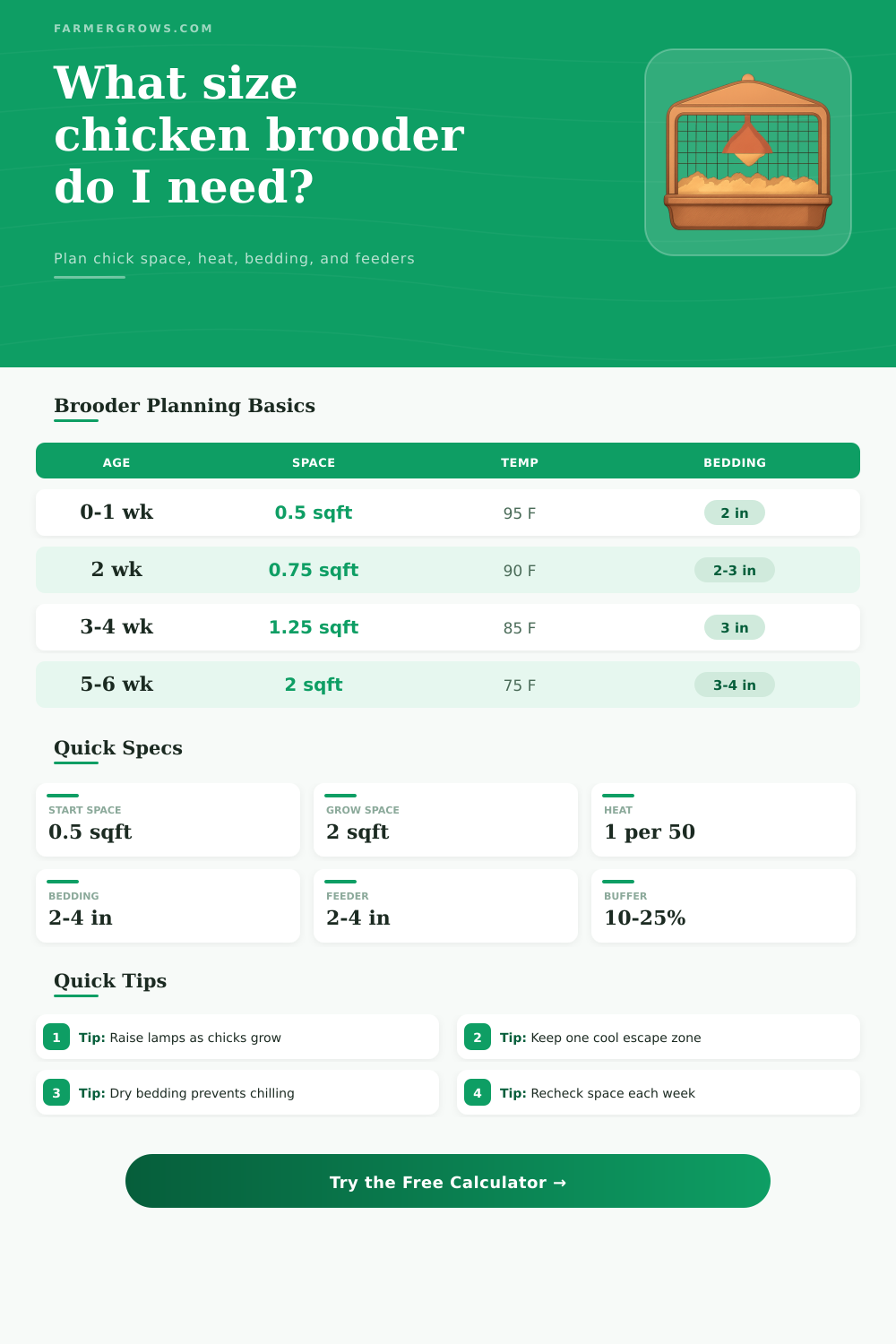
| Chick age | Base floor area per chick | Typical target temperature | Brooder planning note |
|---|---|---|---|
| Hatch to 1 week | 0.4 to 0.5 sq ft | 95 F near heat edge | Use tight draft control but keep a visible cool side. |
| 2 weeks | 0.75 sq ft | 90 F | Feeders start taking more floor space as chicks move faster. |
| 3 to 4 weeks | 1.0 to 1.25 sq ft | 85 to 80 F | Brooder crowding often appears first around feeders and waterers. |
| 5 to 6 weeks | 1.5 to 2.0 sq ft | 75 to 70 F | Many flocks need a larger pen before full coop transition. |
| 7 to 8 weeks | 2.25 to 2.5 sq ft | 70 F or ambient-ready | Use the brooder only if weather or feathering still requires it. |
| Heat source | Area coverage used | Chick capacity used | Calculator note |
|---|---|---|---|
| 250 W heat lamp | 35 sq ft per lamp | 50 chicks per lamp | Works best when height is adjustable and one side remains cooler. |
| 125 W heat lamp | 22 sq ft per lamp | 35 chicks per lamp | Good for smaller indoor brooders or a mild brooding room. |
| Brooder heat plate | 25 sq ft per plate | 25 chicks per plate | Capacity is limited by how many chicks can fit under the plate edge. |
| Radiant panel | 30 sq ft per panel | 40 chicks per panel | Use thermometer readings because panel warmth is directional. |
| Gas or electric hover | 45 sq ft per hover | 75 chicks per hover | Best for larger batches with a clear warm center and cool perimeter. |
| Brooder stage | Feeder edge per chick | Waterer edge per chick | Access planning note |
|---|---|---|---|
| Starter week | 1.5 to 2.0 in | 0.8 to 1.0 in | Low trays and small fountains need less frontage but spill more easily. |
| Weeks 2 to 3 | 2.0 to 3.0 in | 1.0 to 1.5 in | Linear feeders reduce jostling when chicks are uneven in size. |
| Weeks 4 to 6 | 3.0 to 4.0 in | 1.5 to 2.0 in | Raise equipment as birds feather to preserve bedding and floor space. |
| Broiler batches | 3.5 to 5.0 in | 1.5 to 2.5 in | Fast growth makes feeder crowding the first space limit for many pens. |
| Floor area | 2 inch bedding | 3 inch bedding | 4 inch bedding |
|---|---|---|---|
| 10 sq ft | 1.7 cu ft | 2.5 cu ft | 3.3 cu ft |
| 25 sq ft | 4.2 cu ft | 6.3 cu ft | 8.3 cu ft |
| 50 sq ft | 8.3 cu ft | 12.5 cu ft | 16.7 cu ft |
| 100 sq ft | 16.7 cu ft | 25.0 cu ft | 33.3 cu ft |
Size for the largest week in the brooder. Chicks may look tiny on day one, but feeder space and running room become the limiting factors quickly.
Watch chick behavior after calculating. Even a correctly sized brooder needs adjustment if birds avoid the heat, pile in corners, or sleep far from feed and water.
Choosing a correct brooder size is an important task for a person who keeps chick. Choosing the correct brooder size is necessary due to the fact that the brooder that is large enough for the chicks on the first day may not be large enough for the chicks as they begins to grow. Brooders must have enough space for chicks to move quick and eat enough food throughout the day.
If the brooder is too small for chicks, the chicks may not be able to grow normal, may have to compete for feeders, and may struggle with discomfort caused by temperature change within the brooder. Planning the size of the brooder in advance will prevent the need to rebuild brooder or move the brooder setup after the owner has placed the chicks into the brooder during the first month of their lives. Chicks require different sizes of floor area within the brooder based off the age of the chicks.
How to Choose the Right Brooder Size for Chicks
Young chicks can be placed into small areas but, as they grow to three or four weeks of age, the chicks requires more floor area due to their increased activity. Chicks need floor area to allow for the chicks to exhibit normal behaviors of run and moving away from the heat source. Furthermore, chicks need floor area to provide each chick with enough edge area to each feeder and waterer; if there is not enough edge area for each chick, some chicks may be pushed away from the food and water.
The breed of chick also has an impact upon the size of the floor area that are required. Bantam breeds require less floor area than dual-purpose breeds but broiler breeds requires more floor area than layer breeds due to the rapid growth of broiler breeds. The calculator provides a mathematical result based upon the number of chicks, the age of the chicks and their breed, and provides additional area for the chicks to have proper edge area to each feeder and waterer.
An additional factor that will impact the size of the brooder is the amount of heat that the brooder provides. The number of lamp that are placed within the brooder will depend upon the floor area of the brooder but also upon the number of chicks within the brooder. One heat lamp may provide heat for thirty-five square feet for a small number of chicks but that same heat lamp may not be provide enough heat for a doubled number of chicks.
The calculator will compare the brooder area and number of chicks to ensure that the brooder will not have a cold corner to the chicks. Furthermore, a cold corner will be avoided so that the chicks will not become overcrowded within the warm corner of the brooder. Chicks will need to have a cool corner within their brooder so that the chicks can regulate their body temperature.
If there is no cool spot within the brooder for chicks to lie down or move to, the chicks may begin to pile upon each other or pant for relief. The volume of bedding that is to be placed within the brooder will be dependent upon the area of the brooder. Two inches of bedding will be sufficient for the chicks during the first week but three or four inches will be better for chicks once they become more active and the temperature within the brooder begin to drop.
The calculator will convert the area of the brooder into the amount of cubic feet of bedding that will be needed so that the owner is able to purchase the bedding before the chicks arrive. The amount of bedding will help to ensure that enough space is provided for each chick to sleep and the bedding will last for the time period in which the chicks will be in their brooder. The shape of the brooder will impact how the brooder is to be built.
Brooders can be of any custom shape but the rectangular brooder has straight wall to make it easy to guard the chicks and the circular brooder eliminates corners in which the chicks become trapped. The calculator will use the length, width, and diameter measurement of the brooder in calculating the perimeter. The perimeter will help determine the amount of cardboard, plastic, or hardware cloth that will be needed to build the guard for the brooder.
Custom shapes of brooders can be made from other pen and tubs and the tool will factor these in. The target temperature that are provided to the chicks will be based upon the age of the chicks. Day-old chicks require the area to reach a temperature of ninety-five degrees but the target will drop by approximately five degrees each week until the chicks reach seventy degrees.
The owner of the chicks can enter the target temperature into the brooder temperature calculator to ensure that the owner knows how the temperature of the brooder compares to the target. The difference in temperature will help to indicate how often the chicks’ brooder should be heated or how often the brooder should be insulate. The amount of area that is provided for the feeder and waterer is another area that can be underestimated when building the brooder.
A feeding area that can hold six chicks at once may not be enough for twenty chicks attempting to eat at the same time. The calculator will add area based upon the number of inch of feeding space that can be provided for each chick. Adding this area will prevent the owner from making the mistake of only providing space within the brooder for the chicks’ bodies.
Furthermore, the area will ensure that the chicks do not line up to be fed and droppings will not spill from the feeder. A growth buffer can be established within the brooder that the tool calculates. A fifteen percent growth buffer will provide enough space for the chicks to grow in the period between two and four week.
A twenty-five percent growth buffer can be used if the broiler breeds are to be raised or if the chicks are to remain in the brooder for a longer period of time. A growth buffer will be calculated into the area of the brooder and the area for feeding and watering equipment. Brooders that account for growth will allow for chicks’ bodies and equipment to be provided with the space that they need over time.
Although the brooder layout calculated by the tool may be ideal for the brooder, real brooders may not always allow for chicks to remain in the same area. Brooders may experience drafts, may have an uneven floor, and the angle of light onto the brooder will change the behavior of the chicks. The brooder plan will provide an ideal start for the brooder but will require adjustments to be made according to the behavior and location of the chicks within the brooder.
If chicks show an interest in one side of the brooder or one corner over another, the brooder should be adjusted to allow for the chicks to have an even spread out within the brooder. The measurements will assist the owner in determining when to add a second brooder or when to move the chicks to a different brooder. Brooders will need to be enlarged once the brooder size calculator determines the area that is required by the chicks.
This will make it easier for the owner to acquire brooders for the chicks. Furthermore, providing enough space within the brooder will allow for the chicks to behave normal, to feel less stress, and to ensure that the chicks’ growth is steady during the first six week of their lives.