Hoop House Height Calculator
Estimate ridge height from house width, hoop pipe length, ground post allowance, sidewall height, round or gothic shape, target clearance, and a snow or wind reserve.
Use the total bent hoop length before installing the rib. The calculator subtracts the pipe hidden in ground posts and the straight sidewall portions, then estimates the roof rise from a round circular arc or a gothic pointed-arch approximation.
Hoop House Height Results
These results use the selected shape model, then compare the adjusted ridge height with your target clearance.
| Formula | Expression | What it estimates | Planning note |
|---|---|---|---|
| Exposed hoop | pipe length - 2 x post depth | Pipe visible above the ground post sleeves | Use the inserted length on each side, not total post length |
| Roof arc | exposed hoop - 2 x sidewall height | Curved pipe available from eave to eave | If this is less than width, the hoop cannot span cleanly |
| Round arc rise | S = radius x angle, W = 2 x radius x sin(angle / 2) | Height of a circular segment roof | The calculator solves the angle iteratively, then adds sidewall height |
| Gothic rise | rise = sqrt((S / (2 x k))^2 - (W / 2)^2) | Height of a pointed two-shoulder roof | Uses k = 1.035 for modest bend length over straight chord |
| Reserved ridge | ridge height x (1 - allowance) | Usable clearance after snow, wind, and build tolerance | Compare this adjusted height with the target ridge clearance |
| Shape | Best for | Height behavior | Field note |
|---|---|---|---|
| Round circular arc | Low tunnels, caterpillar tunnels, simple benders | Moderate ridge, smoother shoulders | Works well when snow load is light and bending is simple |
| Gothic pointed arch | Winter tunnels, wider houses, tall crops | Higher center ridge for similar pipe length | Better shedding shape, but needs consistent bending |
| Low sidewall | Row covers, nursery starts, short crops | More pipe becomes roof arc | Edge access is tighter near the outside beds |
| Tall sidewall | Tomatoes, trellis crops, equipment clearance | Less pipe remains for roof rise | Check that the remaining roof arc can still span the width |
| Common house | Typical width | Pipe length range | Common target ridge |
|---|---|---|---|
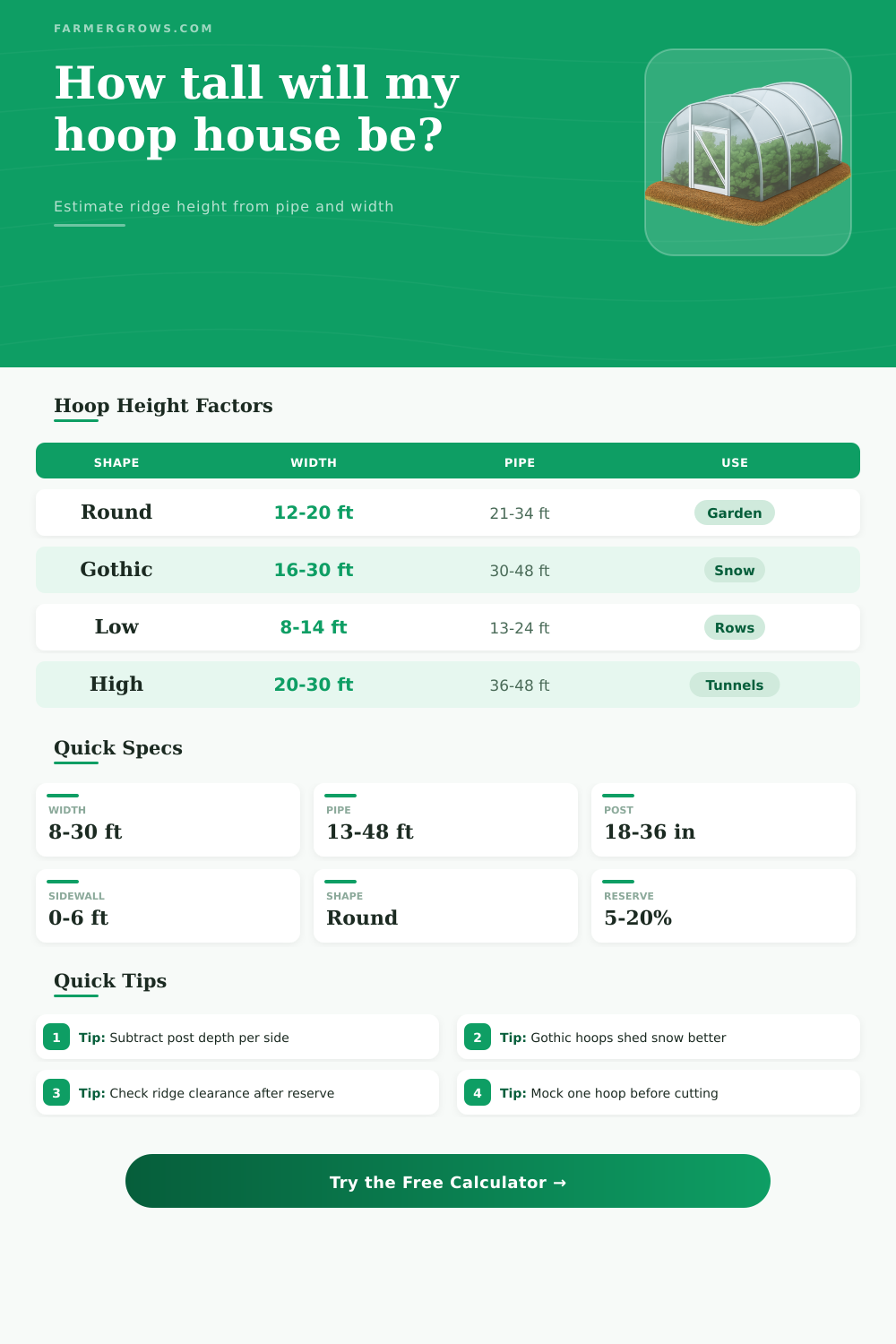
| Low caterpillar tunnel | 10 to 14 ft | 16 to 24 ft | 5 to 7 ft |
| Market garden tunnel | 14 to 18 ft | 24 to 34 ft | 7 to 10 ft |
| Gothic high tunnel | 18 to 24 ft | 34 to 42 ft | 10 to 13 ft |
| Wide production house | 26 to 30 ft | 44 to 52 ft | 13 to 16 ft |
| Metric field tunnel | 4 to 9 m | 6.5 to 16 m | 2 to 5 m |
| Snow/wind allowance | Use when | Clearance effect | Target pipe effect |
|---|---|---|---|
| 0% | Indoor mockups or very controlled builds | No reduction | Target pipe matches the geometry target |
| 5% | Mild sites with good bracing and light weather | Small reserve | Slightly taller hoop needed for the same usable ridge |
| 10% | Typical market garden planning allowance | Moderate reserve | Good default before final engineering checks |
| 15% | Snowy sites, rough ground, or flexible pipe | Noticeable reserve | More pipe or narrower width may be needed |
| 20%+ | Windy exposed sites or conservative planning | Large reserve | Use structural guidance before building |
Before bending: Mark the ground post insertion depth on both ends of one test hoop. A small hidden-length error on both sides can noticeably change ridge height.
Before repeating hoops: Build one rib, measure the real ridge height, then adjust the preset or pipe length before cutting and bending the whole house.
To determine the ridge height for an hoop house, it is necessary to consider the impacts that the ridge height will have upon the plants that is to grow within the hoop house and the materials that is required to construct the hoop house. If the ridge height is too low, for instance, then individuals will have to duck under the hoops that are to be constructed, and the plants that grows to heights taller than the ridge height will be unable to reach those heights. If the ridge height is too tall, however, then more pipe will be required to construct the hoop house, as well as more wind resistance will be placed upon the hoop house structure.
In determining the ridge height of the hoop house, there are several different measurement of the hoop house that help to determine that height. The width of the hoop house will determine the length of the pipe that is required to span the hoop house structure. The total length of the pipe will determine the amount of pipe that will be used in the construction of the hoop house.
How to Choose the Ridge Height for a Hoop House
The depth of the posts that are to be planted into the ground will reduce the amount of pipe that can be used to construct the hoop house, as some of that pipe will be used to create the posts. Finally, the height of the sidewalls of the hoop house will also reduce the amount of pipe that is available for construct the hoop house. These various measurements will help to determine the height of the ridge from which the pipe will form the roof of the hoop house.
The shape of the hoop that is to be used will also help to determine the ridge height of the hoop house. Hoops that are of even sizes will create a ridge height that is similar to the ridge height of hoop houses that use gothic hoops of the same length. However, gothic hoops will create a ridge height that is more taller than round hoops of the same length.
Many individuals prefer the use of gothic hoops because they are better suited for areas that receive heavy snowfalls or areas in which tall crops are to be grown. However, gothic hoops are more difficult to bend than round hoops. Thus, individuals may opt for round hoops if they are growing short plants in a sheltered area.
The height of the sidewalls of the hoop house is another measurement that has the potential to create a tradeoff in relation to the height of the ridge of the hoop house. If the sidewalls are high, for instance, individuals will be able to walk along the sidewalls of the hoop house. Additionally, if the sidewalls are high, individuals will also be able to hang their trellis wires at a more high height.
However, taller sidewalls will use more pipe. Thus, there will be less pipe remaining to create the roof of the hoop house. If the sidewalls are too high, however, there will be an issue in which the roof arc will not be able to span the width of the hoop house; the arc will be too short.
This will result in the roof of the hoop house being relatively flatly, which will lower the ridge height of the house. Another factor that must be considered in determining the height of the ridge of the hoop house is the inclusion of a snow and wind allowance. A snow and wind allowance will reduce the ridge height that is calculated for the hoop house by a certain percentage.
A larger percentage will allow for the hoop house to better withstand heavy snow and strong winds. However, a larger percentage will also lower the height of the ridge of the hoop house. This factor should be considered if the hoop house is to be constructed on an exposed site.
Many individuals make mistakes in measuring the length of the pipe that will be used in the construction of the hoop house. For instance, the total length of the pipe may be used instead of the length of the pipe after the post is inserted into the ground. Additionally, some individuals may forget to account for the height of the sidewalls in relation to the length of the pipe.
These mistakes will result in an incorrect measurement of the ridge height. Thus, it is important for individuals to measure the length of a single test hoop after it is bent and placed into the ground. The target height of the ridge of the hoop house will also be influenced by the types of crops that are to be grown within the hoop house, as well as the types of equipment that will be used within the hoop house.
If the hoop house is to be used to grow foods like salad greens, for instance, the height of the ridge may be lower than if tomatoes or cucumbers is to be grown. These plants require the ridge height of the hoop house to provide them with the necessary direction in which to grow. Additionally, if large equipment is to be driven within the hoop house, the height of the ridge will need to be high enough for those individuals to stand upright while operating such equipment.
Finally, in order to determine the ridge height that is to be used in the construction of the hoop house, it is also important for individuals to utilize a calculator to determine the relationship between the various widths of hoop houses and ridge heights. Hoop houses of different widths require different amount of pipe in order to construct their roofs, as well as to provide for the required ridge height. A calculator will allow individuals to review these relationships prior to the purchase of the hoop house building materials.
To determine the ridge height for an hoop house, it is necessary to consider the impacts that the ridge height will have upon the plants that are to grow within the hoop house and the materials that is required to construct the hoop house. If the ridge height is too low, for instance, then individuals will have to duck under the hoops that are to be constructed, and the plants that grows to heights taller than the ridge height will be unable to reach those heights. If the ridge height is too tall, however, then more pipe will be required to construct the hoop house, as well as more wind resistance will be placed upon the hoop house structure.
In determining the ridge height of the hoop house, there are several different measurement of the hoop house that help to determine that height. The width of the hoop house will determine the length of the pipe that is required to span the hoop house structure. The total length of the pipe will determine the amount of pipe that will be used in the construction of the hoop house.
The depth of the posts that are to be planted into the ground will reduce the amount of pipe that can be used to construct the hoop house, as some of that pipe will be used to create the posts. Finally, the height of the sidewalls of the hoop house will also reduce the amount of pipe that is available for construct the hoop house. These various measurements will help to determine the height of the ridge from which the pipe will form the roof of the hoop house.
The shape of the hoop that is to be used will also help to determine the ridge height of the hoop house. Hoops that are of even sizes will create a ridge height that is similar to the ridge height of hoop houses that use gothic hoops of the same length. However, gothic hoops will create a ridge height that is more taller than round hoops of the same length.
Many individuals prefer the use of gothic hoops because they are better suited for areas that receive heavy snowfalls or areas in which tall crops are to be grown. However, gothic hoops are more difficult to bend than round hoops. Thus, individuals may opt for round hoops if they are growing short plants in a sheltered area.
The height of the sidewalls of the hoop house is another measurement that has the potential to create a tradeoff in relation to the height of the ridge of the hoop house. If the sidewalls are high, for instance, individuals will be able to walk along the sidewalls of the hoop house. Additionally, if the sidewalls are high, individuals will also be able to hang their trellis wires at a more high height.
However, taller sidewalls will use more pipe. Thus, there will be less pipe remaining to create the roof of the hoop house. If the sidewalls are too high, however, there will be an issue in which the roof arc will not be able to span the width of the hoop house; the arc will be too short.
This will result in the roof of the hoop house being relatively flatly, which will lower the ridge height of the house. Another factor that must be considered in determining the height of the ridge of the hoop house is the inclusion of a snow and wind allowance. A snow and wind allowance will reduce the ridge height that is calculated for the hoop house by a certain percentage.
A larger percentage will allow for the hoop house to better withstand heavy snow and strong winds. However, a larger percentage will also lower the height of the ridge of the hoop house. This factor should be considered if the hoop house is to be constructed on an exposed site.
Many individuals make mistakes in measuring the length of the pipe that will be used in the construction of the hoop house. For instance, the total length of the pipe may be used instead of the length of the pipe after the post is inserted into the ground. Additionally, some individuals may forget to account for the height of the sidewalls in relation to the length of the pipe.
These mistakes will result in an incorrect measurement of the ridge height. Thus, it is important for individuals to measure the length of a single test hoop after it is bent and placed into the ground. The target height of the ridge of the hoop house will also be influenced by the types of crops that are to be grown within the hoop house, as well as the types of equipment that will be used within the hoop house.
If the hoop house is to be used to grow foods like salad greens, for instance, the height of the ridge may be lower than if tomatoes or cucumbers is to be grown. These plants require the ridge height of the hoop house to provide them with the necessary direction in which to grow. Additionally, if large equipment is to be driven within the hoop house, the height of the ridge will need to be high enough for those individuals to stand upright while operating such equipment.
Finally, in order to determine the ridge height that is to be used in the construction of the hoop house, it is also important for individuals to utilize a calculator to determine the relationship between the various widths of hoop houses and ridge heights. Hoop houses of different widths require different amount of pipe in order to construct their roofs, as well as to provide for the required ridge height. A calculator will allow individuals to review these relationships prior to the purchase of the hoop house building materials.
To determine the ridge height for an hoop house, it is necessary to consider the impacts that the ridge height will have upon the plants that are to grow within the hoop house and the materials that is required to construct the hoop house. If the ridge height is too low, for instance, then individuals will have to duck under the hoops that are to be constructed, and the plants that grows to heights taller than the ridge height will be unable to reach those heights. If the ridge height is too tall, however, then more pipe will be required to construct the hoop house, as well as more wind resistance will be placed upon the hoop house structure.
In determining the ridge height of the hoop house, there are several different measurement of the hoop house that help to determine that height. The width of the hoop house will determine the length of the pipe that is required to span the hoop house structure. The total length of the pipe will determine the amount of pipe that will be used in the construction of the hoop house.
The depth of the posts that are to be planted into the ground will reduce the amount of pipe that can be used to construct the hoop house, as some of that pipe will be used to create the posts. Finally, the height of the sidewalls of the hoop house will also reduce the amount of pipe that is available for construct the hoop house. These various measurements will help to determine the height of the ridge from which the pipe will form the roof of the hoop house.
The shape of the hoop that is to be used will also help to determine the ridge height of the hoop house. Hoops that are of even sizes will create a ridge height that is similar to the ridge height of hoop houses that use gothic hoops of the same length. However, gothic hoops will create a ridge height that is more taller than round hoops of the same length.
Many individuals prefer the use of gothic hoops because they are better suited for areas that receive heavy snowfalls or areas in which tall crops are to be grown. However, gothic hoops are more difficult to bend than round hoops. Thus, individuals may opt for round hoops if they are growing short plants in a sheltered area.
The height of the sidewalls of the hoop house is another measurement that has the potential to create a tradeoff in relation to the height of the ridge of the hoop house. If the sidewalls are high, for instance, individuals will be able to walk along the sidewalls of the hoop house. Additionally, if the sidewalls are high, individuals will also be able to hang their trellis wires at a more high height.
However, taller sidewalls will use more pipe. Thus, there will be less pipe remaining to create the roof of the hoop house. If the sidewalls are too high, however, there will be an issue in which the roof arc will not be able to span the width of the hoop house; the arc will be too short.
This will result in the roof of the hoop house being relatively flatly, which will lower the ridge height of the house. Another factor that must be considered in determining the height of the ridge of the hoop house is the inclusion of a snow and wind allowance. A snow and wind allowance will reduce the ridge height that is calculated for the hoop house by a certain percentage.
A larger percentage will allow for the hoop house to better withstand heavy snow and strong winds. However, a larger percentage will also lower the height of the ridge of the hoop house. This factor should be considered if the hoop house is to be constructed on an exposed site.
Many individuals make mistakes in measuring the length of the pipe that will be used in the construction of the hoop house. For instance, the total length of the pipe may be used instead of the length of the pipe after the post is inserted into the ground. Additionally, some individuals may forget to account for the height of the sidewalls in relation to the length of the pipe.
These mistakes will result in an incorrect measurement of the ridge height. Thus, it is important for individuals to measure the length of a single test hoop after it is bent and placed into the ground. The target height of the ridge of the hoop house will also be influenced by the types of crops that are to be grown within the hoop house, as well as the types of equipment that will be used within the hoop house.
If the hoop house is to be used to grow foods like salad greens, for instance, the height of the ridge may be lower than if tomatoes or cucumbers is to be grown. These plants require the ridge height of the hoop house to provide them with the necessary direction in which to grow. Additionally, if large equipment is to be driven within the hoop house, the height of the ridge will need to be high enough for those individuals to stand upright while operating such equipment.
Finally, in order to determine the ridge height that is to be used in the construction of the hoop house, it is also important for individuals to utilize a calculator to determine the relationship between the various widths of hoop houses and ridge heights. Hoop houses of different widths require different amount of pipe in order to construct their roofs, as well as to provide for the required ridge height. A calculator will allow individuals to review these relationships prior to the purchase of the hoop house building materials.
To determine the ridge height for an hoop house, it is necessary to consider the impacts that the ridge height will have upon the plants that are to grow within the hoop house and the materials that is required to construct the hoop house. If the ridge height is too low, for instance, then individuals will have to duck under the hoops that are to be constructed, and the plants that grows to heights taller than the ridge height will be unable to reach those heights. If the ridge height is too tall, however, then more pipe will be required to construct the hoop house, as well as more wind resistance will be placed upon the hoop house structure.
In determining the ridge height of the hoop house, there are several different measurement of the hoop house that help to determine that height. The width of the hoop house will determine the length of the pipe that is required to span the hoop house structure. The total length of the pipe will determine the amount of pipe that will be used in the construction of the hoop house.
The depth of the posts that are to be planted into the ground will reduce the amount of pipe that can be used to construct the hoop house, as some of that pipe will be used to create the posts. Finally, the height of the sidewalls of the hoop house will also reduce the amount of pipe that is available for construct the hoop house. These various measurements will help to determine the height of the ridge from which the pipe will form the roof of the hoop house.
The shape of the hoop that is to be used will also help to determine the ridge height of the hoop house. Hoops that are of even sizes will create a ridge height that is similar to the ridge height of hoop houses that use gothic hoops of the same length. However, gothic hoops will create a ridge height that is more taller than round hoops of the same length.
Many individuals prefer the use of gothic hoops because they are better suited for areas that receive heavy snowfalls or areas in which tall crops are to be grown. However, gothic hoops are more difficult to bend than round hoops. Thus, individuals may opt for round hoops if they are growing short plants in a sheltered area.
The height of the sidewalls of the hoop house is another measurement that has the potential to create a tradeoff in relation to the height of the ridge of the hoop house. If the sidewalls are high, for instance, individuals will be able to walk along the sidewalls of the hoop house. Additionally, if the sidewalls are high, individuals will also be able to hang their trellis wires at a more high height.
However, taller sidewalls will use more pipe. Thus, there will be less pipe remaining to create the roof of the hoop house. If the sidewalls are too high, however, there will be an issue in which the roof arc will not be able to span the width of the hoop house; the arc will be too short.
This will result in the roof of the hoop house being relatively flatly, which will lower the ridge height of the house. Another factor that must be considered in determining the height of the ridge of the hoop house is the inclusion of a snow and wind allowance. A snow and wind allowance will reduce the ridge height that is calculated for the hoop house by a certain percentage.
A larger percentage will allow for the hoop house to better withstand heavy snow and strong winds. However, a larger percentage will also lower the height of the ridge of the hoop house. This factor should be considered if the hoop house is to be constructed on an exposed site.
Many individuals make mistakes in measuring the length of the pipe that will be used in the construction of the hoop house. For instance, the total length of the pipe may be used instead of the length of the pipe after the post is inserted into the ground. Additionally, some individuals may forget to account for the height of the sidewalls in relation to the length of the pipe.
These mistakes will result in an incorrect measurement of the ridge height. Thus, it is important for individuals to measure the length of a single test hoop after it is bent and placed into the ground. The target height of the ridge of the hoop house will also be influenced by the types of crops that are to be grown within the hoop house, as well as the types of equipment that will be used within the hoop house.
If the hoop house is to be used to grow foods like salad greens, for instance, the height of the ridge may be lower than if tomatoes or cucumbers is to be grown. These plants require the ridge height of the hoop house to provide them with the necessary direction in which to grow. Additionally, if large equipment is to be driven within the hoop house, the height of the ridge will need to be high enough for those individuals to stand upright while operating such equipment.
Finally, in order to determine the ridge height that is to be used in the construction of the hoop house, it is also important for individuals to utilize a calculator to determine the relationship between the various widths of hoop houses and ridge heights. Hoop houses of different widths require different amount of pipe in order to construct their roofs, as well as to provide for the required ridge height. A calculator will allow individuals to review these relationships prior to the purchase of the hoop house building materials.
To determine the ridge height for an hoop house, it is necessary to consider the impacts that the ridge height will have upon the plants that are to grow within the hoop house and the materials that is required to construct the hoop house. If the ridge height is too low, for instance, then individuals will have to duck under the hoops that are to be constructed, and the plants that grows to heights taller than the ridge height will be unable to reach those heights. If the ridge height is too tall, however, then more pipe will be required to construct the hoop house, as well as more wind resistance will be placed upon the hoop house structure.
In determining the ridge height of the hoop house, there are several different measurement of the hoop house that help to determine that height. The width of the hoop house will determine the length of the pipe that is required to span the hoop house structure. The total length of the pipe will determine the amount of pipe that will be used in the construction of the hoop house.
The depth of the posts that are to be planted into the ground will reduce the amount of pipe that can be used to construct the hoop house, as some of that pipe will be used to create the posts. Finally, the height of the sidewalls of the hoop house will also reduce the amount of pipe that is available for construct the hoop house. These various measurements will help to determine the height of the ridge from which the pipe will form the roof of the hoop house.
The shape of the hoop that is to be used will also help to determine the ridge height of the hoop house. Hoops that are of even sizes will create a ridge height that is similar to the ridge height of hoop houses that use gothic hoops of the same length. However, gothic hoops will create a ridge height that is more taller than round hoops of the same length.
Many individuals prefer the use of gothic hoops because they are better suited for areas that receive heavy snowfalls or areas in which tall crops are to be grown. However, gothic hoops are more difficult to bend than round hoops. Thus, individuals may opt for round hoops if they are growing short plants in a sheltered area.
The height of the sidewalls of the hoop house is another measurement that has the potential to create a tradeoff in relation to the height of the ridge of the hoop house. If the sidewalls are high, for instance, individuals will be able to walk along the sidewalls of the hoop house. Additionally, if the sidewalls are high, individuals will also be able to hang their trellis wires at a more high height.
However, taller sidewalls will use more pipe. Thus, there will be less pipe remaining to create the roof of the hoop house. If the sidewalls are too high, however, there will be an issue in which the roof arc will not be able to span the width of the hoop house; the arc will be too short.
This will result in the roof of the hoop house being relatively flatly, which will lower the ridge height of the house. Another factor that must be considered in determining the height of the ridge of the hoop house is the inclusion of a snow and wind allowance. A snow and wind allowance will reduce the ridge height that is calculated for the hoop house by a certain percentage.
A larger percentage will allow for the hoop house to better withstand heavy snow and strong winds. However, a larger percentage will also lower the height of the ridge of the hoop house. This factor should be considered if the hoop house is to be constructed on an exposed site.
Many individuals make mistakes in measuring the length of the pipe that will be used in the construction of the hoop house. For instance, the total length of the pipe may be used instead of the length of the pipe after the post is inserted into the ground. Additionally, some individuals may forget to account for the height of the sidewalls in relation to the length of the pipe.
These mistakes will result in an incorrect measurement of the ridge height. Thus, it is important for individuals to measure the length of a single test hoop after it is bent and placed into the ground. The target height of the ridge of the hoop house will also be influenced by the types of crops that are to be grown within the hoop house, as well as the types of equipment that will be used within the hoop house.
If the hoop house is to be used to grow foods like salad greens, for instance, the height of the ridge may be lower than if tomatoes or cucumbers is to be grown. These plants require the ridge height of the hoop house to provide them with the necessary direction in which to grow. Additionally, if large equipment is to be driven within the hoop house, the height of the ridge will need to be high enough for those individuals to stand upright while operating such equipment.
Finally, in order to determine the ridge height that is to be used in the construction of the hoop house, it is also important for individuals to utilize a calculator to determine the relationship between the various widths of hoop houses and ridge heights. Hoop houses of different widths require different amount of pipe in order to construct their roofs, as well as to provide for the required ridge height. A calculator will allow individuals to review these relationships prior to the purchase of the hoop house building materials.
To determine the ridge height for an hoop house, it is necessary to consider the impacts that the ridge height will have upon the plants that are to grow within the hoop house and the materials that is required to construct the hoop house. If the ridge height is too low, for instance, then individuals will have to duck under the hoops that are to be constructed, and the plants that grows to heights taller than the ridge height will be unable to reach those heights. If the ridge height is too tall, however, then more pipe will be required to construct the hoop house, as well as more wind resistance will be placed upon the hoop house structure.
In determining the ridge height of the hoop house, there are several different measurement of the hoop house that help to determine that height. The width of the hoop house will determine the length of the pipe that is required to span the hoop house structure. The total length of the pipe will determine the amount of pipe that will be used in the construction of the hoop house.
The depth of the posts that are to be planted into the ground will reduce the amount of pipe that can be used to construct the hoop house, as some of that pipe will be used to create the posts. Finally, the height of the sidewalls of the hoop house will also reduce the amount of pipe that is available for construct the hoop house. These various measurements will help to determine the height of the ridge from which the pipe will form the roof of the hoop house.
The shape of the hoop that is to be used will also help to determine the ridge height of the hoop house. Hoops that are of even sizes will create a ridge height that is similar to the ridge height of hoop houses that use gothic hoops of the same length. However, gothic hoops will create a ridge height that is more taller than round hoops of the same length.
Many individuals prefer the use of gothic hoops because they are better suited for areas that receive heavy snowfalls or areas in which tall crops are to be grown. However, gothic hoops are more difficult to bend than round hoops. Thus, individuals may opt for round hoops if they are growing short plants in a sheltered area.
The height of the sidewalls of the hoop house is another measurement that has the potential to create a tradeoff in relation to the height of the ridge of the hoop house. If the sidewalls are high, for instance, individuals will be able to walk along the sidewalls of the hoop house. Additionally, if the sidewalls are high, individuals will also be able to hang their trellis wires at a more high height.
However, taller sidewalls will use more pipe. Thus, there will be less pipe remaining to create the roof of the hoop house. If the sidewalls are too high, however, there will be an issue in which the roof arc will not be able to span the width of the hoop house; the arc will be too short.
This will result in the roof of the hoop house being relatively flatly, which will lower the ridge height of the house. Another factor that must be considered in determining the height of the ridge of the hoop house is the inclusion of a snow and wind allowance. A snow and wind allowance will reduce the ridge height that is calculated for the hoop house by a certain percentage.
A larger percentage will allow for the hoop house to better withstand heavy snow and strong winds. However, a larger percentage will also lower the height of the ridge of the hoop house. This factor should be considered if the hoop house is to be constructed on an exposed site.
Many individuals make mistakes in measuring the length of the pipe that will be used in the construction of the hoop house. For instance, the total length of the pipe may be used instead of the length of the pipe after the post is inserted into the ground. Additionally, some individuals may forget to account for the height of the sidewalls in relation to the length of the pipe.
These mistakes will result in an incorrect measurement of the ridge height. Thus, it is important for individuals to measure the length of a single test hoop after it is bent and placed into the ground. The target height of the ridge of the hoop house will also be influenced by the types of crops that are to be grown within the hoop house, as well as the types of equipment that will be used within the hoop house.
If the hoop house is to be used to grow foods like salad greens, for instance, the height of the ridge may be lower than if tomatoes or cucumbers is to be grown. These plants require the ridge height of the hoop house to provide them with the necessary direction in which to grow. Additionally, if large equipment is to be driven within the hoop house, the height of the ridge will need to be high enough for those individuals to stand upright while operating such equipment.
Finally, in order to determine the ridge height that is to be used in the construction of the hoop house, it is also important for individuals to utilize a calculator to determine the relationship between the various widths of hoop houses and ridge heights. Hoop houses of different widths require different amount of pipe in order to construct their roofs, as well as to provide for the required ridge height. A calculator will allow individuals to review these relationships prior to the purchase of the hoop house building materials.
To determine the ridge height for an hoop house, it is necessary to consider the impacts that the ridge height will have upon the plants that are to grow within the hoop house and the materials that is required to construct the hoop house. If the ridge height is too low, for instance, then individuals will have to duck under the hoops that are to be constructed, and the plants that grows to heights taller than the ridge height will be unable to reach those heights. If the ridge height is too tall, however, then more pipe will be required to construct the hoop house, as well as more wind resistance will be placed upon the hoop house structure.
In determining the ridge height of the hoop house, there are several different measurement of the hoop house that help to determine that height. The width of the hoop house will determine the length of the pipe that is required to span the hoop house structure. The total length of the pipe will determine the amount of pipe that will be used in the construction of the hoop house.
The depth of the posts that are to be planted into the ground will reduce the amount of pipe that can be used to construct the hoop house, as some of that pipe will be used to create the posts. Finally, the height of the sidewalls of the hoop house will also reduce the amount of pipe that is available for construct the hoop house. These various measurements will help to determine the height of the ridge from which the pipe will form the roof of the hoop house.
The shape of the hoop that is to be used will also help to determine the ridge height of the hoop house. Hoops that are of even sizes will create a ridge height that is similar to the ridge height of hoop houses that use gothic hoops of the same length. However, gothic hoops will create a ridge height that is more taller than round hoops of the same length.
Many individuals prefer the use of gothic hoops because they are better suited for areas that receive heavy snowfalls or areas in which tall crops are to be grown. However, gothic hoops are more difficult to bend than round hoops. Thus, individuals may opt for round hoops if they are growing short plants in a sheltered area.
The height of the sidewalls of the hoop house is another measurement that has the potential to create a tradeoff in relation to the height of the ridge of the hoop house. If the sidewalls are high, for instance, individuals will be able to walk along the sidewalls of the hoop house. Additionally, if the sidewalls are high, individuals will also be able to hang their trellis wires at a more high height.
However, taller sidewalls will use more pipe. Thus, there will be less pipe remaining to create the roof of the hoop house. If the sidewalls are too high, however, there will be an issue in which the roof arc will not be able to span the width of the hoop house; the arc will be too short.
This will result in the roof of the hoop house being relatively flatly, which will lower the ridge height of the house. Another factor that must be considered in determining the height of the ridge of the hoop house is the inclusion of a snow and wind allowance. A snow and wind allowance will reduce the ridge height that is calculated for the hoop house by a certain percentage.
A larger percentage will allow for the hoop house to better withstand heavy snow and strong winds. However, a larger percentage will also lower the height of the ridge of the hoop house. This factor should be considered if the hoop house is to be constructed on an exposed site.
Many individuals make mistakes in measuring the length of the pipe that will be used in the construction of the hoop house. For instance, the total length of the pipe may be used instead of the length of the pipe after the post is inserted into the ground. Additionally, some individuals may forget to account for the height of the sidewalls in relation to the length of the pipe.
These mistakes will result in an incorrect measurement of the ridge height. Thus, it is important for individuals to measure the length of a single test hoop after it is bent and placed into the ground. The target height of the ridge of the hoop house will also be influenced by the types of crops that are to be grown within the hoop house, as well as the types of equipment that will be used within the hoop house.
If the hoop house is to be used to grow foods like salad greens, for instance, the height of the ridge may be lower than if tomatoes or cucumbers is to be grown. These plants require the ridge height of the hoop house to provide them with the necessary direction in which to grow. Additionally, if large equipment is to be driven within the hoop house, the height of the ridge will need to be high enough for those individuals to stand upright while operating such equipment.
Finally, in order to determine the ridge height that is to be used in the construction of the hoop house, it is also important for individuals to utilize a calculator to determine the relationship between the various widths of hoop houses and ridge heights. Hoop houses of different widths require different amount of pipe in order to construct their roofs, as well as to provide for the required ridge height. A calculator will allow individuals to review these relationships prior to the purchase of the hoop house building materials.
To determine the ridge height for an hoop house, it is necessary to consider the impacts that the ridge height will have upon the plants that are to grow within the hoop house and the materials that is required to construct the hoop house. If the ridge height is too low, for instance, then individuals will have to duck under the hoops that are to be constructed, and the plants that grows to heights taller than the ridge height will be unable to reach those heights. If the ridge height is too tall, however, then more pipe will be required to construct the hoop house, as well as more wind resistance will be placed upon the hoop house structure.
In determining the ridge height of the hoop house, there are several different measurement of the hoop house that help to determine that height. The width of the hoop house will determine the length of the pipe that is required to span the hoop house structure. The total length of the pipe will determine the amount of pipe that will be used in the construction of the hoop house.
The depth of the posts that are to be planted into the ground will reduce the amount of pipe that can be used to construct the hoop house, as some of that pipe will be used to create the posts. Finally, the height of the sidewalls of the hoop house will also reduce the amount of pipe that is available for construct the hoop house. These various measurements will help to determine the height of the ridge from which the pipe will form the roof of the hoop house.
The shape of the hoop that is to be used will also help to determine the ridge height of the hoop house. Hoops that are of even sizes will create a ridge height that is similar to the ridge height of hoop houses that use gothic hoops of the same length. However, gothic hoops will create a ridge height that is more taller than round hoops of the same length.
Many individuals prefer the use of gothic hoops because they are better suited for areas that receive heavy snowfalls or areas in which tall crops are to be grown. However, gothic hoops are more difficult to bend than round hoops. Thus, individuals may opt for round hoops if they are growing short plants in a sheltered area.
The height of the sidewalls of the hoop house is another measurement that has the potential to create a tradeoff in relation to the height of the ridge of the hoop house. If the sidewalls are high, for instance, individuals will be able to walk along the sidewalls of the hoop house. Additionally, if the sidewalls are high, individuals will also be able to hang their trellis wires at a more high height.
However, taller sidewalls will use more pipe. Thus, there will be less pipe remaining to create the roof of the hoop house. If the sidewalls are too high, however, there will be an issue in which the roof arc will not be able to span the width of the hoop house; the arc will be too short.
This will result in the roof of the hoop house being relatively flatly, which will lower the ridge height of the house. Another factor that must be considered in determining the height of the ridge of the hoop house is the inclusion of a snow and wind allowance. A snow and wind allowance will reduce the ridge height that is calculated for the hoop house by a certain percentage.
A larger percentage will allow for the hoop house to better withstand heavy snow and strong winds. However, a larger percentage will also lower the height of the ridge of the hoop house. This factor should be considered if the hoop house is to be constructed on an exposed site.
Many individuals make mistakes in measuring the length of the pipe that will be used in the construction of the hoop house. For instance, the total length of the pipe may be used instead of the length of the pipe after the post is inserted into the ground. Additionally, some individuals may forget to account for the height of the sidewalls in relation to the length of the pipe.
These mistakes will result in an incorrect measurement of the ridge height. Thus, it is important for individuals to measure the length of a single test hoop after it is bent and placed into the ground. The target height of the ridge of the hoop house will also be influenced by the types of crops that are to be grown within the hoop house, as well as the types of equipment that will be used within the hoop house.
If the hoop house is to be used to grow foods like salad greens, for instance, the height of the ridge may be lower than if tomatoes or cucumbers is to be grown. These plants require the ridge height of the hoop house to provide them with the necessary direction in which to grow. Additionally, if large equipment is to be driven within the hoop house, the height of the ridge will need to be high enough for those individuals to stand upright while operating such equipment.
Finally, in order to determine the ridge height that is to be used in the construction of the hoop house, it is also important for individuals to utilize a calculator to determine the relationship between the various widths of hoop houses and ridge heights. Hoop houses of different widths require different amount of pipe in order to construct their roofs, as well as to provide for the required ridge height. A calculator will allow individuals to review these relationships prior to the purchase of the hoop house building materials.
To determine the ridge height for an hoop house, it is necessary to consider the impacts that the ridge height will have upon the plants that are to grow within the hoop house and the materials that is required to construct the hoop house. If the ridge height is too low, for instance, then individuals will have to duck under the hoops that are to be constructed, and the plants that grows to heights taller than the ridge height will be unable to reach those heights. If the ridge height is too tall, however, then more pipe will be required to construct the hoop house, as well as more wind resistance will be placed upon the hoop house structure.
In determining the ridge height of the hoop house, there are several different measurement of the hoop house that help to determine that height. The width of the hoop house will determine the length of the pipe that is required to span the hoop house structure. The total length of the pipe will determine the amount of pipe that will be used in the construction of the hoop house.
The depth of the posts that are to be planted into the ground will reduce the amount of pipe that can be used to construct the hoop house, as some of that pipe will be used to create the posts. Finally, the height of the sidewalls of the hoop house will also reduce the amount of pipe that is available for construct the hoop house. These various measurements will help to determine the height of the ridge from which the pipe will form the roof of the hoop house.
The shape of the hoop that is to be used will also help to determine the ridge height of the hoop house. Hoops that are of even sizes will create a ridge height that is similar to the ridge height of hoop houses that use gothic hoops of the same length. However, gothic hoops will create a ridge height that is more taller than round hoops of the same length.
Many individuals prefer the use of gothic hoops because they are better suited for areas that receive heavy snowfalls or areas in which tall crops are to be grown. However, gothic hoops are more difficult to bend than round hoops. Thus, individuals may opt for round hoops if they are growing short plants in a sheltered area.
The height of the sidewalls of the hoop house is another measurement that has the potential to create a tradeoff in relation to the height of the ridge of the hoop house. If the sidewalls are high, for instance, individuals will be able to walk along the sidewalls of the hoop house. Additionally, if the sidewalls are high, individuals will also be able to hang their trellis wires at a more high height.
However, taller sidewalls will use more pipe. Thus, there will be less pipe remaining to create the roof of the hoop house. If the sidewalls are too high, however, there will be an issue in which the roof arc will not be able to span the width of the hoop house; the arc will be too short.
This will result in the roof of the hoop house being relatively flatly, which will lower the ridge height of the house. Another factor that must be considered in determining the height of the ridge of the hoop house is the inclusion of a snow and wind allowance. A snow and wind allowance will reduce the ridge height that is calculated for the hoop house by a certain percentage.
A larger percentage will allow for the hoop house to better withstand heavy snow and strong winds. However, a larger percentage will also lower the height of the ridge of the hoop house. This factor should be considered if the hoop house is to be constructed on an exposed site.
Many individuals make mistakes in measuring the length of the pipe that will be used in the construction of the hoop house. For instance, the total length of the pipe may be used instead of the length of the pipe after the post is inserted into the ground. Additionally, some individuals may forget to account for the height of the sidewalls in relation to the length of the pipe.
These mistakes will result in an incorrect measurement of the ridge height. Thus, it is important for individuals to measure the length of a single test hoop after it is bent and placed into the ground. The target height of the ridge of the hoop house will also be influenced by the types of crops that are to be grown within the hoop house, as well as the types of equipment that will be used within the hoop house.
If the hoop house is to be used to grow foods like salad greens, for instance, the height of the ridge may be lower than if tomatoes or cucumbers is to be grown. These plants require the ridge height of the hoop house to provide them with the necessary direction in which to grow. Additionally, if large equipment is to be driven within the hoop house, the height of the ridge will need to be high enough for those individuals to stand upright while operating such equipment.
Finally, in order to determine the ridge height that is to be used in the construction of the hoop house, it is also important for individuals to utilize a calculator to determine the relationship between the various widths of hoop houses and ridge heights. Hoop houses of different widths require different amount of pipe in order to construct their roofs, as well as to provide for the required ridge height. A calculator will allow individuals to review these relationships prior to the purchase of the hoop house building materials.
To determine the ridge height for an hoop house, it is necessary to consider the impacts that the ridge height will have upon the plants that are to grow within the hoop house and the materials that is required to construct the hoop house. If the ridge height is too low, for instance, then individuals will have to duck under the hoops that are to be constructed, and the plants that grows to heights taller than the ridge height will be unable to reach those heights. If the ridge height is too tall, however, then more pipe will be required to construct the hoop house, as well as more wind resistance will be placed upon the hoop house structure.
In determining the ridge height of the hoop house, there are several different measurement of the hoop house that help to determine that height. The width of the hoop house will determine the length of the pipe that is required to span the hoop house structure. The total length of the pipe will determine the amount of pipe that will be used in the construction of the hoop house.
The depth of the posts that are to be planted into the ground will reduce the amount of pipe that can be used to construct the hoop house, as some of that pipe will be used to create the posts. Finally, the height of the sidewalls of the hoop house will also reduce the amount of pipe that is available for construct the hoop house. These various measurements will help to determine the height of the ridge from which the pipe will form the roof of the hoop house.
The shape of the hoop that is to be used will also help to determine the ridge height of the hoop house. Hoops that are of even sizes will create a ridge height that is similar to the ridge height of hoop houses that use gothic hoops of the same length. However, gothic hoops will create a ridge height that is more taller than round hoops of the same length.
Many individuals prefer the use of gothic hoops because they are better suited for areas that receive heavy snowfalls or areas in which tall crops are to be grown. However, gothic hoops are more difficult to bend than round hoops. Thus, individuals may opt for round hoops if they are growing short plants in a sheltered area.
The height of the sidewalls of the hoop house is another measurement that has the potential to create a tradeoff in relation to the height of the ridge of the hoop house. If the sidewalls are high, for instance, individuals will be able to walk along the sidewalls of the hoop house. Additionally, if the sidewalls are high, individuals will also be able to hang their trellis wires at a more high height.
However, taller sidewalls will use more pipe. Thus, there will be less pipe remaining to create the roof of the hoop house. If the sidewalls are too high, however, there will be an issue in which the roof arc will not be able to span the width of the hoop house; the arc will be too short.
This will result in the roof of the hoop house being relatively flatly, which will lower the ridge height of the house. Another factor that must be considered in determining the height of the ridge of the hoop house is the inclusion of a snow and wind allowance. A snow and wind allowance will reduce the ridge height that is calculated for the hoop house by a certain percentage.
A larger percentage will allow for the hoop house to better withstand heavy snow and strong winds. However, a larger percentage will also lower the height of the ridge of the hoop house. This factor should be considered if the hoop house is to be constructed on an exposed site.
Many individuals make mistakes in measuring the length of the pipe that will be used in the construction of the hoop house. For instance, the total length of the pipe may be used instead of the length of the pipe after the post is inserted into the ground. Additionally, some individuals may forget to account for the height of the sidewalls in relation to the length of the pipe.
These mistakes will result in an incorrect measurement of the ridge height. Thus, it is important for individuals to measure the length of a single test hoop after it is bent and placed into the ground. The target height of the ridge of the hoop house will also be influenced by the types of crops that are to be grown within the hoop house, as well as the types of equipment that will be used within the hoop house.
If the hoop house is to be used to grow foods like salad greens, for instance, the height of the ridge may be lower than if tomatoes or cucumbers is to be grown. These plants require the ridge height of the hoop house to provide them with the necessary direction in which to grow. Additionally, if large equipment is to be driven within the hoop house, the height of the ridge will need to be high enough for those individuals to stand upright while operating such equipment.
Finally, in order to determine the ridge height that is to be used in the construction of the hoop house, it is also important for individuals to utilize a calculator to determine the relationship between the various widths of hoop houses and ridge heights. Hoop houses of different widths require different amount of pipe in order to construct their roofs, as well as to provide for the required ridge height. A calculator will allow individuals to review these relationships prior to the purchase of the hoop house building materials.
To determine the ridge height for an hoop house, it is necessary to consider the impacts that the ridge height will have upon the plants that are to grow within the hoop house and the materials that is required to construct the hoop house. If the ridge height is too low, for instance, then individuals will have to duck under the hoops that are to be constructed, and the plants that grows to heights taller than the ridge height will be unable to reach those heights. If the ridge height is too tall, however, then more pipe will be required to construct the hoop house, as well as more wind resistance will be placed upon the hoop house structure.
In determining the ridge height of the hoop house, there are several different measurement of the hoop house that help to determine that height. The width of the hoop house will determine the length of the pipe that is required to span the hoop house structure. The total length of the pipe will determine the amount of pipe that will be used in the construction of the hoop house.
The depth of the posts that are to be planted into the ground will reduce the amount of pipe that can be used to construct the hoop house, as some of that pipe will be used to create the posts. Finally, the height of the sidewalls of the hoop house will also reduce the amount of pipe that is available for construct the hoop house. These various measurements will help to determine the height of the ridge from which the pipe will form the roof of the hoop house.
The shape of the hoop that is to be used will also help to determine the ridge height of the hoop house. Hoops that are of even sizes will create a ridge height that is similar to the ridge height of hoop houses that use gothic hoops of the same length. However, gothic hoops will create a ridge height that is more taller than round hoops of the same length.
Many individuals prefer the use of gothic hoops because they are better suited for areas that receive heavy snowfalls or areas in which tall crops are to be grown. However, gothic hoops are more difficult to bend than round hoops. Thus, individuals may opt for round hoops if they are growing short plants in a sheltered area.
The height of the sidewalls of the hoop house is another measurement that has the potential to create a tradeoff in relation to the height of the ridge of the hoop house. If the sidewalls are high, for instance, individuals will be able to walk along the sidewalls of the hoop house. Additionally, if the sidewalls are high, individuals will also be able to hang their trellis wires at a more high height.
However, taller sidewalls will use more pipe. Thus, there will be less pipe remaining to create the roof of the hoop house. If the sidewalls are too high, however, there will be an issue in which the roof arc will not be able to span the width of the hoop house; the arc will be too short.
This will result in the roof of the hoop house being relatively flatly, which will lower the ridge height of the house. Another factor that must be considered in determining the height of the ridge of the hoop house is the inclusion of a snow and wind allowance. A snow and wind allowance will reduce the ridge height that is calculated for the hoop house by a certain percentage.
A larger percentage will allow for the hoop house to better withstand heavy snow and strong winds. However, a larger percentage will also lower the height of the ridge of the hoop house. This factor should be considered if the hoop house is to be constructed on an exposed site.
Many individuals make mistakes in measuring the length of the pipe that will be used in the construction of the hoop house. For instance, the total length of the pipe may be used instead of the length of the pipe after the post is inserted into the ground. Additionally, some individuals may forget to account for the height of the sidewalls in relation to the length of the pipe.
These mistakes will result in an incorrect measurement of the ridge height. Thus, it is important for individuals to measure the length of a single test hoop after it is bent and placed into the ground. The target height of the ridge of the hoop house will also be influenced by the types of crops that are to be grown within the hoop house, as well as the types of equipment that will be used within the hoop house.
If the hoop house is to be used to grow foods like salad greens, for instance, the height of the ridge may be lower than if tomatoes or cucumbers is to be grown. These plants require the ridge height of the hoop house to provide them with the necessary direction in which to grow. Additionally, if large equipment is to be driven within the hoop house, the height of the ridge will need to be high enough for those individuals to stand upright while operating such equipment.
Finally, in order to determine the ridge height that is to be used in the construction of the hoop house, it is also important for individuals to utilize a calculator to determine the relationship between the various widths of hoop houses and ridge heights. Hoop houses of different widths require different amount of pipe in order to construct their roofs, as well as to provide for the required ridge height. A calculator will allow individuals to review these relationships prior to the purchase of the hoop house building materials.
To determine the ridge height for an hoop house, it is necessary to consider the impacts that the ridge height will have upon the plants that are to grow within the hoop house and the materials that is required to construct the hoop house. If the ridge height is too low, for instance, then individuals will have to duck under the hoops that are to be constructed, and the plants that grows to heights taller than the ridge height will be unable to reach those heights. If the ridge height is too tall, however, then more pipe will be required to construct the hoop house, as well as more wind resistance will be placed upon the hoop house structure.
In determining the ridge height of the hoop house, there are several different measurement of the hoop house that help to determine that height. The width of the hoop house will determine the length of the pipe that is required to span the hoop house structure. The total length of the pipe will determine the amount of pipe that will be used in the construction of the hoop house.
The depth of the posts that are to be planted into the ground will reduce the amount of pipe that can be used to construct the hoop house, as some of that pipe will be used to create the posts. Finally, the height of the sidewalls of the hoop house will also reduce the amount of pipe that is available for construct the hoop house. These various measurements will help to determine the height of the ridge from which the pipe will form the roof of the hoop house.
The shape of the hoop that is to be used will also help to determine the ridge height of the hoop house. Hoops that are of even sizes will create a ridge height that is similar to the ridge height of hoop houses that use gothic hoops of the same length. However, gothic hoops will create a ridge height that is more taller than round hoops of the same length.
Many individuals prefer the use of gothic hoops because they are better suited for areas that receive heavy snowfalls or areas in which tall crops are to be grown. However, gothic hoops are more difficult to bend than round hoops. Thus, individuals may opt for round hoops if they are growing short plants in a sheltered area.
The height of the sidewalls of the hoop house is another measurement that has the potential to create a tradeoff in relation to the height of the ridge of the hoop house. If the sidewalls are high, for instance, individuals will be able to walk along the sidewalls of the hoop house. Additionally, if the sidewalls are high, individuals will also be able to hang their trellis wires at a more high height.
However, taller sidewalls will use more pipe. Thus, there will be less pipe remaining to create the roof of the hoop house. If the sidewalls are too high, however, there will be an issue in which the roof arc will not be able to span the width of the hoop house; the arc will be too short.
This will result in the roof of the hoop house being relatively flatly, which will lower the ridge height of the house. Another factor that must be considered in determining the height of the ridge of the hoop house is the inclusion of a snow and wind allowance. A snow and wind allowance will reduce the ridge height that is calculated for the hoop house by a certain percentage.
A larger percentage will allow for the hoop house to better withstand heavy snow and strong winds. However, a larger percentage will also lower the height of the ridge of the hoop house. This factor should be considered if the hoop house is to be constructed on an exposed site.
Many individuals make mistakes in measuring the length of the pipe that will be used in the construction of the hoop house. For instance, the total length of the pipe may be used instead of the length of the pipe after the post is inserted into the ground. Additionally, some individuals may forget to account for the height of the sidewalls in relation to the length of the pipe.
These mistakes will result in an incorrect measurement of the ridge height. Thus, it is important for individuals to measure the length of a single test hoop after it is bent and placed into the ground. The target height of the ridge of the hoop house will also be influenced by the types of crops that are to be grown within the hoop house, as well as the types of equipment that will be used within the hoop house.
If the hoop house is to be used to grow foods like salad greens, for instance, the height of the ridge may be lower than if tomatoes or cucumbers is to be grown. These plants require the ridge height of the hoop house to provide them with the necessary direction in which to grow. Additionally, if large equipment is to be driven within the hoop house, the height of the ridge will need to be high enough for those individuals to stand upright while operating such equipment.
Finally, in order to determine the ridge height that is to be used in the construction of the hoop house, it is also important for individuals to utilize a calculator to determine the relationship between the various widths of hoop houses and ridge heights. Hoop houses of different widths require different amount of pipe in order to construct their roofs, as well as to provide for the required ridge height. A calculator will allow individuals to review these relationships prior to the purchase of the hoop house building materials.
To determine the ridge height for an hoop house, it is necessary to consider the impacts that the ridge height will have upon the plants that are to grow within the hoop house and the materials that is required to construct the hoop house. If the ridge height is too low, for instance, then individuals will have to duck under the hoops that are to be constructed, and the plants that grows to heights taller than the ridge height will be unable to reach those heights. If the ridge height is too tall, however, then more pipe will be required to construct the hoop house, as well as more wind resistance will be placed upon the hoop house structure.
In determining the ridge height of the hoop house, there are several different measurement of the hoop house that help to determine that height. The width of the hoop house will determine the length of the pipe that is required to span the hoop house structure. The total length of the pipe will determine the amount of pipe that will be used in the construction of the hoop house.
The depth of the posts that are to be planted into the ground will reduce the amount of pipe that can be used to construct the hoop house, as some of that pipe will be used to create the posts. Finally, the height of the sidewalls of the hoop house will also reduce the amount of pipe that is available for construct the hoop house. These various measurements will help to determine the height of the ridge from which the pipe will form the roof of the hoop house.
The shape of the hoop that is to be used will also help to determine the ridge height of the hoop house. Hoops that are of even sizes will create a ridge height that is similar to the ridge height of hoop houses that use gothic hoops of the same length. However, gothic hoops will create a ridge height that is more taller than round hoops of the same length.
Many individuals prefer the use of gothic hoops because they are better suited for areas that receive heavy snowfalls or areas in which tall crops are to be grown. However, gothic hoops are more difficult to bend than round hoops. Thus, individuals may opt for round hoops if they are growing short plants in a sheltered area.
The height of the sidewalls of the hoop house is another measurement that has the potential to create a tradeoff in relation to the height of the ridge of the hoop house. If the sidewalls are high, for instance, individuals will be able to walk along the sidewalls of the hoop house. Additionally, if the sidewalls are high, individuals will also be able to hang their trellis wires at a more high height.
However, taller sidewalls will use more pipe. Thus, there will be less pipe remaining to create the roof of the hoop house. If the sidewalls are too high, however, there will be an issue in which the roof arc will not be able to span the width of the hoop house; the arc will be too short.
This will result in the roof of the hoop house being relatively flatly, which will lower the ridge height of the house. Another factor that must be considered in determining the height of the ridge of the hoop house is the inclusion of a snow and wind allowance. A snow and wind allowance will reduce the ridge height that is calculated for the hoop house by a certain percentage.
A larger percentage will allow for the hoop house to better withstand heavy snow and strong winds. However, a larger percentage will also lower the height of the ridge of the hoop house. This factor should be considered if the hoop house is to be constructed on an exposed site.
Many individuals make mistakes in measuring the length of the pipe that will be used in the construction of the hoop house. For instance, the total length of the pipe may be used instead of the length of the pipe after the post is inserted into the ground. Additionally, some individuals may forget to account for the height of the sidewalls in relation to the length of the pipe.
These mistakes will result in an incorrect measurement of the ridge height. Thus, it is important for individuals to measure the length of a single test hoop after it is bent and placed into the ground. The target height of the ridge of the hoop house will also be influenced by the types of crops that are to be grown within the hoop house, as well as the types of equipment that will be used within the hoop house.
If the hoop house is to be used to grow foods like salad greens, for instance, the height of the ridge may be lower than if tomatoes or cucumbers is to be grown. These plants require the ridge height of the hoop house to provide them with the necessary direction in which to grow. Additionally, if large equipment is to be driven within the hoop house, the height of the ridge will need to be high enough for those individuals to stand upright while operating such equipment.
Finally, in order to determine the ridge height that is to be used in the construction of the hoop house, it is also important for individuals to utilize a calculator to determine the relationship between the various widths of hoop houses and ridge heights. Hoop houses of different widths require different amount of pipe in order to construct their roofs, as well as to provide for the required ridge height. A calculator will allow individuals to review these relationships prior to the purchase of the hoop house building materials.
To determine the ridge height for an hoop house, it is necessary to consider the impacts that the ridge height will have upon the plants that are to grow within the hoop house and the materials that is required to construct the hoop house. If the ridge height is too low, for instance, then individuals will have to duck under the hoops that are to be constructed, and the plants that grows to heights taller than the ridge height will be unable to reach those heights. If the ridge height is too tall, however, then more pipe will be required to construct the hoop house, as well as more wind resistance will be placed upon the hoop house structure.
In determining the ridge height of the hoop house, there are several different measurement of the hoop house that help to determine that height. The width of the hoop house will determine the length of the pipe that is required to span the hoop house structure. The total length of the pipe will determine the amount of pipe that will be used in the construction of the hoop house.
The depth of the posts that are to be planted into the ground will reduce the amount of pipe that can be used to construct the hoop house, as some of that pipe will be used to create the posts. Finally, the height of the sidewalls of the hoop house will also reduce the amount of pipe that is available for construct the hoop house. These various measurements will help to determine the height of the ridge from which the pipe will form the roof of the hoop house.
The shape of the hoop that is to be used will also help to determine the ridge height of the hoop house. Hoops that are of even sizes will create a ridge height that is similar to the ridge height of hoop houses that use gothic hoops of the same length. However, gothic hoops will create a ridge height that is more taller than round hoops of the same length.
Many individuals prefer the use of gothic hoops because they are better suited for areas that receive heavy snowfalls or areas in which tall crops are to be grown. However, gothic hoops are more difficult to bend than round hoops. Thus, individuals may opt for round hoops if they are growing short plants in a sheltered area.
The height of the sidewalls of the hoop house is another measurement that has the potential to create a tradeoff in relation to the height of the ridge of the hoop house. If the sidewalls are high, for instance, individuals will be able to walk along the sidewalls of the hoop house. Additionally, if the sidewalls are high, individuals will also be able to hang their trellis wires at a more high height.
However, taller sidewalls will use more pipe. Thus, there will be less pipe remaining to create the roof of the hoop house. If the sidewalls are too high, however, there will be an issue in which the roof arc will not be able to span the width of the hoop house; the arc will be too short.
This will result in the roof of the hoop house being relatively flatly, which will lower the ridge height of the house. Another factor that must be considered in determining the height of the ridge of the hoop house is the inclusion of a snow and wind allowance. A snow and wind allowance will reduce the ridge height that is calculated for the hoop house by a certain percentage.
A larger percentage will allow for the hoop house to better withstand heavy snow and strong winds. However, a larger percentage will also lower the height of the ridge of the hoop house. This factor should be considered if the hoop house is to be constructed on an exposed site.
Many individuals make mistakes in measuring the length of the pipe that will be used in the construction of the hoop house. For instance, the total length of the pipe may be used instead of the length of the pipe after the post is inserted into the ground. Additionally, some individuals may forget to account for the height of the sidewalls in relation to the length of the pipe.
These mistakes will result in an incorrect measurement of the ridge height. Thus, it is important for individuals to measure the length of a single test hoop after it is bent and placed into the ground. The target height of the ridge of the hoop house will also be influenced by the types of crops that are to be grown within the hoop house, as well as the types of equipment that will be used within the hoop house.
If the hoop house is to be used to grow foods like salad greens, for instance, the height of the ridge may be lower than if tomatoes or cucumbers is to be grown. These plants require the ridge height of the hoop house to provide them with the necessary direction in which to grow. Additionally, if large equipment is to be driven within the hoop house, the height of the ridge will need to be high enough for those individuals to stand upright while operating such equipment.
Finally, in order to determine the ridge height that is to be used in the construction of the hoop house, it is also important for individuals to utilize a calculator to determine the relationship between the various widths of hoop houses and ridge heights. Hoop houses of different widths require different amount of pipe in order to construct their roofs, as well as to provide for the required ridge height. A calculator will allow individuals to review these relationships prior to the purchase of the hoop house building materials.
To determine the ridge height for an hoop house, it is necessary to consider the impacts that the ridge height will have upon the plants that are to grow within the hoop house and the materials that is required to construct the hoop house. If the ridge height is too low, for instance, then individuals will have to duck under the hoops that are to be constructed, and the plants that grows to heights taller than the ridge height will be unable to reach those heights. If the ridge height is too tall, however, then more pipe will be required to construct the hoop house, as well as more wind resistance will be placed upon the hoop house structure.
In determining the ridge height of the hoop house, there are several different measurement of the hoop house that help to determine that height. The width of the hoop house will determine the length of the pipe that is required to span the hoop house structure. The total length of the pipe will determine the amount of pipe that will be used in the construction of the hoop house.
The depth of the posts that are to be planted into the ground will reduce the amount of pipe that can be used to construct the hoop house, as some of that pipe will be used to create the posts. Finally, the height of the sidewalls of the hoop house will also reduce the amount of pipe that is available for construct the hoop house. These various measurements will help to determine the height of the ridge from which the pipe will form the roof of the hoop house.
The shape of the hoop that is to be used will also help to determine the ridge height of the hoop house. Hoops that are of even sizes will create a ridge height that is similar to the ridge height of hoop houses that use gothic hoops of the same length. However, gothic hoops will create a ridge height that is more taller than round hoops of the same length.
Many individuals prefer the use of gothic hoops because they are better suited for areas that receive heavy snowfalls or areas in which tall crops are to be grown. However, gothic hoops are more difficult to bend than round hoops. Thus, individuals may opt for round hoops if they are growing short plants in a sheltered area.
The height of the sidewalls of the hoop house is another measurement that has the potential to create a tradeoff in relation to the height of the ridge of the hoop house. If the sidewalls are high, for instance, individuals will be able to walk along the sidewalls of the hoop house. Additionally, if the sidewalls are high, individuals will also be able to hang their trellis wires at a more high height.
However, taller sidewalls will use more pipe. Thus, there will be less pipe remaining to create the roof of the hoop house. If the sidewalls are too high, however, there will be an issue in which the roof arc will not be able to span the width of the hoop house; the arc will be too short.
This will result in the roof of the hoop house being relatively flatly, which will lower the ridge height of the house. Another factor that must be considered in determining the height of the ridge of the hoop house is the inclusion of a snow and wind allowance. A snow and wind allowance will reduce the ridge height that is calculated for the hoop house by a certain percentage.
A larger percentage will allow for the hoop house to better withstand heavy snow and strong winds. However, a larger percentage will also lower the height of the ridge of the hoop house. This factor should be considered if the hoop house is to be constructed on an exposed site.
Many individuals make mistakes in measuring the length of the pipe that will be used in the construction of the hoop house. For instance, the total length of the pipe may be used instead of the length of the pipe after the post is inserted into the ground. Additionally, some individuals may forget to account for the height of the sidewalls in relation to the length of the pipe.
These mistakes will result in an incorrect measurement of the ridge height. Thus, it is important for individuals to measure the length of a single test hoop after it is bent and placed into the ground. The target height of the ridge of the hoop house will also be influenced by the types of crops that are to be grown within the hoop house, as well as the types of equipment that will be used within the hoop house.
If the hoop house is to be used to grow foods like salad greens, for instance, the height of the ridge may be lower than if tomatoes or cucumbers is to be grown. These plants require the ridge height of the hoop house to provide them with the necessary direction in which to grow. Additionally, if large equipment is to be driven within the hoop house, the height of the ridge will need to be high enough for those individuals to stand upright while operating such equipment.
Finally, in order to determine the ridge height that is to be used in the construction of the hoop house, it is also important for individuals to utilize a calculator to determine the relationship between the various widths of hoop houses and ridge heights. Hoop houses of different widths require different amount of pipe in order to construct their roofs, as well as to provide for the required ridge height. A calculator will allow individuals to review these relationships prior to the purchase of the hoop house building materials.
To determine the ridge height for an hoop house, it is necessary to consider the impacts that the ridge height will have upon the plants that are to grow within the hoop house and the materials that is required to construct the hoop house. If the ridge height is too low, for instance, then individuals will have to duck under the hoops that are to be constructed, and the plants that grows to heights taller than the ridge height will be unable to reach those heights. If the ridge height is too tall, however, then more pipe will be required to construct the hoop house, as well as more wind resistance will be placed upon the hoop house structure.
In determining the ridge height of the hoop house, there are several different measurement of the hoop house that help to determine that height. The width of the hoop house will determine the length of the pipe that is required to span the hoop house structure. The total length of the pipe will determine the amount of pipe that will be used in the construction of the hoop house.
The depth of the posts that are to be planted into the ground will reduce the amount of pipe that can be used to construct the hoop house, as some of that pipe will be used to create the posts. Finally, the height of the sidewalls of the hoop house will also reduce the amount of pipe that is available for construct the hoop house. These various measurements will help to determine the height of the ridge from which the pipe will form the roof of the hoop house.
The shape of the hoop that is to be used will also help to determine the ridge height of the hoop house. Hoops that are of even sizes will create a ridge height that is similar to the ridge height of hoop houses that use gothic hoops of the same length. However, gothic hoops will create a ridge height that is more taller than round hoops of the same length.
Many individuals prefer the use of gothic hoops because they are better suited for areas that receive heavy snowfalls or areas in which tall crops are to be grown. However, gothic hoops are more difficult to bend than round hoops. Thus, individuals may opt for round hoops if they are growing short plants in a sheltered area.
The height of the sidewalls of the hoop house is another measurement that has the potential to create a tradeoff in relation to the height of the ridge of the hoop house. If the sidewalls are high, for instance, individuals will be able to walk along the sidewalls of the hoop house. Additionally, if the sidewalls are high, individuals will also be able to hang their trellis wires at a more high height.
However, taller sidewalls will use more pipe. Thus, there will be less pipe remaining to create the roof of the hoop house. If the sidewalls are too high, however, there will be an issue in which the roof arc will not be able to span the width of the hoop house; the arc will be too short.
This will result in the roof of the hoop house being relatively flatly, which will lower the ridge height of the house. Another factor that must be considered in determining the height of the ridge of the hoop house is the inclusion of a snow and wind allowance. A snow and wind allowance will reduce the ridge height that is calculated for the hoop house by a certain percentage.
A larger percentage will allow for the hoop house to better withstand heavy snow and strong winds. However, a larger percentage will also lower the height of the ridge of the hoop house. This factor should be considered if the hoop house is to be constructed on an exposed site.
Many individuals make mistakes in measuring the length of the pipe that will be used in the construction of the hoop house. For instance, the total length of the pipe may be used instead of the length of the pipe after the post is inserted into the ground. Additionally, some individuals may forget to account for the height of the sidewalls in relation to the length of the pipe.
These mistakes will result in an incorrect measurement of the ridge height. Thus, it is important for individuals to measure the length of a single test hoop after it is bent and placed into the ground. The target height of the ridge of the hoop house will also be influenced by the types of crops that are to be grown within the hoop house, as well as the types of equipment that will be used within the hoop house.
If the hoop house is to be used to grow foods like salad greens, for instance, the height of the ridge may be lower than if tomatoes or cucumbers is to be grown. These plants require the ridge height of the hoop house to provide them with the necessary direction in which to grow. Additionally, if large equipment is to be driven within the hoop house, the height of the ridge will need to be high enough for those individuals to stand upright while operating such equipment.
Finally, in order to determine the ridge height that is to be used in the construction of the hoop house, it is also important for individuals to utilize a calculator to determine the relationship between the various widths of hoop houses and ridge heights. Hoop houses of different widths require different amount of pipe in order to construct their roofs, as well as to provide for the required ridge height. A calculator will allow individuals to review these relationships prior to the purchase of the hoop house building materials.
To determine the ridge height for an hoop house, it is necessary to consider the impacts that the ridge height will have upon the plants that are to grow within the hoop house and the materials that is required to construct the hoop house. If the ridge height is too low, for instance, then individuals will have to duck under the hoops that are to be constructed, and the plants that grows to heights taller than the ridge height will be unable to reach those heights. If the ridge height is too tall, however, then more pipe will be required to construct the hoop house, as well as more wind resistance will be placed upon the hoop house structure.
In determining the ridge height of the hoop house, there are several different measurement of the hoop house that help to determine that height. The width of the hoop house will determine the length of the pipe that is required to span the hoop house structure. The total length of the pipe will determine the amount of pipe that will be used in the construction of the hoop house.
The depth of the posts that are to be planted into the ground will reduce the amount of pipe that can be used to construct the hoop house, as some of that pipe will be used to create the posts. Finally, the height of the sidewalls of the hoop house will also reduce the amount of pipe that is available for construct the hoop house. These various measurements will help to determine the height of the ridge from which the pipe will form the roof of the hoop house.
The shape of the hoop that is to be used will also help to determine the ridge height of the hoop house. Hoops that are of even sizes will create a ridge height that is similar to the ridge height of hoop houses that use gothic hoops of the same length. However, gothic hoops will create a ridge height that is more taller than round hoops of the same length.
Many individuals prefer the use of gothic hoops because they are better suited for areas that receive heavy snowfalls or areas in which tall crops are to be grown. However, gothic hoops are more difficult to bend than round hoops. Thus, individuals may opt for round hoops if they are growing short plants in a sheltered area.
The height of the sidewalls of the hoop house is another measurement that has the potential to create a tradeoff in relation to the height of the ridge of the hoop house. If the sidewalls are high, for instance, individuals will be able to walk along the sidewalls of the hoop house. Additionally, if the sidewalls are high, individuals will also be able to hang their trellis wires at a more high height.
However, taller sidewalls will use more pipe. Thus, there will be less pipe remaining to create the roof of the hoop house. If the sidewalls are too high, however, there will be an issue in which the roof arc will not be able to span the width of the hoop house; the arc will be too short.
This will result in the roof of the hoop house being relatively flatly, which will lower the ridge height of the house. Another factor that must be considered in determining the height of the ridge of the hoop house is the inclusion of a snow and wind allowance. A snow and wind allowance will reduce the ridge height that is calculated for the hoop house by a certain percentage.
A larger percentage will allow for the hoop house to better withstand heavy snow and strong winds. However, a larger percentage will also lower the height of the ridge of the hoop house. This factor should be considered if the hoop house is to be constructed on an exposed site.
Many individuals make mistakes in measuring the length of the pipe that will be used in the construction of the hoop house. For instance, the total length of the pipe may be used instead of the length of the pipe after the post is inserted into the ground. Additionally, some individuals may forget to account for the height of the sidewalls in relation to the length of the pipe.
These mistakes will result in an incorrect measurement of the ridge height. Thus, it is important for individuals to measure the length of a single test hoop after it is bent and placed into the ground. The target height of the ridge of the hoop house will also be influenced by the types of crops that are to be grown within the hoop house, as well as the types of equipment that will be used within the hoop house.
If the hoop house is to be used to grow foods like salad greens, for instance, the height of the ridge may be lower than if tomatoes or cucumbers is to be grown. These plants require the ridge height of the hoop house to provide them with the necessary direction in which to grow. Additionally, if large equipment is to be driven within the hoop house, the height of the ridge will need to be high enough for those individuals to stand upright while operating such equipment.
Finally, in order to determine the ridge height that is to be used in the construction of the hoop house, it is also important for individuals to utilize a calculator to determine the relationship between the various widths of hoop houses and ridge heights. Hoop houses of different widths require different amount of pipe in order to construct their roofs, as well as to provide for the required ridge height. A calculator will allow individuals to review these relationships prior to the purchase of the hoop house building materials.
To determine the ridge height for an hoop house, it is necessary to consider the impacts that the ridge height will have upon the plants that are to grow within the hoop house and the materials that is required to construct the hoop house. If the ridge height is too low, for instance, then individuals will have to duck under the hoops that are to be constructed, and the plants that grows to heights taller than the ridge height will be unable to reach those heights. If the ridge height is too tall, however, then more pipe will be required to construct the hoop house, as well as more wind resistance will be placed upon the hoop house structure.
In determining the ridge height of the hoop house, there are several different measurement of the hoop house that help to determine that height. The width of the hoop house will determine the length of the pipe that is required to span the hoop house structure. The total length of the pipe will determine the amount of pipe that will be used in the construction of the hoop house.
The depth of the posts that are to be planted into the ground will reduce the amount of pipe that can be used to construct the hoop house, as some of that pipe will be used to create the posts. Finally, the height of the sidewalls of the hoop house will also reduce the amount of pipe that is available for construct the hoop house. These various measurements will help to determine the height of the ridge from which the pipe will form the roof of the hoop house.
The shape of the hoop that is to be used will also help to determine the ridge height of the hoop house. Hoops that are of even sizes will create a ridge height that is similar to the ridge height of hoop houses that use gothic hoops of the same length. However, gothic hoops will create a ridge height that is more taller than round hoops of the same length.
Many individuals prefer the use of gothic hoops because they are better suited for areas that receive heavy snowfalls or areas in which tall crops are to be grown. However, gothic hoops are more difficult to bend than round hoops. Thus, individuals may opt for round hoops if they are growing short plants in a sheltered area.
The height of the sidewalls of the hoop house is another measurement that has the potential to create a tradeoff in relation to the height of the ridge of the hoop house. If the sidewalls are high, for instance, individuals will be able to walk along the sidewalls of the hoop house. Additionally, if the sidewalls are high, individuals will also be able to hang their trellis wires at a more high height.
However, taller sidewalls will use more pipe. Thus, there will be less pipe remaining to create the roof of the hoop house. If the sidewalls are too high, however, there will be an issue in which the roof arc will not be able to span the width of the hoop house; the arc will be too short.
This will result in the roof of the hoop house being relatively flatly, which will lower the ridge height of the house. Another factor that must be considered in determining the height of the ridge of the hoop house is the inclusion of a snow and wind allowance. A snow and wind allowance will reduce the ridge height that is calculated for the hoop house by a certain percentage.
A larger percentage will allow for the hoop house to better withstand heavy snow and strong winds. However, a larger percentage will also lower the height of the ridge of the hoop house. This factor should be considered if the hoop house is to be constructed on an exposed site.
Many individuals make mistakes in measuring the length of the pipe that will be used in the construction of the hoop house. For instance, the total length of the pipe may be used instead of the length of the pipe after the post is inserted into the ground. Additionally, some individuals may forget to account for the height of the sidewalls in relation to the length of the pipe.
These mistakes will result in an incorrect measurement of the ridge height. Thus, it is important for individuals to measure the length of a single test hoop after it is bent and placed into the ground. The target height of the ridge of the hoop house will also be influenced by the types of crops that are to be grown within the hoop house, as well as the types of equipment that will be used within the hoop house.
If the hoop house is to be used to grow foods like salad greens, for instance, the height of the ridge may be lower than if tomatoes or cucumbers is to be grown. These plants require the ridge height of the hoop house to provide them with the necessary direction in which to grow. Additionally, if large equipment is to be driven within the hoop house, the height of the ridge will need to be high enough for those individuals to stand upright while operating such equipment.
Finally, in order to determine the ridge height that is to be used in the construction of the hoop house, it is also important for individuals to utilize a calculator to determine the relationship between the various widths of hoop houses and ridge heights. Hoop houses of different widths require different amount of pipe in order to construct their roofs, as well as to provide for the required ridge height. A calculator will allow individuals to review these relationships prior to the purchase of the hoop house building materials.
To determine the ridge height for an hoop house, it is necessary to consider the impacts that the ridge height will have upon the plants that are to grow within the hoop house and the materials that is required to construct the hoop house. If the ridge height is too low, for instance, then individuals will have to duck under the hoops that are to be constructed, and the plants that grows to heights taller than the ridge height will be unable to reach those heights. If the ridge height is too tall, however, then more pipe will be required to construct the hoop house, as well as more wind resistance will be placed upon the hoop house structure.
In determining the ridge height of the hoop house, there are several different measurement of the hoop house that help to determine that height. The width of the hoop house will determine the length of the pipe that is required to span the hoop house structure. The total length of the pipe will determine the amount of pipe that will be used in the construction of the hoop house.
The depth of the posts that are to be planted into the ground will reduce the amount of pipe that can be used to construct the hoop house, as some of that pipe will be used to create the posts. Finally, the height of the sidewalls of the hoop house will also reduce the amount of pipe that is available for construct the hoop house. These various measurements will help to determine the height of the ridge from which the pipe will form the roof of the hoop house.
The shape of the hoop that is to be used will also help to determine the ridge height of the hoop house. Hoops that are of even sizes will create a ridge height that is similar to the ridge height of hoop houses that use gothic hoops of the same length. However, gothic hoops will create a ridge height that is more taller than round hoops of the same length.
Many individuals prefer the use of gothic hoops because they are better suited for areas that receive heavy snowfalls or areas in which tall crops are to be grown. However, gothic hoops are more difficult to bend than round hoops. Thus, individuals may opt for round hoops if they are growing short plants in a sheltered area.
The height of the sidewalls of the hoop house is another measurement that has the potential to create a tradeoff in relation to the height of the ridge of the hoop house. If the sidewalls are high, for instance, individuals will be able to walk along the sidewalls of the hoop house. Additionally, if the sidewalls are high, individuals will also be able to hang their trellis wires at a more high height.
However, taller sidewalls will use more pipe. Thus, there will be less pipe remaining to create the roof of the hoop house. If the sidewalls are too high, however, there will be an issue in which the roof arc will not be able to span the width of the hoop house; the arc will be too short.
This will result in the roof of the hoop house being relatively flatly, which will lower the ridge height of the house. Another factor that must be considered in determining the height of the ridge of the hoop house is the inclusion of a snow and wind allowance. A snow and wind allowance will reduce the ridge height that is calculated for the hoop house by a certain percentage.
A larger percentage will allow for the hoop house to better withstand heavy snow and strong winds. However, a larger percentage will also lower the height of the ridge of the hoop house. This factor should be considered if the hoop house is to be constructed on an exposed site.
Many individuals make mistakes in measuring the length of the pipe that will be used in the construction of the hoop house. For instance, the total length of the pipe may be used instead of the length of the pipe after the post is inserted into the ground. Additionally, some individuals may forget to account for the height of the sidewalls in relation to the length of the pipe.
These mistakes will result in an incorrect measurement of the ridge height. Thus, it is important for individuals to measure the length of a single test hoop after it is bent and placed into the ground. The target height of the ridge of the hoop house will also be influenced by the types of crops that are to be grown within the hoop house, as well as the types of equipment that will be used within the hoop house.
If the hoop house is to be used to grow foods like salad greens, for instance, the height of the ridge may be lower than if tomatoes or cucumbers is to be grown. These plants require the ridge height of the hoop house to provide them with the necessary direction in which to grow. Additionally, if large equipment is to be driven within the hoop house, the height of the ridge will need to be high enough for those individuals to stand upright while operating such equipment.
Finally, in order to determine the ridge height that is to be used in the construction of the hoop house, it is also important for individuals to utilize a calculator to determine the relationship between the various widths of hoop houses and ridge heights. Hoop houses of different widths require different amount of pipe in order to construct their roofs, as well as to provide for the required ridge height. A calculator will allow individuals to review these relationships prior to the purchase of the hoop house building materials.
To determine the ridge height for an hoop house, it is necessary to consider the impacts that the ridge height will have upon the plants that are to grow within the hoop house and the materials that is required to construct the hoop house. If the ridge height is too low, for instance, then individuals will have to duck under the hoops that are to be constructed, and the plants that grows to heights taller than the ridge height will be unable to reach those heights. If the ridge height is too tall, however, then more pipe will be required to construct the hoop house, as well as more wind resistance will be placed upon the hoop house structure.
In determining the ridge height of the hoop house, there are several different measurement of the hoop house that help to determine that height. The width of the hoop house will determine the length of the pipe that is required to span the hoop house structure. The total length of the pipe will determine the amount of pipe that will be used in the construction of the hoop house.
The depth of the posts that are to be planted into the ground will reduce the amount of pipe that can be used to construct the hoop house, as some of that pipe will be used to create the posts. Finally, the height of the sidewalls of the hoop house will also reduce the amount of pipe that is available for construct the hoop house. These various measurements will help to determine the height of the ridge from which the pipe will form the roof of the hoop house.
The shape of the hoop that is to be used will also help to determine the ridge height of the hoop house. Hoops that are of even sizes will create a ridge height that is similar to the ridge height of hoop houses that use gothic hoops of the same length. However, gothic hoops will create a ridge height that is more taller than round hoops of the same length.
Many individuals prefer the use of gothic hoops because they are better suited for areas that receive heavy snowfalls or areas in which tall crops are to be grown. However, gothic hoops are more difficult to bend than round hoops. Thus, individuals may opt for round hoops if they are growing short plants in a sheltered area.
The height of the sidewalls of the hoop house is another measurement that has the potential to create a tradeoff in relation to the height of the ridge of the hoop house. If the sidewalls are high, for instance, individuals will be able to walk along the sidewalls of the hoop house. Additionally, if the sidewalls are high, individuals will also be able to hang their trellis wires at a more high height.
However, taller sidewalls will use more pipe. Thus, there will be less pipe remaining to create the roof of the hoop house. If the sidewalls are too high, however, there will be an issue in which the roof arc will not be able to span the width of the hoop house; the arc will be too short.
This will result in the roof of the hoop house being relatively flatly, which will lower the ridge height of the house. Another factor that must be considered in determining the height of the ridge of the hoop house is the inclusion of a snow and wind allowance. A snow and wind allowance will reduce the ridge height that is calculated for the hoop house by a certain percentage.
A larger percentage will allow for the hoop house to better withstand heavy snow and strong winds. However, a larger percentage will also lower the height of the ridge of the hoop house. This factor should be considered if the hoop house is to be constructed on an exposed site.
Many individuals make mistakes in measuring the length of the pipe that will be used in the construction of the hoop house. For instance, the total length of the pipe may be used instead of the length of the pipe after the post is inserted into the ground. Additionally, some individuals may forget to account for the height of the sidewalls in relation to the length of the pipe.
These mistakes will result in an incorrect measurement of the ridge height. Thus, it is important for individuals to measure the length of a single test hoop after it is bent and placed into the ground. The target height of the ridge of the hoop house will also be influenced by the types of crops that are to be grown within the hoop house, as well as the types of equipment that will be used within the hoop house.
If the hoop house is to be used to grow foods like salad greens, for instance, the height of the ridge may be lower than if tomatoes or cucumbers is to be grown. These plants require the ridge height of the hoop house to provide them with the necessary direction in which to grow. Additionally, if large equipment is to be driven within the hoop house, the height of the ridge will need to be high enough for those individuals to stand upright while operating such equipment.
Finally, in order to determine the ridge height that is to be used in the construction of the hoop house, it is also important for individuals to utilize a calculator to determine the relationship between the various widths of hoop houses and ridge heights. Hoop houses of different widths require different amount of pipe in order to construct their roofs, as well as to provide for the required ridge height. A calculator will allow individuals to review these relationships prior to the purchase of the hoop house building materials.
To determine the ridge height for an hoop house, it is necessary to consider the impacts that the ridge height will have upon the plants that are to grow within the hoop house and the materials that is required to construct the hoop house. If the ridge height is too low, for instance, then individuals will have to duck under the hoops that are to be constructed, and the plants that grows to heights taller than the ridge height will be unable to reach those heights. If the ridge height is too tall, however, then more pipe will be required to construct the hoop house, as well as more wind resistance will be placed upon the hoop house structure.
In determining the ridge height of the hoop house, there are several different measurement of the hoop house that help to determine that height. The width of the hoop house will determine the length of the pipe that is required to span the hoop house structure. The total length of the pipe will determine the amount of pipe that will be used in the construction of the hoop house.
The depth of the posts that are to be planted into the ground will reduce the amount of pipe that can be used to construct the hoop house, as some of that pipe will be used to create the posts. Finally, the height of the sidewalls of the hoop house will also reduce the amount of pipe that is available for construct the hoop house. These various measurements will help to determine the height of the ridge from which the pipe will form the roof of the hoop house.
The shape of the hoop that is to be used will also help to determine the ridge height of the hoop house. Hoops that are of even sizes will create a ridge height that is similar to the ridge height of hoop houses that use gothic hoops of the same length. However, gothic hoops will create a ridge height that is more taller than round hoops of the same length.
Many individuals prefer the use of gothic hoops because they are better suited for areas that receive heavy snowfalls or areas in which tall crops are to be grown. However, gothic hoops are more difficult to bend than round hoops. Thus, individuals may opt for round hoops if they are growing short plants in a sheltered area.
The height of the sidewalls of the hoop house is another measurement that has the potential to create a tradeoff in relation to the height of the ridge of the hoop house. If the sidewalls are high, for instance, individuals will be able to walk along the sidewalls of the hoop house. Additionally, if the sidewalls are high, individuals will also be able to hang their trellis wires at a more high height.
However, taller sidewalls will use more pipe. Thus, there will be less pipe remaining to create the roof of the hoop house. If the sidewalls are too high, however, there will be an issue in which the roof arc will not be able to span the width of the hoop house; the arc will be too short.
This will result in the roof of the hoop house being relatively flatly, which will lower the ridge height of the house. Another factor that must be considered in determining the height of the ridge of the hoop house is the inclusion of a snow and wind allowance. A snow and wind allowance will reduce the ridge height that is calculated for the hoop house by a certain percentage.
A larger percentage will allow for the hoop house to better withstand heavy snow and strong winds. However, a larger percentage will also lower the height of the ridge of the hoop house. This factor should be considered if the hoop house is to be constructed on an exposed site.
Many individuals make mistakes in measuring the length of the pipe that will be used in the construction of the hoop house. For instance, the total length of the pipe may be used instead of the length of the pipe after the post is inserted into the ground. Additionally, some individuals may forget to account for the height of the sidewalls in relation to the length of the pipe.
These mistakes will result in an incorrect measurement of the ridge height. Thus, it is important for individuals to measure the length of a single test hoop after it is bent and placed into the ground. The target height of the ridge of the hoop house will also be influenced by the types of crops that are to be grown within the hoop house, as well as the types of equipment that will be used within the hoop house.
If the hoop house is to be used to grow foods like salad greens, for instance, the height of the ridge may be lower than if tomatoes or cucumbers is to be grown. These plants require the ridge height of the hoop house to provide them with the necessary direction in which to grow. Additionally, if large equipment is to be driven within the hoop house, the height of the ridge will need to be high enough for those individuals to stand upright while operating such equipment.
Finally, in order to determine the ridge height that is to be used in the construction of the hoop house, it is also important for individuals to utilize a calculator to determine the relationship between the various widths of hoop houses and ridge heights. Hoop houses of different widths require different amount of pipe in order to construct their roofs, as well as to provide for the required ridge height. A calculator will allow individuals to review these relationships prior to the purchase of the hoop house building materials.
To determine the ridge height for an hoop house, it is necessary to consider the impacts that the ridge height will have upon the plants that are to grow within the hoop house and the materials that is required to construct the hoop house. If the ridge height is too low, for instance, then individuals will have to duck under the hoops that are to be constructed, and the plants that grows to heights taller than the ridge height will be unable to reach those heights. If the ridge height is too tall, however, then more pipe will be required to construct the hoop house, as well as more wind resistance will be placed upon the hoop house structure.
In determining the ridge height of the hoop house, there are several different measurement of the hoop house that help to determine that height. The width of the hoop house will determine the length of the pipe that is required to span the hoop house structure. The total length of the pipe will determine the amount of pipe that will be used in the construction of the hoop house.
The depth of the posts that are to be planted into the ground will reduce the amount of pipe that can be used to construct the hoop house, as some of that pipe will be used to create the posts. Finally, the height of the sidewalls of the hoop house will also reduce the amount of pipe that is available for construct the hoop house. These various measurements will help to determine the height of the ridge from which the pipe will form the roof of the hoop house.
The shape of the hoop that is to be used will also help to determine the ridge height of the hoop house. Hoops that are of even sizes will create a ridge height that is similar to the ridge height of hoop houses that use gothic hoops of the same length. However, gothic hoops will create a ridge height that is more taller than round hoops of the same length.
Many individuals prefer the use of gothic hoops because they are better suited for areas that receive heavy snowfalls or areas in which tall crops are to be grown. However, gothic hoops are more difficult to bend than round hoops. Thus, individuals may opt for round hoops if they are growing short plants in a sheltered area.
The height of the sidewalls of the hoop house is another measurement that has the potential to create a tradeoff in relation to the height of the ridge of the hoop house. If the sidewalls are high, for instance, individuals will be able to walk along the sidewalls of the hoop house. Additionally, if the sidewalls are high, individuals will also be able to hang their trellis wires at a more high height.
However, taller sidewalls will use more pipe. Thus, there will be less pipe remaining to create the roof of the hoop house. If the sidewalls are too high, however, there will be an issue in which the roof arc will not be able to span the width of the hoop house; the arc will be too short.
This will result in the roof of the hoop house being relatively flatly, which will lower the ridge height of the house. Another factor that must be considered in determining the height of the ridge of the hoop house is the inclusion of a snow and wind allowance. A snow and wind allowance will reduce the ridge height that is calculated for the hoop house by a certain percentage.
A larger percentage will allow for the hoop house to better withstand heavy snow and strong winds. However, a larger percentage will also lower the height of the ridge of the hoop house. This factor should be considered if the hoop house is to be constructed on an exposed site.
Many individuals make mistakes in measuring the length of the pipe that will be used in the construction of the hoop house. For instance, the total length of the pipe may be used instead of the length of the pipe after the post is inserted into the ground. Additionally, some individuals may forget to account for the height of the sidewalls in relation to the length of the pipe.
These mistakes will result in an incorrect measurement of the ridge height. Thus, it is important for individuals to measure the length of a single test hoop after it is bent and placed into the ground. The target height of the ridge of the hoop house will also be influenced by the types of crops that are to be grown within the hoop house, as well as the types of equipment that will be used within the hoop house.
If the hoop house is to be used to grow foods like salad greens, for instance, the height of the ridge may be lower than if tomatoes or cucumbers is to be grown. These plants require the ridge height of the hoop house to provide them with the necessary direction in which to grow. Additionally, if large equipment is to be driven within the hoop house, the height of the ridge will need to be high enough for those individuals to stand upright while operating such equipment.
Finally, in order to determine the ridge height that is to be used in the construction of the hoop house, it is also important for individuals to utilize a calculator to determine the relationship between the various widths of hoop houses and ridge heights. Hoop houses of different widths require different amount of pipe in order to construct their roofs, as well as to provide for the required ridge height. A calculator will allow individuals to review these relationships prior to the purchase of the hoop house building materials.