Coco Coir Calculator
Estimate total potting volume, hydrated coir bricks, perlite, compost, hydration water, compaction buffer, and rinse volume for a target EC before planting.
Use hydrated loose volume for mixes. The calculator converts all volume internally to liters, then displays gallons or liters based on the selected unit system.
Coco coir batch estimate
Enter your containers and mix ratios to size the batch.
container count x pot volume = filled volume
filled volume x (1 + waste percent) = total media
perlite = total media x perlite percent; compost = total media x compost percent; coir = remaining volume
hydration water = whole bricks x brick kg x L/kg; rinse volume = coir volume x ln(start EC / target EC) / efficiency
| Compressed product | Typical dry weight | Hydrated yield | Best use |
|---|---|---|---|
| Small seed-starting brick | 0.45 to 0.65 kg | 6 to 9 L | Trays, cells, and small transplant batches |
| Standard 650 g brick | 0.60 to 0.70 kg | 8 to 11 L | Houseplants, herbs, and small container mixes |
| Large 5 kg block | 4.5 to 5.0 kg | 60 to 75 L | Pot runs, fabric bags, and greenhouse batches |
| Loose bagged coco | Already expanded | Use label volume | Fast mixing when rinse and buffer status is known |
| Container or crop use | Coco coir | Perlite | Compost |
|---|---|---|---|
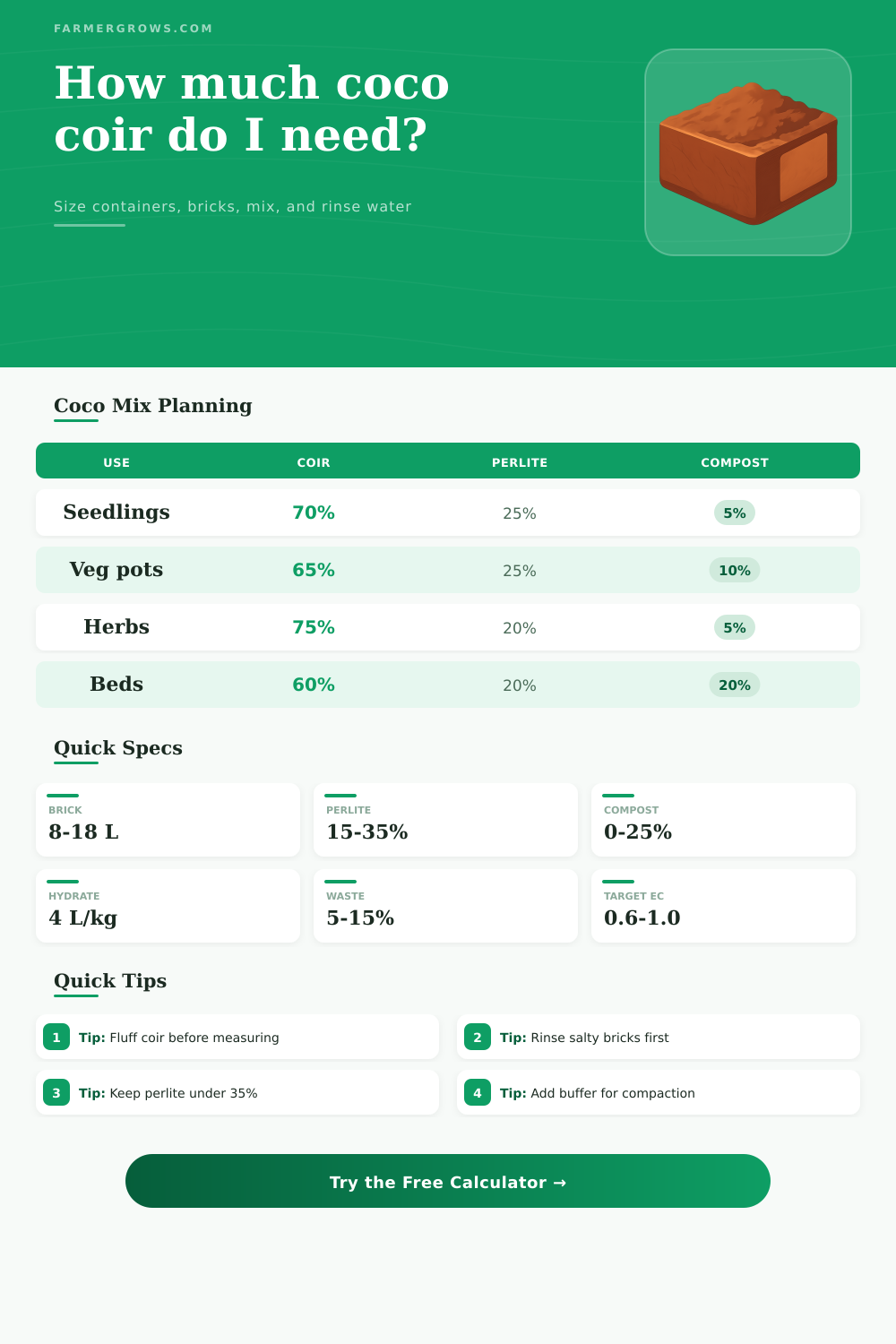
| Seedlings and starts | 70% | 25% | 5% |
| Tomato and pepper pots | 65% | 25% | 10% |
| High-frequency fertigation | 70% | 30% | 0% |
| Herbs and leafy greens | 75% | 20% | 5% |
| Large planters with slow release nutrition | 60% | 20% | 20% |
| Container | Approx volume | Liters | Notes |
|---|---|---|---|
| 72-cell tray | 0.18 to 0.30 gal total | 0.7 to 1.1 L | Varies by cell depth and fill line |
| 1 gallon nursery pot | 0.65 to 0.85 gal actual | 2.5 to 3.2 L | Trade gallons are often smaller than liquid gallons |
| 3 gallon nursery pot | 2.2 to 2.7 gal actual | 8.3 to 10.2 L | Good size for herbs, peppers, and annuals |
| 5 gallon bucket or fabric pot | 4.5 to 5.0 gal actual | 17 to 19 L | Add compaction buffer for fabric pots |
| 10 gallon fabric pot | 9 to 10 gal actual | 34 to 38 L | Useful for larger vegetables and patio fruit |
| Runoff EC reading | Target before feeding | Rinse approach | Calculator factor |
|---|---|---|---|
| Below 0.8 mS/cm | 0.6 to 0.8 mS/cm | Light rinse or direct buffering may be enough | Low rinse volume |
| 0.8 to 1.5 mS/cm | 0.6 to 1.0 mS/cm | Hydrate fully, drain, then rinse once | Normal rinse |
| 1.5 to 2.5 mS/cm | 0.6 to 1.0 mS/cm | Use multiple drain-through passes before buffering | Moderate rinse |
| Above 2.5 mS/cm | Below 1.0 mS/cm | Rinse thoroughly and retest before mixing fertilizer | High rinse volume |
Measure after expansion. Hydrated coco changes volume as it is fluffed, squeezed, and screened, so use the loose final volume when comparing it with perlite and compost.
Retest runoff after rinsing. EC drop is not perfectly linear in packed coir, so the rinse volume estimate is a planning target, not a substitute for a meter reading.
Coco coir are a growing medium that many person use for there container gardens. Before people can plant seeds into the coco coir, there is specific steps that they must follow to prepare the coco coir. One of the first step is to order coco coir bricks and then to add water to the coco coir bricks until they has expanded.
However, when mixing coco coir with other medium like perlite and compost, people often commit mistake that will lead to drainage and salt issue within the coco coir. The coco coir calculator will help people to avoid these mistakes by mathematicaly calculate the amount of coco coir, perlite, and compost that will be need for the containers. To use the coco coir calculator, people must first enter the number of container and the volume of each container into the calculator.
How to Use the Coco Coir Calculator
Including these measurement allows the coco coir calculator to scale the coco coir according to the number of containers that will be filled with the coco coir and coco coir mixture. By entering these variable, the coco coir calculator will calculate how much coco coir will be needed for each container. This will prevent people from running out of coco coir before they have filled all of there container.
Another variable that the coco coir calculator take into account is the hydrated yield of the coco coir bricks. Coco coir bricks will expand to a specific volume when they are hydrated, but the actual volume of the brick can change depending on how tightly the bricks is packed. By entering the hydrated yield of the coco coir bricks, people can ensure that the coco coir calculator calculates how much coco coir will be available.
Additionally, by entering the dry weight of the coco coir bricks, the coco coir calculator will calculate how much water will be needed to hydrate the coco coir bricks. Another important variable that determine the coco coir mixture is the percentage of perlite or compost that people will use in the coco coir. Using a high percentage of perlite in the coco coir will cause the coco coir mixture to drain more frequent.
Additionally, using a high percentage of compost will increase the amount of nutrient and the moisture that will remain in the coco coir. The coco coir calculator will automatically calculate the amount of coco coir that will be needed according to the percentage of perlite and compost that are selected. This automatic calculation allows people to see the effect that changing the percentage of one ingredient have on the amount of coco coir required for the container.
The coco coir calculator also allow people to add a buffer to account for any coco coir that may be lost during the mixing of coco coir, perlite, and compost. Some of the coco coir may compact when it is place into fabric pots or mixing tubs. To account for this, people may add a buffer of five or ten percent to the total mixture.
This buffer ensure that there will be enough coco coir to fill each container after the coco coir mix with the other ingredient. The coco coir calculator will calculate the number of liters or gallon of water that will be needed to rinse the coco coir of the salts that accumulated during the coco coir hydration process. This rinsing of the coco coir is necessary to ensure that the electrical conductivity of the coco coir does not adversely affect the seedlings that grow in the coco coir.
The coco coir calculator will help people to determine the target electrical conductivity for there plants. Different plant species will require different electrical conductivity and rinsing amounts. For instance, seedlings will require low electrical conductivity level, while plants like tomatoes may require more higher electrical conductivity levels.
The coco coir calculator will ask for the starting electrical conductivity of the coco coir bricks. Based off the electrical conductivity of the coco coir and the type of plant that people are to be grown in the containers, the coco coir calculator will calculate the number of liters or gallon of water that will be needed to rinse the coco coir of the excess salt. Thus, the coco coir calculator will allow people to turn the conductivity of the coco coir into a specific number of liters or gallon of water to be used for rinsing.
This coco coir calculator allows people to change the variable and to see the result of the changes to the variables. The coco coir calculator can display the measurement in both metric and imperial units. For instance, if the amount of perlite is increased, the amount of water that will be needed to rinse the coco coir will decrease.
This type of calculator allows people to understand the effect of each ingredient on the coco coir mixture. Additionally, by utilizing the coco coir calculator, people will no longer have to perform the calculation manually. Instead, the coco coir calculator will perform these calculation for people and will allow them to prepare there coco coir mixture to be used in there container.