PVC Pipe Flow Calculator
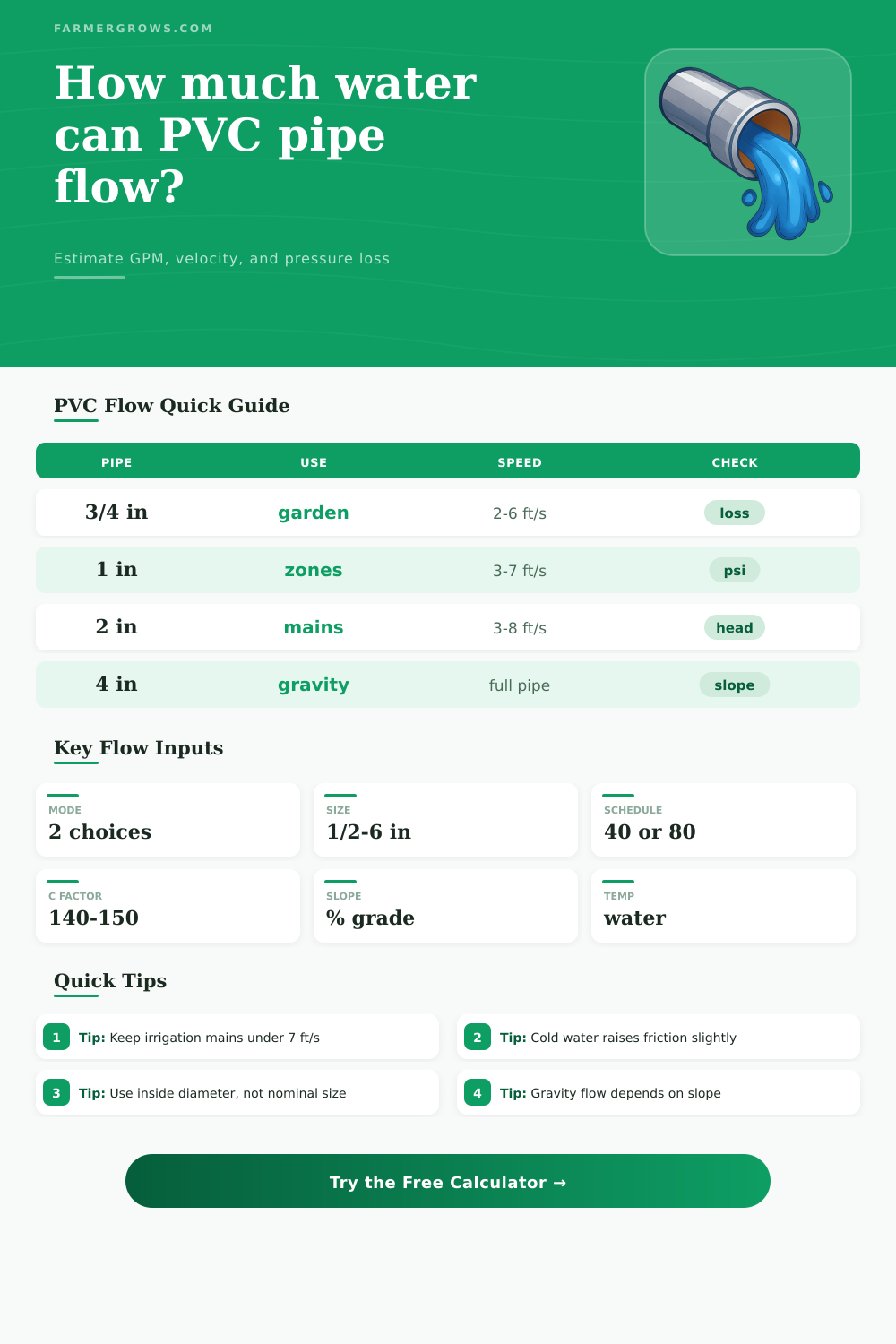
Estimate water flow through PVC pipe by nominal size, schedule, available pressure drop, pipe length, slope, Hazen-Williams C factor, inlet pressure, water temperature, and gravity or pressurized flow mode.
Pressurized mode solves flow from available pressure drop using Hazen-Williams. Gravity mode estimates full-pipe flow from slope with a Manning-style equation and also shows pressure-drop equivalence for comparison.
PVC Flow Result
Enter pipe details to estimate water flow.
The grid compares nearby Schedule 40 or 80 sizes with the same pressure drop, length, C factor, temperature, and slope inputs.
| Nominal size | Sch 40 ID | Sch 80 ID | Farm use note |
|---|---|---|---|
| 1/2 in | 0.622 in | 0.546 in | Short hose bibs, small greenhouse branches |
| 3/4 in | 0.824 in | 0.742 in | Drip zone feeds and compact wash lines |
| 1 in | 1.049 in | 0.957 in | Garden mains and small irrigation zones |
| 1-1/4 in | 1.380 in | 1.278 in | Longer branch runs with modest pressure loss |
| 1-1/2 in | 1.610 in | 1.500 in | Manifolds, nursery benches, and transfer lines |
| 2 in | 2.067 in | 1.939 in | Orchard blocks, pump discharge, and stock water |
| 3 in | 3.068 in | 2.900 in | Large mains, gravity drains, and pond plumbing |
| 4 in | 4.026 in | 3.826 in | High-capacity gravity and low-loss pumped mains |
| Velocity band | Interpretation | Good for | Watch point |
|---|---|---|---|
| Under 2 ft/s | Very gentle flow | Suction, settling-sensitive lines | Large pipe may not scour debris |
| 2 to 5 ft/s | Efficient farm plumbing range | Irrigation mains and branch lines | Check pressure loss on long runs |
| 5 to 7 ft/s | High but often usable | Short washdown and transfer lines | Valves should close slowly |
| Over 7 ft/s | Review pipe size | Only short intermittent runs | Noise, surge, and friction rise fast |
| Slope | Drop per 100 ft | Gravity effect | Common use |
|---|---|---|---|
| 0.25% | 0.25 ft | Low capacity | Carefully graded drains |
| 0.50% | 0.50 ft | Moderate capacity | Yard and greenhouse drain lines |
| 1.00% | 1.00 ft | Strong capacity | Farm overflow and pond return lines |
| 2.00% | 2.00 ft | High capacity | Short steep drain or bypass runs |
| Input | Typical value | Calculator role | Practical note |
|---|---|---|---|
| New PVC C factor | 150 | Higher flow for same pressure drop | Best for clean new pressure pipe |
| Aged PVC C factor | 140 | Slightly lower flow | Use when mineral film or biofilm is possible |
| Cold water | 40 to 50°F | Small friction increase | Useful for spring or well feeds |
| Warm water | 80 to 100°F | Small friction decrease | Do not exceed PVC temperature ratings |
These estimates are for water in clean PVC pipe. Final system design should also consider fittings, valves, filters, elevation change, surge control, code limits, and manufacturer pressure ratings.
To calculate the amount of waters that will move through a pipe, given certain conditions, there are several factors to consider. PVC is often used for irrigation systems in gardens and on farm due to the fact that PVC is inexpensive and easy to use. Additionally, PVC is a smoothly material, indicating that it will experience low friction losses for a long period of time.
A flow calculator can help to determine the proper size of the irrigation systems pipes based off these considerations. The variables that impact the calculated flow of water is the inputs into the flow calculator. The size of the pipe is one of the primary variable, but the schedule for the pipe can also impact the calculation of the flow.
How to Calculate Water Flow in Pipes
For instance, if the schedule of the pipe are increased, the diameter of the pipe will be smaller. Therefore, if the size of the pipe is set to 2 inches, a higher schedule will allow for less water to flow through the pipe than a lower schedule for that same size of pipe. The length of the pipe can be entered into the flow calculator, but other variables like the number of elbow in the system, valves, or filters will also impact the flow.
Therefore, another input is the degree of pressure loss that the system will accept. Higher pressure losses allow for smaller pipes to be used to handle the irrigation system. If the system is using gravity to allow water to move through the system, the slope of the system will be an input into the flow calculator.
The gravity mode use a different equation than the pressurized mode for calculating the flow of water. The percentage of the slope indicate the steepness of the slope of the gravity system, and the percentage of how full the pipe will be will also impact the calculations. Many farms has gravity systems to drain their field, but these drains are not always filled with water.
A one percent slope will allow for more water to move through the system than a quarter of one percent slope, and will back up less often. The Hazen-Williams C factor will represent the smoothness of the pipe. For new PVC pipe, the C factor will be 150.
Water temperature can change the C factor for the pipe, with colder water being more viscous than water at room temperatures. As the pipe age, the buildup of scale or biofilm will reduce the C factor towards 140 or lower. As the C factor decreases, less water will travel through the system.
Therefore, an older pipe will allow less water to travel through the system than a new pipe. Another consideration for the designer is the velocity of the water. Velocities that are too low will allow for sediment to settle within the pipe.
Velocities that are too high will create noise within the system, cause the water to create surges within the system, and cause the fittings to wear out at a faster rate. These velocities are indicated within the flow calculator so that designer can ensure that the velocity within the system is within an acceptable range. A grid next to the main results will indicate the changes in the flow of water if the size of the pipe is changed by one increment.
By examining this grid, designers can make informed decision about the size of the pipe. For instance, if the grid indicates that a change in pipe size will allow for more water to flow through the system, the designer may consider that change. Additionally, the grid can be used to determine the smallest size of pipe that may be used in the system based upon the velocity and pressure requirement.
The flow calculator cannot account for all of the complications that may exist within an irrigation system. For instance, the flow calculator does not account for the reduction in pressure that can result from the presence of fitting, strainers, or valves that are not fully open. Any changes in the elevation of the system will impact the pressure at the outlet of the system.
Any changes in the temperature of the water will impact the friction within the system, as well as any changes to the long-term pressure that the PVC pipes can stand over time. As such, the calculations from the flow calculator should of been adjusted according to these factor. Some of the most common mistake in the calculations are using the nominal size of the pipe instead of the inside diameter.
Another mistake is to ignore the fact that the pipes may become dirty or filled with sediment over time. Additionally, many irrigation system are created with the assumption that they need to handle the peak flow of water from an area, but they do not need to handle the flows of water during dry periods when the velocity of the water may be slower. The best way to utilize the grid within the flow calculator is to enter the size and schedule of the pipes that will be used in the irrigation system.
Additionally, the length of the pipes and the amount of pressure loss that will be allowed in those system can be entered. After determining the flow and velocity of the water that will move through those systems, the user can change the size of the pipe by one inch, and the new flow and velocity compared to the initial calculations. If the system will use gravity to allow for the movement of water, the gravity mode should be selected, and the actual slope of the land where the system will be installed entered.
While the flow calculator can perform the mathematical calculation for the designer, the designer will need to use their own judgment about the water source and the goal for the irrigation system. While the flow calculator will eliminate some of the guesses that the designer might use when determining system components, walking the site along which the irrigation system will be installed will help the designer to create an efficient irrigation system.