
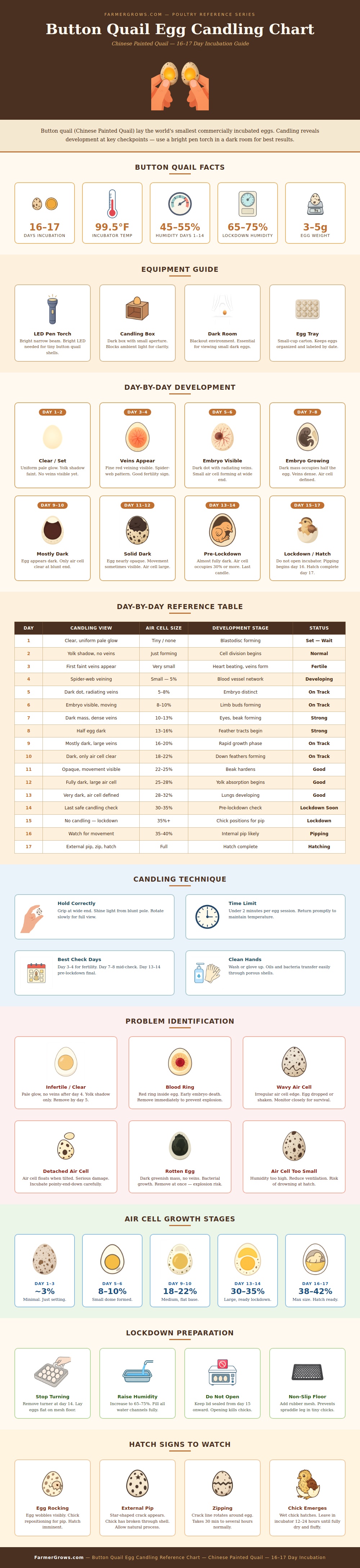
Candling is a process that you use to inspect button quail eggs. Candling allow you to see inside of teh button quail egg. You use candling to determine if a button quail egg is fertile.
Candling allows you to determine if the embryo inside of the button quail egg is grow correctly. Candling also allows you to determine the size and shape of the air cell inside of the button quail egg. Because candling allows you to visualy inspect the button quail egg, it is a useful process in that you can determine which button quail eggs to keep inside of an incubator.
How to Candle Button Quail Eggs
To candle a button quail egg, you will use a light source that emit a narrow and bright beam of light. A narrow beam of light is more better than a broad beam of light because the narrow beam of light can penetrate the thin shell of the button quail egg. Hold the button quail egg at the blunt end of the button quail egg and shine the light upward through the blunt end of the button quail egg.
Gently roll the button quail egg to ensure that you can view the entire button quail egg. You should perform this process in a dark room so that the beam of light is more easier to view. You must also perform this process quick because opening the incubator for the button quail eggs will change the humidity and the temperature of the button quail eggs.
You should perform candling for the first time around day three or day four of incubation. At this point, if the button quail egg is fertile, the button quail egg will appear with fine red lines that emanate from the center of the button quail egg. If the button quail egg is infertile, the button quail egg will appear pale.
Infertile button quail eggs will only have a faint shadow of the yolk inside the button quail egg. If you find any infertile button quail eggs, remove them from the incubator so they dont introduce bacteria to other button quail eggs inside of the incubator. During the second week of incubation, the embryo inside of the button quail egg will have grown to become a dark mass that fills about half of the button quail egg.
During the second week, the air cell will become a clear dome that is visible at the wide end of the button quail egg. Perform candling again during this second week to ensure that the embryo is still live. During this second week the embryo has grown inside of the button quail egg and takes up more of the space within the button quail egg so it may become difficult to read the button quail egg through the beam of light.
Perform candling one more time by day fourteen when the humidity of the incubator should be stable. The air cell in the button quail egg allows you to determine the moisture levels in the incubator. You can see the air cell inside of the button quail egg and it grow in size as moisture leaves the button quail egg.
When the air cell reaches one-third of the size of the button quail egg, the chicks are ready to enter the lockdown stage. If the air cell inside of the button quail egg is too small when the button quail egg reaches one-third of its size, this means the humidity of the incubator was likely too high during incubation of the button quail egg. In this situation the chick will have difficulty with the process of pip.
Additionally, if the air cell appears ragged or if the air cell moves when tilting the button quail egg, it means you jarred or moved the button quail egg from there place during incubation. There are specific problem that can occur inside of the button quail egg that can be identified through candling. If there is a blood ring inside of the button quail egg, this means that the embryo inside of the button quail egg has passed away.
Blood rings indicate that the blood vessel have moved away from the shell of the button quail egg. If the button quail egg appears to be completely clear after day five of incubation, this means the button quail egg is infertile. If the interior of the button quail egg is green or black, the interior is rotting.
Remove any button quail eggs whose interior is rotting immediately to prevent introducing bacteria to the other button quail eggs inside of the incubator. Lockdown is a phase for the button quail eggs after candling. During lockdown dont turn the button quail eggs and do not open the incubator.
The reason for not opening the incubator during lockdown is to avoid dropping the humidity inside of the incubator. Low humidity is harmful to the button quail chicks. Instead, increase the humidity level of the incubator during lockdown.
During lockdown, when the button quail chick begins to pip, a small crack in the shape of a star will form on the shell of the button quail egg. The chicks will be able to pip on there own, so there is no need to assist in the pipping process of any of the button quail eggs unless it is absolutely necessity.