Water Pump Horsepower Calculator
Estimate water horsepower, pump shaft horsepower, electrical input, rounded motor size, and voltage notes from flow, total dynamic head, losses, specific gravity, and efficiency.
Load a farm or homestead pump scenario, then adjust the numbers to match the measured flow and pump curve head.
Horsepower Estimate
Calculated pump horsepower and motor sizing details will appear here.
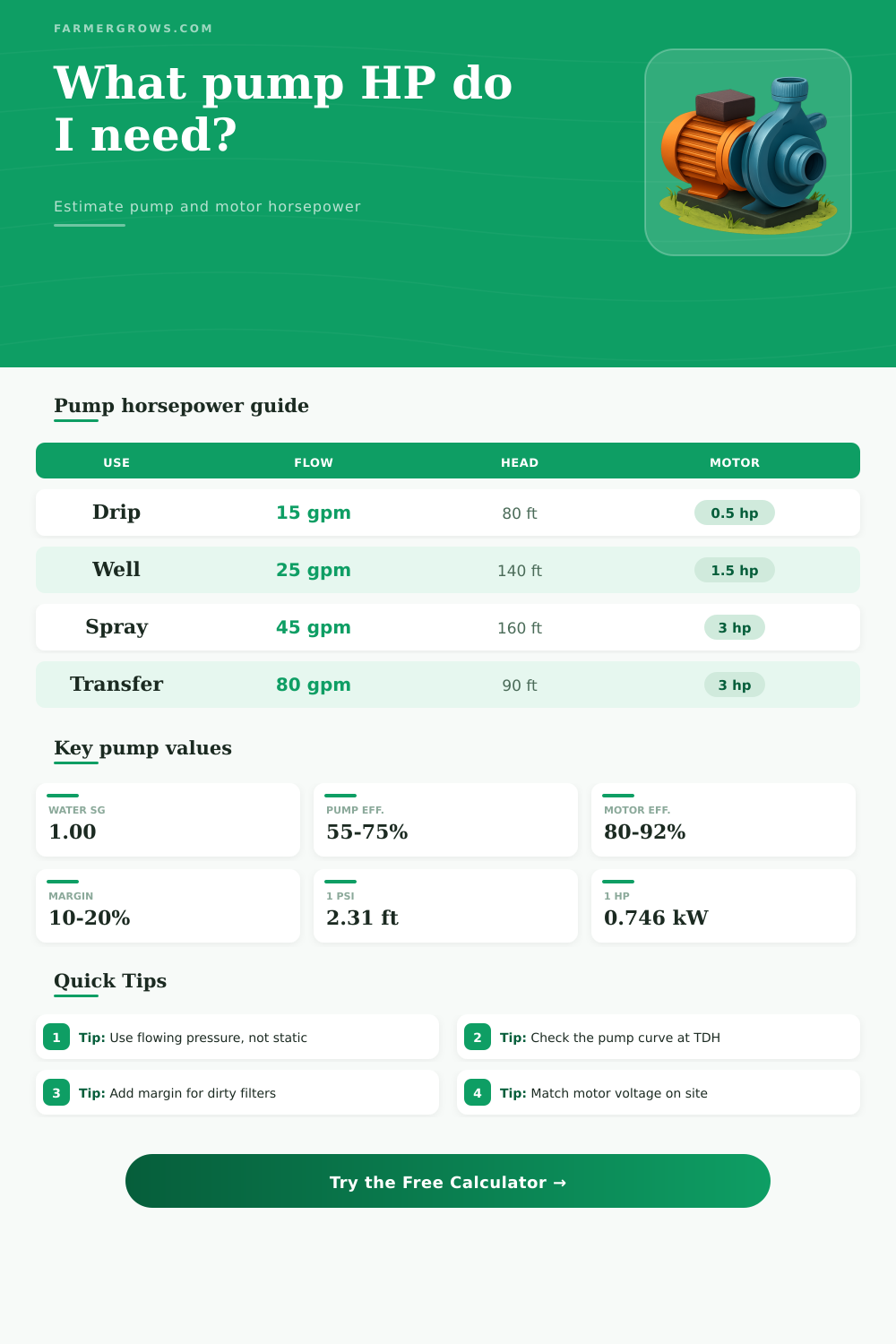
Moderate flow with steady pressure. Filter loss often grows through the day, so include realistic pipe loss and a small safety factor.
Higher TDH and nozzle pressure. Check the operating point on the curve so horsepower is not sized from flow alone.
Elevation, drawdown, and pressure tank settings can change TDH. Single phase motors may need more attention to starting load.
Often high flow with lower head. Pipe diameter drives horsepower because friction rises quickly as velocity increases.
Specific gravity above 1.00 increases horsepower. Confirm seal, impeller, and material compatibility with the fluid.
Variable speed can reduce energy use, but the motor and drive must be matched to voltage, phase, current, and enclosure needs.
| Total Flow | 75 ft TDH | 125 ft TDH | 175 ft TDH | 225 ft TDH |
|---|---|---|---|---|
| 10 gpm | 0.29 hp | 0.49 hp | 0.68 hp | 0.87 hp |
| 25 gpm | 0.73 hp | 1.21 hp | 1.70 hp | 2.18 hp |
| 50 gpm | 1.46 hp | 2.43 hp | 3.40 hp | 4.37 hp |
| 75 gpm | 2.18 hp | 3.64 hp | 5.10 hp | 6.56 hp |
| 100 gpm | 2.91 hp | 4.86 hp | 6.80 hp | 8.74 hp |
| Supply Type | Typical Farm Use | Practical Note | When to Check Closely |
|---|---|---|---|
| 115 V single phase | Small pumps below 1 hp | Current rises quickly as hp increases | Long cords, washdown pumps, old circuits |
| 230 V single phase | Wells, boosters, small irrigation | Common for 0.5 to 5 hp motors | High starting load or low voltage at pump |
| 230 V three phase | Shop and pump house service | Smoother starting and better larger motors | Phase balance and overload settings |
| 460 V three phase | Large irrigation or transfer pumps | Lower current for the same power | Drive, starter, and motor nameplate match |
| VFD | Variable pressure or multiple zones | Can reduce speed instead of throttling | Motor insulation and enclosure rating |
| Component | What It Represents | Common Range | Calculator Field |
|---|---|---|---|
| Static lift | Vertical rise from water source to discharge | 5-250 ft | Elevation lift |
| Pressure head | Outlet pressure converted to feet of water | 23.1 ft per 10 psi | Base TDH |
| Pipe friction | Loss from pipe length, diameter, and flow | 2-60 ft | Pipe loss |
| Filter and valve loss | Screens, discs, manifolds, elbows, and reducers | 3-35 ft | Pipe loss |
| Safety factor | Margin for fouling, wear, and seasonal variation | 10-20% | Safety factor |
| Fluid | Typical SG | Horsepower Effect | Sizing Note |
|---|---|---|---|
| Clean water | 1.00 | Baseline | Use for most wells, ponds, and irrigation |
| Dilute fertilizer solution | 1.02-1.10 | Small increase | Check chemical compatibility |
| Milk or nutrient mix | 1.03-1.08 | Small increase | Confirm sanitary pump suitability |
| Brine or dense solution | 1.10-1.25 | Moderate increase | Motor margin becomes more important |
| Slurry-like fluids | Varies | Curve may not apply | Use a pump built for solids or slurry |
When you choose a pump for your system, you must determine the correct amount of horsepower for that system. The amount of horsepower that you choose for your pump should provide enough power to move the waters from your system’s source to its destination, yet not provide such a large amount of horsepower that the pump will waste energy and burn out. There are many different factors that will influence the amount of horsepower that a pump should have, including the distance that the water will travel, and the resistance to that movement of the water.
One way to calculate the amount of horsepower that a pump should have is to calculate the total dynamic head of the system. The total dynamic head of a system are equal to the vertical lift of the system (the distance from the water to the discharge point) plus the friction caused by the system’s components. By entering the vertical lift and friction values into a horsepower calculator, a person can calculate the total dynamic head that the system will experience.
How to Choose the Right Horsepower for Your Pump
A person can increase the total dynamic head if, for instance, they chooses to use a clogged screen or longer pipes. An increased total dynamic head will indicate the need for a larger motor to provide the necessary amount of power for the system. Besides the total dynamic head of a system, another factor that will influence the amount of horsepower that a pump should have is the weight of the fluid.
Fluids other than water will have a different specific gravity than water (which is 1.0). For instance, fertilizers and nutrient solutions has a specific gravity that is higher than water. This increased specific gravity will require an increased amount of power to move the fluid through the system.
Thus, the specific gravity of the fluid should be entered into the horsepower calculator to ensure that the pump will provide the apropriate amount of horsepower for the system. In addition to the total dynamic head of the system and the weight of the fluid, the efficiency of a system’s components can influence the amount of horsepower that is required. Two components that should be considered are the efficiency of the pump and the efficiency of the motor.
The efficiency of the pump is the amount of power that is delivered to the water. The efficiency of the motor is the amount of power that the motor delivers to the pump (without power loss due to heat). These two efficiency factors can change for any given pump, so they should be adjusted on the horsepower calculator to reflect the efficiency of the pumps that will be purchased.
Another consideration when calculating the amount of horsepower for a system is introducing a safety margin. A safety margin is a percentage of additional power that can be introduced into the system to account for any changes to the components of the system. For instance, a safety margin can be used to account for dirty filter or the normal wear of system components.
Not providing a sufficient safety margin can lead to the motor struggling to move the water during increased demands on the system. However, providing too great of a safety margin will lead to the purchase of an oversized motor that cannot efficient move the water. In addition to the variables described above, other factors that can influence the total dynamic head include variables related to the actual installation of the system.
For instance, a system may experience a change in elevation of around twenty feet during peak usage of the system. This change in elevation can have a greater impact upon the amount of horsepower required than the difference between the two sizes of motors. Thus, changes in elevation should be accounted for when calculating the total dynamic head.
These losses should be measured and accounted for in the system rather than using the static lift value of the system alone. The third main variable to consider when choosing the amount of horsepower for the motor is the phase and the voltage of the motor. Single-phase motors are typically used for small farm wells.
Three-phase motors are typically used for larger installations and may draw less current then single phase motors when performing the same tasks. However, three-phase power connections are more specific than single-phase connections. The voltage that is supplied to the motor must match the voltage of the motor that is to be installed.
A common mistake is the use of the wrong head when determining the size of the pump that will be used. Many people make this mistake when using only the static lift or the nozzle pressure of the system. Using only the static lift or the nozzle pressure will not account for the friction caused by the system.
As a result, the pump will struggle to move the water from the source to the destination. The base head, the pipe loss, and the elevation should be calculated separately to determine the amount of horsepower that the motor should have. Another common error is in the treatment of efficiency as a specific number.
Efficiency is a value that can change in relation to the flow of the water. One efficiency value of a pump may occur at one flow rate of water, but that same efficiency may be different at a different flow rate. Calculating the amount of horsepower required using the efficiency of the pump at the flow rate at which the pump will be operating will help to avoid high electric bills for the system.
The reference tables that are present show the amount of horsepower that is required for various amounts of flow and head. These tables are not a list of motors to buy, but they do provide a suggestion of how the factors may change. For instance, given a flow of 25 gpm and a head of 100 feet, various amounts of pipe loss and safety margin will change the horsepower requirement.
These tables allow individuals to make decisions about the cost of purchasing an additional motor of a certain size. Balancing the amount of horsepower that a pump will have relates to the balance between the amount of pressure, efficiency, and longevity of the system components. A horsepower calculation is located at the center of this balance.
The accuracy of the calculations made will depend upon the accuracy of the individual’s inputs. The more accurate that the variables are measured, the more accurate the horsepower calculation will be. Vague input variables will result in a vague horsepower calculation, leading to higher bills and maintenance costs for the system.