
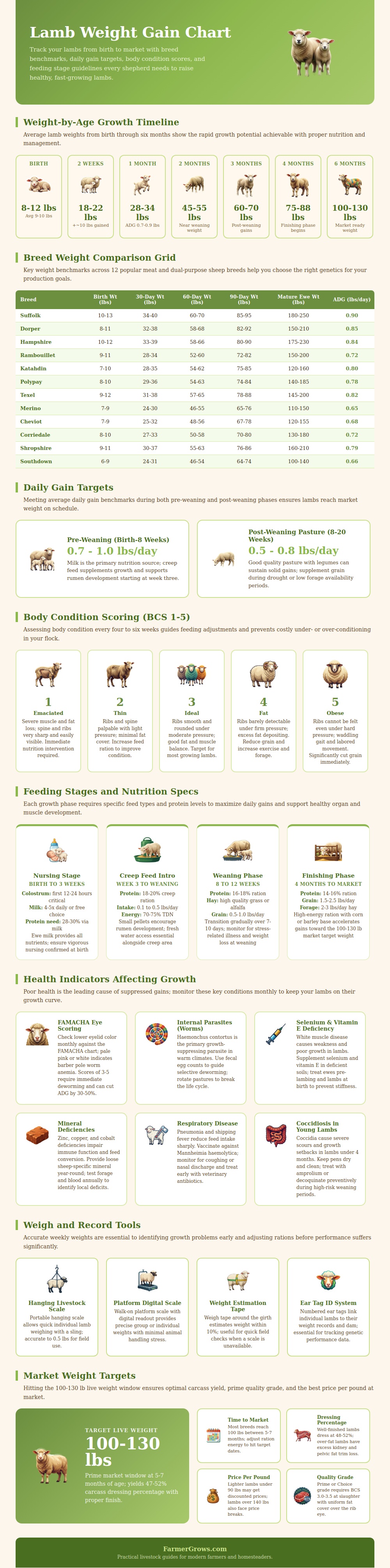
Weight tracking is another method that can be use to monitor the growth of the lambs. Furthermore, weight tracking can also help to reveal any potential growth problems in the lambs before those issue become severe. The weight of the lambs can be used as a means of turning the raw data regarding the growth of the lambs into information that can be used within the barn or on the pasture itself.
Many individual may not appreciate the importance of the first eight week of a lambs life, but they are actualy critical in determining the weight that the lambs will gain during this nursing period. Lambs that gain good weight during this initial period will find it difficult to gain the same amount of weight later in there lives. The development of the rumen in lambs begins around three weeks of age, when the lambs begin to eat creep feed, and the development of the rumen changes the way that the lambs utilize the pasture or hay available to them.
How to Track Lamb Weight and Growth
Another factor that can impact the weight that the lambs gain is the breed of the lambs. For instance, one of the factors to consider when selecting the breed of lambs to raise is that some breed will gain more weight than others. For instance, if the lambs will have limited access to supplemental feed, it would be beneficial to select a breed that gains weight even with the limited access to supplemental feed.
Lambs that are born with a higher birth weight do not necessarily have an advantage over lambs of a lower birth weight if the lambs of the higher birth weight are genetically predisposed to gain less weight than other breeds. In addition to monitoring the weight of the lambs, daily gain target can be established for each of the lambs. The daily gain targets for lambs can be separated into two groups: those that are to be established before the lambs are weaned, and those that will be established after the lambs are weaned.
For lambs before weaning, milk will be the primary determinant of how much weight the lambs gain each day. After weaning, however, the quality of the forage that is provided to the lambs, as well as the amount of grain that is provided, will determine the weight of the lambs. If the lambs are not gaining the amount of weight that is targeted after weaning, more time will be required to reach the market weight for the lambs, and more feed will be required to reach that market weight.
Another method that can be utilized in the management of the lambs is body condition scoring. Body condition scoring can be used in conjunction with the weight charts that are created for each of the lambs. Body condition scoring can help to determine if the lambs are gaining muscle, or if they are only gaining the weight that is required for filling the lambs’ gut.
Since the weight of the lambs can be measured on the scale, body condition scoring is a five-point system that can be used to determine if the feeding program for the lambs is gaining the correct type of weight. Even if the lambs have a weight that is within the target range, if the body condition score is low for each of the lambs, the lambs are not yet mature enough to be slaughtered for meat. Health issues in the lambs, such as internal parasites, mineral gaps, and respiratory issues can lead to the lambs not gaining the amount of weight that is targeted for each of those animals.
Furthermore, these health issue may result in the lambs’ weight gain stalling altogether. It is important to monitor the health of the lambs so that any health problems are caught early in there development. For instance, you can perform FAMACHA or temperature checks to monitor the health of the lambs, which will reveal any health problems before they impact the weight of the lambs.
In addition to the other management tools for the lambs, weighing equipment will need to be utilized in the management operation and regular monitoring of the lambs to ensure that the weight tracking methods are accurate. For example, hanging scales can be used if there are small groups of lambs to be weighed, but platform scales can be used if there are many lambs to be weighed, or if the weight of the lambs is to be minimized. Another tool is the use of weight tapes, which are an estimate of the weight of the lambs.
However, they are not as precise as using a scale to measure the weight of the lambs. Regardless of the type of weighing equipment that is utilized for the lambs, consistency in using such equipment will ensure the effectiveness of the weight tracking methods. Another final goal within the management of the lambs is the market weight of the lambs.
The price of the lambs per pound of weight, and the amount of weight that is determined from the carcass yield, can determine the market weight of the lambs. If the lambs are too light when they are slaughtered for meat, the meat may receive a discount in it’s market value. In contrast, lambs that are too heavy for market will lose money for the owner of the lambs.
Any breeding and feeding decisions can be timed to ensure the lambs reach the target weight for market. Finally, weight tracking helps in the management of the lambs in that it can reveal which periods of time the lambs’ gains in weight began to slow. This information can help to adjust the feeding program or the parasite control program for the next group of lambs being managed.