Pressure Washer Hose Calculator
Estimate hose pressure drop, water velocity, fitting loss, elevation effect, and nozzle-size match for farm wash bays, greenhouse cleanup, equipment rinsing, and long hose runs.
This calculator uses Darcy-Weisbach friction, minor-loss coefficients for fittings, 0.433 PSI per foot of water lift, and the common pressure-washer nozzle sizing relationship based on 4000 PSI rating.
Best for compact electric units and short reach. At higher GPM it can create large velocity and quick pressure loss.
A balanced size for many 2.5 to 3.5 GPM machines where the hose length stays moderate and handling still matters.
Useful for farm equipment cleanup, longer reels, and commercial washers because the larger ID keeps drop lower.
The orifice should match the pressure available at the nozzle, not only the pump rating printed on the machine.
Pressure Washer Hose Results
Results update from hose ID, length, GPM, nozzle size, fittings, material roughness, and elevation.
| Formula | Calculator Use | Inputs | Notes |
|---|---|---|---|
| Velocity = 0.4085 x GPM / ID² | Hose speed | GPM, inside diameter in inches | Gives feet per second for round hose. |
| Re = V x D / nu | Flow regime | Velocity, diameter, water viscosity | Uses nu = 1.1e-5 ft²/s for water near room temperature. |
| f = Swamee-Jain | Friction factor | Roughness, diameter, Reynolds number | Used for turbulent flow; laminar fallback is 64/Re. |
| Loss = f x L/D x V²/(2g) | Hose PSI loss | Length, ID, velocity, friction factor | Head loss is converted to PSI with 0.433 PSI per foot of water. |
| Nozzle Formula | Meaning | Example | How to Use |
|---|---|---|---|
| Size = GPM / sqrt(PSI / 4000) | Required nozzle number | 3.0 GPM at 3000 PSI needs about 3.46 | Choose the closest available nozzle size for target pressure. |
| GPM = Size x sqrt(PSI / 4000) | Flow through orifice | Size 3.0 at 4000 PSI flows 3.0 GPM | Used when checking whether a nozzle is too small or too large. |
| PSI = 4000 x (GPM / Size)² | Pressure implied by nozzle | 3.0 GPM through size 3.5 gives about 2939 PSI | Compare to pressure available after hose losses. |
| Tip angle does not change size | Spray pattern | 15, 25, and 40 degree tips can share size 3.5 | The orifice number sets flow-pressure match. |
| Hose ID | Good Flow Range | Velocity at 3 GPM | Best Fit |
|---|---|---|---|
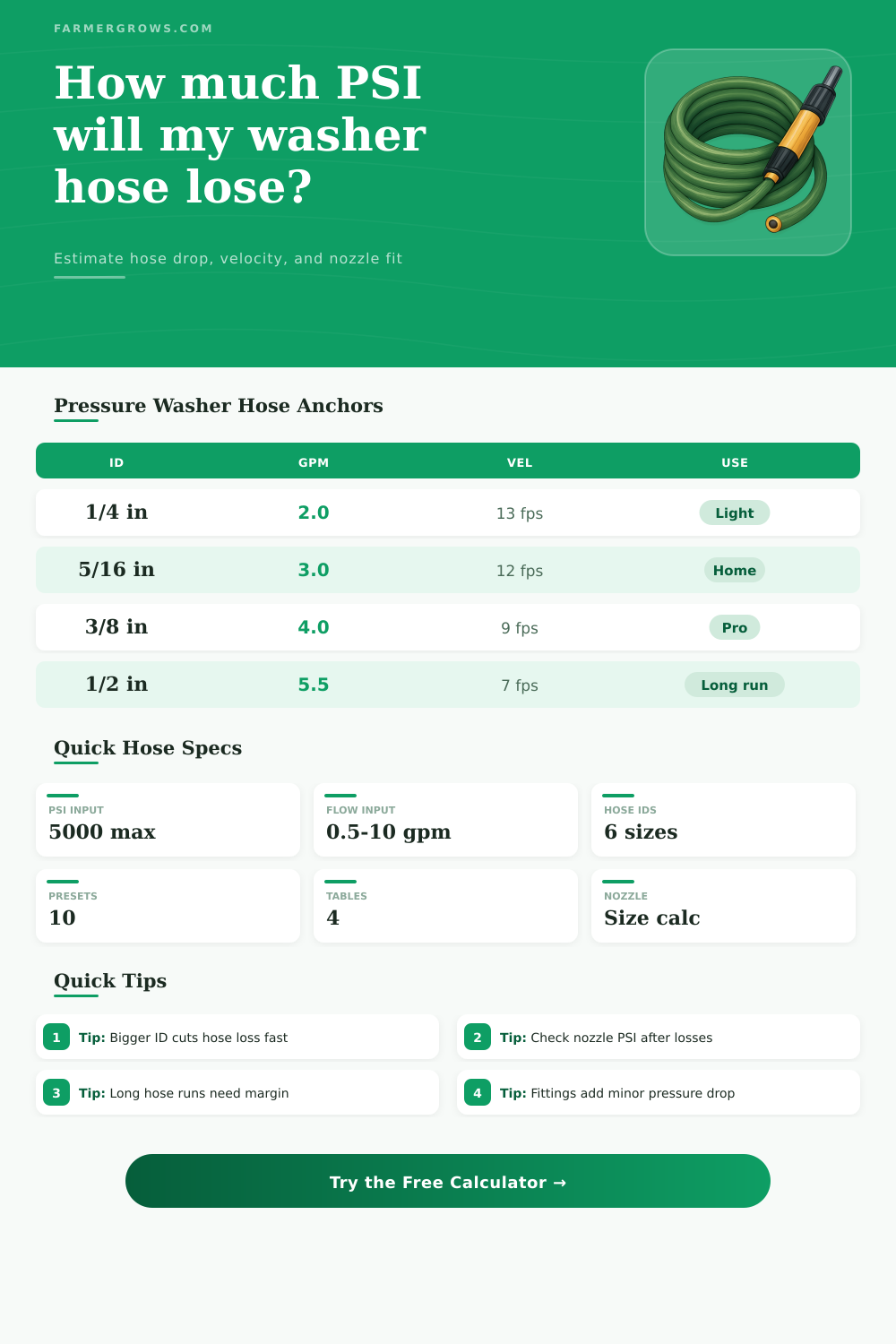
| 1/4 in | 1.2 to 2.3 GPM | 19.6 ft/s | Compact units, short hoses, light rinsing. |
| 5/16 in | 2.0 to 3.5 GPM | 12.5 ft/s | Residential gas washers and moderate hose runs. |
| 3/8 in | 3.0 to 5.5 GPM | 8.7 ft/s | Farm wash bay, equipment cleanup, and reels. |
| 1/2 in | 5.0 to 8.0 GPM | 4.9 ft/s | High-flow units and long low-loss hose runs. |
| 5/8 in | Supply or bypass | 3.1 ft/s | Low-pressure feed lines, not typical high-pressure wand hose. |
| 3/4 in | Long transfer | 2.2 ft/s | Special long-run or low-loss plumbing sections. |
| Item | Calculator Value | Pressure Effect | Field Note |
|---|---|---|---|
| Quick coupler | K = 0.35 each | Minor loss rises with velocity squared | Several couplers on reels can matter at high GPM. |
| Sharp elbow | K = 0.75 each | More restrictive than smooth hose bends | Count hard turns, manifolds, and tight wand entries. |
| Elevation rise | 0.433 PSI per ft | Uphill reduces nozzle pressure | Downhill hose runs recover static pressure. |
| Allowance | Percent of pump PSI | Compares total loss to your limit | Use 10% for typical checks and less for pressure-critical work. |
Keep velocity reasonable. Very high velocity makes every fitting, kink, reel, and extra hose section more expensive in PSI, so upsize ID before adding long extensions.
Match the nozzle after losses. A nozzle sized only from pump PSI can act too small once hose, elevation, and fittings are included, especially on long farm lanes.
Pressure loss through a hose is a phenomenon that occur when water moves through a hose. Pressure loss through a hose occur due to friction and elevation changes. Pressure loss through a hose will make teh water stream at the nozzle more weak than the pressure of the pump.
Pressure loss through a hose occurs due to friction within the hose, the friction within the fittings, and the changes in elevation between the machine and the nozzle. All of the system component, from the pump to the nozzle, will impact the remaining pressure at the nozzle. The calculator require several specific input from the users to calculate the pressure loss through the hose.
Why Water Pressure Drops in a Hose
The users must enter the pump pressure, flow rate, the length of the hose, and the inside diameter of the hose into the calculator. Additionally, the users must enter the nozzle size, the number of fittings on the hose, and the change in elevation between the machine and the nozzle into the calculator. Each of these variable can impact the remaining pressure at the nozzle.
If the length of the hose is shorter, there will be less friction in the hose compared than a longer hose. The longer the hose, the greater the surface area for friction between the water and the hose. The diameter of the hose is one of the primary factor in the pressure loss through the hose.
The narrower the inside diameter of the hose, the higher the velocity of the water through the hose. As the velocity of the water increases, so does the friction of the water within the hose. This additional friction create additional pressure loss within the hose.
Many people will purchase a light hose so that it is easier to transport. The issue with a light hose is that it will often have a smaller diameter. Using a hose with a larger diameter will lead to a reduction in the pressure loss through the hose.
The downside to a larger diameter hose is that it will be heavier and more stiff. The flow rate of the water through the hose will also impact the pressure loss. The higher the flow rate, the higher the velocity of the water through the hose.
A higher flow rate will create more friction within the hose, leading to a higher pressure loss within the hose. Using a machine with a high flow rate may require the use of a larger diameter hose to prevent high pressure loss within the hose. The velocity of the water can create turbulence within the water at every fitting and every bend in the hose.
Each fitting on the hose will lead to a loss of pressure within the hose. Quick coupler and elbows are just some of the fittings on a hose. Each of these will create a loss of pressure within the system.
Using many of these will result in a higher loss of pressure within the system. If the nozzle and the machine experience a change in elevation, there will also be a loss of pressure within the hose due to gravity. For every foot of rise between the machine and the nozzle, there is a loss of 0.433 PSI of static pressure.
This pressure loss due to elevation is a constant because it do not depend on the length of the hose. If the nozzle is higher than the pump machine, the high elevation relative to the pump will lead to a loss of pressure within the hose due to elevation. The final component is the nozzle sizing for the hose.
Many people will choose a nozzle sized for the pump machine’s pressure rather than the nozzle’s pressure. The nozzle pressure is the pump pressure minus the pressure loss due to the hose, fittings, and elevation. Choosing a nozzle that is too small for the hose will result in the nozzle not perform its function correctly.
Using the calculator will reveal what the proper nozzle size should be for the given hose. Another impact on the pressure loss through a hose is the condition of the hoses material. Using a new hose that has a smooth inner diameter will lead to less friction within the hose.
As the hose age, the condition of its inner diameter can worsen. A high degree of roughness within the hose will create more pressure loss through the hose. Using different roughness values within the calculator allows hoses of different condition to be accounted for.
The condition of the hose may not significantly impact the pressure loss within a short hose. However, if the hose is long and has significant pressure loss, the condition of the hose will have a significant impact on the pressure loss within the hose. Some of the mistake people make with water hoses include buying a very long hose to accept a low nozzle pressure at the end of the hose.
Additionally, people might add many hose fittings without considering the loss of hose pressure due to these component. Other people will choose a nozzle size based only on the pressure of the pump machine, not considering the water pressure that will survive the trip from the pump to the nozzle. Users can avoid these mistakes by using the calculator.
The calculator will make visible to the users the relationships between the pump, hose, fittings, and nozzle. Some of the variables that may impact the system differently from the mathematical equation within the calculator include the water temperature within the hose and the age of the hose. Water temperature impact the viscosity of the water within the hose.
Another factor affecting the hoses is how they are routed on the hose reel. The water temperature and the age of the hose may differ from the calculations made with the calculator. If using the calculator, the water stream may be found to be weaker than calculated.
In this case, it is necessary to check the nozzle and the hose for potential issue, such as pinches in the hose. The pump sets the initial pressure of the water. The hose and the fittings determine the surviving pressure of that water.
Finally, the nozzle determine the performance of that water jet.