Generator Runtime Calculator
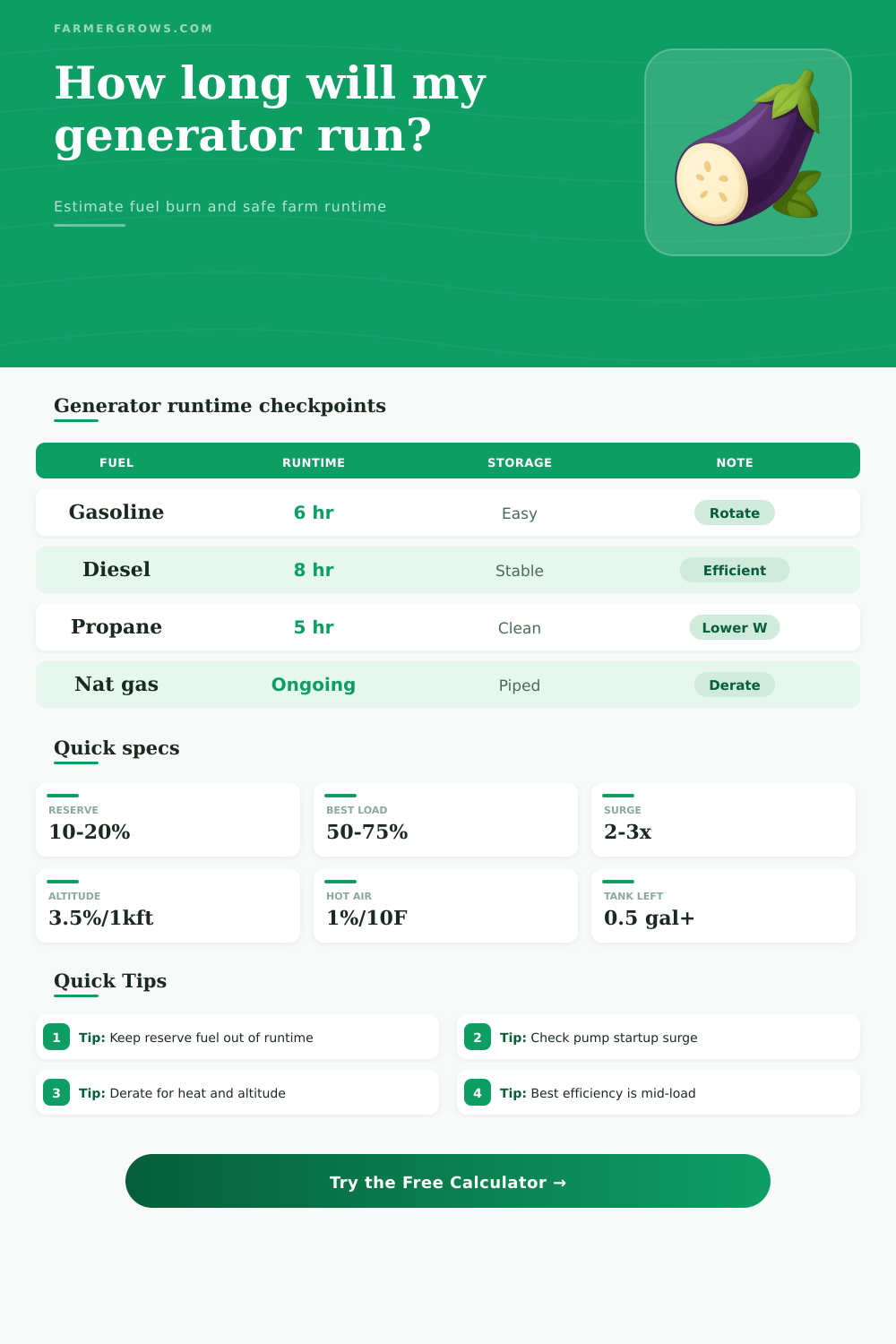
Estimate how long a farm generator will run from tank size, reserve fuel, fuel type, generator load, efficiency curve, surge load, and altitude or hot-weather derating.
Pick a realistic starting point, then adjust fuel, load, tank, surge, and weather. Runtime is calculated from usable fuel after reserve and the selected efficiency curve.
Generator Runtime Results
Runtime uses usable fuel after reserve, selected fuel energy, load curve burn rate, load percent, surge margin, and altitude plus temperature derating.
| Fuel type | Calculator unit | Runtime tendency | Farm planning note |
|---|---|---|---|
| Gasoline | Gallons | Middle baseline | Common portable choice; keep stored fuel fresh and stabilized. |
| Diesel | Gallons | Usually longer | Higher energy per gallon and efficient at steady heavy loads. |
| Propane | Liquid gallons | Usually shorter | Stores well but many engines make less power on propane. |
| Natural gas | Therms | Supply based | Useful for fixed standby sets; verify pressure during outages. |
| Dual fuel | Selected fuel | Depends on mode | Run the calculator separately for each fuel setting. |
| Load percent | Fuel behavior | Generator stress | Runtime interpretation |
|---|---|---|---|
| Below 25% | Poor fuel per kWh | Light load, possible wet stacking on diesel | Runtime can be long, but fuel efficiency is weak. |
| 25% to 50% | Improving efficiency | Comfortable for many portable units | Good for overnight essential circuits. |
| 50% to 75% | Best planning band | Stable voltage and useful headroom | Often the best balance of runtime and output. |
| 75% to 90% | Higher hourly burn | Less surge margin | Watch heat, refueling schedule, and motor starts. |
| Above 90% | Short runtime | Near continuous limit | Reduce loads or use a larger generator for reliability. |
| Condition | Typical derate | Runtime effect | Capacity effect |
|---|---|---|---|
| Sea level to 1000 ft | Minimal | Normal curve | Use rated running watts. |
| Every 1000 ft above 1000 ft | About 3.5% | Burn rate similar, usable watts lower | Load percent rises as capacity falls. |
| Above 77 F | About 1% per 10 F | Small fuel change | Hot weather reduces surge and running headroom. |
| Propane or natural gas | Extra output loss | Runtime can still be steady | Confirm alternate-fuel watt rating on the nameplate. |
| Dirty air filter or stale fuel | Variable | May increase burn | Can reduce both voltage stability and surge capacity. |
| Equipment | Running watts | Startup surge | Runtime note |
|---|---|---|---|
| Submersible well pump | 700 to 2000 W | 3x to 5x | Surge often determines generator size before runtime does. |
| Irrigation transfer pump | 1000 to 3500 W | 2x to 4x | High continuous load shortens runtime fast. |
| Greenhouse exhaust fan | 150 to 700 W | 2x to 3x | Long summer operation needs derate headroom. |
| Walk-in cooler compressor | 800 to 2500 W | 3x to 6x | Use duty cycle for average watts when measured. |
| LED grow lights | 300 to 2000 W | 1x to 1.5x | Mostly steady load, so fuel burn follows wattage closely. |
| Brooder or heat mats | 250 to 1800 W | 1x | Resistive heat is easy to start but fuel intensive. |
| Step | Formula | What it checks | Why it matters |
|---|---|---|---|
| Usable fuel | Tank x (1 - reserve) | Fuel available before planned stop | Prevents a dry tank and hard restart. |
| Derated watts | Rated watts x derate factor | Weather and altitude output | Changes true generator load percent. |
| Load percent | Load watts / derated watts | How hard the set is working | Controls burn curve and headroom. |
| Fuel burn | Load kW x curve rate | Units consumed per hour | Turns farm load into runtime. |
| Runtime | Usable fuel / burn rate | Hours before reserve is reached | Sets refueling interval. |
| Surge margin | Surge rating - surge load | Motor-start headroom | Identifies starts that may trip the generator. |
When a power outage occurs on a farm, there is an immediate need for electricity. Farms requires electricity to provide ventilation for the animals, to keep coolers cold, to operate pump to supply water to the farm, and to maintain the machines in greenhouses or brooders. In addition to considering whether the generator will start, it is also necessary to consider how long the fuel in the generator tank will last.
The length of time that the fuel will last depend on the load that the generator is running and the weather conditions. Many people consider the size of the fuel tank for generators. The size of the tank is important to know, but the usable fuel in the tank is less than the total size of the tank.
How to Plan Fuel and Run Time for a Farm Generator
A fuel reserve are necessary for a generator for several reasons. A fuel reserve is necessary to account for the inability of a hot engine to start with low fuel levels in the tank, as well as to provide time for fuel delivery issues to be account for in case of bad weather or bad roads. The calculator that can be found on this page allows the user to input the size of the fuel tank and the percentage of the fuel tank that is to be reserved.
The calculator will output the appropriate fuel quantity that should be stocked in the fuel tank. The load watts that the generator is to provide are also important. The load watts are even more important than many machine owners believe.
The load watts are important because if the load that the generator is to provide is higher than that which is estimated, the generator will run out of fuel at a faster rate. Conversely, if the load that the generator is to provide is lightly relative to that which is required to perform the tasks on the farm, the runtime of the generator will be longer, but it will not necessarily be an efficient use of the fuel for the generator. Generators that are operating at very low percentages of their capabilities burn fuel less efficiently than they should.
Therefore, the calculator accounts for this inefficient burn rate of the generator, and allows users to select the efficiency curve for their specific model of generator. The efficiency curves may be inverter, portable, standby, or carbureted models of generators. Surge capacity is also an important factor in determining the load that will be placed upon the generator.
Machines that are to be operated may have a start-up load of two to four times the required running watts for only a few second during startup of the machine. If the surge is not accounted for in the calculation of the load upon the generator, the generator may not be able to start those machines. Additionally, if the surge is not accounted for in the calculations, the breaker on the generator may trip unexpectedly.
Therefore, the surge margin should be accounted for in the calculations. The calculator includes a feature that allows users to enter the surge of each of the machines that are to be started, and the calculator will output whether or not the surge margin is appropriate for the generator that is being utilize. The altitude at which the generator is to be used and the temperature at which the generator will be operating will also change the output of the generator.
As the altitude decreases, the air becomes thinner. The thinner the air is the less power will be provided by the small engines of the generator. Additionally, hot weather also indicates a lessening amount of oxygen in the air.
Less oxygen in the air will also lead to less power that is provided by the small engines. Therefore, the percentage of the load upon the generator will be higher than the watts of the equipment if the generator is operating at 60% of its capacity in cooler weather at sea level versus in hot weather at high altitudes. The calculator can account for these variables, as well as recalculate the percentage of the load upon the generator with these changed variables.
The type of fuel that is to be used can impact the generator in two ways. First, the fuel can impact the way that the generator runs. Second, the type of fuel impacts how to store the fuel.
Gasoline is a fuel that is often used with portable generators. Gasoline requires a stabilizer to be added to gasoline for long periods of time, and the gasoline will only last if it is circulated regular. Diesel fuel burns more efficiently than gasoline.
However, if the diesel generator runs too lightly for too long, it can experience wet stacking of the fuel. Propane fuel does not degrade over time, and it is easy to start, even in cold weather. However, most generators will produce fewer watts using propane than using gasoline.
The generator can also use natural gas if the utility line that supplies the gas remains pressurized. If many individuals in the area are utilizing natural gas to start generators during the power outage, however, the pressure of the gas line may drop to less than the required pressure for the generator. The generator calculator allows users to change the fuel types to see the impact that each fuel can have upon the generator.
The reference tables can be used to account for the different load types on farms. For instance, ventilation fans will draw more power in July than they will in October. Heat mats will draw steady watts of power, but transfer pumps will have a high surge of power that is greater than the running watts of the pump.
These tables allow users to ensure that the loads are realistic, which ensures that the refueling schedule for the generator will be realistic as well. Common mistake are made by those who plan the runtime of the generator. For instance, many individuals will use the peak wattage ratings instead of the continuous running ratings.
Using the peak wattage will make the calculated runtime of the generator to last longer than it will in reality. Additionally, those that calculate the run time of the generator may not account for the impact of both altitude and heat upon the generator. Yet another mistake is to treat the fuel reserve as an optional part of the calculation of the runtime for the generator; it is a necessity.
Finally, individuals may calculate the runtime for only one machine rather than calculating the runtime of the total load that will be placed upon the generator at once. It is recommended that the generator runtime plan is run twice to ensure accuracy of the plan. One calculation will use the normal number of watts of each machine on the farm.
A second calculation will use the highest temperature at which the farm is to be maintained, the highest surge load that each machine will have, and the actual altitude of the farm. The difference in the two calculations will indicate the margin of error for the setup of the generator. If the calculation based off the highest temperature, surge load, and altitude indicates that the runtime of the generator will be too short for the tasks that are to be performed on the farm, then the size of the fuel tank can be increased, the number of non-essential machines can be turned off, or the frequency with which the fuel is refilled can be increased.
The calculation of the runtime of the generator is a planning number only; it is not a guarantee as to how long the generator will run. During the time in which the generator is running, additional variables will act upon the generator; the load upon the generator will change over time. However, the variables that can impact the runtime of the generator are accounted for in the generator runtime calculation.
Therefore, the calculation will assist the individuals who manage the farm in making decisions regarding the animals, the equipment for the farm, and the weather that may impact the farm.