Paddock Size Calculator
Estimate herd animal units, daily forage demand, usable dry matter, paddock acres, rotation count, rest recovery, pasture yield, and fence length for practical grazing moves.
Pick a real-style herd and forage situation, then tune the animal class, forage dry matter, utilization, grazing days, and rest period for your place.
Rotational Grazing Results
| Animal class | Typical live weight | Animal unit factor | Daily DM intake rule |
|---|---|---|---|
| Cow-calf pair | 1,200-1,400 lb pair basis | 1.20-1.35 AU | 2.5-2.8% body weight |
| Mature beef cow | 1,000-1,300 lb | 1.00-1.30 AU | 2.2-2.6% body weight |
| Stocker cattle | 500-900 lb | 0.50-0.90 AU | 2.6-3.0% body weight |
| Lactating dairy cow | 1,200-1,500 lb | 1.40-1.70 AU | 3.0-3.5% body weight |
| Ewe with lambs | 160-220 lb pair basis | 0.16-0.22 AU | 3.0-3.5% body weight |
| Meat goat doe | 120-170 lb | 0.12-0.18 AU | 3.0-3.8% body weight |
| Horse | 900-1,200 lb | 0.90-1.20 AU | 1.8-2.3% body weight |
| Bison cow | 900-1,100 lb | 0.90-1.10 AU | 2.1-2.5% body weight |
| Forage condition | Standing forage | Utilization target | Planning note |
|---|---|---|---|
| Short cool-season regrowth | 1,500-2,500 lb DM/ac | 45-55% | Keep residual for fast regrowth |
| Tall cool-season pasture | 2,500-4,500 lb DM/ac | 50-65% | Best fit for 1-3 day moves |
| Mixed clover and grass | 2,500-5,000 lb DM/ac | 45-60% | Protect legumes from overgrazing |
| Native range or prairie | 800-2,500 lb DM/ac | 25-45% | Use longer rest and lower use |
| Warm-season annual | 3,000-7,000 lb DM/ac | 50-70% | High yield but maturity changes quality |
| Winter stockpile | 3,000-6,000 lb DM/ac | 55-75% | Strip grazing can raise harvest efficiency |
| Season or growth speed | Typical rest | 1 day moves need | 3 day moves need |
|---|---|---|---|
| Fast spring growth | 18-25 days | 19-26 paddocks | 7-10 paddocks |
| Steady early summer | 25-35 days | 26-36 paddocks | 10-13 paddocks |
| Hot dry summer | 40-60 days | 41-61 paddocks | 15-21 paddocks |
| Native range recovery | 60-90 days | 61-91 paddocks | 21-31 paddocks |
| Winter stockpile | No regrowth cycle | Use feed days | Use feed days |
| Layout style | Fence assumption | Best use | Watch point |
|---|---|---|---|
| Shared grid with lanes | Boundary plus internal grid lines | Permanent or semi-permanent paddocks | Add gates, lanes, and water access |
| Parallel strip paddocks | Long sides plus repeated cross fences | Temporary polywire and daily moves | Field shape drives actual wire length |
| Separate square paddocks | Each paddock has its own perimeter | Conservative material estimate | Overstates fence when sides are shared |
| Single hub or wagon wheel | Many radial fences from water center | Central water on smaller farms | Uneven paddock shapes reduce accuracy |
Rotational grazing involve dividing a pasture into a series of timed meal. Each meal has to be of a correct size to ensure the grazing system remain effective. If paddocks is too small, the herd will eat the grass down to the dirt.
If paddocks are too large, the plants will become over-mature before the herd finish eating the plants. A person must determine the correct size of each paddock so that the herd and pasture can keep up with the grazing animal. One of the first calculation to make is of the demand of the animal grazing the pasture.
How to Plan Rotational Grazing and Calculate Paddock Size
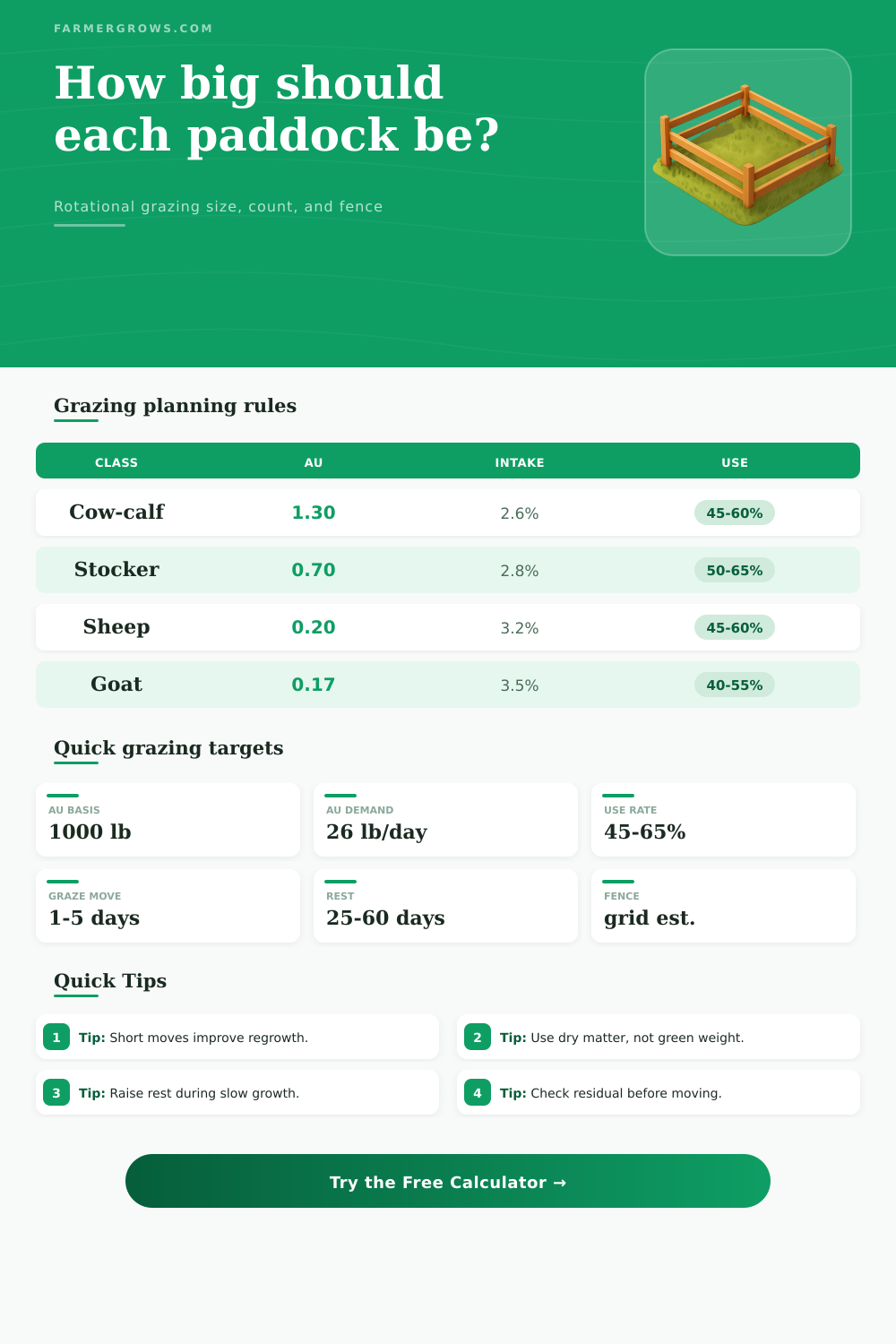
A 1,000 pound animal unit will eat approximately 26 pound of dry matter each day. This 26 pound figure is the cornerstone of all grazing plans. Dairy cows will have more higher demands than beef cows, and beef cows will have higher demand than ewes or sheep.
Grazing calculators ask for the size of the herd, the weight of the animals in the herd, and the percent of intake of the animals. The calculator will output the total daily demand of the herd in pound of forage. The next consideration is how much forage are available for the grazing animals.
Standing forage is measured in pound of dry matter per acre. Because the moisture content of grass change from day to day, measuring dry matter is the best indicator of how much forage is available for grazing. The standing forage is multiplied by a utilization rate to find the amount of forage that the grazing animals will harvest.
Grazing calculators allow individual to adjust the percentage of the standing forage that the grazing herd will utilize. The % utilized will determine the amount of grazing pressure that will be placed upon the pasture. A common % utilized rate range between 45 and 65%.
Grazing too much of the standing forage will prevent the pasture from being able to recuperate quick between grazing periods. Another calculation involve determining the total amount of forage that will grow in each paddock during the period that the animals will spend in that paddock. The daily demand of the grazing animals is multiplied by the number of grazing days that the animals will spend in each paddock.
The total is divided by the amount of usable forage per acre to determine the footprint of each paddock. The length of the paddocks’ stay in each rotational grazing paddock will determine how many paddock are required for the entire pasture. Grazing calculators can automatically determine how many paddock are required for each pasture based off the time that the animals spend in each paddock.
Based upon the footprint of each paddock, the calculator can determine how much wire and permanent fence are required to establish each paddock. The layout of the paddocks will change the amount of fencing material that is required for each paddock. The calculator will determine the amount of fencing materials need based upon the layout of the paddocks and the percentage of each paddock that will share its lane with another paddock.
The environmental conditions of the pasture will impact how the animals graze each paddock. The soil type, the slope of the land, and the placement of the water access point for the herd will impact rotational grazing calculations. These factor may prevent paddocks from grazing evenly.
The climate for the region also have an impact upon rotational grazing calculations. The amount of rainfall and temperature will impact the growth of the pasture. The length of the rest periods for the paddocks may have to be changed based upon the effects of the weather.
Grazing calculators allow individual to establish a buffer for these environmental factor. A ten percent buffer will allow for normal year for the pasture to produce the amount of forage that is calculated for each paddock. However, a twenty percent buffer will account for the possibility of drought condition.
The growth rates for the pasture will change over time. The growth rate will change with the season of the year. The growth of forage will be faster in the spring than during the heat of the summer month.
As a result, paddocks may have to be rotated more frequent during the spring than during the summertime month. A rotational grazing management system that incorporate paddocks of the same size will find that during the summer month the paddocks will experience under-resting plant. A rotational grazing management system that incorporate different length of time for each paddock will allow paddocks to be grazed for a period of time while the plants are rapid growing.
During the month when the plants are growing more slowly, the same paddock can be grazed for longer periods of time. Grazing calculators allow individual to adjust the length of grazing period for paddocks of various size according to the growth rate for the area. Different type of forage have different yields and different utilization rate.
Native range land will produce less forage than fertilized cool-season mixes. Each type of pasture require different type of rotational grazing management. Stockpiled winter forage will have a more higher rate of utilization because there is no need for the plant to regrow during the winter month.
Individual must know the difference between forage type in order to properly establish paddock rotational grazing plan. One of the most common mistake in rotational grazing management is of the animal in the pasture. All animal do not have the same demand of the pasture.
For instance, a lactating dairy cow will have higher demand of forage than a dry beef cow. Another of the most common mistake is in the calculation of the amount of forage that is available for the grazing animal. The amount of standing forage that is available is often entered as the green weight of the pasture rather than the % of dry matter of that standing forage.
The grazing management calculator will perform all calculation based upon the dry matter of the pasture. Because dry matter does not change from day to day, utilizing dry matter as the calculating factor eliminate error caused by daily moisture change in the pasture. One of the most useful habit for those managing rotational grazing paddock is to check the amount of residual forage in each paddock prior to moving the grazing animal.
If the paddocks have been grazed to a lower level than calculate for the paddock, additional adjustment will be required for that paddock. If the plant are still tall within the paddock after the set grazing period, the size of the herd may be increased, or the length of time that the animal spend in each paddock may be increased. The number in each rotational grazing plan are less important than the rhythm of the rotational grazing management system that is developed.
Over time, as individual implement rotational grazing management plan into the farm, individual will learn how many paddock the land can support and how quickly the forage will begin to recover after being grazed by the animal. The grazing calculation will help to start the rotational grazing management system, but the adjustment that are made each year will become the system that is developed for that farm and its paddock.