🐖 Farrowing Date Calculator
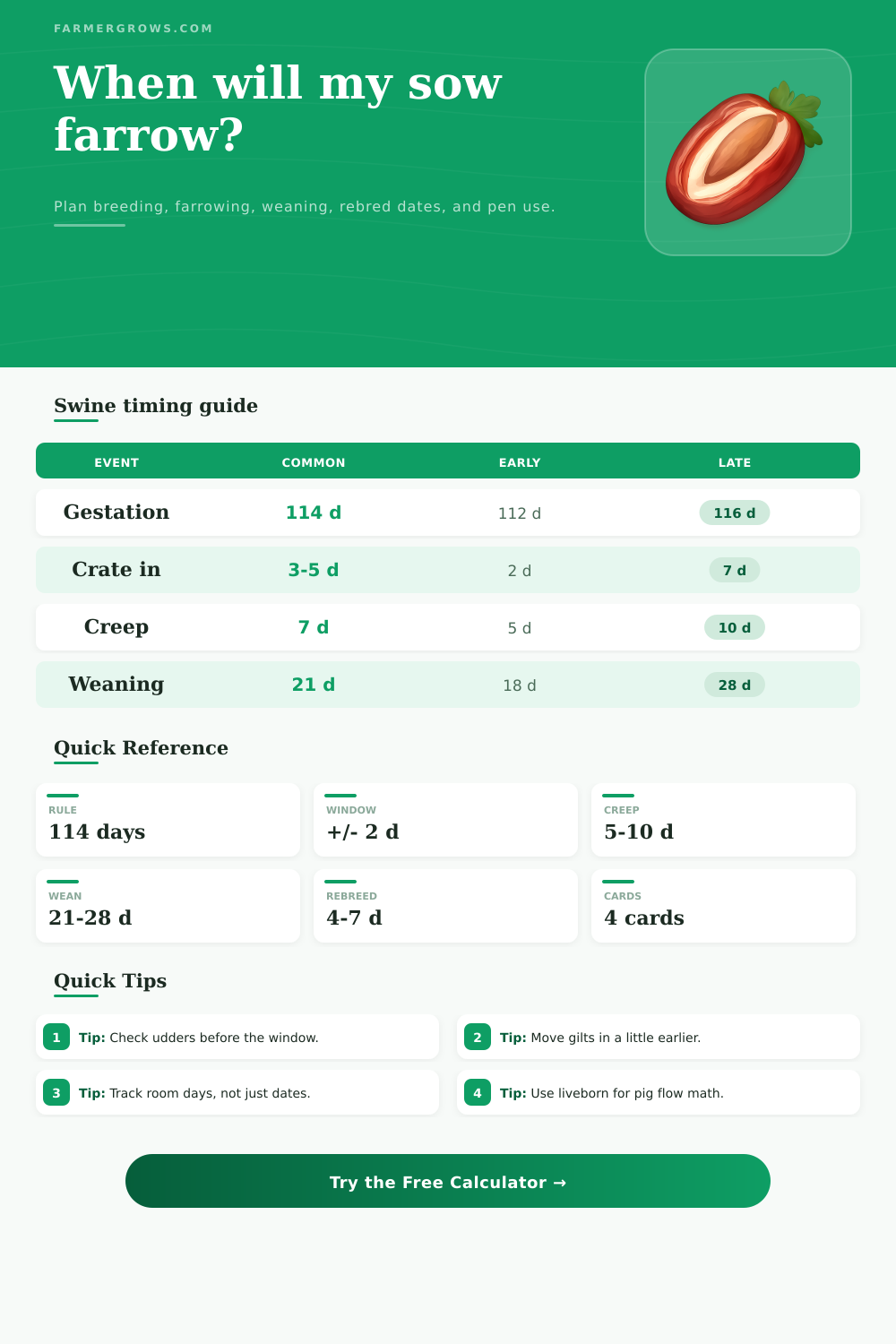
Plan the 114-day swine gestation rule from breeding date through farrowing window, creep feed, weaning, rebred timing, next litter date, pig flow, and farrowing pen occupancy.
Choose a named production pattern to seed the calculator. Presets adjust sow status, gestation rule, litter expectation, weaning age, rebreed interval, and pen days.
This tool is a planning calculator for breeding flow and room occupancy. Confirm individual animals with normal farm records, veterinary guidance, and close observation near farrowing.
Farrowing Plan Output
Due date, farrowing watch window, weaning flow, and pen occupancy from the settings above.
These production systems use the same biology but create different room pressure, pig age, and rebreeding rhythm.
| Event | Common Planning Value | Practical Range | Why It Matters |
|---|---|---|---|
| Gestation | 114 days after breeding | About 112 to 116 days | Sets expected due date and watch window. |
| Move to farrowing pen | 3 to 5 days before due | 2 to 7 days before due | Allows settling, washing flow, and close checking. |
| Creep feed start | 7 days of piglet age | 5 to 10 days where used | Supports feed familiarity before weaning. |
| Weaning age | 21 or 28 days | 18 to 35 days by system | Controls lactation length and pen occupancy. |
| Wean-to-service | 5 days | 4 to 7 days in many sows | Starts the next reproductive cycle. |
| Female Type | Total Born Planning | Liveborn Planning | Typical Notes |
|---|---|---|---|
| First-litter gilt | 10 to 13 pigs | 9 to 12 pigs | Lower litter size and more farrowing attention. |
| Parity 2 to 5 sow | 12 to 16 pigs | 11 to 14 pigs | Common high-output planning group. |
| High-parity sow | 11 to 15 pigs | 10 to 13 pigs | Watch birth weight spread and stillborn risk. |
| Maternal line herd | 14 to 18 pigs | 12 to 16 pigs | Needs strong cross-fostering and nurse sow planning. |
| System | Move-In Days | Wean Age | Wash/Idle | Pen Days Per Litter |
|---|---|---|---|---|
| Fast crate turn | 3 | 21 | 1 | 25 days |
| Standard commercial | 5 | 21 | 2 | 28 days |
| Older wean batch | 5 | 28 | 2 | 35 days |
| Gilt watch group | 7 | 24 | 3 | 34 days |
| Batch Pattern | Groups Per Year | Common Use | Room Planning Effect |
|---|---|---|---|
| Weekly farrowing | 52 groups | Large continuous systems | Even pig flow, constant room pressure. |
| 2-week batch | 26 groups | Medium farms | Cleaner group moves and nursery fills. |
| 3-week batch | 17 groups | All-in all-out rhythm | Matches common sow cycle grouping. |
| 4-week batch | 13 groups | Small herds and room resets | More time for washing and labor focus. |
A farrowing date calculator is a tool that will help you to determine when a sow will give birth to her piglets. A farrowing date calculator take the date on which the sow was bred and the gestation length of the sow to calculate the date on which the sow will give birth to her piglets. You use a farrowing date calculator because it will help you to determine the time in which you must prepare your farm for the arrival of the piglets; it helps to organize the farm schedule, and it helps to prepare the farm for the piglets arrival.
Many use the 114-day rule for the gestation length of sows; this number is simple and accurate for planning sows schedules. However, the actual date upon which the sow will give birth may occur a few days before or after the 114-day mark; a farrowing date calculator accounts for this by presenting a watch window for the farrowing sow. The status of the sow will impact the information that the farrowing date calculator presents to the farm manager.
Use a Farrowing Date Calculator to Plan Pig Births
A gilt is a female pig that is having her first litter of piglets. Gilts typically have smaller litters then sows that have reached maturity. Furthermore, high-parity females are sows that have had many litters; these sows typically have smaller litters of piglets than young sows, and can have a more higher risk of giving birth to stillborn piglets.
The manager must adjust the status of the sow within the calculator; adjusting for the status of the sow will ensure that the litter size and watch window parameters of the calculator are accurate according to that specific sow. The farrowing date calculator allows the manager to determine a variety of dates after the sow is bred. Each of these dates can impact the management of the farm and the sows.
For instance, the date after which the sow will give birth can be used to determine when the manager should move the sow into a farrowing pen. Additionally, the calculator can help to determine the date upon which creep feed should be introduced to the piglets; introducing creep feed will allow the piglets to become familiar with solid food prior to weaning. The weaning age of the piglets can be set according to management and farming decisions; the weaning age will impact both the piglets and the number of farrowing pens that is required within the farm.
Additionally, short lactation periods will free the farrowing pen of the sow earlier, but require more attention to the pens in which the piglets are raised. Conversely, long lactation periods will allow the piglets to gain more weight prior to weaning, but will continue to occupy the farrowing pens and delay the breeding cycle for those sows. The number of days that a farrowing pen is occupied can be calculated with the farrowing date calculator.
The total number of days that the pen will be in use within a year can help to determine how many groups of sows can be farrowed within that year. For instance, if a farrowing system is established that cycles every seven days, the number of days that a farrow pen is in use will be quite high. However, if batches of sows are bred every three or four weeks, there will be more time to clean the pens.
The farrowing date calculator can be used to compare the number of days that each farrowing pen is in use to the number of farrowing pens that exist within the farm; this will allow a farm manager to determine if the number of farrowing pens is compatible with the number of sows that the farm breeds. In addition to the dates that the farrowing date calculator can calculate, additional information can be entered into the calculator to account for the number of piglets that are to be born by each sow, the mortality rate of those piglets, the total number of born piglets, the liveborn piglets, the pre-weaning mortality of the piglets, and the percentage of piglets that die before they are weaned. These percentages can be adjusted within the calculator; adjusting the percentage of piglets that die can reveal how many weaned piglets will be born by the sows.
A slight change in the percentage rate of liveborn piglets can be more beneficial to a farrowing farm than increasing the number of sows that the farm breeds. The reproductive cycle of a sow can be followed with the farrowing date calculator. Each sow will cycle through the process of being bred, gestating, lactating, and resting prior to being bred again.
The length of the cycle will impact the number of litters that each sow can produce each year. The number of litters can be compared to the number of farrowing pens within the farm to determine if the farm system is operating within its limits or at an optimal pace. While a farrowing date calculator allows a farm manager to plan the farm and sows according to the breeding cycle, it cannot account for variables like the weather, the health of the sows, and the availability of laborers to manage the farm.
The manager must enter the date upon which the sow was bred into the calculator to determine the date upon which the sow will give birth. The manager can adjust the settings within the calculator to account for the specific sows that the farm manages. The manager should observe the dates that are shown within the calculator, and each variable can be adjusted one at a time to determine its impact on the other variables within the calculator.
You should of used the calculator more often to see how it helps. It is actualy quite easy to use and helps alot with the planning. Most managers finds that it makes things more comfortabley.
You’ll find that it works better than most moddern tools. It is a luxurios tool for a pig farm. There are alot of ways to use it.