🥚 Chicken Egg Laying Calculator
Estimate eggs from hen count, breed, age, daylight hours, feed protein, molt status, current lay rate, egg size, season pressure, and collection loss.
Start with a common flock profile. Each preset fills hen count, breed, age, daylight, feed protein, molt status, lay rate, egg size, season, and collection loss.
Chicken Egg Laying Output
Estimated from breed data, age curve, light response, feed protein, molt status, season, egg size, observed rate, and collection loss.
| Breed or flock type | Typical eggs/year | Daily lay rate | Common egg size | Notes |
|---|---|---|---|---|
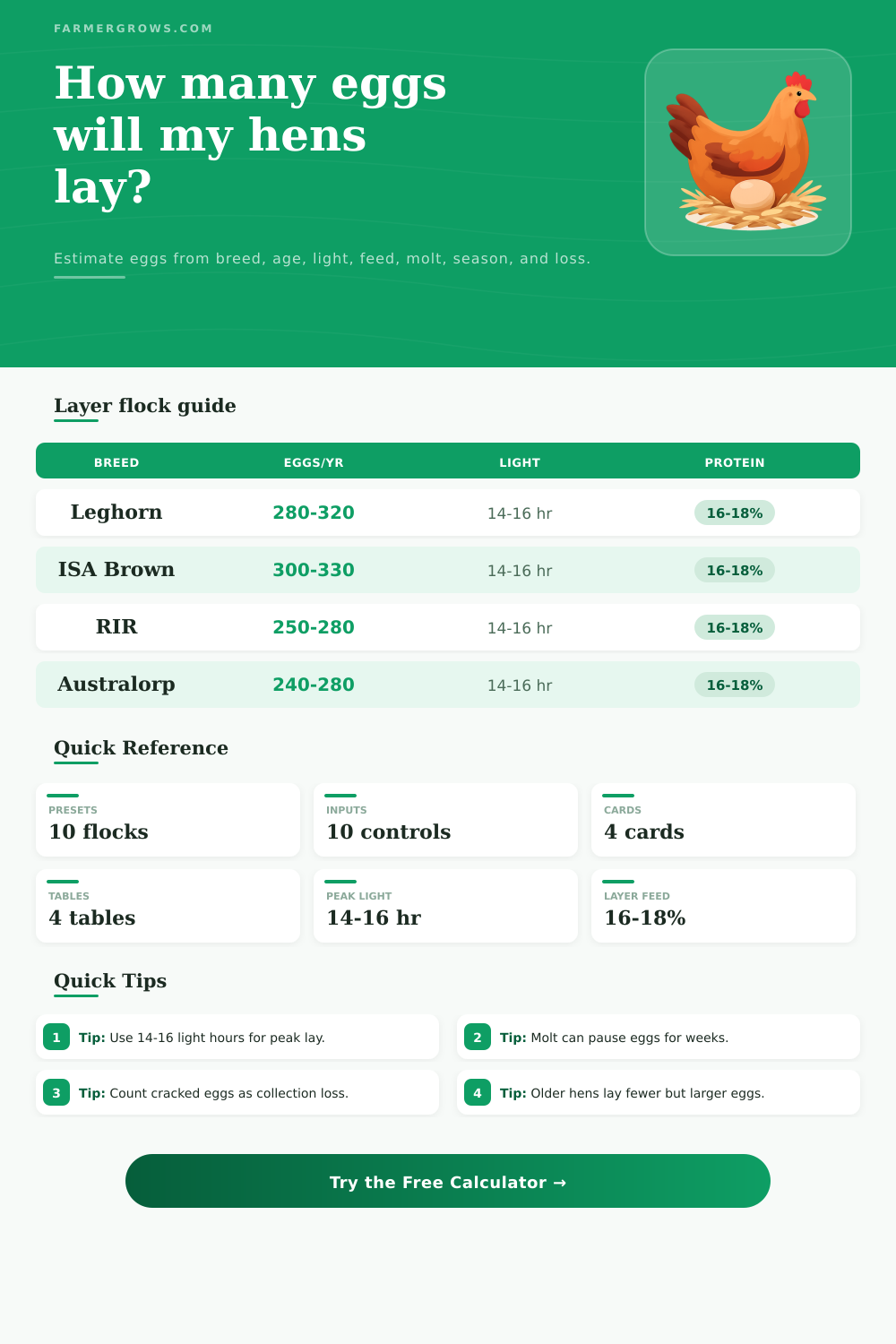
| White Leghorn | 280 to 320 | 77 to 88% | Large white | High-output, efficient layer; often starts early. |
| ISA Brown or red sex-link | 300 to 330 | 82 to 90% | Large brown | Commercial hybrid selected for steady brown egg production. |
| Rhode Island Red | 250 to 280 | 68 to 77% | Large brown | Hardy dual-purpose layer for small flocks. |
| Australorp | 240 to 280 | 66 to 77% | Large brown | Calm, consistent, and good in many backyard systems. |
| Plymouth Rock | 200 to 240 | 55 to 66% | Large brown | Cold-tolerant dual-purpose breed. |
| Sussex | 200 to 250 | 55 to 68% | Large tinted | Good for mixed-purpose homestead flocks. |
| Buff Orpington | 170 to 220 | 47 to 60% | Large to XL brown | Gentle, heavier bird; production is moderate. |
| Brahma | 140 to 180 | 38 to 49% | Large brown | Slow-maturing heavy breed with lower annual output. |
| Condition | Planning range | Model factor | Production meaning |
|---|---|---|---|
| Short natural day | 8 to 10 hours | 0.45 to 0.62 | Many flocks slow sharply without supplemental light. |
| Shoulder season light | 11 to 13 hours | 0.75 to 0.93 | Eggs rise as daylight approaches spring conditions. |
| Peak layer light | 14 to 16 hours | 1.00 | Common target for steady laying in managed flocks. |
| Very long or hot days | 17+ hours | 0.96 | Too much light or heat stress may reduce performance. |
| Low protein feed | Under 14% | 0.74 to 0.86 | Egg numbers and egg size may drop. |
| Layer ration | 16 to 18% | 1.00 | Typical complete layer-feed target for mature hens. |
| Factor | Range | Model factor | Use in calculator |
|---|---|---|---|
| Pullet start | 18 to 22 weeks | 0.25 to 0.75 | Ramp-up depends on breed maturity age. |
| Peak first cycle | 23 to 72 weeks | 0.98 to 1.04 | Best expected lay after full point-of-lay maturity. |
| Second year | 73 to 104 weeks | 0.90 | Still productive, often with larger eggs. |
| Third year | 105 to 156 weeks | 0.76 | Lay rate typically tapers. |
| Active molt | 2 to 12 weeks | 0.12 | Egg output may pause while feathers regrow. |
| Winter pressure | Cold, short days | 0.80 | Season factor stacks with actual light hours. |
| Egg size | Approx weight | Dozen weight | Common collection loss causes |
|---|---|---|---|
| Small | 43 g | 1.14 lb | Young pullets, breed size, early cycle eggs. |
| Medium | 50 g | 1.32 lb | Common in pullet flocks and smaller breeds. |
| Large | 57 g | 1.51 lb | Standard planning size for many layer flocks. |
| Extra large | 64 g | 1.69 lb | Older hens and heavier breeds often trend larger. |
| Jumbo | 71 g | 1.88 lb | Less frequent, but useful for mass estimates. |
| Loss range | 2 to 10% | varies | Cracks, dirty shells, hidden nests, breakage, predators. |
The egg production calculator allow you to calculate how many egg a flock of chickens will produce. The egg production calculator allows you to view how different variable to the flock will alter the number of eggs that the flock produce. Thus, while it does not replace the act of actualy collecting the eggs from the flock, it does allow you to have an estimate of the number of eggs that the flock will produce each given period of time.
To determine the number of eggs that a flock will produce, several different variable must be considered. For example, the number of laying hen in the flock will obviously impact the number of eggs that the flock produces. In addition to the number of laying hens, though, other variable include the breed of the laying hens, their ages, the amount of light in their environment, the protein level in their feed, whether or not they are molting, the time of year, and in how many of the eggs that is laid by the flock are collected by humans.
How to Use the Egg Production Calculator
The breed of the hens can impact the number of eggs that is produced by the flock; different breeds lay more egg than others. The age of each hen also affects the number of eggs that is produced by each hen; young hens (called pullets) do not lay many egg when they are young, but do increase in the number of eggs that they lay as they age. After reaching the peak number of eggs that each hen can lay, though, the number of eggs that each hen lays will slowly decline, but the size of each egg will increase.
Thus, the size selector in the egg production calculator will allow individuals to view how the size of the eggs may impact the total mass of the eggs that is produced by the flock. The amount of light in the hen’s environment will impact the number of eggs that is produced by that flock; hens require between 14 and 16 hour of light each day in order to produce a steady number of eggs. If the number of light hour each day decreases, though, then the number of eggs that is produced by the flock will decrease, as well.
Similarly, the amount of protein contained within the diet of the flock will impact the number of eggs that is laid; the flock will not reach the maximum number of eggs if the protein level are too low within the diet of the flock. Additionally, hens will molt (they will lose and grow new feather) every few months, at which time the flock will decrease in the number of eggs that is produced by the flock. In the egg production calculator, settings for early molt, active molt, and recovery can help to adjust for the time during which the flock will be unable to lay many egg.
Thus, the calendar and the ability to adjust for molting can allow individuals to account for the low period in egg production that occur during this time of year. Lastly, seasonal factor can impact the number of eggs that is produced by a flock of hens. For instance, in the summer, the flock may be exposed to high level of heat, and in the winter, they may be exposed to very cold temperature.
Both of these season may impact the number of eggs that each hen lay. The ability to adjust for these seasonal difference in the egg production calculator allows individuals to more accurate determine the number of eggs that will be laid. Finally, the number of eggs that are collected from the flock will also affect the total number of eggs that is produced by the flock; some egg may be broken during collection, some may be hidden by the chickens, or some may be taken by predator.
Thus, an adjustment for the percentage of collected egg will allow individuals to determine the total number of eggs that will be collected rather than the total number of eggs that is laid. Finally, there are reference table that provide information regarding the number of eggs that each breed of hen can produce each year, the size of the eggs that they produce, and the amount of light and protein that commercial egg producing breeds require to lay those eggs. While the egg production calculator is a helpful tool, the calculator cannot account for all change that occur in the flock.
For instance, if there are change to the access that the flock has to water or nesting box, egg production could change in response to these change. Thus, the calculator should be adjusted each time that any change are noticed to the egg production of the flock. The egg production calculator should be used twice each year.
Each year, the daylight hour that the flock see will change; there will be period of longer daylight hour and shorter daylight hour. By using the calculator twice each year (once before the longest day of the year and once before the shortest day of the year), individuals can ensure that their calculation of egg production are accurate. Additionally, as they use the calculator each year, individuals will become aware of whether each flock produce more egg with extra light or if their laying hen require more protein in their diet.
Thus, the calculator allows individuals to gain an understanding of these different variable to be able to make adjustment to the flocks management practice.