Swale Calculator
Estimate runoff volume from a design storm, then compare it with trapezoid swale storage, soil infiltration, freeboard, slope drop, and berm earthwork.
Load a realistic scenario to compare catchment runoff, swale cross-section, freeboard, berm dimensions, and soil drawdown behavior.
Swale Hydrology Output
Calculated from event runoff, trapezoid storage below freeboard, bottom-area infiltration, slope drop, and berm geometry.
| Catchment surface | Typical C | Hydrology note | Good use |
|---|---|---|---|
| Metal or asphalt roof | 0.85-0.95 | Nearly all rainfall runs off | Roof swales and cistern overflow |
| Concrete or asphalt paving | 0.75-0.95 | Fast peak runoff | Driveway edge swales |
| Gravel lane | 0.35-0.60 | Some storage in voids | Farm road interception |
| Compacted pasture | 0.30-0.55 | Higher when grazed wet | Hillside spreader swales |
| Garden soil with cover | 0.15-0.35 | Mulch and roots reduce runoff | Market garden beds |
| Woodland or deep mulch | 0.05-0.20 | High interception and infiltration | Food forest contour lines |
| Soil texture | Use rate | Metric rate | Design note |
|---|---|---|---|
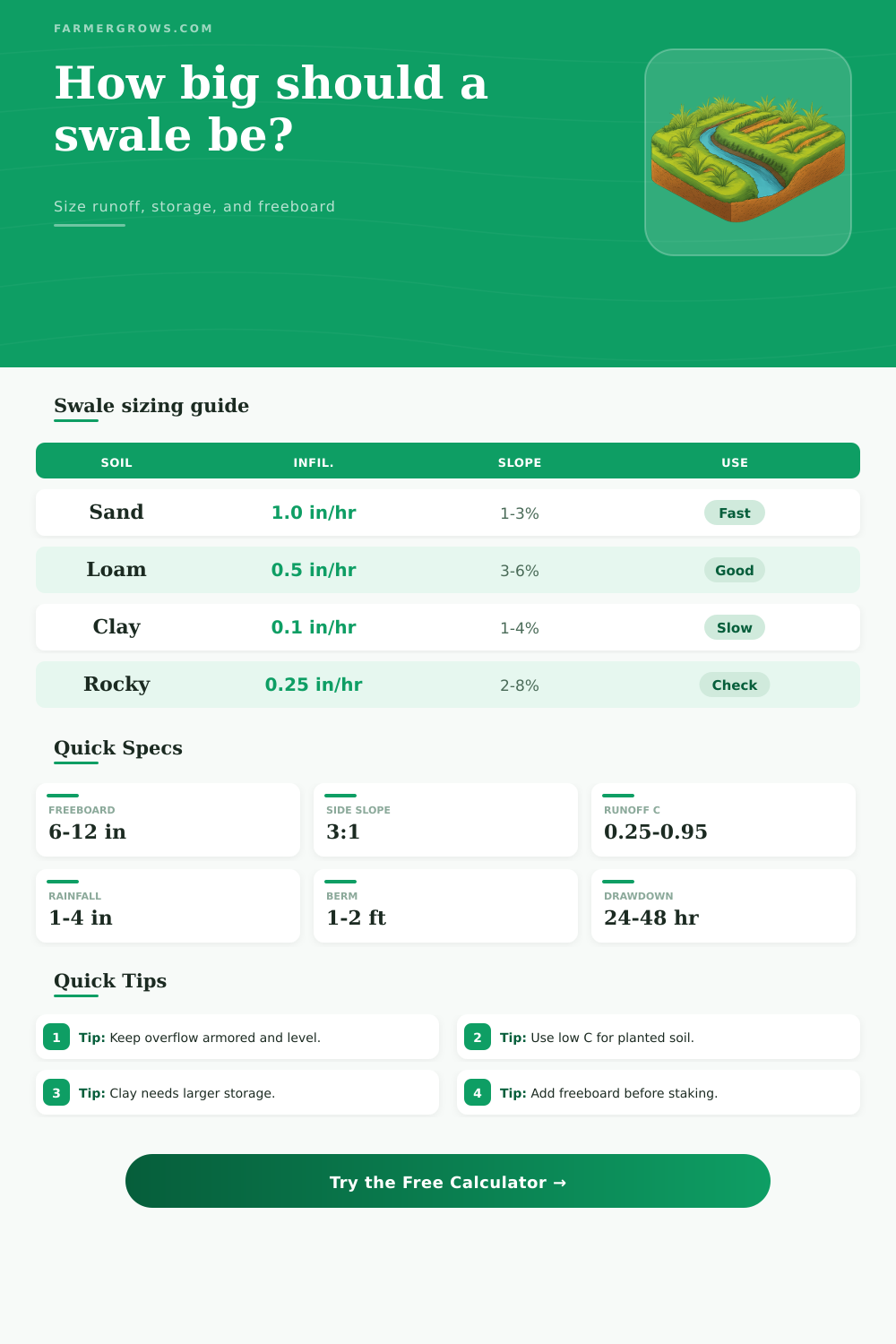
| Coarse sand | 1.0-2.0 in/hr | 25-50 mm/hr | Fast drawdown, watch erosion |
| Sandy loam | 0.5-1.0 in/hr | 13-25 mm/hr | Strong infiltration credit |
| Loam | 0.25-0.60 in/hr | 6-15 mm/hr | Balanced swale sizing |
| Silt loam | 0.15-0.35 in/hr | 4-9 mm/hr | Protect surface with plants |
| Clay loam | 0.05-0.20 in/hr | 1-5 mm/hr | Storage drives sizing |
| Compacted clay | 0.01-0.08 in/hr | 0.3-2 mm/hr | Use conservative drawdown |
| Land slope | Swale behavior | Freeboard target | Field note |
|---|---|---|---|
| 0.5-1% | Slow spread | 6 in minimum | Confirm positive overflow path |
| 1-3% | Best contour range | 6-9 in | Good for gardens and orchards |
| 3-6% | Faster entry flow | 9-12 in | Armor inlets and spillways |
| 6-10% | Erosion risk rises | 12 in plus | Use check dams or terraces |
| Over 10% | Special design | Engineer review | Avoid long unbroken runs |
| Feature | Formula | Typical range | Why it matters |
|---|---|---|---|
| Storage area | d x (b + z d) | 2:1 to 4:1 side slope | Trapezoid section below freeboard |
| Top water width | b + 2 z d | 4-12 ft common | Checks field footprint |
| Berm base width | top + 2 z h | 5-12 ft common | Stability and soil quantity |
| Berm volume | h x (top + z h) x L | Convert to yd3 or m3 | Earthwork planning |
| Slope drop | L x slope percent | Keep level on contour | Shows site elevation change |
A swale is a landscape feature that allow water to slow down, spread out, and soak into the ground. The main purpose of constructing a swale is to make sure that water from precipitation does not rush away from the area or create channel in the ground. Swales has to be carefully planned before construction begins, as improperly sized swales will not function as intended.
If a swale is too large for the area that it will manage, it will become a ditch that never fills with water. Alternatively, if the size of a swale is too small for the precipitation that may fall within the area, the swale will flood over the banks during periods of rainfall. To calculate the dimensions necessary to construct an efficient swale, there are calculators available that require the input of three variables: the size of the area that will be “caught” by the swale, the depth of the precipitation that falls within that area, and the runoff coefficient for that area.
How to Plan and Size a Swale
These three variables is needed in determining how much water the swale will receive from the land. The amount of water that runs off of different types of land surfaces will vary; metal roofs will allow almost all of the precipitation to run off of the property, while a garden with mulch will allow much of the water to be absorbed into the soil. The size of the area that the swale is to capture is one of the most important variables.
The size of that area will determine how large the swale must be constructed. A small area covered by a swale will require a small swale structure, while large areas, such as hillside pastures or driveways, require larger swales to handle the increased volume of runoff. The slope of the land also plays a role in the function of the swale.
On flats, swales do not need to be constructed with an incline. However, on steeper areas, you must make adjustments to the swale construction to account for the faster movement of water within the swale structure. The infiltration rate of the soil will impact how much water must be held by the swale.
Areas with sandy soil will allow precipitation to infiltrate quick into the ground. In contrast, clay soil will allow run-off to move slowly through the land. These variables can be tested within the calculator to determine how much water will infiltrate into the soil, and how much the swale will need to store.
Freeboard is the height of the swale that goes above the land. This feature protects the swale from precipitation events that are more intense than the design rainfall for that area. Freeboard is essential for protecting the swale when the land is already covered in standing water from previous rain events.
In addition, freeboard acts as an allowance for any error in the construction of the swale. Berm height and side slopes determine the amount of soil that will be moved to construct the swale. A berm with a low height but a broad base is more stable than a tall berm.
However, constructing a low and broad berm requires more space than a tall and narrow berm. The calculators’ website provides the tables that list typical runoff coefficients for different surfaces and infiltration rates for different soils. These tables provides example rates for different conditions.
Actual landscapes will likely be different than these examples. For example, a driveway covered in gravel for many years may behave differently from one covered in fresh gravel. The same can be said for a pasture that livestock frequently graze.
These reference tables allow swale designer to make adjustments to the parameters based off the land that will be used for constructing the swale. One of the most common mistake in constructing a swale is failing to provide a stable path for the overflow of water from the swale. This can lead to erosion of the land.
Another mistake is to ignore the sediment that carries with the initial rainfall. This sediment will settle at the bottom of the swale, reducing the infiltration rate of the swale. Building a forebay or planting vegetation at the inlet of the swale will keep sediment from entering the swale and reduce the likelihood of reduced infiltration rates.
Drawdown time determines how long it takes for the water in the swale to infiltrate into the soil. Drawdown time is important in that if too much water remains in the swale for several days, the roots of the plants in the swale may die due to lack of oxygen. In addition, standing water can become home to mosquitoes.
The duration input into the calculator allows the designer to test how long it will take for the soil to clear the water from the swale. For land that features clay soils, the drawdown time may be longer, or check dams can be installed along the swale to create different pools of water. Calculations of the volume of the berm are necessary to determine how much soil will need to be moved to build the berm.
These calculations allow the land developer to decide what use the berm will have. For instance, the soil can be used as a planting bed, or it may be spread elsewhere on the property. Calculating the berm volume will reduce the cost of constructing the swale by avoiding having to move the soil more than once.
Sometimes, land features and properties change during the construction of the swale. Soil alterations or changes to the catchment area due to construction by neighboring properties may require changes to the dimensions of the swale. Constructing the swale with the help of the calculators allows the land developer to quickly rerun the calculations based on these alterations.
Making small changes to the length or the bottom width of the swale is more efficient than deepening the swale to accommodate for the shortfall in water storage. By understanding how to construct a swale and calculate its dimensions, it is possible to ensure that the land utilizes the water that falls on it appropriately. It is also possible to avoid common mistakes and construction costs associated with them.
By performing these calculations prior to the construction of a swale, land developer will have a complete understanding of the relationship between rainfall, soil, and water storage structures.