🍯 Sugar to Maple Syrup Conversion Calculator
Convert sugar mass into finished syrup, sap demand, and evaporation load using maple-specific Brix reference data.
Pick a real batch size or sap run. Each preset loads sugar source, purity, target finish, sap sweetness, available sap, RO target, and loss allowance.
The calculator uses a Brix finish for syrup, a Rule of 86/87 estimate for sap, and a small-loss allowance so the output stays closer to real batches.
Projected conversion
See syrup output, sap demand, water removal, and how much syrup your entered sap batch can actually make.
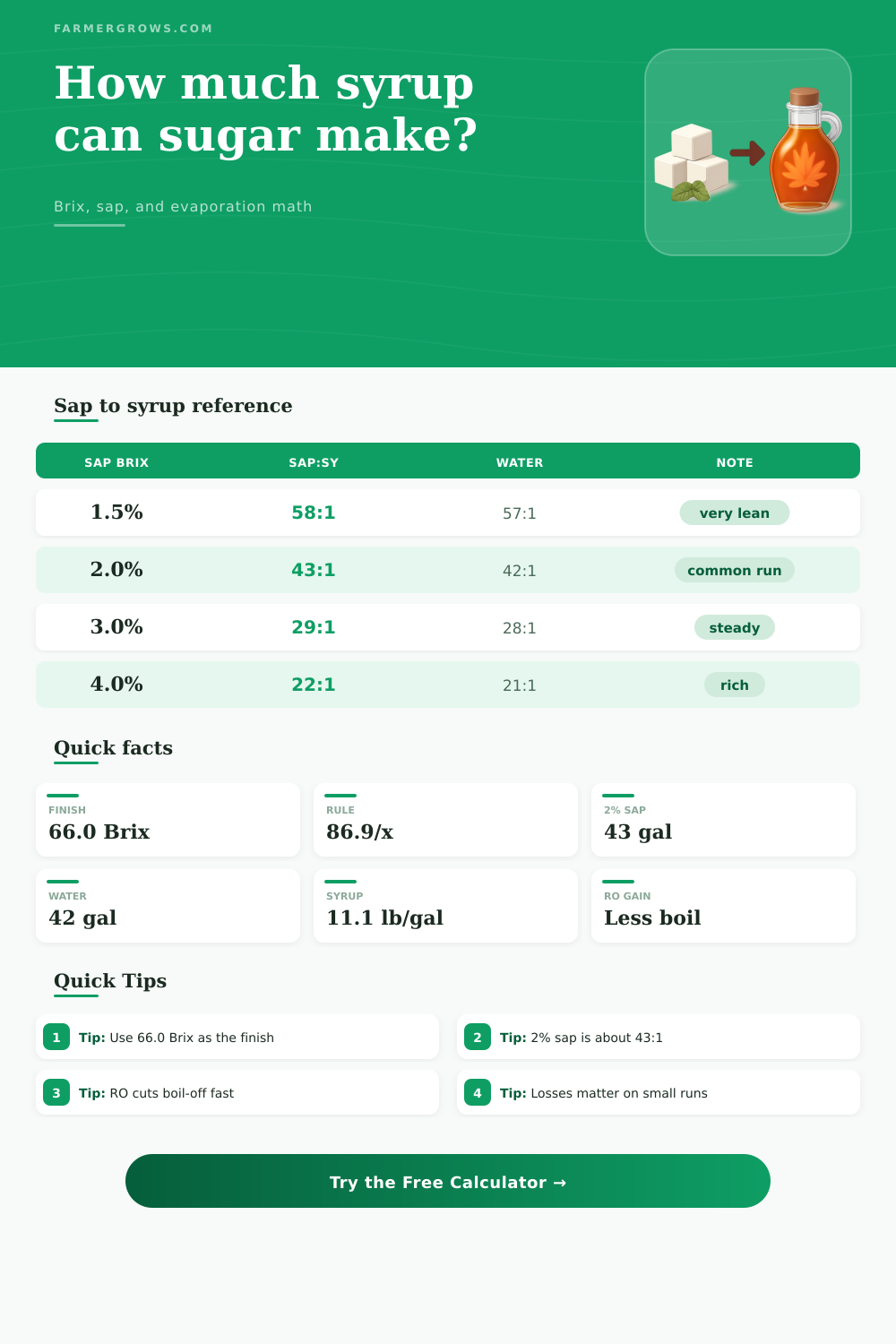
These cards show how yield changes as sap gets sweeter. The same syrup gallon takes much less sap once Brix rises above the low-2 percent range.
1.5% sap
58.1 gal sap, 57.1 gal water
2.0% sap
43.6 gal sap, 42.6 gal water
3.0% sap
29.0 gal sap, 28.0 gal water
4.0% sap
21.8 gal sap, 20.8 gal water
| Brix | SG | lb/gal | Note |
|---|---|---|---|
| 66.0 | 1.347 | 11.09 | Standard finish |
| 66.5 | 1.333 | 11.12 | Light boil |
| 67.0 | 1.335 | 11.15 | Tighter set |
| 68.9 | 1.340 | 11.25 | Upper limit |
| Sap Brix | Sap gal | Water gal | Use |
|---|---|---|---|
| 1.5% | 58.1 | 57.1 | Lean |
| 2.0% | 43.6 | 42.6 | Common |
| 2.5% | 34.8 | 33.8 | Sweet |
| 3.0% | 29.0 | 28.0 | Sweet |
| Sap gal | Syrup gal | Water gal | Batch |
|---|---|---|---|
| 10 | 0.23 | 9.77 | Small |
| 25 | 0.57 | 24.43 | Backyard |
| 50 | 1.15 | 48.85 | Mid run |
| 100 | 2.30 | 97.70 | Long boil |
| Sugar lb | Syrup gal | Qt | Note |
|---|---|---|---|
| 5 | 0.68 | 2.7 | Small |
| 10 | 1.37 | 5.5 | Small |
| 25 | 3.42 | 13.7 | Backyard |
| 50 | 6.83 | 27.3 | Bulk |
Maple syrup production is essentially a process of removing water from maple sap. In order to understand how to produce maple syrup, it is important to understand the relationship between maple sap and maple syrup. Maple sap contain a high amount of water and a low amount of sugar.
In contrast, maple syrup contains a high amount of sugar and a low amount of water. In order to produce maple syrup from maple sap, it is necessary to evaporate the water from the sap. The sugar content of the sap change from day to day; on one day the sugar content may be high and on another day it may be low.
How to Make Maple Syrup by Boiling Sap and Measuring Sugar
The amount of sugar in the evaporating sap can be measured in relation to a value known as Brix. Brix is a value that represent the percentage of sugar solids that are contained within a liquid. Brix is the single most important measurement that must be understood in the process of making maple syrup.
By knowing the Brix value of the sap that is being evaporated, an individual can calculate how much water needs to be removed in order to achieve the desired Brix value of the maple syrup. Although many producer will attempt to estimate how much syrup will be produced based off the level of the sap in the evaporator, this estimation isnt accurate due to the changing density of the liquid. Thus, knowing the Brix value of the evaporating sap is essential in producing maple syrup in a precise manner.
If individuals wishes to use sugar as a means of simulating the production of maple syrup, the purity of the sugar must be accounted for. Not all sugars are 100% sucrose. Thus, in order to simulate the production of maple syrup, the weight and purity of the sugar must be calculated in order to determine how much syrup will be produced.
A calculator can assist in the calculation of the amount of sugar that is required to simulate the production of maple syrup. A calculator is able to calculate the specific gravity of the product that is to be produced. Furthermore, by using a calculator, individuals can set a target volume of syrup that is to be produced.
By establishing a target volume, an individual is essentially able to prevent the production of maple syrup that is boiled to boiling point (which will result in the production of candy rather than maple syrup). An alternative means of estimating the amount of sap that will produce a certain amount of maple syrup is the use of what is known as the rule of 86 or 87. The rule of 86 or 87 is a means of estimating the amount of water that must be evaporated from the sap to produce syrup.
This rule allow for the estimation of the amount of sap that is required to produce a certain amount of syrup. However, if the syrup is boiled to a thickness beyond the standard thickness of maple syrup, the yield of syrup will decrease. Thus, if the yield of syrup is less, the amount of fuel that is consumed during the boiling of the sap will increase.
The Brix level of the initial sap will also have an impact upon the amount of effort that an individual must put in the boiling of the sap. If the Brix level of the initial sap is 3% instead of 2%, for example, then less water will have to be evaporated in order to produce syrup with the same Brix; thus, time and fuel will be saved. In addition to the factors described above, the equipment that is used to produce maple syrup will also have an impact upon the amount of water that must be evaporated in order to produce syrup.
For instance, if a reverse osmosis system is used to remove water from the sap prior to boiling the sap, then the amount of sap that is boiled will have a higher Brix level than standard maple sap. Thus, if the Brix level of the sap is high, it means that the evaporator will have to remove less water from the initial amount of sap in order to produce maple syrup with the desired Brix. Thus, planning the Brix level of the initial sap will allow an individual to understand the efficiency of the equipment that is to be used in the production of maple syrup.
Finally, another factor to consider in the production of maple syrup is the amount of syrup that can be packaged. During the packaging of syrup in bottles, some of the syrup will stick to the sides of the evaporator or become stuck in the funnel. Thus, there will be a loss of the amount of syrup that is produced.
For instance, if 3% of the syrup sticks to the sides of the evaporator, then there will be a shortage in the amount of syrup that is produced. Thus, individuals must account for this loss when producing maple syrup; otherwise, they will not have enough syrup to fill all of there bottles. Maple syrup production is, therefore, a process of subtraction, removing the water from the sap to reveal the sugar in the sap.
Whether individuals are using a calculator to calculate the amount of sugar needed to simulate the production of maple syrup, or calculating the amount of sugar in a gallon of maple syrup that is to be produced, math is the only means of achieving precision in the production of maple syrup. Thus, by incorporating elements of mathematics into the production of maple syrup, individuals can ensure that they will have enough syrup to fill their bottles.