💧 Evapotranspiration Rate Calculator
Estimate reference evapotranspiration, crop evapotranspiration, irrigation volume, and seasonal water use from weather data, crop stage, and field area.
Pick a real crop-and-weather setup to seed the calculator. Each preset loads crop stage, Kc, temperature, humidity, wind, radiation, elevation, area, efficiency, flow rate, and season length.
Radiation inputs stay in MJ/m2/day because the FAO-56 equation uses metric energy units even when the rest of the form is shown in imperial units.
Live ET Results
Enter weather data to calculate FAO-56 reference evapotranspiration and crop water demand.
| Symbol | Meaning | Unit | Role |
|---|---|---|---|
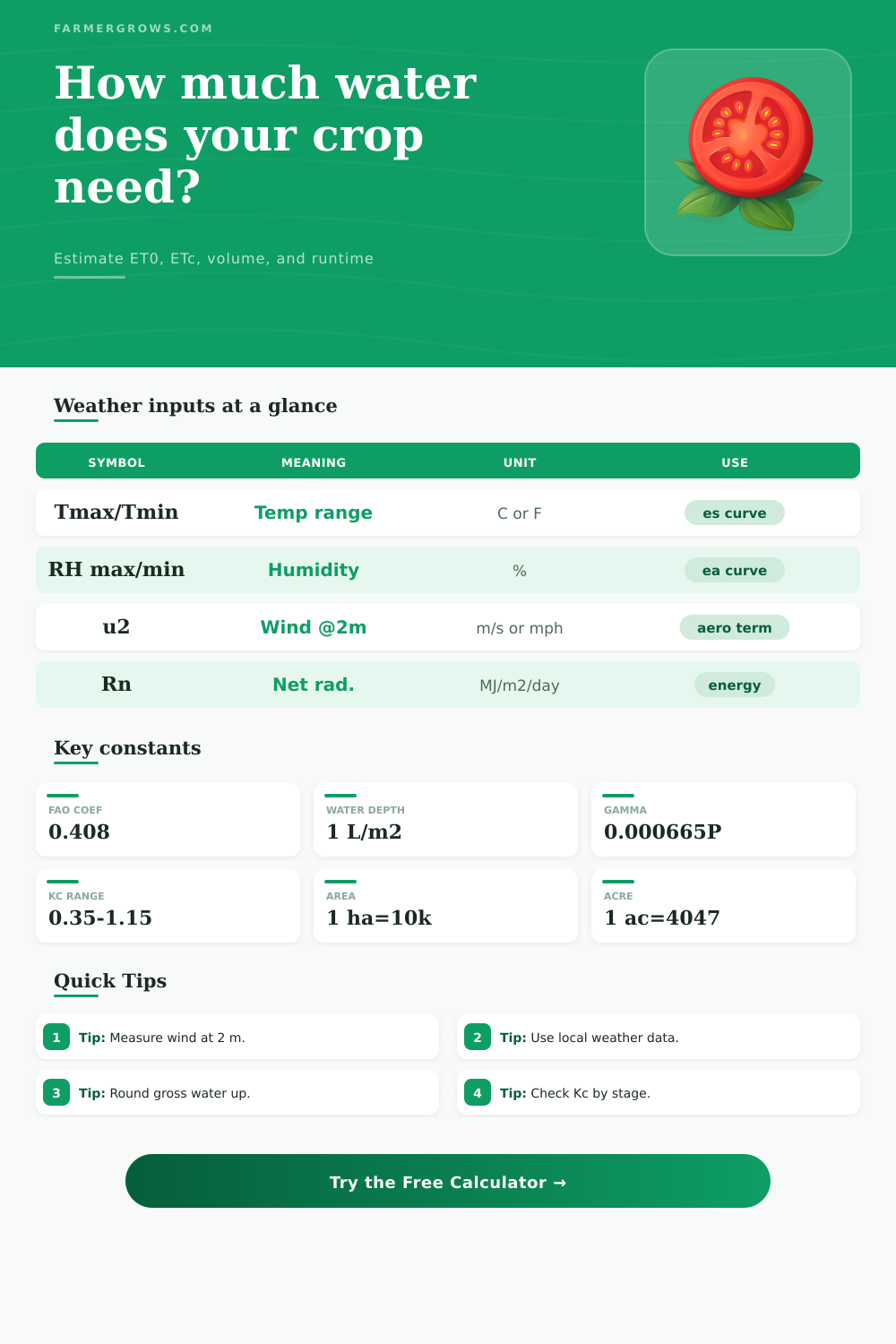
| Tmax/Tmin | Daily air temp | deg C or F | Saturation curve |
| RHmax/RHmin | Humidity bounds | % | Actual vapour pressure |
| u2 | Wind at 2 m | m/s or mph | Aerodynamic term |
| Rn / G | Net radiation and soil flux | MJ/m2/day | Energy balance |
| Crop | Initial | Mid-season | Late season |
|---|---|---|---|
| Dry bean | 0.35 | 1.10 | 0.50 |
| Lettuce | 0.45 | 1.00 | 0.90 |
| Maize grain | 0.40 | 1.15 | 0.70 |
| Tomato | 0.45 | 1.15 | 0.80 |
| Depth | Water over 1 m2 | Water over 1 ha | Inches |
|---|---|---|---|
| 1 mm | 1 L | 10 m3 | 0.0394 |
| 5 mm | 5 L | 50 m3 | 0.197 |
| 25.4 mm | 25.4 L | 254 m3 | 1.000 |
| 1 acre-in | 102.8 m3 | 27,154 gal | 1.000 |
| Condition | ETc | Efficiency | Planning note |
|---|---|---|---|
| Low demand | 2-3 mm/day | 85-90% | Single daily set |
| Moderate | 3-5 mm/day | 80-85% | Check soil moisture |
| High demand | 5-7 mm/day | 75-80% | Split runtime |
| Peak weather | 7+ mm/day | 70-75% | Watch runoff |
Evapotranspiration is a process of both evaporation from the soil and transpiration from the plants leaves. Evapotranspiration work to move the water from the soil and the plants into the air. Because evapotranspiration is a process that leads to the loss of water from the crops, it is essential for crop growers to add water to the crops to compensate for the water lost to evapotranspiration.
If the water that is lost to evapotranspiration are not replaced, the crops will wilt and the yields of those crops will decrease. However, if there is too much water added to the crops, the grower can waste that water, as it is also possible that the roots of those plants will drown if there is too much water provided. Thus, it is essential for growers to calculate the amount of water that is lost to evapotranspiration in order to provide the crops with exact amount of water that is needed.
Evapotranspiration and Crop Water Needs
Many individuals attempt to calculate the amount of water that is lost to evapotranspiration by measuring the temperature of the environment in which the crops are grown. However, temperature is not the only factor that determine the amount of water that is lost to evapotranspiration. For instance, hot weather with high humidity will lead to a different amount of water loss than hot weather with low humidity.
Thus, the Penman-Monteith approach to calculating evapotranspiration considers multiple factor that influence the rate of evapotranspiration. The Penman-Monteith approach to calculating evapotranspiration considers factors like temperature, wind speed, relative humidity, and net radiation. Using these factors, the Penman-Monteith approach is able to calculate the reference evapotranspiration (ET0) of an area; the amount of water that a theoretical grass field would lose in that area.
After calculating the reference evapotranspiration of the growing area, it is also essential to calculate the evapotranspiration of the specific type of crop that is being grown. Different types of crop have different evapotranspiration rates due to the different needs of the crops for water, and the different amounts of leaf area of each type of crop. A factor that is used to calculate the evapotranspiration of a specific type of crop is a factor called the crop coefficient (Kc).
The Kc is used to adjust the reference evapotranspiration to the needs of the specific type of crop that is being grown. Each type of crop has a different Kc value. Additionally, a Kc value is only used for a specific growth stage of the crop.
Using the incorrect Kc value can lead to provide either too much or too little water to the crops. Too much water can lead to soggy soil and fungal issues, while too little water can lead to the crops wilting and having decreased yields. In addition to the factors discussed above, it is also essential for crop growers to calculate the efficiency of the irrigation system that is being used for the crops.
Efficiency of the irrigation system refer to the amount of water that is applied to the crops relative to the amount of water that is lost to processes like evaporation. No irrigation system is 100% efficient. Thus, if the efficiency of the irrigation system is low, growers must pump more water than the crops require in order to ensure that the crops receive the amount of water that they require in order to maximize their yields.
The depth of water that is applied to the crops (in units like mm/day) can be converted to the volume of water (in units like m³ or gallons) that should be applied to the crops. Wind speed is another factor that must be considered when calculating evapotranspiration rates. Because wind speed impact the rate at which transpiration occurs from the crops, the grower must measure the wind speed in the growing area.
High wind speeds will lead to faster transpiration rates, thus requiring the crops to pull more water from the ground. To measure the wind speed accuratley, the speed of the wind at a height of 2 meters from the ground must be measured. Any inaccuracies in the measurement of the wind speed will have a positive impact upon the calculations of evapotranspiration, leading to the possibility that the plants will either receive too much or too little water.
By calculating the amount of water that is required by the crops each day, a grower can plan the irrigation of those crops for the long term. The seasonal gross water requirement for a field of crops can be calculated with these different evapotranspiration methods. By calculating the seasonal gross water requirement, a grower can determine whether he or she has enough water in the ponds in his or her area, or whether he or she has enough water in their water rights.
Additionally, by calculating these evapotranspiration rates and factors, growers can shift from a reactive method of irrigation to a proactive method of irrigation. By calculating the evapotranspiration rate of the growing area, the grower can determine in advance how many hours the pump that irrigates the crops must run each day to provide the crops with the amount of water that they require. By tracking the reference evapotranspiration rate in the area and using the correct Kc factor for each type of crop, the grower can measure the amount of water that is lost by the crops, as opposed to guessing at that amount.