Cover Crop Nitrogen Calculator
Estimate plant-available nitrogen from cover crop area, dry biomass, stand mix, termination timing, and residue handling. Compare legumes, mixes, and cereal covers in one plan.
Use a real planting pattern to load the calculator. Each preset sets the field shape, field size, crop type, biomass rate, legume share, termination stage, and handling method.
Nitrogen Credit Output
Calculated from field area, biomass rate, cover crop type, and termination conditions.
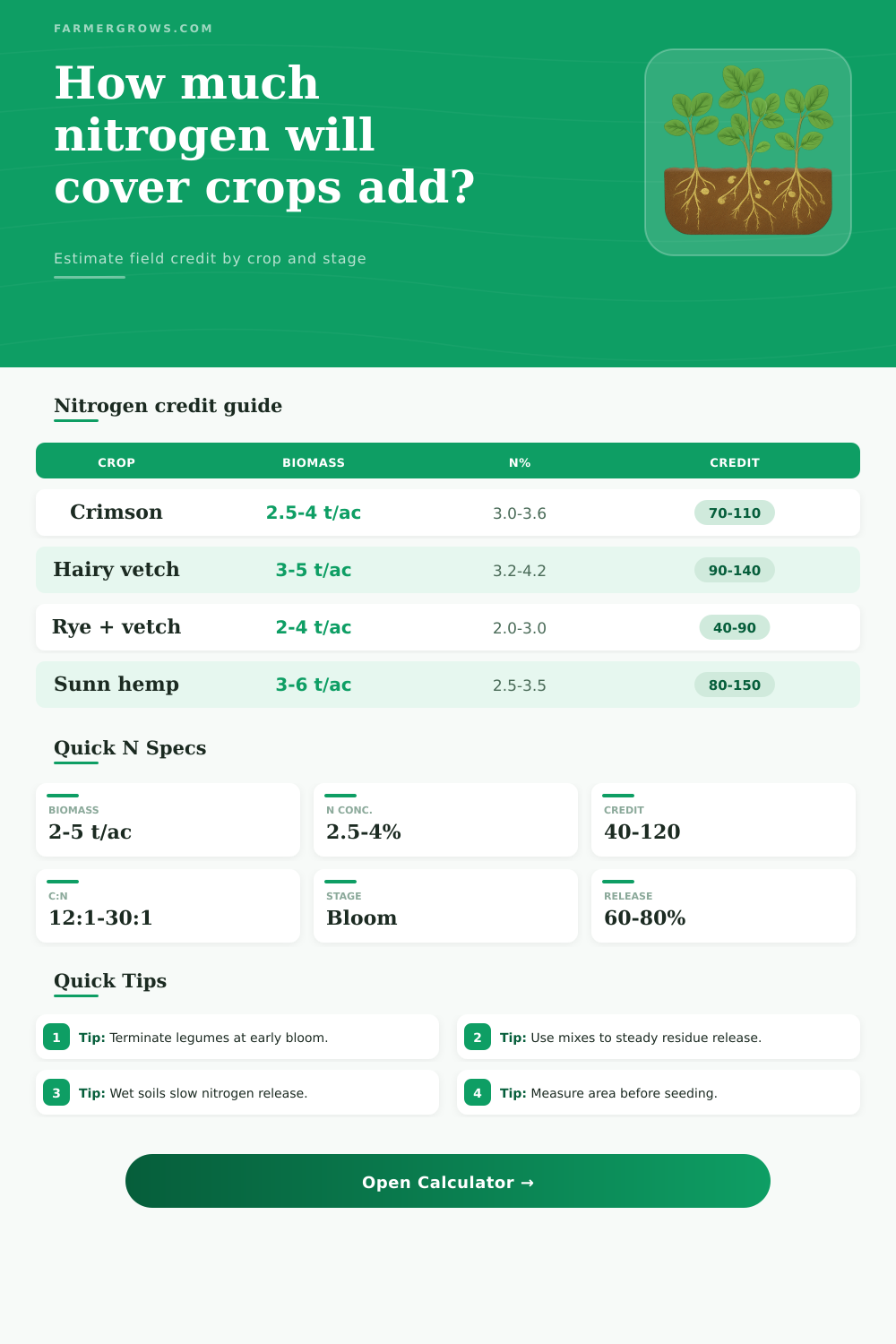
| Crop | Biomass | N% | Credit |
|---|---|---|---|
| Crimson clover | 2.5-4.0 t/ac | 3.0-3.6 | 70-110 |
| Hairy vetch | 3.0-5.0 t/ac | 3.2-4.2 | 90-140 |
| Austrian pea | 2.0-4.0 t/ac | 2.5-3.5 | 50-90 |
| Red clover | 2.5-4.5 t/ac | 2.8-3.5 | 60-100 |
| Berseem clover | 2.5-4.0 t/ac | 3.0-3.8 | 65-105 |
| Cowpea | 2.0-4.0 t/ac | 2.3-3.2 | 50-90 |
| Sunn hemp | 3.5-6.0 t/ac | 2.5-3.5 | 80-150 |
| Rye + vetch | 2.5-5.0 t/ac | 2.0-3.0 | 40-90 |
| Stage | Factor | Window | Release note |
|---|---|---|---|
| Early vegetative | 1.10 | 2-4 wks | Fastest release |
| Early bloom | 1.00 | 3-6 wks | Best balance |
| Pod fill / heading | 0.88 | 4-8 wks | Slower start |
| Mature / seed set | 0.72 | 6-10 wks | Lowest credit |
| Method | Factor | Contact | Release note |
|---|---|---|---|
| Incorporated | 1.00 | High | Fastest contact |
| Mowed and left | 0.93 | Medium | Good compromise |
| Rolled / crimped | 0.86 | Low | Slower start |
| Killed standing | 0.80 | Low | Cool soils slow |
| Shape | Formula | Imperial example | Metric example |
|---|---|---|---|
| Rectangle | L x W | 120 x 60 = 7200 | 36 x 18 = 648 |
| Circle | pi r2 | 80 ft dia | 24 m dia |
| Triangle | 0.5 x b x h | 100 x 80 = 4000 | 30 x 24 = 360 |
| Custom | Direct area | 43560 = 1 ac | 4047 = 1 ha |
Cover crops are crop that are grown to provide nitrogen for the future cash crop that will be planted. Cover crops can contain nitrogen through the decomposition of the plant residue that the cover crop leaves behind after it germinate and matures. Legumes is a type of cover crop that contains the ability to pull nitrogen from the air and store the nitrogen in there roots and shoots.
Because of their ability to store nitrogen, legumes contains approximately 3 percent of the dry weight of the legume that contains nitrogen. Grasses is another type of cover crop, but the grasses do not contain the ability to fix the nitrogen from the air. Instead, grasses contain the ability to scavnge for nitrogen in the soil.
How Cover Crops Add Nitrogen to the Soil
Additionally, grasses contain high amounts of carbon, which locks the nitrogen within the root residue of the grass. Thus, grasses will contain nitrogen that is not available for the emerging cash crop. The total weight of the biomass of the stand will contain the nitrogen that is available to the soil.
Thus, if the stand that is established for the cover crop is thin, then there will be less biomass of the cover crop stand that will result in lesser nitrogen available to that soil. Conversely, if the stand that is established for the cover crop is thick, there will be more biomass, which will result in more nitrogen available to that soil. In addition to the biomass, it is also important to consider the area of the field.
For instance, if there are 10 acres of field and the biomass is 3 tons per acre, then the field will produce 30 tons of biomass. Thus, it is critical to calculate the area of the field to which the cover crop will be planted. Errors in calculating the area of the field will result in errors in the nitrogen that is estimated to be available.
Another factor in determining the amount of nitrogen that will be available to the future crop is the timing of when to kill the cover crop. For instance, if the legume cover crop is killed during its early bloom stage, there will be a balance between its biomass and the rate at which it decompose. If the farmer kills the legume during its vegetative stage, it will decompose quickly, but contain less biomass.
Finally, if the legume cover crop is killed when it is mature, there will be more biomass, but it will take longer for the biomass to decompose. The method in which the residue is managed will also impact the rate at which nitrogen becomes available to the soil. For instance, if the microbes incorporate the biomass into the soil, the microbes will break it down and release the nitrogen.
However, if the biomass is left on the soil surface, such as by using a roller-crimper to compact the biomass, it will release nitrogen at a slower rate. The type of cover crop to be utilized also contains differences in the amount of nitrogen with which they is capable of working. For instance, hairy vetch (a legume) contains the ability to fix large amounts of nitrogen, but will fix less nitrogen if the soil is wet or if the hairy vetch is terminated too late in its growing period.
Sunn hemp (a legume) contains the ability to grow rapidly in hot climates, but contains tough stems that must be terminated early to provide nitrogen to the soil. Finally, cereal rye (a grass) contains the ability to scavange for nitrogen in the soil, but does not contain the ability to add nitrogen to the soil. Thus, cereal rye is often used as mulch for the soil in which it was planted.
Many mistakes are made in the estimation of the nitrogen that will be available from cover crops. One error is to overestimate the amount of biomass that the cover crops produce. An accurate way to determine the biomass production is to clip a square yard of the stand and weigh it.
Another mistake is to not consider the effect of the weather on the rate at which the nitrogen move out of the biomass and into the soil. For instance, if the spring seasons are wet, nitrogen will not move out of the biomass. Finally, another mistake is to not be honest about the amount of legume within the cover crop mixture.
Because grasses will contain nitrogen at a lower rate than legumes, the amount of legume must be accounted for within the mixture. There are different types of outputs from cover crops that may be of interest to those managing the fields. For instance, the total biomass that the cover crop stand produces will help indicate the total amount of biomass of the stand.
Additionally, raw nitrogen can be measured to determine how much nitrogen is contained within that biomass. Available nitrogen credit will provide information regarding the pounds of nitrogen per acre that will be available to the emerging cash crop. Residual nitrogen will provide information regarding how much nitrogen remains within the soil for those later crops.
Finally, per-acre rates will provide information regarding each of these variable on a per-acre basis. Because nitrogen credit is a part of the ecosystem accounting of the farm, soil tests should of been performed at the time of termination to test for nitrogen content. Thus, if the biomass is measured, if the amount of legume is identified within the stand, and if the timing of termination is managed, it is possible to accurately predict the amount of nitrogen that will be credited to the soil by that cover crop stand.